Author: Webmaster

  • Sensorimotor Collapse? Deleuze and the Practice of Cinema

    Timothy Bewes (bio)
    Brown University

    Abstract

    This essay discusses the central historical proposition of Gilles Deleuze’s cinema books, the “sensorimotor break” that separates the classical cinema of the movement-image from the modern cinema of the time-image. That proposition is more or less in line with dominant accounts of the politics of periodization in twentieth-century aesthetics. Jacques Rancière’s thought offers a powerful challenge to any such notion of a break or rupture, and Rancière pays particular critical attention to Deleuze’s work on cinema. A work by the Iranian filmmaker Jafar Panahi (The Mirror) is introduced in order to show up some shortcomings of Rancière’s critique insofar as it impacts Deleuze’s project, and to illustrate the difference between understanding cinema as a medium of thought and as a practice.
    Bewes Fig. 1
    Bewes Fig. 2

    Mediators are fundamental. Creation is all about mediators. Without them nothing happens. They can be people—for a philosopher, artists or scientists; for a scientist, philosophers or artists—but things too, even plants or animals … Whether they’re real or imaginary, animate or inanimate, you have to form your mediators. It’s a series. If you’re not in some series, even a completely imaginary one, you’re lost. I need my mediators to express myself, and they’d never express themselves without me: you’re always working in a group, even when you seem to be on your own.

    Gilles Deleuze (Negotiations 125).

    The status of the medium in Gilles Deleuze’s thought is far from straightforward. On one hand, mediators are necessary, indeed irreducible. Neither thought nor ideas are possible without them. “Ideas have to be treated like potentials already engaged in one mode of expression or another and inseparable from the mode of expression, such that I cannot say that I have an idea in general” (“What is the Creative Act” 312). On the other hand, no idea is transferable from one medium to another. “Ideas in cinema can only be cinematographic” (316). For all their irreducibility, media do not function as vehicles for ideas. The importance Deleuze attaches to the ‘mediator’ should be understood as a departure from the concept of medium. Mediators, he says, are “fundamental”—no longer intermediary but primary (Negotiations 125). To conceive of cinema, say, as a mediator is quite unlike seeing it as a medium or a form. Cinema’s concepts, writes Deleuze, “are not given in cinema. And yet they are cinema’s concepts, not theories about cinema” (Cinema 2 280). Statements like these in Deleuze’s work raise many questions, for the ideas of a work seem thereby to be both wrested away from the form in which they become thinkable and returned to it.

    A cinematographic idea, according to Deleuze, is frequently an event of disconnection. As such, a cinematographic idea is less an idea than a collapse or disturbance of the links that make nameable, attributable, applicable ideas possible. Take, for example, the dissociation of speech and image, an effect explored in the cinematic work of Hans-Jürgen Syberberg, Jean-Marie Straub and Danièle Huillet, or Marguerite Duras, which effects “a veritable transformation of elements at the level of cinema” (“What is the Creative Act?” 319). Where does such an idea take place: in the technical apparatus itself or in the choices and decisions of the filmmaker? In the thought of the theorist or scholar who documents it or in the historical forces and conditions that determine its appearance? Such questions refocus our attention on the problem of the medium and its relation to thought.

    This essay addresses these concerns mainly in the context of Deleuze’s work on cinema. However, the case of the novel stands as a constant backdrop to this discussion, for the novel is a form in which the question of the relation between idea and medium is easily forgotten and is often ignored by critics – no doubt because of the linguistic basis of the material, which encourages the assumption that the novel is an unproblematic form for the transmission of ideas. Three questions that Deleuze raises in his work on cinema have particular significance for the context of the novel: (i) Is a distinctively cinematic thought possible? (ii) If so, how should we understand the historical dimensions of its emergence? And (iii) what is, or what can be, the role of the critic or philosopher with respect to that thought? These questions have as much relevance to contemporary literary studies as to cinema, and yet – again, because of the material qualities peculiar to literature – they rarely come into focus as a central concern of literary critics. Yet Deleuze’s work on cinema makes possible and necessary a theoretical attentiveness to the novel as a mode of thought; indeed, a working assumption of this essay is that the implications of Deleuze’s cinema books for the novel are as profound and far-reaching as any work of novel theory since the founding contributions of thinkers such as Georg Lukács and Mikhail Bakhtin. Such implications will be especially apparent insofar as there is a historical, rather than medium-specific, argument to Deleuze’s work on cinema. This essay, therefore, will primarily engage the second of the three questions listed above (although the other two are indissociable from it). How should we understand the historical claim of the emergence of a distinctively cinematic thought? What, in other words, is entailed for thought by the proposition of a “sensorimotor collapse”?

    The most contentious idea in Deleuze’s writings on cinema is also its central organizing principle: the “sensorimotor break” that separates the classical cinema of the movement-image from the modern cinema of the time-image. “The link between man and the world is broken,” writes Deleuze (Cinema 2 177). But what is the historical status of this break? And what is its relationship to the narratives that are sometimes put forward to explain developments in twentieth-century literature and aesthetics which have generally been understood in terms of a historical shift from realist, representative modes to non-realist, non-representative ones? If the sensorimotor break is a development specific to cinema, its historical significance will be that of a merely formal (i.e., technological or subjective) development. If, on the contrary, the sensorimotor break describes a historical shift, a transformation of consciousness, then it must be detectable in other forms also, including literature, painting and music.

    Certainly, the quandaries that Deleuze’s proposition of a sensorimotor break puts us in as critics seem readily transferable to the literary context. Mikhail Bakhtin’s early work on Dostoevsky, for example, invites the question of whether Bakhtin (the theorist) or Dostoevsky (the writer) is the real originator of the concept of polyphony. That is to say, is the collapse of the “monologically perceived and understood world” in Dostoevsky’s works a historical event, anticipated by Dostoevsky in a prophetic vein as Bakhtin claimed (7, 285), or is it an effect peculiar to his aesthetic intentions? Similarly, is the supposed “meaninglessness” of Samuel Beckett’s work “one that … developed historically,” as Adorno insisted (153), or a merely aesthetic conceit specific to the world of the writer? Is Beckett’s meaninglessness, in other words, the result of an especially acute historical sense or a deficient one? And what kind of principles do such works call on the critic to adopt: an urgent, compensatory historicism, or a spirited refusal of what Nietzsche called the “historical sense” (“On the Uses and Disadvantages of History for Life” 63), a refusal that might have equal claim to historicity?

    Such questions take on particular resonance in the context of Deleuze’s work on cinema and the shift from the cinema of the movement-image to that of the time-image, a shift that Deleuze conceptualizes using Henri Bergson’s concept of the sensorimotor schema. According to Deleuze, this shift, which he presents as a break in the links between action, perception and affection, takes place at different historical moments, depending on the economic and political circumstances of the national cinema in question. In Italy, for example, the shift happens immediately after the war with the “neo-realism” of Vittorio de Sica and Roberto Rossellini; in France it happens in the late 1950s and early 1960s with the “new wave,” and in Germany it takes place with the “new German cinema” of the early 1970s. In different ways, the pre-war films of Yasujiro Ozu in Japan and the early works of Orson Welles in Hollywood “foreshadow” these developments (Negotiations 59). Even these small differences in chronology, however, open up a tension or a quandary in the historical thesis of the sensorimotor break. For Deleuze’s explanations for the temporal discrepancies appear to restore the sensorimotor links at the very moment of their rupture; indeed, those explanations might be said to draw on a relatively conventional conception of ideology. France, says Deleuze, “had, at the end of the war, the historical and political ambition to belong fully to the circle of victors”; hence the cinematographic image initially “found itself kept within the framework of a traditional action-image, at the service of a properly French ‘dream’” (Cinema 1 211). In Italy, there was no possibility of claiming the status of victor, and yet the institution of cinema had largely escaped the influence of fascism, even during the war. Thus cinema was able to “begin again from zero, questioning afresh all the accepted facts of the American tradition” (211–12). In Germany, neither of these crucial conditions was met, and so the change there took place a decade later than in France.

    Consequently, perhaps, Deleuze does not seem entirely comfortable with the historical dimensions of his thesis, such that at certain moments he disavows them. The strongest such statement is found in the preface to the French edition of The Movement-Image: “This study is not a history of the cinema. It is a taxonomy, an attempt at the classification of images and signs” (xiv).[i]

    The recent work of Jacques Rancière affords a good opportunity to revisit the historical dimensions of Deleuze’s thesis for a number of reasons. In several essays, most notably in his book Film Fables, Rancière explicitly rejects the historical claims of Deleuze’s work on cinema—and yet he does so in the context of an analysis that offers as lucid an account of that project as we have anywhere. Rancière’s critique is thus difficult to dismiss on the grounds of a failure of understanding or a shortfall in interpretive subtlety. More substantively, Rancière’s recent work on aesthetics constitutes the most significant challenge to the notion of a general break or rupture in twentieth-century literature and culture, a notion that has been so much a part of critical thinking about the century.

    For Rancière, the crucial event in the modern evolution of literature is not the collapse of realism, the shift from modernity to postmodernity, or “disturbances” in the sensorimotor schema noted by Deleuze, but the appearance of “literature” as such: the moment, 200 years ago in Europe, when literature became capable of saying anything, on the condition that its utterances would no longer have transmissible significance or referential value. The terms in which Rancière conceptualizes this event, however, are remarkably similar to Deleuze’s theorization of the sensorimotor break. Consider the following two passages, the first from Deleuze’s Cinema 1, the second from Rancière’s essay “The Politics of Literature”:

    The crisis which has shaken the action image has depended on many factors which only had their full effect after the war, some of which were social, economic, political, moral and others more internal to art, to literature and to the cinema in particular. We might mention, in no particular order, the war and its consequences, the unsteadiness of the “American Dream” in all its aspects, the new consciousness of minorities, the rise and inflation of images both in the external world and in people’s minds, the influence on the cinema of the new modes of narrative with which literature had experimented, the crisis of Hollywood and its old genres. Certainly, people continue to make SAS and ASA [narrative driven] films: the greatest commercial successes always take that route, but the soul of the cinema no longer does … We hardly believe any longer that a global situation can give rise to an action which is capable of modifying it—no more than we believe that an action can force a situation to disclose itself, even partially. The most “healthy” illusions fall. The first things to be compromised everywhere are the linkages of situation-action, action-reaction, excitation-response, in short, the sensory-motor links which produced the action-image. Realism, despite all its violence—or rather with all its violence which remains sensory-motor—is oblivious to this new state of things where the synsigns disperse and the indices become confused. We need new signs. A new kind of image is born that one can attempt to identify in the post-war American cinema, outside Hollywood. (Cinema 1 206)

    This is where the historic novelty introduced by the term “literature” lies: not in a particular language but in a new way of linking the sayable and the visible, words and things. This is what was at stake in the attack mounted by the champions of classic belles-lettres on Flaubert, but also on all the artisans of the new practice of the art of writing known as literature. These innovators had, the critics said, lost the sense of human action and significance. That was a way of saying that they had lost the sense of a certain sort of action and a certain way of linking action and significance. (Politics of Literature 9)

    Rancière is not talking about the transition from realism to modernism, or from modernism to postmodernism, but the appearance of the “regime” of literature around the turn of the nineteenth century, a specific form of writing that emerges at the same time as—and as part of—the aesthetic, displacing what Rancière calls the “representative regime.” For Rancière, then, the break or crisis of narrative links occurs not with modernism, and certainly not with postmodernism. If it takes place within cinema, it is nothing other than a repetition of the earlier break in European thought that marked the appearance of the aesthetic as such.[ii] From this moment, art and literature are determined by new conditions that constitutively limit their referential (sensorimotor) function. In the work of writers such as Flaubert, Balzac, and later Proust, literature stages a relationship between two logics. The first is that of “the collapse of the system of differences that allowed the social hierarchies to be represented” (Politics of Literature 21); that is to say, of the old regime in which literary activity was constrained by appropriate subject matter and circumscribed rules of access to literary discourse. The arrival of the order of “literature” brings that system to an end. Realism, for Rancière, is thus not the form that is broken with, but the form that effects the break. Rancière describes this quality of realism in “Literary Misunderstanding” as follows:

    “Realist” proliferation of beings and things signifies the opposite of what the age of Barthes and Sartre would see it as. It marks the ruin of the all that was in harmony with the stability of the social body … For the critic, Flaubert is a writer for a time where everything is on the same plane and where everything has to be described …. (Politics of Literature 39)

    The second logic is that of interpretation, which presupposes the existence of a “true” level of meaning that requires the critic to “tunnel into the depths of society.” Modern hermeneutical technologies such as Marxism and psychoanalysis are entirely implicated in the modern literary regime, since their explanatory models are derived from literature itself.

    The Sensorimotor Hypothesis

    In order to put Rancière’s critique into dialogue with Deleuze’s hypothesis of the sensorimotor break, a closer examination of the latter is necessary. Deleuze’s cinema books appear to advance a kind of historical thesis that is unknown elsewhere in Deleuze’s work. This thesis turns on the proposition of a transition from the analysis of the movement-image, in Cinema 1, to that of the time-image in Cinema 2; and a corresponding historical evolution from the classical cinema, in which time is subordinated to movement, to the modern cinema in which we see a situation of time liberated from that subordination to movement. Thus, works such as Rossellini’s Germany Year Zero or Ozu’s Late Spring or Antonioni’s Eclipse are transitional works in Deleuze’s terms. They mark the beginning of what Deleuze calls the “upheaval” (Cinema 2 1) or “collapse” (128) of the sensorimotor system organized around the three important elements of the movement-image: perception, action and affection. The challenge that this hypothesis raises for us is twofold.

    First is the question of the relation that Deleuze is attempting to envisage between cinema and philosophy. Is cinema an illustration of a certain historical process that transcends cinema (that might equally be articulated, for example, in Bergson, or Hegel); or is it, on the contrary, the realization or even the agent of that process? This is also the question of the philosophical substance of Deleuze’s thesis. But what is the relation between the historical thesis and the philosophical one? Another way of putting this question is to ask: how do we reconcile the detailed knowledge of cinema in Deleuze’s work—the anatomization or “typology” of various types of signs and images that we encounter in it—with the set of philosophical theses concerning time, movement, duration, subjectivity, etc.? Regarded separately, both aspects of Deleuze’s thinking are relatively accessible. If one knows the films he is talking about, Deleuze’s analyses of scenes and sequences are often dazzling. Likewise, Deleuze’s reading of Bergson and the adaptation of his thought in the context of cinema are philosophically compelling and rewarding. But the relation between the two is much more enigmatic.

    Second is the question of the sensorimotor collapse: how, where, and why does this take place? Does it actually “take place” at all? What does it mean to say, for example, that “we no longer believe in this world”? Who is Deleuze’s “we,” and which two periods of history are divided by this “no longer”? He goes on: “We do not even believe in the events which happen to us, love, death, as if they only half concerned us. … The link between man and the world is broken. Henceforth, this link must become an object of belief … Only belief in the world can reconnect man to what he sees and hears. The cinema must film, not the world, but belief in this world, our only link …” (Cinema 2 171–2)?[iii]

    Let’s consider these problems one at a time.

    1. History or Philosophy?

    The relation between the historical and philosophical dimensions of Deleuze’s argument is stated explicitly on the last page of Cinema 2:

    Cinema’s concepts are not given in cinema. And yet they are cinema’s concepts, not theories about cinema. So that there is always a time, midday-midnight, when we must no longer ask ourselves, ‘What is cinema?’ but ‘What is philosophy?’ Cinema itself is a new practice of images and signs, whose theory philosophy must produce as conceptual practice. For no technical determination, whether applied (psychoanalysis, linguistics) or reflexive, is sufficient to constitute the concepts of cinema itself. (280)

    Cinema, then, is not simply a representation of, say, Bergson’s ideas about movement and duration; rather, cinema is itself philosophy. But how is it possible for cinema to generate concepts? What would it mean for cinema to constitute a form of knowing that is inaccessible to us—or that we can only grasp with its help or by its means?

    One example of a concept that is specific to cinema, and ungraspable without it, is the any-instant-whatever. In the first chapter of Cinema 1 Deleuze identifies a crucial tension within cinema: between the “privileged instant”—moments at which the great directors attempt to extract meaning from the moving image—and the “any-instant-whatever,” the technological basis of the image. This is really an opposition between two forms of perception: the perception of the technical apparatus—the cinema—and the perception of human beings. Referring to Eadweard Muybridge’s early experiments photographing the movements of animals, Deleuze points out the following: if there are privileged instants in Muybridge’s pictures (for example, when the horse has one hoof on the ground, or none), “it is as remarkable or singular points which belong to movement, and not as the moments of actualization of a transcendent form.” Deleuze goes on:

    The privileged instants of Eisenstein, or of any other director, are still any-instants-whatever: to put it simply, the any-instant-whatever can be regular or singular, ordinary or remarkable. If Eisenstein picks out remarkable instants, this does not prevent him deriving from them an immanent analysis of movement, and not a transcendental synthesis. The remarkable or singular instant remains any-instant-whatever among the others …. (5–6)

    This passage establishes a close relation between the technical specificity of cinema, the apparatus (the fact of a movement-image being constructed out of a succession of “any-instants-whatever,” twenty-four frames per second), and its “soul” (Cinema 1 206). From the beginning, according to Deleuze, cinema is in conflict with itself; the temptation is always there to extract privileged instants from the succession of any-instants-whatever, as in Eisenstein’s “dialectical” cinema but also in every commercial film that is ever made.

    Deleuze’s entire thesis on movement is organized around this opposition between the privileged instant and the any-instant-whatever. The essence of cinema is to know—despite what we “know,” despite what its practitioners “know,” despite what Eisenstein “knows”—that there are no privileged instants; or at least, there are privileged instants only insofar as we impose our own interests, our own cuts or disconnections, on the movement image: “As Bergson says, we do not perceive the thing or the image in its entirety, we always perceive less of it, we perceive only what we are interested in perceiving, or rather what it is in our interest to perceive, by virtue of our economic interests, ideological beliefs, and psychological demands. We therefore normally perceive only clichés” (Cinema 2 20). Deleuze presents the emphasis on the any-instant-whatever as an anti-dialectical (that is to say, a non-historicist, non-historical) move. Cinema is the expression of a shift, itself historical, in which meaning and history have ceased to operate dialectically. It is no longer possible, or necessary, to locate a synthesis of the disparate elements or moments in order to give those elements order and closure, to derive meaning from them. The “instants” of cinema are all “equidistant” from one another, and from the whole; no single moment emerges to unify and explain the rest. Insofar as cinema does locate or search for such moments, it is only by fleeing from or suppressing its “essence.” In his essay on Deleuze’s cinema books, Rancière refers to this thesis as Deleuze’s “rigorous ontology of the cinematographic image” (107).

    2. The Sensorimotor Schema and its Collapse

    Bergson’s contribution to and importance for Deleuze’s cinema books is his discovery of the sensorimotor schema, according to which perception, action and affection are part of the same corporeal system. The first chapter of Bergson’s Matter and Memory describes the interplay of these three elements within the system that he calls “sensorimotor.” Bergson’s theory of perception does not begin, like Descartes, with human perception, but from “the reality of matter,” which is to say, “the totality of its elements and of their action of every kind” (30). Elsewhere he makes clear that the totality of matter can also be described as “the totality of perceived images” (64). Associated with this “totality of elements” is the hypothesis of an order of “pure perception”: “a perception which exists in theory rather than in fact and would be possessed by a being … capable … by giving up every form of memory, of obtaining a vision of matter both immediate and instantaneous” (97). From that starting point, human perception emerges not as something added to matter, but rather, as a gradual limitation of it, as the subject is formed as a center not of determinacy but of “indetermination.” Bergson rejects the idea that our perception produces knowledge of the object perceived (17). Perception is corporeal, which means that it is “subtractive”: it results from “the discarding of what has no interest for our needs, or more generally for our functions” (30). The most direct description of the sensorimotor system in Bergson’s work comes in the opening chapter of Matter and Memory:

    Perception, understood as we understand it, measures our possible action upon things, and thereby, inversely, the possible action of things upon us. The greater the body’s power of action (symbolized by a higher degree of complexity in the nervous system), the wider is the field that perception embraces. The distance which separates our body from an object perceived really measures, therefore, the greater or less imminence of a danger, the nearer or more remote fulfilment of a promise. … Consequently, our perception of an object distinct from our body, separated from our body by an interval, never expresses anything but a virtual action. But the more the distance decreases between this object and our body (the more, in other words, the danger becomes urgent or the promise immediate), the more does virtual action tend to pass into real action. Suppose the distance reduced to zero, that is to say that the object to be perceived coincides with our body, that is to say again, that our body is the object to be perceived. Then it is no longer virtual action, but real action, that this specialized perception will express: and this is exactly what affection is. […] Our sensations are, then, to our perceptions that which the real action of our body is to its possible or virtual action. Its virtual action concerns other objects, and is manifested within those objects; its real action concerns itself, and is manifested within its own substance. (57–8)

    Perception, action and affection exist, therefore, as mutually constitutive events within the sensorimotor schema.

    What does it mean to talk of the collapse of this schema? Deleuze asks the same question in the second chapter of Cinema 2. The answer is found in the possibility of a perception that is no longer organized around “interest” or “needs,” that is to say, around action, whether deferred or real (affection). On the contrary, the “interval” between perception, action and affection is no longer relative or deferred, but becomes absolute. This is the difference that delineates a “modern” from a “classical” cinema:

    [F]rom its first appearances, something different happens in what is called modern cinema: not something more beautiful, more profound, or more true, but something different. What has happened is that the sensory-motor schema is no longer in operation, but at the same time it is not overtaken or overcome. It is shattered from the inside. That is, perceptions and actions ceased to be linked together, and spaces are now neither co-ordinated nor filled. Some characters, caught in certain pure optical and sound situations, find themselves condemned to wander about or go off on a trip. These are pure seers, who no longer exist except in the interval of movement, and do not even have the consolation of the sublime, which would connect them to matter or would gain control of the spirit for them. They are rather given over to something intolerable which is simply their everydayness itself. It is here that the reversal is produced: movement is no longer simply aberrant, aberration is now valid in itself. (39–41)

    Cinema opens onto the world through the experience of “direct time-images”; this is its revolutionary importance for Deleuze. Examples include the shot of the vase in Ozu’s Late Spring; the anxiety of the characters in Hitchcock’s films, which is expressed in pure “optical situations”—the perception-image of the poisoned glass of milk in Suspicion, the figure of the spiral in Vertigo, the many perception-images in Rear Window; but, also earlier, such famous moments in Italian neo-realism as the girl’s perception of her own pregnant stomach in De Sica’s Umberto D.

    The sensory-motor break makes man a seer who finds himself struck by something intolerable in the world, and confronted by something unthinkable in thought. Between the two, thought undergoes a strange fossilization, which is as it were its powerlessness to function, to be, its dispossession of itself and the world. For it is not in the name of a better or truer world that thought captures the intolerable in this world, but, on the contrary, it is because this world is intolerable that it can no longer think a world or think itself. The intolerable is no longer a serious injustice, but the permanent state of a daily banality. (169–70)

    What is the “something intolerable in the world,” the “something unthinkable” within thought? It is simply the fact of the discrepancy between thought and the forms available to it; it is unthinkability itself. This might seem tautological. Indeed, for Artaud, writes Deleuze, “Thought has no other reason to function than its own birth, always the repetition of its own birth, secret and profound” (165). But it is not tautological as long as we retain an openness to the idea that, in Deleuze’s work, it is cinema itself that thinks. It is not that cinema enables us to think something other than cinema, but that cinema is itself thought. Cinema has become capable of thinking something that was not thinkable before: the absence of linkages, the break in the sensorimotor schema itself. And that thinkability of the absence of links in cinema must mean that cinema is one of the historical factors behind the destruction of the links themselves.

    According to Deleuze, then, cinema establishes a material basis for the realization of Bergson’s hypothesis of a world of “pure perception,” in which perception is coterminous with matter itself. Cinema gives us, directly, a world in which image = movement; that is to say, in which perception = matter; in which, after centuries of philosophy devoted to the problem of their unbridgeable divide, subject and object are brought into real, rather than merely theoretical alliance.

    The revolutionary core of Deleuze’s work on cinema is found here, not in the transition from the “movement-image” to the “time-image” signaled in the shift between Cinema 1 and Cinema 2. Cinema, says Deleuze, “is the pure vision of a non-human eye, of an eye which would be in things” (Cinema 1 81).

    One of the places where Deleuze deals directly with the effects of the sensorimotor break at the level of the cinematic image is chapter 7 of Cinema 2, devoted to “Thought and Cinema.” Even here the break is a hypothetical proposition; but at least it becomes possible, with the new cinema, to imagine a world in which perception is separate from action; where universal non-human perception (Bergson’s category of pure perception) is possible. The new cinema will be characterized by the proliferation of pure optical and sound situations unconnected to any centered narrative or plot, and by the displacement or suspension of action-oriented movement and action-oriented perception.

    For Deleuze it is Jean-Luc Godard, even more than directors such as Carl Dreyer, Robert Bresson and Eric Rohmer, who represents the highest achievement of cinema in producing a cinema not of the idea, or of the positive term, but rather of the “interstice,” a cinema that does away with “all the cinema of Being = is” (180), a cinema of the “unthought in thought,” a cinema that is therefore able to restore “our belief in the world” by filming interstices. In Godard, cinema is itself thought; cinema has liberated itself from the task of representing thought. In Godard there is no “privileged” image or discourse: the “good” discourses of “the militant, the revolutionary, the feminist, the philosopher, the film-maker,” are all treated with the same “categorical” inflection—that is to say, generically. Thought in Godard happens elsewhere than in these representational moments, which is to say that it happens in cinema itself—as cinema.

    For Deleuze, the crucial distinction between the work of Dreyer, Bresson and Rohmer, on one hand, and Godard, on the other, is contained in the distinction between two phrases: the whole is the open and the whole is the outside (Cinema 2 179). Both phrases refer to the out-of-field (or out-of-shot). By the whole is the open, what is meant is an out-of-field that “refer[s] on one hand to an external world which was actualizable in other images, on the other hand to a changing whole which was expressed in the set of associated images. “The whole is the open” thus posits an out-of-field that is in continuity with what is in the shot. “The whole is the outside,” by contrast, refers to something like an absolute out-of-field: an out-of-field that has no hope of ever entering the shot. What counts is no longer “the association or attraction of images” but “the interstice between images, between two images.” “In Godard’s method,” writes Deleuze,

    it is not a question of association. Given one image, another image has to be chosen which will induce an interstice between the two. … The fissure has become primary, and as such grows larger. It is not a matter of following a chain of images, even across voids, but of getting out of the chain or the association. Film ceases to be “images in a chain … an uninterrupted chain of images each one the slave of the next”, and whose slave we are … It is the method of BETWEEN, “between two images,” which does away with all cinema of the One. It is the method of AND, “this and then that”, which does away with all the cinema of Being = is. Between two actions, between two affections, between two perceptions, between two visual images, between two sound images, between the sound and the visual: make the indiscernible, that is the frontier, visible. …

    Just as the image is itself cut off from the outside world, the out-of-field in turn undergoes a transformation. When cinema became talkie … the sound itself becomes the object of a specific framing which imposes an interstice with the visual framing. The notion of voice-off tends to disappear in favour of a difference between what is seen and what is heard, and this difference is constitutive of the image. There is no more out-of-field. The outside of the image is replaced by the interstice between the two frames in the image … Interstices thus proliferate everything, in the visual image, in the sound image, between the sound image and the visual image. … Thus, in Godard, the interaction of two images engenders or traces a frontier which belongs to neither one nor the other. (179–81)

    Jafar Panahi’s The Mirror (1997)

    It would be relatively easy to talk about Godard’s cinema in relation to this set of claims, for films such as Two or Three Things I Know About Her (1966) or Ici et ailleurs (1976) precede Deleuze’s work on cinema and directly inform it. I would like instead to consider a more recent body of work—produced in quite different historical circumstances—by the Iranian director Jafar Panahi, and within that body of work a scene from his 1997 film The Mirror (Ayeneh).

    The question of the conditions of emergence of the so-called “new wave” of Iranian cinema is a complex one, especially its rediscovery and reinvention of the time-image in the period since the 1979 Islamic Revolution. In many ways, the situation of Iran’s filmmakers since the Revolution has been analogous to the one that Deleuze describes in post-war Italy, in that they are neither implicated in the ancien régime nor enjoy ideological or unambiguous material support under the newer one.[iv] Notwithstanding this complexity—a full account of which would have to include the undoubted influence of European art cinema on its stylistic and thematic concerns—the recent history of Iranian cinema dramatizes the same questions with which I began this essay: in particular, of whether the breakage of the sensorimotor links is a historical development or merely a subjective one.

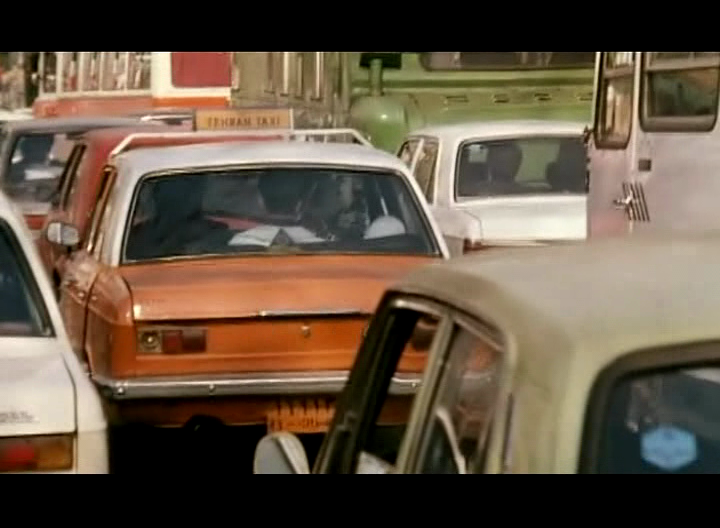
    Panahi’s The Mirror concerns a seven-year old girl whose mother does not arrive to pick her up from school one day. The first half of the film is the story of the girl’s attempt to get home by herself; the journey is complicated by the fact that her left arm is in a cast. First, a man with a scooter gives her a ride to the bus stop; she gets on the bus, but it turns out to be going in the wrong direction. Eventually she makes it onto the right bus. And then abruptly, half way through the film, the narrative frame is broken by an apparently unanticipated event: the girl looks directly at the camera, and is addressed by a crew member offscreen: “Mina, don’t look at the camera.” Mina removes her cast, angrily declares, “I’m not acting anymore,” and demands to be let off the bus. Panahi, directing the film, and other crew members enter the frame as they try to reason with her, but she is intransigent. The director decides to allow her to make her own way home. Mina has not removed her microphone, and the crew continues to film as she walks away. We see and hear as she tries and fails to take a taxi; she has various conversations, including one with an actor, an older woman, with whom she has interacted as a character in the earlier part of the film; finally she takes another taxi that will carry her part of the way. We hear the conversation among the other passengers inside the taxi, while the film crew follows in another car (fig. 1). And then, in a heavy traffic jam, she gets out of the taxi and we (that is to say, the camera), fifty feet behind, lose sight of her. All we hear is her feet pattering down the street as the soundtrack becomes entirely disconnected from the image onscreen.

    Fig. 1. The Mirror (Ayeneh), dir. Jafar Panahi, Rooz Film, Iran, 1997.

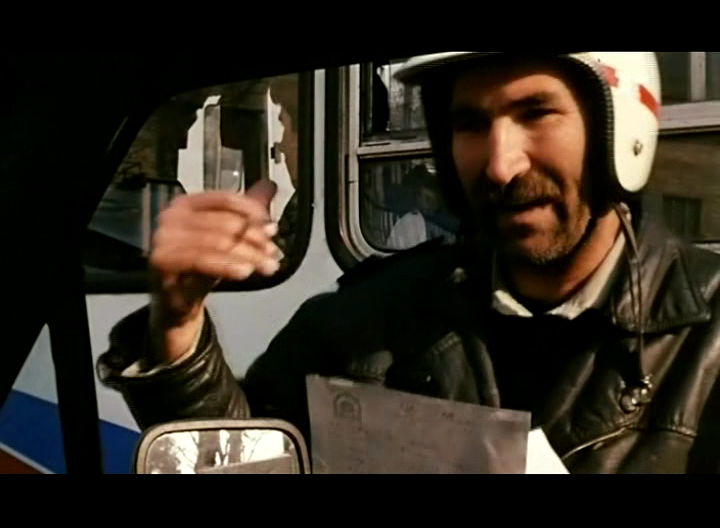
    The sequence during which Mina is out of view of the camera lasts for 6 or 7 minutes. A traffic policeman in a white helmet approaches the car, and a conversation takes place with the driver through the passenger window (fig. 2).

    Fig. 2. The Mirror (Ayeneh), dir. Jafar Panahi, Rooz Film, Iran, 1997.

    The only sound is from the microphone attached to Mina, so we hear nothing of what is said in the conversation with the policeman, only the noise of people watching a football match between Iran and South Korea as Mina apparently walks past a café. After a few minutes, the film crew again catches up with Mina who, meanwhile, has been conversing with a man who has worked in the Iranian film industry, dubbing John Wayne into Farsi. As Mina again comes into view of the camera, she is standing on the curb waiting for her brother to meet her.

    So, what do we see in this seven-minute sequence? Is this a film of the interstice, as Deleuze says of Godard’s cinema? What or where is the whole? Should we say the whole is the open (continuous with the action onscreen) or the whole is the outside (discontinuous with it and unavailable to the cinematic image)? How should we conceptualize the out-of-field in this sequence, as relative or absolute? Can we say, with Deleuze, that the out-of-field is abolished, that the “outside of the image” is replaced by “the interstice between the two frames in the image,” that is, by “the difference between what is seen and what is heard”? Can we say that this difference is “constitutive of the image”? Or is it the case that, on the contrary, there is no justification for dispensing with the out-of-field, that the primary organization of the image remains sensorimotor? If, as Deleuze notes, the objection that an interstice can only take place between associated images is merely “proof that we are not yet ready for a true ‘reading’ of the visual image” (Cinema 2 179), what basis do we have in sequences such as this for continuing to strive for or even imagine the possibility of such a “true ‘reading’”?

    There is no way to resolve these questions, and yet it is on them that the dialogue between Rancière’s and Deleuze’s work turns.

    Rancière’s Critique

    Rancière’s essay on Deleuze’s cinema books, entitled “From One Image to Another: Deleuze and the Ages of Cinema,” offers one of the most concise overviews of Deleuze’s cinema project available. Rancière characterizes Deleuze’s theory of the sensorimotor break as follows: “Thenceforward, what creates the link is the absence of the link: the interstice between images commands a re-arrangement from the void and not a sensory-motor arrangement” (108). But Rancière goes on to construct a strong critique of Deleuze, predicated in part on the ambiguity of Deleuze’s historical thesis about the shift from the movement-image to the time-image.

    There are several emblematic moments in Rancière’s critique—emblematic because they turn out to be principles of Rancière’s general reading of Deleuze, in which the “rupture” in the sensorimotor schema is shown to be amenable to, indeed complicit with, the links of narrative. Wherever instances of the crystal-image, or the disruption of the sensorimotor schema, appear, Rancière suppresses their radicalism by re-inserting them into a narrative logic, re-establishing their sensorimotor function. By such means, Rancière will argue that Deleuze’s “classical” cinema, participating in a “logic of the movement-image,” and “modern” cinema, “the logic of the time-image,” are both “indiscernibly” part of the aesthetic regime: “Cinema is the art that realizes the original identity of thought and non-thought that defines the modern image of art and thought” (122).

    Thus, in his account of Vertov’s Man With a Movie Camera, Rancière disputes the proposition that Vertov’s camera attempts to (as Deleuze has it) “put perception into things, to put perception into matter, so that any point whatsoever in space itself perceives all the points on which it acts, or which act on it …” For Rancière it is not at all clear that this is what Vertov was trying to do; the implication is rather that Vertov’s camera attempts “to join all spatial points at the center it constitutes” (110). Rancière claims that the real significance of the moments that Deleuze finds important in Man With a Movie Camera—moments of looking—is primarily a narrative significance: “Every image in Man with a Movie Camera ultimately points back to the persistent representations of the omnipresent cameraman with his machine-eye and of the editor whose operations alone can breathe life into images inert in themselves” (110). Vertov’s film for Rancière, then, is simply a narrative of two men travelling around Odessa shooting a film.

    A second emblematic moment occurs in Rancière’s reading of Hitchcock’s Vertigo. In the last chapter of Cinema 1, Deleuze writes of the rare moments in Hitchcock where the hero is caught living in “a strange state of contemplation.” His examples include the photographer-hero who has broken his leg in Rear Window and the inspector in Vertigo (both played, incidentally, by James Stewart). Both characters, for different reasons, are reduced to “a state of immobility” and thus to “a pure optical situation” (205). In each case, a narrative explanation for the paralysis is provided by the diegesis; yet such moments, says Deleuze, anticipate the “crisis” of the movement-image that will happen only “in [Hitchcock’s] wake” (205).

    As with Man With a Movie Camera, Rancière rejects Deleuze’s reading: “[Scottie’s] vertigo doesn’t hinder in the least, but rather favors the play of mental relations and of ‘sensory-motor’ situations that develop around these questions” (115). In such passages, writes Rancière, Deleuze “turns against Hitchcock the fictional paralysis that the manipulative thought of the director had imposed on his characters for his own expressive ends. Turning this paralysis against Hitchcock amounts to transforming it, conceptually, into a real paralysis” (116). This is the approach that will lead to Rancière concluding (via an ingenious analysis of Bresson’s Au hazard, Balthazar) that Deleuze’s reading of such works is dependent upon an “allegorical” extension of such narrative elements into the metaphysical sphere.[v] For Rancière, Deleuze’s reading of Hitchcock imports an absolute out-of-field—that is, a transcendental principle—into a text whose out-of-field is never anything other than strictly relative. Ultimately, for Rancière, the collapse of the sensorimotor schema in post-war cinema never takes place. In every case, what appears to be a proliferation of optical or sound situations are situations of narrative (or narrativizable) “paralysis” that are perfectly comprehensible within, and often central to, the “expressive” intentions of the director.

    These alternative readings of Man With a Movie Camera and Vertigo are undecidable; and the same could be said of Panahi’s The Mirror. There is certainly a coherent narrative to be excavated out of The Mirror. Reading it as Rancière might read it we could say that the film opens with a false frame—the story of the little girl whose mother has forgotten to pick her up from school—only to reveal, half way through, that the first story was simply a story within a story. The real story of The Mirror concerns the making of a film about a little girl named Mina, played by an actress who also happens to be called Mina. But in order to hold to that account of the film; in order to reject the thesis of the breakdown or the collapse of the sensorimotor schema that underpins the exceptionality of cinematic thought in Deleuze’s cinema books; in order to claim that the “interval” between the two girls in The Mirror is merely a narrative one, not a philosophical one; in order to retain the sense of cinema as a medium of thought, rather than a substratum of it, a “mediator”—the simple fictionality of the work would have to be shown to be beyond doubt. Writing about Tod Browning’s film The Unknown, and taking issue with Deleuze’s account of it, Rancière declares: “It is very difficult to specify, in the shots themselves or in their sequential arrangement, the traits by which we would recognize the rupture of the sensory-motor link, the infinitization of the interval, and the crystallization of the virtual and the actual” (118). In the case of The Mirror, however, the reverse is true, for it seems impossible to determine “in the shots themselves or in their sequential arrangement” the traits by which we could be assured of their fictional (i.e., purely narrative) significance, that is to say, of the merely “aesthetic” intentions of the filmmaker, the merely “paradoxical” quality of Mina herself.

    Deleuze’s hypothesis of the sensorimotor collapse seems to involve an acceptance of the idea that, as Deleuze puts it, “we are not yet ready for a true ‘reading’ of the visual image” (180). The hypothesis is hostage to an imagined future evolution of cinema in which the elimination of the narrative alibi of the time-image might be achieved. If, as Rancière proposes, and as even Deleuze at times seems to suggest, the sensorimotor collapse has not (yet) taken place, how can we avoid the conclusion that its prominence in post-war cinema is not a historical but an aesthetic, or a theoretical, proposition? A decisive moment in Rancière’s critique of Deleuze comes with his proposition that the distinction between the movement-image and the time-image (or, as Rancière calls them, the “matter-image” and the “thought-image”) is “strictly transcendental” precisely because it is not grounded in history, in the “natural history of images” (114). There is, for Rancière, no “identifiable rupture, whether in the natural history of images or in the history of human events or of forms of the art of cinema.”

    And yet, the premise of Deleuze’s analysis of cinema is not that cinema is the medium of the sensorimotor collapse but that cinema has taught us to think the rupture of the sensorimotor link, the “infinitization” of the interval, which is to say the inseparability of the virtual and the real. The event of the sensorimotor break is not its actualization but its thinkability. After cinema, the chronological hypothesis according to which the sensorimotor break is a historical moment forever dividing a cinema of “matter” from a cinema of “thought” is no longer feasible. It is cinema, however, not Rancière (or Deleuze), that teaches us that. Rancière concludes his essay by noting the “near-total indiscernibility between the logic of the movement-image and the logic of the time-image” (122); but, far from undermining Deleuze’s project, this is its crucial lesson.

    The truly revolutionary moment in Deleuze’s cinema project is not the historical claim of a sensorimotor collapse, but the proposition, grounded in the reading of Bergson, that cinema is the form in which Bergson’s hypothesis of “pure perception” dispenses with its limitations as a hypothesis. This event is achieved not in the course of cinema’s development but with the earliest works of cinema. The moment at which “movement is no longer simply aberrant [but] is now valid in itself” is not dependent on some real or hypothetical development of cinema; it is there from the beginning, indeed, before a single shot has been produced.

    The real revolution is thus Bergson’s sensorimotor hypothesis itself, the first modern theory of the distribution of perception. The theory of the sensorimotor schema is simultaneously the collapse of the schema, the moment when perception is revealed to be determined by nothing other than interest. The sensorimotor collapse is not the event that divides cinema into classical and modern, but the condition of possibility of cinema as such—cinema conceived not as a medium but as a practice. The sensorimotor collapse has always already taken place: before Deleuze, before Rancière, and before the claims of both, very different in inflection, that it has not.

    Footnotes

    [i] In an interview given shortly after the publication of Cinema 2, Deleuze was asked about the principles behind the “changes” in the cinematic image, and consequently, about the “basis” upon which we can assess films. His response was to situate the changes biologically: “I think one particularly important principle is the biology of the brain, a micro-biology. It’s going through a complete transformation and coming up with extraordinary discoveries. It’s not to psychoanalysis or linguistics but to the biology of the brain that we should look for principles, because it doesn’t have the drawback, like the other two disciplines, of applying ready-made concepts. We can consider the brain as a relatively undifferentiated mass and ask what circuits, what kinds of circuit, the movement-image or time-image trace out, or invent, because the circuits aren’t there to begin with” (Negotiations 59-60).

    [2] In Critique of Judgment, for example, Immanuel Kant describes the aesthetic idea as one “to which no determinate thought whatsoever, i.e., no concept, can be adequate, so that no language can express it completely and allow us to grasp it” (182; §49).

    [3] Rancière articulates these two problems as follows: “First of all, how are we to think the relationship between a break internal to the art of images and the ruptures that affect history in general? And secondly, how are we to recognize, in concrete works, the traces left by this break between two ages of the image and between two types of image?” (108)

    [4] Adam Bingham writes: “The very strictures placed by [Khomeini’s] government on cinematic representation had a direct effect on this new aesthetic, as they were forced to approach their subjects and themes obliquely, indirectly, through inference and allusion” (169). Bingham goes on to characterize the period as “a cinematic new beginning as marked as that which took place in society” (170).

    [5] Rancière’s insistence upon an allegorical basis to Deleuze’s reading of Au hazard, Balthazar has two aspects. The first relates to Deleuze’s conception of the relation between cinema and thought, which is for Rancière not directly philosophical but allegorical (116, 119); thus, “the rupture of the sensory-motor link” is an idea not of cinema but of Deleuze himself, and not an event in the history of thought but an object of Deleuze’s philosophical imagination. Second, Bresson’s film suggests itself to Rancière as an allegorical lesson in the evasions of Deleuze’s philosophy of cinema, and thus, in the persistence of the sensorimotor schema in the very moment of its collapse. In Rancière’s reading, the manipulative character Gérard, who pursues Marie with a succession of traps and schemes, stands in for Hitchcock, “the manipulating filmmaker par excellence” (116), and is contrasted with Bresson himself, the filmmaker of the sensorimotor break. The problem is that this “bad filmmaker,” observes Rancière (mischaracterizing the place of Hitchcock in Deleuze’s analysis) “is uncannily like the good one.” The “visually fragmented shots and connections” in Bresson’s work that, for Deleuze, reveal “the power of the interval,” for Rancière amount to nothing more than a narrative ellipsis, “an economic means of bringing into sharp focus what is essential in the action” (122).

    Works Cited

    • Adorno, Theodor W. Aesthetic Theory. Trans. Robert Hullot-Kentor. Minneapolis: U of Minnesota P, 1997. Print.
    • Bakhtin, Mikhail. Problems in Dostoevsky’s Poetics. Trans. Caryl Emerson. Minneapolis: U of Minnesota P, 1984. Print.
    • Bergson, Henri. Matter and Memory. Trans. Nancy Margaret Paul and W. Scott Palmer. New York: Macmillan, 1911. Print.
    • Bingham, Adam. “Post-Revolutionary Art Cinema in Iran.” Directory of World Cinema Volume 10: Iran. Ed. Parviz Jahed. Bristol: Intellect, 2012. Print.
    • Deleuze, Gilles. Cinema 1: The Movement-Image. Trans. Hugh Tomlinson and Barbara Habberjam. London: Athlone, 1986. Print.
    • —————. Cinema 2: The Time-Image. Trans. Hugh Tomlinson and Robert Galeta. London: Athlone, 1989. Print.
    • —————. Negotiations, 1972–1990. Trans. Martin Joughin. New York: Columbia UP, 1995. Print.
    • —————. “What is the Creative Act?” Two Regimes of Madness: Texts and Interviews 1975–1995. Trans. Ames Hodges and Mike Taormina. New York: Semiotext(e), 2006: 312–324. Print.
    • Kant, Immanuel. Critique of Judgment. Trans. Werner S. Pluhar. Indianapolis: Hackett, 1987. Print.
    • Nietzsche, Friedrich. “On the Uses and Disadvantages of History for Life.” Untimely Meditations. Trans. R. J. Hollingdale. Cambridge: Cambridge UP, 1997. Print.
    • Rancière, Jacques. Film Fables. Trans. Eliliano Battista. Oxford: Berg, 2006. Print.
    • —. The Politics of Literature. Trans. Julie Rose. Cambridge: Polity, 2011. Print.

  • Notes on Contributors

    Aaron Colton is a Ph.D. candidate in English at the University of Virginia. His research centers on the development of American metafiction from 1919 through present and its implications for ethical theory and critical methodology.

    Megan Fernandes is an academic and poet. She received her PhD in English at UC Santa Barbara and her MFA in poetry at Boston University. Her research focuses on modern and contemporary literature, science and technology studies, and gender theory. Currently, she is an assistant professor of English at Lafayette College and lives in NYC.

    Diana Filar is a Ph.D. candidate studying post-1945 American literature at Brandeis University. She received her BFA from Emerson College and her MA in English and American Literature at the University of New Mexico. She plans to write her dissertation on the U.S. immigrant novel from the Progressive Era into contemporaneity through the theoretical lenses of critical race theory, affect theory, and the impacts of neoliberal economic policy.

    Todd Hoffman is an associate professor of English and philosophy in the English and Foreign Languages department at Georgia Regents University. He teaches courses on literary theory, post-structuralism, existentialism and literature and American literature. He has recently published a psychoanalytic account of Toni Morrison’s Jazz and has a forthcoming essay on speculative materialism and capitalist realism.

    Daniel Kane is Reader in English and American Literature at the University of Sussex. His publications include We Saw the Light: Conversations Between The New American Cinema and Poetry (The University of Iowa Press, 2009); Don’t Ever Get Famous: Essays on New York Writing after the New York School (Dalkey Archives Scholarly Series, 2007); All Poets Welcome: The Lower East Side Poetry Scene In the 1960’s (The University of California Press, 2003); and What is Poetry: Conversations with the American Avant-Garde (Teachers & Writers, 2003).

    Viviane Mahieux is Associate Professor of Spanish and Portuguese at the University of California, Irvine. She is the author of Urban Chroniclers in Modern Latin America: The Shared Intimacy of Everyday Life (University of Texas Press, 2011). Her research interests include Mexican studies, the avant-gardes, urban theory, the genre of the chronicle, journalism and media theory.

    Signor Benedick the Moor is the future. google his name if you really wanna know.
     
    Jonathan Snipes, formally of Captain Ahab infamy, makes music as 1/3 of noise rap trio clipping. as well as for films such as Room 237 and The Nightmare
     
    Daveed Diggs is also 1/3rd of clipping. and is currently starring in the Broadway hit Hamilton.
     
    12:00am was commissioned by Carlos Lopez Estrada for visuals that eventually became his short film 12:00am.

    Jake Nabasny is a Ph.D. student in Comparative Literature at the University of Buffalo. His other translations have appeared in Anarchist Developments in Cultural Studies and El Libertario. He has recently published an article on politics and subjectivity in 3:AM Magazine.

    Lisa Uddin is Assistant Professor of Art History and Visual Culture Studies at Whitman College and the author of Zoo Renewal: White Flight and the Animal Ghetto (University of Minnesota Press, 2015). Her writings on human/nonhuman entanglements in American visual culture and the built environment have also appeared in Parallax, Topia, Humanimalia, Public: Art/Culture/Ideas and Afterimage.

    Xiaoping Wang received his Ph.D. in Asian Studies from the University of Texas at Austin. He is now distinguished professor of Chinese literature at Huaqiao University. His research interests are modern and contemporary Chinese literature and culture as well as critical theory. His major publications include Contending for the Chinese Modern: The Writing of Fiction in the Great Transformative Epoch of Modern China, 1937-1949 (Leiden and Boston: Brill, 2016, forthcoming); In Search of Modern China: Studies of Chinese Fiction in the 1940s (in Chinese) (Beijing: China Social Science Press, 2014); and New Voices in Foreign Lands: Practice of Historical Hermeneutics in Cross-Cultural Studies (in Chinese) (Xiamen: Xiamen University Press, 2014). He has published articles in Journal of Contemporary China, China Perspectives, Modern Chinese Literature Studies, Australian Journal of Popular Culture, International Critical Thought, Critique, Stanford Journal of East Asia Affairs, and Frontier of Literary Studies in China.

    Heriberto Yépez is the author of two dozen books of fiction, poetry, and critical writing in Spanish. He is also the editor and translator of Jerome Rothenberg’s poetics, and more recently the co-editor of several volumes of Ulises Carrión’s work. His experimental book Wars. Threesomes. Drafts and Mothers was published by Factory School in 2007, and the translation of his book around Charles Olson’s Mexican experience, The Empire of Neomemory, appeared in 2013 from Chain Links. He lives in Tijuana and defines himself as a post-national writer.
     

  • Politics, Animal-Style

    Lisa Uddin (bio)

    Whitman College

    uddinlm@whitman.edu


    A review of Brian Massumi, What Animals Teach Us about Politics. Durham: Duke UP, 2014.


    Brian Massumi’s book arrives after a more-than-ten-year multidisciplinary brainstorm on “the question of the animal.” While the question has proven as hard to pose as it is to address, it is possible to point to some key moves that have inaugurated the field of animal studies and instigated a great deal of research activity across the humanities, social and life sciences. Examinations of the legal, religious, scientific, and social channels through which nonhuman animals have remained outside the purview of subjects figure large in this output (How are animals considered objects?). So too are critiques of the autonomy and stability of the human vis-à-vis that which is designated as beastly, wild, more-than-human, or otherwise animal (How does the objectivity of animals secure the subjectivity of humans?). Some of this work is empirical: studies and practices attesting to a bio-social complexity of animal species that matches if not exceeds the human, while troubling established distinctions between the two more generally. Some of it is ethical, asking how animal alterities, vulnerabilities and traumas echo or prefigure those of historically minoritized human communities and call for particular responses. Other research considers how animals come to mean what they mean, to whom, when, and why: the representations through which animality itself is conjugated. Another approach takes what Kari Weil has called a counterlinguistic turn, arguing that representation has muffled what animals might be and/or do and concealed the animality always already within the human. What Animals Teach us About Politics makes its intervention into political theory from this fourth angle, and is also sustained by a shared expectation in the field that nonhuman animals point to alternate and more hopeful ways of being in and relating to the world. If only we could tap into that promise. If only we could figure out how to think with or as animals rather than at or about them. Massumi’s offering responds to both desires; the book’s 97 pages consider how animality can help us re-evaluate “the all-too-human ways of working the political” (3).
     
    The opening dedication to Massumi’s “childhood friendship” with a daily playmate “with whom I became many an animal” sets the book’s tone and aspirations. For Massumi, any meaningful discussion of animals and politics begins with the recognition that humans are also animals, that we belong on an “animal continuum,” the spectrum of which includes capacities traditionally allocated to humans but that are in fact prevalent across species (3). Our task is to read for those capacities. The risk of anthropomorphism is quickly acknowledged here, echoing other recent attempts to understand what is human-ish about the nonhuman realm.[1] Massumi’s caveat, however, carries its own risk of undermining precisely the animality he seeks to highlight as constitutive of human-to-human relations. It takes a lot of practice to think as an animal, and the suggestion that such animality might have inflections of the human is a distracting conceit to the experiment at hand.
     
    The experiment is to build on the concept of “becoming animal” first laid out by Massumi’s philosophical forebears, Gilles Deleuze and Félix Guattari, in a way that feels less arrogant than its initial imaginings of a nonhierarchical pack animality that defies knowable type. This is how play comes to serve as both the central motif and method of Massumi’s political theory: a process of becoming animal awash in routine-yet-still-vital “ludic gestures” that create “zones of indiscernibility” between two or more participants while also respecting and playing with their differences. Play also matters to Massumi for its ability to disrupt assumptions held about instinct more generally – for example, instinct as a state of bare and inflexible nature or instinct as pre-linguistic and oriented towards the continuity of species. Massumi reassesses instinct in light of the dynamics of animals-at-play. Contra your parents’ sociobiology, the appeal of instinct as a form of play lies in its distance from survival imperatives and its proximity to qualities of sympathy and creativity. Using Gregory Bateson’s 1972 essay on the subject, and with a possible nod to Deleuze and Guattari’s wolf pack, Massumi draws attention to two wolf cubs engaged in a play fight. “The [first] wolf cub says through his teeth: ‘this is not a bite; this is not a fight; this is a game; I am hereby placing myself on a different register of existence, which nevertheless stands for its suspended analogue” (4). From here, we learn that the bite made during play is always already gestural; a kind of lived abstraction, performed in the conditional mode, whose very execution as gesture defines the scenario of play. Importantly, the gestural aspect of the play bite is highly stylized: it produces an aesthetic yield. The cubs do not aspire to approximate real combat; there is too much flourish for that. “It is not so much ‘like’ a combat move as it is combatesque.” (9) Play is thus a “surplus-value of life [which] it performs with enthusiasm of the body, overspills instrumentality” (11), and “opens the door to improvisation” (12). Joining Bateson’s story of the cubs are Charles Darwin’s account of burrowing earthworms and Niko Tinbergen’s studies of feeding herring gull chicks, which Massumi mobilizes to argue that the social lives of animals (humans included) gravitate more towards singular expressive exuberance than toward mechanistic, normative survivalism. If true, then the lesson would seem to be that relations of conflict exercised as animal play can be full of open-ended affective life, affirming differences without reifying them.
     
    Readers who are not conversant in the philosophies of Baruch Spinoza, Henri Bergson, Alfred North Whitehead, Deleuze and Guattari, as well as current developments in affect theory and the so-called new materialisms will struggle through the main essay. To assist, Massumi includes a series of enumerated propositions that could be consulted first for some bearings on the overall argument. In these propositions, for example, the author critiques Bruno Latour’s “parliament of things” (too many nouns, not enough verbs), the default quest to assign agency to animals (too many subjects, not enough subjectivity), and the value of singular situations over particular-yet-generalizable contexts (the historian’s bread and butter). The effect of the essay, with its concluding propositions, is accretive; it helps readers grasp its emphatic but often cryptic claims, such as “Animal politics is an ethico-aesthetics of appetition’s self-driving toward ever more inclusive immanent excess” (43). More assistance comes by way of the book’s three supplements. Essays in their own right, the supplements elaborate on some of the underpinnings of Massumi’s approach. In Supplement 1, “To Write Like a Rat Flicks Its Tail,” he builds on Deleuze and Guattari’s theory of writing as a form of becoming animal. In Supplement 2, “The Zoology of Play,” he interrogates the zoo as a visual and spatial site through which Bateson generated his observation-based analysis. Supplement 3, “Six Theses on the Animal to Be Avoided,” critiques the field of animal studies with advice on how to do it better and shift it towards animal politics. Even with these helpful extensions, however, there is no mastering of the text, and this is likely the point. In its content as well as its frisky delivery, What Animals Teach Us About Politics is dedicated to animal play as both a topic and mode of theorizing: a contingent, rollicking sociality that reimagines the political as the “aesthetico-political” (40).
     
    One lingering concern amidst this playfulness is precisely the conditions under which it takes place. Recalling Donna Haraway’s position that Deleuze and Guattari’s is a philosophy “of the sublime, not the earthly, not the mud; becoming-animal is not an autre-mondialisation,” we might ask if Massumi’s variant thereof is chaotic and micro enough, if it is locatable in the lived relations between actual humans and animals, humans and humans, and animals and animals (28). On the one hand, the reconsideration of historical animal behavior studies and the theoretical propensity for unrestrained “bodying” across species signals Massumi’s eagerness to get into the ontological groove irrespective of the species confusions that flow from it. This is admirable and exciting. But at what point does his process-ontology lose the singularity of the politics he seeks to theorize and veer towards generalization? More on the tendencies of wolf cubs to bite, worms to burrow, gulls to peck, and children to play animal would be welcome. So much is riding on all of them. Consider, for instance, remarks on a child who sees a tiger, however momentarily and through whatever medium:
     

    The child immediately sets about, not imitating the tiger’s substantial form as he saw it, but rather giving it life – giving it more life. The child plays the tiger in situations in which the child has never seen a tiger. More than that, it plays the tiger in situations no tiger has ever seen, in which no earthly tiger has ever set paw. The child immediately launches itself into a movement of surpassing the given, remaining remarkably faithful to the theme of the tiger, not in its conventionality but from the angle of its processual potentiality. (83)

     
    In fairness, the discussion carries on, forming one of the most detailed, and euphoric, descriptions of animal play in the book. Missing throughout, though, is any consideration of how “tigritude” takes flight differently for different children through different temporal, spatial, aesthetic, and even affective assemblages. Asking for specificity of this sort in Massumi’s writing is not meant to ramify an all-too-human politics of tigers (in the way that the author skewers the all-too-human politics of the zoo as an apparatus of identification and sentiment). But it does draw attention to how animal politics might reside more or less exclusively in an idealized state of childhood, immune from the contemporary killjoys of, say, attention deficits, time outs, hunger, anxiety, boredom, the Disney influence, or organized play dates.
     
    And what of the state of tigerhood? Can the tiger’s force be anything more than an “esque” for the child? Do earthly tigers ever play human, or worm? Are there meaningful differences for an animal politics between Bateson’s carefully observed cubs who played in their own orbits and a child-tiger extending itself beyond his (Massumi’s pronoun of choice for a child, in addition to “it”)? These questions bring out the curious instability of animals in this book, which serves a theory of lively indeterminacy well, until it does not. Mid-book, Massumi takes a moment to acknowledge some randomness and justify his key term. After recognizing that “[c]alling nature’s continuum of mutual inclusion ‘animal’ is. . . somewhat arbitrary,” he argues for it as a way of starting “smack in the middle of the glorious mess that is the actual world” and for allowing “the real stakes to revolve around play” (52). These seem like plausible explanations, though at the cost of rendering the title of the book somewhat disingenuous. Animals might not teach us anything per se if their ontological status is so fluid.
     
    A final concern is how animal politics plays in relation to politicized activity that continues to find strategic currency in the human/nonhuman distinction, even at the radical end of the spectrum. What, for example, might Massumi’s rendition of becoming animal mean, if anything, for African Americans mobilizing under #BlackLivesMatter? For people enduring state-sponsored violence that too often places them on an animal continuum of a different order, Massumi’s notion of animality and its instinctive mannerisms will probably not appeal as conceptual resources, despite its possible affinities with the more-than-human(ist) currents of, for example, Afrofuturism. This is to say that there is something disappointing about a philosophy espousing creative connectivity to others when it fails to connect with the human communities that stand to gain the most from rethinking the political. The extent to which that connection can be made at all will test the humble utopianism of politics as animal play and help clarify the future of animal studies.

    Katherine Kinney teaches American literature and Hollywood film in the English department at the University of California, Riverside. She is the author of Friendly Fire: American Images of the Vietnam War (Oxford 2000). She is currently writing a book on acting in late 1960s American cinema.

    Footnotes

    [1] Massumi credits the guidance of Jane Bennett’s Vibrant Matter, which differentiates between anthropomorphism and anthropocentrism.

    Works Cited

    • Bennett, Jane. Vibrant Matter: A Political Ecology of Things. Durham: Duke UP, 2010. Print.
    • Deleuze, Gilles, and Félix Guattari. A Thousand Plateaus: Capitalism and Schizophrenia. Trans. Brian Massumi. Minneapolis: U of Minnesota P, 1987. Print.
    • Haraway, Donna. When Species Meet. Minneapolis: U of Minnesota P, 2008. Print.
    • Weil, Kari. Thinking Animals: Why Animal Studies Now? New York: Columbia UP, 2012. Print.
  • Government Intrusion and the Afro-Modernist Experience

    Todd Hoffman (bio)

    Georgia Regents University

    THOFFMA1@gru.edu


    A review of William J. Maxwell, F.B.Eyes. How J. Edgar Hoover’s Ghostreaders Framed African American Literature. Princeton: Princeton UP, 2015.


    William J. Maxwell’s exhaustively researched and compelling study uncovers and interprets the complicated history of the relation between African American literature and the J. Edgar Hoover-led Federal Bureau of Investigations.  Maxwell examines 51 FBI files requested through the Freedom of Information Act on prominent African American writers.  In reviewing the literally thousands of pages of records on those 51 figures who comprise what Maxwell broadly calls “Afro-modernism”—namely, the arts beginning with the Harlem Renaissance and ending with the Black Arts Movement—Maxwell wishes not only to point to the obsessive and intrusive monitoring of twentieth-century African American arts and their key producers, but the ironic intimacy that formed between these two dissimilar communities as a result of their “depth of contact” through literature (6).  Maxwell states: “my overarching aim is to read the files responsively as well as judgmentally, and to reconstruct rather than prosecute the meddling of the FBI in Afro-modernist letters, a collision of dissimilar cultural forces wrongly assumed to occupy disconnected worlds” (15).  The result is a multi-dimensional book covering a range of critical topics all governed by the central thesis that government invasion, surveillance, and manipulation of the Afro-modernist community and African Americans more generally was strangely a dialectical process of asymmetrical reinforcement through mutual hostility and suspicion.  Maxwell concludes through a set of five theses that Hoover’s construction of the FBI directly corresponds with his methods of monitoring the literary output of Afro-modernism, at once indirectly shaping the evolution of various Afro-modernist aesthetics, offering American literary works (and African-American literature particularly) sustained critical attention and, through continual meddling and manipulation, directly participating in the construction of the internationalist character of Afro-modernism.
     
    In order to elucidate the forces at work in the interaction between Afro-modernism and the FBI, Maxwell’s book takes on an unusual heteroglossic form, ranging over a variety of topics written with a kind of bifurcated authorial persona, as if Maxwell were trying to target both an academic audience and a lay audience.  For instance, Maxwell may casually and somewhat loosely invoke Foucault or Agamben, defining key theoretical terms that are well known to academics when he’s in popular historical narrative mode.  Here it feels as if his primary audience is not so much the academic as the interested lay person. At other times he engages in fairly rigorous theoretical exposition, invoking current academic debates and providing context that seems directed to fellow academics.  The book covers a diverse range of topics too.  Among them: a history of New Criticism that elucidates the interpretive tactics often prevalent in the CIA in contradistinction to the FBI’s more ideologically minded approach; an overview of current trans-nationalist theory used to discuss key distinctions between the nation and the state and their various repressive regimes; a popular biography of Hoover and several other key FBI figures; historical overviews in the mode of popular history of key evolutionary moments in the FBI, including its on-again, off-again relationship with the Executive branch and with spy agencies and its adaptation to major events or periods; and formalist readings of bureaucratic documents side-by-side with readings of poems and novels.  Each of these often lengthy contextualizing frames can make one forget the central topic, namely, Afro-modernists and the FBI, because the subject of FBI surveillance of Afro-modernism drops out of the discussion for many pages at a time.  However, these contexts are also fascinating in their own right and crucial to and enlarge the story at hand.  In other words, while the thesis concerns the FBI/Afro-modernist correlation, the story gives the FBI and Afro-modernists the status of fully developed “characters,” complete with psychological idiosyncrasies and insecurities.  When Maxwell returns us to the main subject at hand, he is deftly able to move us back to the primary subject and shift fluidly from narrative to scholarly analysis and back again.  (Nonetheless, some may find the length of these digressions and the indecisiveness or inconsistency in authorial tone and voice and subject focus frustrating).
     
    Woven through this eclectic, comprehensive study, then, is an epic noirish chronicle. The complex protagonists are represented by the cast of Afro-modernist writers struggling to “elevate or transcend their terms of engagement with the FBI, exposing unsightly facts about government spying while recycling them into imaginative fictions,” while the antagonists are represented by J. Edgar Hoover and the vast bureaucratic policing machine he constructed in part as a kind of jealous fascination of the artistic success and credibility of the very “subversive” element he sought to undermine (15).  The result of this hybrid endeavor is a thoroughly engaging look—though a somewhat uneven one—into this not-so-secret relationship.
     
    Maxwell advances five broad theses.  The first argues that the FBI, and particularly Hoover’s hiring there in 1919, promoted a sustained interest in African American letters.  Initially this was a result of a deep suspicion of the New Negro and the literary self-refashioning of African Americans’s public image, but maintained and even intensified through the 1950s communist paranoia and through government interest in the Black Arts movement.  Maxwell notes Hoover’s expansion of the FBI’s own literary activities in the form of publications, reports, and crime bulletins, but also its development of a library, its involvement in the publishing industry, and its engagement in criticism to assess and monitor the content of, among other writings, those of Afro-modernism.  This “lit.-cop federalism,” as Maxwell terms it, was “state supervision pursued through a cluster of text-centered desires and activities ranging from the archival to the editorial, the interpretive to the authorial” (43).  The aim of “lit.-cop federalism” was to act as a counter-subversive force through public relations.  Hoover’s own book, Radicalism and Sedition among the Negroes as Reflected in their Publications, written along with several ghostreaders (that is, FBI readers) in the Bureau, provided an examination of the New Negro with a veritable academic rigor unseen in non-black academic circles.  The very public rebuttal of the so-called subversive activities of Afro-modernist texts demonstrated a careful critical examination and classification of African American arts.  While the “critical glosses” of Hoover’s book were “thin, steeped in a stunted interpretive code in which literary interest [was] measured by moral or ideological admissibility,” his book nonetheless served, ironically, as a platform for diligent, serious research, even halting admiration, concerning the arts and political defiance.
     
    This ironic devotion to Afro-modernism was linked to the successful evolution of the FBI, the subject of Maxwell’s second thesis.  In order to continue the relentless monitoring of African American letters as the century unfolded, the FBI became increasingly involved in pervasive and totalizing modes of mimicry and control.  These were used to justify and ultimately quarantine the African American arts as seditious.  Initially, during the Harlem Renaissance, the FBI engaged in what Maxwell calls “counterliterature”: a method borrowed from counter-espionage in which spies mimic the espionage of an enemy agency in order to reverse the intended goal of the original espionage.  Maxwell uncovers a steady effort by ghostreaders to employ a counterliterature that “digested and repurposed the public voices of Afro-modernist authors … [and] endeavored to police black writing with some of its own imaginative medicine and succeeded in enriching the FBI’s authority and ambition at almost every phase of the process” (62).
     
    Maxwell notes a Foucauldian fashioning of the dissident subject throughout the files, constructing the Afro-modernist through criminological typing, often through the aid of a counterliterature whose purpose was to “out-write an entire ethnic modernism” (75).  Once again, the Hoover Bureau ironically shared with modernism a sense of the ideological efficacy of art.  The Orwellian expansion of the FBI’s counterliterature program by the time of the Cold War to what Maxwell calls “Total Literary Awareness” saw a program put in place to screen suspicious books prior to publication or plays prior to production.  And by the time of the Black Arts movement, the FBI’s first “counterintelligence program” (COINTELPRO), which started as an anti-communist effort in 1956, was used for audio-surveillance, monitoring author-audience interactions, book collections, and, in the case of political figures and groups, even writing poison pen-letters and provoking conflicts.  Yet to maintain this counterliterature required an unprecedented expertise in Afro-modernism that bordered on admiration.
     
    All this is to say that the FBI acted as an influential and perhaps even the most dedicated critic of African American literature—which is Maxwell’s third thesis.  Maxwell says that in combing through the FOIA files one can’t help but note they are “works of literary commentary, state-subsidized explications debating informal curricula and obliquely bidding for interpretive dominance” (130).  This prompts Maxwell to ask to what degree these “critic-spies” shared methodology with literary critiques of the day.  Here Maxwell takes us on a long excursion into the scholarly debates within academia concerning the proper methods of literary criticism and how these contrasting methods came to be embodied by the two competing spy agencies, the OSS/CIA and the FBI.  While the CIA—in a shorthand caricature—thought of the typical FBI man as a less educated, lower class Irish-Catholic, the FBI saw the typical CIA man as a snobby, WASPish prep boy from the Ivy Leagues.  This cultural clash corresponds to a methodological difference in literary reading: the CIA tended toward New Critical readings (prevalent in the Ivy Leagues at the time) while the FBI was fashioned out of the historical biographical method common prior to the rise of the New Critics in the 1920s, as exemplified in Hoover’s aforementioned analysis of so-called race literature.  However, as the FBI became more obsessed with rooting out communist dissidents in America, their readings took on an increasingly cultural slant.  In this its methods resembled in some ways Marxist interpretative strategies.  Thus the interpretive approach that the FBI brought to bear on Afro-modernism was complex, utilizing formalist, bibliographic historicist and, interestingly, quasi-Marxist techniques.
     
    The fourth thesis proclaims that the FBI was instrumental in blocking and forcing the movements of black artists in and out of America, thus helping to produce the internationalist character of Afro-modernism.  This effort amounts to what Maxwell calls “state-sponsored transnationalism” (21).  When African American writers left for Paris after World War II, for instance, many developed paranoia that everyone was being monitored and that some ex-pats had been coopted to spy upon each other.  The most prominent such writer was Richard Wright, whose poem “The FB Eye Blues” details the intolerable invasiveness of being spied upon (and is the source of Maxwell’s title).  Maxwell’s study of author files confirms the suspicions of these writers: indeed, the FBI cancelled passports, placed stop notices on specific travelers, influenced printing presses and publishers, and sought to control the movements and authorial output of Afro-modernists whenever it could to mitigate what it felt was the growing “Pan-Africanist” threat of these writers.  Thus, the FBI patrolled the US borders, denying some African American writers re-entry to the US and not letting others leave.  Failing to prevent the black diaspora, the FBI sought to manage it.
     
    The ubiquitous presence of the FBI may have created unmeasurable deleterious effects on the literary output of Afro-modernists; however, awareness of its ghostreaders created a literary backlash, most often seen in unpublished materials.  Thus, Maxwell’s fifth and final thesis notes the way in which the FBI marks “a deep and characteristic vein in African American literature” (215).  The extent of negative FBI influence is hard to measure because it is expressed in silence: by “the number of novels abandoned or banned from bookstores and libraries; the number of early radical poems unreprinted or apologized for; the number of whole literary careers shortened or never started” (22).  These are some of the effects of ghostreading.  A number of memoirs and author files verify FBI interrogations and interviews with family members.  Since Afro-modernism, as Maxwell has defined the term, refers to “the diverse body of audacious and self-consciously modern black American writing,” it is no surprise that this literary style incorporates the consciousness of ghostreading into its literary expression (221).  Indeed, Maxwell argues that the Afro-modernists “‘pre-responded’ to FBI inspection, internalizing the likelihood of Bureau ghostreading and publicizing its implications” (222), and in this rival such postmodernists as DeLillo and Pynchon.
     
    The fifth section of Maxwell’s book then explores a range of writings, covering different historical stages of Afro-modernism and the parallel growing surveillance programs of the FBI during the Hoover era.  His methodology is to read with an eye toward the ghostreading audience, a novel literary critical approach that seeks the effects of ghostreading on the manner and method of expression and the consequences of the conclusions to be drawn from such readings. To give one example, Maxwell reads Richard Wright’s unpublished Island of Hallucination as an anti-paranoid novel, directly confronting the various layers of monitoring to which he believed he was subject from various agencies.  This work becomes typical of an “antifile,” Maxwell’s term for a “novelized counterinvestigation that represents and recodes known forms of state surveillance” (258). While intriguing enough as a specific interpretive approach, the larger point for Maxwell is to show the necessity of including the omnipresence of the FBI in the shaping of Afro-modernism, including rethinking some of the interpretive stances of individual works vis-à-vis their FB Eyed contexts, and even “the value of integrating histories of state surveillance not only into Black Atlantic theory…but also into the narrower field of African American literary history” (251).
     
    FB Eyes is a significant contribution to American literary study. Not only does the book research the extensive and deeply troubling invasiveness of the FBI into the lives of African Americans and its profound, even if nebulous, effects on Afro-modernism, it also demands a reshaping of the field itself to more formally and directly address the issue of state intrusion into the arts.  Indeed, the very form of his study—a kind of postmodern collage of theoretical methods, authorial voices and narrative organization—suggests a novel kind of literary criticism in its own right.  What remains perhaps most important here, as Maxwell very rightly notes, at a time where revelations of vast surveillance programs of American citizens has come to light through Edward Snowden’s leaked CIA documents, understanding the continuing interaction of the spy agencies and cultural production seems perpetually relevant.

    Todd Hoffman is an associate professor of English and philosophy in the English and Foreign Languages department at Georgia Regents University. He teaches courses on literary theory, post-structuralism, existentialism and literature and American literature. He has recently published a psychoanalytic account of Toni Morrison’s Jazz and has a forthcoming essay on speculative materialism and capitalist realism.

  • Feeling, Form, Framework

    Diana Filar (bio)

    Brandeis University

    dfilar@brandeis.edu


    A review of Rachel Greenwald Smith, Affect and American Literature in the Age of Neoliberalism. Cambridge UP, 2015.


    In recent scholarship about contemporary literature, it has become in vogue to declare the death of postmodernism as an appropriate periodizing break for thinking of the contemporary as a unique, twenty-first-century category. In her first monograph, Rachel Greenwald Smith contributes to this conversation about “the contemporary,” but unlike some, she offers up the economic (and therefore, political and social) practices of neoliberalism as the parameters for defining contemporary literature and its various forms. Smith further defines neoliberalism with respect to affect, namely, that neoliberalism’s relationship to affect presents much more starkly than affective conditions in other periods precisely because of the unprecedented expansion of privatization, free market ideology, and individualism that has infiltrated both the external economy and the internal lives of its subjects. Many scholars of contemporaneity have connected neoliberalism to affect; however, Smith highlights the productivity of literary “feelings that are not as easily identifiable as such to readers trained to look for emotional payoff for their readerly investments” (33). In so doing, Smith maintains that in contemporary literature, there are affective modes that cannot be reduced to entrepreneurial individualism.
     
    In Affect and American Literature in the Age of Neoliberalism, Smith argues convincingly against the “affective hypothesis” popular in literary studies. Smith defines this trend in literary criticism as “the belief that literature is at its most meaningful when it represents and transmits the emotional specificity of personal experience,” a theory Smith decidedly opposes, arguing that we do not require the presence of affect in literary texts in order to learn to be unique human beings, but instead, we need it so that we – as readers, subjects, citizens – can recognize neoliberalism’s impact on the human condition more collectively (1).
     
    Smith explains that the prevalence of the affective hypothesis in criticism has surged under neoliberalism, not only because of the corresponding resurgence of books representing common personal feelings (such as fear, grief, happiness, hope, disappointment, and sadness)  alongside the exponential rise of neoliberal policies, but also because of the spread of the neoliberal market mindset into everyday lives. In the lived neoliberal experience, “feelings frequently become yet another material foundation for market-oriented behavior: emotions are acquired, invested, traded, and speculated upon” (6). Throughout her study, Smith’s smart and consistent deployment of the vocabulary of economic policy when describing emotions enhances her argument structurally, bolstering the connections between economics and literature. The way to combat this neoliberal, investment-oriented attitude toward feelings, Smith proposes, is via the writing and subsequent reading of literary works that employ what she terms “impersonal feelings.” Importantly, “impersonal feelings” are still feelings (and implied here is that Smith sees feelings as essential to literature to some degree), but feelings which are less recognizable, more complex, and difficult to assign individually, thereby challenging neoliberalism’s hegemony in our contemporary moment. These impersonal feelings are what allow novels to move away from the model of reader-character identification, instead providing a space for a wider range of affects.
     
    Subsequently, the first chapter dives much deeper into case studies of both personal (Cormac McCarthy’s The Road) and impersonal feelings (Paul Auster’s Book of Illusions), the literary difference between them, and the reasons for Smith’s reliance on this terminology. Before she does so, however, Smith recalls the recent debates about novelistic experimentation between Jonathan Franzen and Ben Marcus and posits that experimental form on its own is not enough to disturb the neoliberal model, and that recent tendencies toward formal experimentation are not “merely a result of the march of literary history, but rather [they reflect] the growth of neoliberalism during the period” (33). However, Smith maintains hope for formal innovation and even for novels more generally. In fact, each chapter’s structure – a presentation of one complicitly neoliberal novel countered by another that better represents impersonal feelings – highlights Smith’s hopes for contemporary literature’s political potential. Ultimately, this lack of doom and gloom strengthens her work. Because neoliberalism holds so tightly that any movement outside of its reign seems implausible, Smith’s ability to posit literary solutions beyond the problem and its symptoms offers a refreshing relief.
     
    Smith begins with The Road, a minimalist work sans punctuation, which, like all of the novels considered, is experimental to some degree. It would seem that the sparse details of McCarthy’s minimalism might remove the threat of neoliberal personal identification with characters, which, in Smith’s view, repeats and helps to further internalize the affective hypothesis and its relation to neoliberal conditions. And yet, Smith argues, what actually occurs is an even more intense attachment to the father and son protagonists because they are all we have to gravitate toward, thereby creating “a contract with the reader…not by producing an engaging plot, or offering much in the way of concrete and applicable forms of instruction, but by eliciting intense emotional engagement out of readers and returning to those readers a sense of emotional connection with two particular, irreplaceable people” (46). The Book of Illusions, on the other hand, operates under a detached tone that strips the personal element out of the reader-text relationship and “tells a series of stories that chronicle experiences of the loss of self, affective investments in works of art, and momentary connections with others” (54). This, in turn, elicits a more complex – because it is not readily identifiable – emotional response. And so, these more distanced, nuanced emotions (often having to do with the feeling of being unable to identify one’s feelings) are privileged by Smith over those more easily identifiable and more common emotions like sadness, anger, and disappointment.
     
    Chapters 2 and 3 shift away from general definitions of key terms and toward the more specific considerations of the 9/11 novel and what it means to read (and write) like an entrepreneur. Smith aligns with other scholars of contemporary literature by zeroing in on the events of September 11, 2001 as one possible periodizing starting point for the category of not just contemporary, but also neoliberal literature. For Smith, the novels which forcefully imply that 9/11 was a tragic, but “transformative” event, fail to simultaneously acknowledge the exponential advancement and expansion of neoliberal ideologies put into effect in the aftermath of the attack, when citizens were most vulnerable to such manipulation (61). Jonathan Safran Foer’s Extremely Loud and Incredibly Close serves as the case study for the type of novel that presents 9/11 as such a disruptive event. A less neoliberal novel, however, would position the attacks not as a break from the norm, but as one event in a series of already existing geopolitical conditions. The more inclusive and understanding novel – Smith suggests – would be like the much less well known The Exquisite by Laird Hunt, which provides “no tonal guide” for affective response to 9/11, and which, although the narrative commences on this same date, does not centralize “‘the recent events downtown’” (71). Therefore, this better represents the un-representability not of the trauma of 9/11, but of “the intricacy of the web from which it emerges and causes to vibrate in turn” (75).
     
    Just as Smith outlines the limits of writing about trauma’s emotional impact in Chapter 2, Chapter 3 depicts the limits on the “freedom of choice” that neoliberalism purportedly values. In fact, the supposed choices of everyday life appear so expansive because we have been led to believe that choices and emotions need to be rational. Contrary to this, of course, we are often aware of how the choices we make are attached to emotions, emotions easily manipulated by economic and political forces. Smith connects this tension to literature by comparing two works that present its readers with choices – Dave Eggers’s A Heartbreaking Work of Staggering Genius and Ben Marcus’s The Age of Wire and String. Smith reads Heartbreaking Work as a self-aware choose-your-own-adventure story that, despite its footnotes, parentheticals, and breakings of the fourth wall, still leads us to the bottom line: a distinct emotional identification with the narrator and sympathy for his struggle to raise his younger brother.
     
    No matter whether or not we choose to skip the portions of Eggers’s text that he encourages us to skip, Smith argues, each reader reaches the same affective conclusion, and thus arrives at a redemptive identification that shores up the neoliberal subject. Unlike in previous chapters, here Smith gives away – albeit subtly – her own personal feelings toward the book, calling it “captivating” and “an extraordinary reading experience” (88). Once this rare moment reveals itself, one wishes Smith would delve further into similar readerly emotions in other sections as a means by which to contemplate her own personal feelings against those of other reviewers, critics, and readers. Jennifer Doyle, in Hold It Against Me: Difficulty and Emotion in Contemporary Art, spends significant time grappling with the emotional relationship between author and reader, noting that emotion is “where ideology does its most devastating work” (xi). But, as Catherine Zuromskis notes in her review of Doyle’s book, “this fact does not make our feelings any less authentically or individually felt.” Because we get a glimpse of this in Smith’s reading of Eggers, we wish for more of this kind of interpretation of contemporary fiction, one that considers the emotions of the critic as participating in and susceptible to the same neoliberal, emotional attachment she warns against.
     
    Smith does not divulge as much attachment to The Age of Wire and String, which nonetheless, in its opacity and purposefully difficult reading experience productively offers “an awareness that reader mastery is impossible,” an awareness which is “created not for its own sake – not to make readers feel powerless or passive – but as an attempt to create the specific feeling of what it feels like to think outside of one’s forms of daily awareness” (94). This is, in turn, one example of “impersonal feelings.” Part of Smith’s analysis of these two works rests on the idea of the “contract” between reader and writer, which she mentions earlier in a discussion of Franzen. Is the novel a contract between reader and writer? If novels are both an object in the marketplace and a work of art, what responsibility do authors have to the reader, to themselves as individual art producers, and to our atomized, neoliberal society? If Eggers enters into a personal affective contract and Marcus specifically chooses not to write in a definable way, aren’t their contracts just different? These questions, of course, subscribe to an understanding of aesthetics in which art is always under contract—a fundamentally neoliberal thought process. But since Smith offers a non-neoliberal alternative for feelings, can there also be a non-neoliberal loophole out of contract aesthetics?
     
    Instead, in the final chapter, Smith takes a turn toward ecology, which she alerts us to in the introduction, arguing that unlike most other systems that have adopted and adapted to neoliberal market ideology, ecosystems have resisted even as the novel has continued to have difficulty expressing non-human relationships. Despite Smith’s earlier notice, the fourth chapter’s topic comes as a surprise in its intense focus on ecocriticism and environmentalism in literature, namely “the desire to represent ecological thinking as an alternative to neoliberal thinking on the one hand, and the danger that exists in making ecosystems the subjects of human narratives, and therefore domesticating them, on the other” (103), especially since none of the other chapters rely on a theme as external as this non-human framework. Smith’s close readings of Lydia Millet’s How the Dead Dream countered with Richard Powers’s The Echo Maker are very detailed and poignant, but feel out of place in the greater context of the monograph. Smith concludes: “Encounters with texts … do not merely represent non-human others, nor does the system by which we encounter literary works simply mimic an ecological system. Literature is part of our ecosystem” (126). While it might be easy to agree and see great value in this, it is more difficult to assert that Smith fully earns this closing thought given the lack of buildup to this chapter’s central point. While we can see how ecological thinking functions as an alternative to economic thinking in its broader consideration of social context, affect’s role in this continuum remains a bit murky.
     
    In spite of the last chapter’s deviation, Smith’s book makes important contributions to affect theory, contemporary literary studies, and cultural studies more broadly, while also offering useful definitions for thinking about literary history and categorization. While the book takes on the political monster of neoliberalism, it shies away from race and gender, the latter of which has been particularly integral to the development of affect theory. Most of the works considered are by well-known male authors, and so Smith’s defense of her “eclectic” choices – which doesn’t appear until the epilogue – comes too late (127). Some authors who would have fit into her affectual, experimental framework include Junot Díaz, Louise Erdrich, Jennifer Egan, and Colson Whitehead, not to mention authors outside the scope of the United States, such as Roberto Bolaño, Tom McCarthy, or Zadie Smith. The focus on predominantly white, male writers is especially odd given race and gender’s intersections and interplay with neoliberal policy. Nevertheless, Affect and American Literature successfully and deftly portrays and classifies contemporary literature’s engagements with affect under neoliberalism. Moreover, the work challenges current critical practices by offering an alternative to the affect hypothesis and by remaining hopeful that literature can enact change in our privatized present.

    Diana Filar is a Ph.D. candidate studying post-1945 American literature at Brandeis University. She received her BFA from Emerson College and her MA in English and American Literature at the University of New Mexico. She plans to write her dissertation on the U.S. immigrant novel from the Progressive Era into contemporaneity through the theoretical lenses of critical race theory, affect theory, and the impacts of neoliberal economic policy.

    Works Cited

    • Doyle, Jennifer. Hold It Against Me: Difficulty and Emotion in Contemporary Art. Durham: Duke UP, 2013. Print.
    • Zuromskis, Catherine. “Thinking Feeling Contemporary Art: Review of Hold It Against Me: Difficulty and Emotion in Contemporary Art.” Postmodern Culture 23.3 (2013). Web. 2 Sep. 2015.
  • Epistemologies of State, Epistemologies of Text

    Aaron Colton (bio)

    University of Virginia

    agc3bs@virginia.edu


    A review of Timothy Melley, The Covert Sphere: Secrecy, Fiction, and the National Security State. Ithaca: Cornell UP, 2012.


    Richard J. Hofstadter’s “The Paranoid Style in American Politics” (1952) provides the classic framework for any scholarly discussion of conspiracy and paranoia in the United States. In his essay, Hofstadter reminds us of the self-assured heroism implicit in the conspiratorial mindset—how the paranoiac understands conspiracy solely in “apocalyptic terms,” and how he “traffics in the birth and death of whole worlds . . . manning the barricades of civilization” (29-30). Scholarship on conspiracy is thus an exceptionally tone-sensitive genre. Write too modestly and the argument will fail to catch; write too strongly and you risk enacting the same paranoia you seek to gauge. Restraint can make for unconvincing prose, but even worse, discernibly paranoid criticism can end up, as Eve Kosofsky Sedgwick has remarked, “blotting out any sense of the possibility of alternative ways of understanding or things to understand” (131). In The Covert Sphere: Secrecy, Fiction, and the National Security State (2012), Timothy Melley manages these demands deftly.
     
    The conspiracy theorist, as Hofstadter notes, aims toward the reduction of global systems into sinister, coherent plots managed by a handful of individuals “not caught in the toils of the vast mechanism of history” (32). Melley, however, is more interested in explicating discursive processes than in pinning major cultural and political developments on a few persons or sources; he defines “the covert sphere” as “a cultural imaginary shaped by both institutional secrecy and public fascination with the secret work of the state” (5). Melley contends that the US government’s efforts to silence or censor journalism after WWII implicitly authorized only select, speculative media—postmodern fiction, in large part—to probe the covert action of the state. This, however, would begin a vicious feedback loop. While writers such as Don DeLillo, Margaret Atwood, Robert Coover, Tim O’Brien, Joan Didion, and E.L Doctorow would deploy “postmodern epistemological skepticism” to critique state secrecy (10), so too would the Cold War US state erect comparable “epistemological barriers to knowing the work of the state” (105). By investing his prose in this intricate, two-way relationship between state and text—rather than proposing a model of cultural and social development engineered only from highest government offices—Melley effectively evades the self-aggrandizing, me-against-the-world stereotype of thinkers involved in conspiracy theories. Claims that could easily come off as conspiratorial—for instance, that “geopolitical melodramas” such as Fox’s 24 underlie the twenty-first century discourse on national security (219)—are rendered reasonable and compelling. Readers hardly suspect the author as paranoid himself.
     
    Melley’s text seamlessly weaves together decades of American studies scholarship on the Cold War and its sociological and aesthetic repercussions. In the context of current scholarship, one might think of The Covert Sphere as a companion to and even an expansion of Daniel Grausam’s On Endings: American Postmodern Fiction and the Cold War (2011), which investigates what exactly the fictional narrative can and cannot articulate in the context of mutually assured destruction. Comparatively, one can think of The Covert Sphere as an institutional parallel to Tobin Siebers’s Cold War Criticism and the Politics of Skepticism (1993), an analysis of the ways that theorists (as opposed to novelists) offer a cult of personality and power over knowledge in response to a world that could, at any given moment, erupt into nuclear warfare. Melley’s work follows another acclaimed historicization of fiction in the Cold War era, Mark McGurl’s The Program Era: Postwar Fiction and the Rise of Creative Writing (2009), which chronicles the advent of American MFA programs in the mid- to late-twentieth century. While McGurl speaks mainly to the ways in which the Cold War allowed universities to both philosophically and financially seize on “the linked values of fictionality and creativity” and thus mark their investment in “vivacious American individualism” (McGurl 265), Melley sketches the overarching, epistemological structures that govern such transactions. Indeed, one of the most admirable features of Melley’s prose is how infrequently it slips into dull taxonomies (an implicit danger for authors who try to extract national-scale principles of knowledge from literary texts). While Melley might simply have offered a theory of the Cold War narrative by pointing to a number of texts that exemplify his claim, he instead cultivates his concepts by way of close readings that comingle and comprise his greater theses. For example, case studies on brainwashing as a cultural fascination following the Korean War, Didion’s journalistic fictions, and the use of false documents in the Rosenberg trial all culminate in convincing articulations of grander cultural processes that bear on knowledge in both public and governmental domains.
     
    Melley’s work finds use beyond literary and historicist contexts in women’s and gender studies: he argues that the conditions of knowledge prompted by the Cold War state depend on a feminization of national discourse through the stereotypically female mode of speculation. By licensing postmodern fiction and film as speculative mediums, the paternalistic Cold War state sought to domesticate the public and public channels of information. This would place civilians in a categorically feminine “position of unknowing, ‘safe’ from the rough-and-tumble realm of ‘real’ political struggle” (Melley 68). In one of Melley’s more astute observations, he notes that contemporary video games such as Call of Duty seize on the corresponding opportunity to “re-masculinize” the young American male through the first-person shooter (25-26). Melley’s work thus stands at the intersection of American studies, media studies, literary criticism, and critical theory, adept at disciplinary and interdisciplinary efforts alike.
     
    Although Melley’s project—mapping how “the Cold War security state transformed the conditions of social knowledge in a way that would later become a topic of central interest in postmodern narrative”—requires him to borrow plentifully from the canonical theorists of postmodernism, he sees the conceptual revision of postmodernism as a task beyond the scope of his book (73). Yet, because Melley takes such care to avoid shattering our fundamental understandings of culture and politics, he ends up shying away from the major discursive shift that his work is capable of fulfilling. Melley explicitly states his aversion to reconciling deviating views of postmodernism; rather than “offer[ing] a new general theory,” he instead chooses to “concentrate on what seems largely settled about postmodernism” (36). But so little actually is. The elements of postmodernism Melley calls upon most confidently—reflexivity, skepticism, fragmentation, and the distortion of reality and history—are all debatably more modernist than postmodern (if not simply old hat). Further, the works from which Melley derives these concepts often hinge methodologically on the anecdote or case study. Indeed, the theorist of postmodernism often risks missing the forest for the Bonaventure Hotel. How easy it is, for instance, to take Baudrillard’s reading of Disneyland in Simulacra and Simulation (1981) as emblematic of the sociocultural totality.
     
    Yet, by undertaking a historical and international-scale analysis of the cultural and political repercussions of (supposedly) postmodern concepts, Melley has the opportunity to reconsider postmodernism with a sense of legitimacy and durability few writers achieve. As Jason Gladstone and Daniel Worden have noted, before the culture wars of the 1990s, scholars tended to treat the dominant elements of postmodernism as invariably pliable, dictated by the epistemological plasticity of poststructuralist thinking (292). Additionally, for some scholars, the recent “temporal and spatial expansions” of modernist studies into the late twentieth century threaten the possibility of a distinct postmodernism (Mao and Walkowitz 737). Melley’s work could undercut both threats; together, the historical bedrock and cultural span of his analysis have the potential to reorient postmodernism as a definite and definable period and concept. Even so, readers hoping for a new theoretical take on postmodernism might find themselves justifiably underwhelmed by The Covert Sphere.
     
    Melley’s work does, however, mount an implicit challenge to a contemporary understanding of one major mode of postmodern literature: American metafiction. In David Foster Wallace’s emphatic call to revive and augment realism in American fiction writing, metafiction emblematizes a turn away from the dilemmas of intrapersonal engagement and toward irony and self-celebration. Neil Schmitz’s 1974 contention that the primary ambition of metafiction is to spotlight the writer’s own “conception of literature, his sense of himself as a writer and as a human being” foreshadows Wallace’s conception explicitly (212). A major argument of Wallace’s “E Unibus Pluram: Television and U.S. Fiction” (1997) can be summed up accordingly: by making narrative content out of the inner-structures of fiction writing, metafiction turns its back on the human dilemmas (and, perhaps, corresponding political outcomes) better explored in a realist aesthetic. “[I]f Realism called it like it saw it, Metafiction simply called it as it saw itself seeing itself see it,” writes Wallace (34). Since the turn of the century, authors of more recent literatures have taken less than kindly to the mode. Zadie Smith speaks for the field when she describes metafiction as “relegated to a safe corner of literary history, to be studied in postmodernity modules, and dismissed, by our most prominent public critics, as a fascinating failure, intellectual brinkmanship that lacked heart” (74).
     
    Reading American metafiction in one such postmodernity module, Melley arrives at a set of political imperatives not typically allied with reflexive narrative, and even absolves metafiction from the charge that it lacks humanistic conviction. For Melley, the incessant reflexivity evinced by metafictionists such as Coover, Atwood (in The Handmaiden’s Tale, especially), and Barth serves to mirror and critique the distorted epistemological conditions perpetuated by the Cold War state in its efforts to veil covert actions and obscure trails of accountability. While Melley’s analysis of Coover’s 1977 novel The Public Burning makes for an obvious case given President Nixon’s role as narrator, his brief segue into Barth’s short story “Lost in the Funhouse” (1968) more impressively enlivens the political valences of a reflexive fiction we could otherwise consider solely self-involved. While readers require little assistance understanding “Lost in the Funhouse” as rumination on the art of fiction writing, Melley makes a creative move in interpreting the narrative’s experimental and often dysfunctional structure as the product of a Cold War epistemology fortified by national policy. Tracing the narrator’s aversion to causal explanation and linear narrative progress, Melley draws a striking similarity between the conditions of knowledge maintained by the narrator and those maintained by Cold War America. Through a narratologically-oriented reading, Melley theorizes a binding relationship between the story’s WWII setting and the divergence the story makes from the typical narrative arc (exemplified in “Lost in the Funhouse” by Freytag’s Pyramid). What “may seem a strikingly ahistorical and playful metafiction,” Melley claims, “thus turns out to be substantially influenced by the problem of Cold War public knowledge” (170). In this sense, the metafictionist designs a sort of training ground in the processes of reading and interpretation for recognizing the epistemological exploitations of the covert state. Barth’s story makes visible American metafiction’s commitment to enacting and exposing the state’s subtle manipulations of the public’s capacity for knowledge. With this reading in mind, many of American fiction’s greatest narcissists turn out to be undercover activists, dedicated to exposing the regulation of discursive possibility. And while Melley refrains from casting the repercussions of his interpretation as such, The Covert Sphere, as it spotlights the political values of “Lost in the Funhouse,” effectually challenges one of the most deeply ingrained understandings of American metafiction.
     
    Given Melley’s major contention that “Cold War secrecy has made it difficult to know what is true or to narrate events as history,” his work risks an obvious (and perhaps tiresome) contradiction (28). If during the Cold War and after, “the truth-value of fiction sometimes trumps that of narrative history,” then Melley’s own attempt at historicization should be considered vulnerable to the same Cold War epistemology that renders historicization suspect (144). Melley, however, anticipates this challenge, especially in his interpretation of the 2002, 2004, and 2007 Bourne films. Calling attention to the faith that the film series places in restoring “the wounded public sphere in light of publicity,” Melley realizes how such efforts can have “the paradoxical effect of inviting its viewers to dismiss covert action as an exaggeration that can, in any given case, be corrected by the restoration of the democratic public sphere” (174). Indeed, no monograph (nor any other medium, for that matter) can undo decades of epistemological regulation by simply shining a light on those procedures. Any diachronic analysis on Melley’s topics that claims historiography as an unproblematic, remedial effort shows only naiveté. This is a lesson well learned from Alan Nadel, who argues in Containment Culture that the postmodern period has encouraged us “to regard our historical narratives as consumer choices” (294-95). Following this point, Melley’s admitted vulnerability to the Cold War’s historiographical paradox becomes a marker of mature scholarship. The Covert Sphere reminds us that no theory of history or culture can announce itself from beyond the strictures of a given discourse or historical context.
     
    Taking into account the fact that literary critics now find themselves in an era of methodological proliferation, Melley’s brazen reflexivity makes for a timely example. As scholars over the last decade have tried to move past a hermeneutics of suspicion through methods such as “surface reading” (Stephen Best and Sharon Marcus), “distant reading” (Franco Moretti), and “neophenomenology” (Rita Felski), Melley’s admission that his work remains directed by the same structures it hopes eventually to shake off reminds us how difficult it is to repudiate a discourse without simultaneously reinforcing its parameters. In this way, Melley’s self-conscious historiography harkens back to the work of Guy Debord, who once contended that structuralism cannot effectively refute the work of the state because it is, in form, critique “underwritten by the state” itself (142). Might the same be said of recent disavowals of suspicious reading? By casting suspicion as the major methodological antagonist, have scholars only bolstered suspicion as literary and cultural studies’ dominant disposition? By encouraging such questions, Melley gives his readers a principle for the evaluation of any seemingly radical injunction into the historiographical, literary, or critical discourses of the present.
     
    Thus, the necessary imperative Melley leaves us with—while solidifying that “we have institutionalized undemocratic means of preserving our democracy” (222)—is to ask which methods of critique, if any, lie outside the purview of the covert sphere. Which tools have been sanctioned by the very political, institutional, or canonical forces we seek to probe or repudiate? While these questions remain to be settled (and cannot be settled by any one scholar or individual discipline), Melley does an important service by initiating such self-assessment and, perhaps more importantly, by offering an exemplar of how to proceed without lapsing into paranoia.
     

    Aaron Colton
     
    Aaron Colton is a Ph.D. candidate in English at the University of Virginia. His research centers on the development of American metafiction from 1919 through present and its implications for ethical theory and critical methodology.
     

    Works Cited


    • Debord, Guy. The Society of the Spectacle. Trans. Donald Nicholson Smith. New York: Zone, 1995. Print.
    • Gladstone, Jason, and Daniel Worden. “Introduction: Postmodernism, Then.”
    • Twentieth-Century Literature 57.3 & 57.4 (2011): 291-308. Print.
    • Hofstadter, Richard. The Paranoid Style in American Politics, and Other Essays.
    • Cambridge: Harvard UP, 1996. Print.
    • Mao, Douglass, and Rebecca L. Walkowitz. “The New Modernist Studies.” PMLA 123.3
    • (2008): 737-748. Print.
    • McGurl, Mark. The Program Era: Postwar Fiction and the Rise of Creative Writing.
    • Cambridge: Harvard UP, 2011. Print.
    • Nadel, Alan. Containment Culture: American Narrative, Postmodernism, and the Atomic
    • Age. Durham: Duke UP, 1995. Print.
    • Schmitz, Neil. “Robert Coover and the Hazards of Metafiction.” NOVEL: A Forum on
    • Fiction 7.3 (1974): 210-19. Print.
    • Sedgwick, Eve Kosofsky. “Paranoid Reading and Reparative Reading, or, You’re So
    • Paranoid, You Probably Think This Essay Is About You.” Touching Feeling: Affect, Pedagogy, Performativity. Durham: Duke UP, 2003. 123-152. Print.
    • Smith, Zadie. “Two Directions for the Novel.” Changing My Mind: Occasional Essays.
    • New York: Penguin, 2009. 72-96. Print.
    • Wallace, David Foster. “E Unibus Pluram: Television and U.S. Fiction.” A Supposedly
    • Fun Thing I’ll Never Do Again: Essays and Arguments. Boston: Bay Back, 1998. 21-82. Print.

  • The Enchantment of Commodified Desire in Post-Revolutionary China: “Rain Clouds over Wushan” (1996) as Post-Socialist Film

    Xiaoping Wang (bio)

    Huaqiao University, Xiamen University

    wxping75@163.com


    Abstract

    Rain Clouds over Wushan (Wushan Yunyu巫山云雨, also known as In Expectation) was a key film in the Chinese avant-garde movement of the 1990s. This paper contends that the film’s use of symbolism, naturalism, and super-realism to indicate the omnipotence of desire in contemporary China, which actually works through the seduction of the logic of commodity exchange at the historical moment of early market economy in post-socialist China. A postmodern film with a modernist and realist facade, Rain Clouds demonstrates that postmodern culture in China is premised upon a post-socialist political-economic regime and its sensory machine.

    Introduction

    China’s neoliberal reforms in the 1990s resulted in a rapid increase in layoffs and a tremendous expansion of so-called “disadvantaged groups” (Ruoshi qunti弱势群体) in a short period of time. The living situation of the “understrata” (Diceng底层) also gradually became a hot topic in Chinese art. In 2004, the concept of “Understrata Literature”(diceng wenxue底层文学)emerged to define a host of works reminiscent of the leftist literature popular in China from the 1920s to the 1940s. In the case of film, the story is different. Starting in the late ‘80s, Sixth Generation auteurs first focused on the anomie and angst of intellectual figures, signaling a break not only from officially sanctioned, mainstream production, but also from the Fifth Generation directors who mostly worked in the state-sponsored studio systems and cast their cameras on the national past in order to orchestrate legendary stories. Carrying on the spirit and technique of the neorealist Italian cinema of the late 1940s and the French New Wave of the late 1950s, these directors are considered more “avant-garde” than their predecessors. Understandably, then, some of them also turned their gazes on the economically weak and unprotected. Since these directors proclaim that “my camera does not lie,” this move is easy to understand: they aim to show life “as it is,” with the assistance of a documentary impulse, in contrast to the epic-oriented narration of Fifth Generation auteurs that often allegorizes the legendary fables of ancient China.[1] For the purposes of realism, the lamentable living situation of the socially marginalized is a convenient subject. The first film to treat this subject was Rain Clouds over Wushan (Wushan Yunyu巫山云雨, also known as In Expectation), written by famed avant-garde writer Zhu Wen (朱文 b. 1967)[2] and directed by key avant-gardist Zhang Ming (章明b. 1967).[3] Since its release in 1996, the film has steadily gained in reputation as part of the Chinese avant-guard cinematic movement.[4]
     
    The movie has a tripartite narrative structure, a form frequently used in international art films but that had not been used by other Chinese Sixth Generation auteurs. Two plotlines follow two characters whose experiences seemingly do not intersect or overlap with each other until the third section, which also helps to explain earlier weird and uncanny phenomena. Meanwhile, each section focuses on one group of people, all in their mid-thirties. The critic Nick Kaldis notes that within this general framework,
     

    the most notable features of the film’s structure are … numerous scenes with recurring events and motifs, which conjure up inexplicable connections between characters and events, endowing the film with a mysterious, ambiguously symbolic quality that resists chronological narrative explanation and easy paraphrase. (61)


    This results in a strong effect of defamiliarization,[5] reminiscent of Brecht’s “Verfremdung” or estrangement.[6] In defining its “suggestive, imagistic style” as “paratactic cinematics,” Kaldis argues that the movie presents
     

    an exploration into the relationship between the destruction of the local ecosystem and the psychosexual conflicts of residents being displaced by that destruction, and almost all of the film’s events arise out of this overarching structural relationship between national development and individual sexuality. (58)


    In his view, “in its uncompromising attempt to explore repressed and disavowed sexual conflicts in contemporary Chinese society, and in linking disruptions in human desire and sexuality to the destruction of the environment and communities,” the film is “doubly radical” (58).
     
    Sexual issues are indeed foregrounded in and central to the story. Yin Hong notes that the film “uses a nearly emotionless factual documentation and the ‘disastrous’ metaphor of the Three Gorges relocation as a backdrop … to narrate the ‘sexual’ core of the existential states of a few average men and women” (91). But why is a sexual complex approached and exploited here as the “core” of the living conditions of these Chinese people? Is it simply something that we are familiar with, namely, a cinematic expression of the pansexualism of Freudian theory? In publicity material for the film, the director explains that “In the time of peace and prosperity in which we live, many people’s emotional desires cannot be satisfied. Our film is concerned with this fundamental aspect of existence” (Beijing 1). But instead of showing “peace and prosperity,” the movie exemplifies the rampant human casualties of the destruction of housing and the impending catastrophes of physical displacement—and under this shadow, the psychological turmoil caused by the lamentable living conditions of the subaltern.
     
    On the surface, the psyches of the individual characters are a result of “a traumatic experience of environmental destruction on a massive, historically unprecedented and highly disorienting scale” that renders them “alienated from [their] own environment, experience, and desire, resulting in a confusion of real and imagined relations to other people” (Kaldis 59). Yet the theme of alienation aside, my reading of the cinematic text and its allegorical texture finds that the “traumatic experience” is brought about less by the unprecedented environmental destruction than by the post-revolutionary, de-collectivized society in which the atomized working class is marginalized to be the subaltern. The highlighted omnipotence and omnipresence of physical desires, meanwhile, are merely due to the enchantment of the logic of commodity exchange at a certain historical moment, an enchantment yet to be realized consciously by the characters, by the director, and by society in general. Seen this light, the film is not exactly, as Kaldis writes,
     

    an allegory of any nation experiencing rapid, large-scale development, in which the government-propagated ideology of the unquestionable good of economic “progress” and “modernization” is shown to be the cause of irreversible ecological damage and the obliteration of historically-rich local communities, bringing alienation, rupture, and confusion to the inner and outer worlds of the very citizens whose lives it is ostensibly improving. (72)


    Rather, in its symptomatic (re)presentation, projection, and displacement of the illusionary expectations of bourgeois elites (to become the desires of average citizens, particularly subaltern figures), the film becomes a social-historical fable dealing with the post-socialist conditions of China in the early stage of market economy, when the nation bid farewell to the planned, abstinent economic system of the revolutionary period. In accordance with this subject matter, the film applies heavy doses of symbolism, naturalism and hyper-realism. And in this way, it is a postmodern film with a modernist and realist facade, demonstrating that postmodern culture in China is essentially predicated upon the post-socialist, political-economic regime, and premised on its sensory machine.


    Portraying the Working Class in the Era of Depoliticization

    At the beginning of each of the three sections, captions briefly introduce the characters and the origin of the drama. The first two sections follow the two protagonists, who represent the working class in the contemporary era of depoliticization, and who seemingly care for nothing political but their own physical desires and individual concerns.
     
    The first part follows a prologue in which the title appears after strange music reminiscent of the uncanny rhythm of a Hitchcock movie; then a close-up portrays the protagonist pulling a rope, followed by a long shot of him returning to his nearby workroom in a lighthouse perched over a river, in which he appears merely as a small figure. The caption reads: “Mai Qiang, thirty-years old, a local river signalman. In the afternoon, Ma Bing brings Lili in.” The camera then turns to Mai Qiang, again in the room, painting something.
     
    A solitary man, Mai is the only staff in this signal station in the town of Wushan, a dull little burg located along the Yangtze River; and implicitly, he is the only resident of the isolated island. The establishing shots show that his job is to receive calls about relevant navigation conditions and then relay the messages to other related parties and change the signal flag. Still a bachelor, his life is listless and short of interests. His only pastime seems to be ink drawings, yet he uses the works he creates merely as toilet paper: his distraction is simultaneously a kind of self-annihilation. We do not know how long has he been entrenched in this living situation, which seems to be the norm for him. Considering that in the socialist period, workers were assigned to a “work unit” in which they were expected to engage in lively (and sometimes very tense) political life, Mai’s solitary life in the dilapidated house is possible only after the collectivist socialist culture had gradually come to an end after the reform period began.
     
    Dull and colorless life looks burdensome; it needs some sort of stimulation. One day, Mai’s buddy Ma Bing and his “girlfriend” Lili drop by for a visit. Apparently, Ma brings Lili just to entertain Mai, since he insinuates this to Mai and arranges for the two to spend the night together. Yet Mai shows no interest in Lili. Let us look carefully at this section filled merely with bland and tasteless episodes that nevertheless have much more allegorical import than realistic significance. A de-socialized worker living in an isolated station is just like a prisoner in a wasteland. It seems that Mai has neither parents nor any other relatives, and he rarely contacts his colleagues and friends on his own initiative. Only occasionally, one or two friends pay him a visit – at least this is what we see in this cinematic time-space. In effect, this is the imaginary situation of an atomized individual who lives not in the real world, but in the philosophical world of deliberation. This is not to deny that many members of the working class in post-revolutionary, de-collectivized China have been extremely atomized and marginalized into being the subaltern; but what the movie highlights is that in this hypothetical state, none but the “natural” desires for food and sex exist, making this a hyper-alienated condition. Mai’s work is uninteresting, and his distraction after work – or rather, his major occupation during his working hours – is boring. He draws, yet he has no passion for it. His friend Ma Bing comforts him by saying that his “masterpieces” should not be used as toilet paper but could be brought to Beijing for sale: he offers Mai Qiang a meaning for this dispirited life.
     
    Yet a human being of the real world would not be used to this hypothetical vacuum state, so as soon as Mai Qiang returns to the living room, he turns on the TV. It broadcasts a piece of news about the Chinese premier at a commencement ceremony, announcing the building of the Three Gorges Dam. Later on, we see that Mai turns on the TV punctually, deliberately watching the CCTV news. Does he care about national affairs, or is he just concerned about the imminent emigration that will impinge on his life and on the life of the tens of thousands of local residents? We cannot tell from the visual scenes. The TV screen usually flickers, indicating the dysfunction of signals, but also implicitly referring to the station’s run-down condition. On the other hand, the flickering also seems to serve as a pretext for the inability to present Mai’s living conditions in a realistic way. In this light, I suggest that the representation of Mai’s environmental alienation here is incomprehensive and partial: these existential conditions are presented much more as the consequence of an “event” psychologically felt, than as authentic reality per se.
     
    How great is the force of the “event”? And how does it bring about such psychological turmoil for the masses that it even verges on trauma? Fredric Jameson’s lesson is worth mentioning here:
     

    What I have called its meaning … [lies] in the problem of the indeterminacy itself and that of assessing the nature of an external force that does something to you, but which, by virtue of the fact that its power transcends your own and cannot be matched, by definition also transcends your capacity to understand it or to conceptualize — better still, to represent — it. (Geopolitical 88)


    This event is both the background of the characters and their inexorable life per se. It becomes the subtext for understanding the characters’ psychologies and behaviors, and why they are represented as such. This subtext is not shown directly not because it is unimportant, but because the populace have become used to it and are barely able to think about it outside of its circumscription. Consequently, although the film is unfamiliar enough technically, it is not the Brechtian effects of de-familiarization that encourage us to reflect upon reality. We must locate the reality of the “event” in the clues or traces of the diegetic space; and the film ostensibly encourages us to search for this truth with its uncanny score and reversed and interspersed storyline. Although this event is seemingly the ongoing destruction of the town and the impending doom of the locals, or development-as-destruction, in fact it is much larger in scope and much more complicated in nature.
     

    Soon after they arrive, in the dining room Ma Bing explains his and Mai Qiang’s relationship to Lili. It turns out that Mai was his master, and they had been “brothers of the working class.” Towards the end of the movie, he asks Mai to leave his job, go into business, or at least find a new job. Here, Ma’s urging partially reveals the truth of the epoch: the two “main melodies” or alternatives after the historical event of the birth of the market economy are to “plunge into the commercial sea” or to look for a job that can satisfy one’s personal interests. Both sharply contrast with what Mai Qiang is doing now as “a cog in the party’s (or the nation’s) machine” (a popular slogan in the Maoist period calling for selfless devotion to the socialist enterprise), namely, a job that satisfies the national interest. Although Mai Qiang repudiates this supplication by arguing that he has no interest in the two sorts of work Ma Bing proposes, we do not know whether this is due to his lack of ability or to his sense of responsibility to the socialist ethic. But because of his rejection of the reasonable proposal, he appears less than human in an era of individualism.
     
    Consequently, he must be enlightened. Ma Bing, who now becomes a Tom and Jerry character treating life as a game, is the candidate. To dispel Mai’s feeling of loneliness, Ma brings Lili to look upon his erstwhile master. We are not sure whether this is out of “class feeling” or “personal concern,” for we are not told anything about their past experience. For instance, we are not informed what Mai Qiang the master had taught Ma Bing and what kind of friendship they had developed before, which seems to be a past that needs not be recalled. From his emotionless face, we do not know how Mai Qiang feels even about this visit, as if it is a dispensable move that disturbs his religious-styled cultivation. What the audience witnesses are their behaviors on a superficial level: Ma Bing demands that Mai Qiang move out of his house to make room for him and Lili, and then arranges for Lili to sleep with Mai Qiang. Whether this proposal emerges only on the spur of the moment or was planned earlier, it is no surprise that the apparently ascetic Mai has no interest in Lili. Instead of making love, the two go out to the seaside without Ma Bing’s noticing. Witnessing Lili’s excitement over a passing steamboat, Mai still looks cold and numb. In this regard, the protagonist Mai Qiang indeed looks less than human. Yet the next day, when Lili asks for payment from Ma Bing for her work, Mai, facing Lili’s earnest eye contact, responds evasively to Ma’s interrogation about whether he has slept with her.[7]
     
    The second section caption tells us about the second protagonist: “Chen Qing, a hotel receptionist, is preparing her second marriage.” Chen is a single mother with a young child living a lamentable life, for her salary from her job is meager. When she appears, she is undertaking her daily business: holding a signboard, she eagerly solicits the patronage of tourists coming to see the famous gorges before they are submerged. She proclaims that the hotel is state-run so its charge is reasonable and low, and it has everything necessary. The last point is not true: when the visitors follow her to the hotel, they find that it is indeed a cheap roadhouse, yet it has few facilities. This does not mean Chen is a swindler without a conscience; it merely indicates the metamorphosis of workers of SOEs (state-owned enterprises) as well as the run-down conditions of such enterprises following the gigantic event of an emerging market economy. The SOEs at the time still had their reputation compared to private-owned businesses; yet with the new market economy, they did not get enough support from the state, and so were mostly entrenched in a difficult financial situation, which forced staff like Chen Qing to find clients by any means.
     
    Situated in this depoliticized state, the leaders of the SOEs or the work units, who used to be (or were supposed to be) not only political leaders but also moral paragons in the Maoist era, also lost their aura – moral integrity, personal appeal, and even political authority. Lao Mo, the manager of the hotel, imposes a sexual relation on Chen Qing by taking advantage of her financial difficulty. Though he keeps this secret carefully, nevertheless his ambiguous attitude is detected by a staff member, who then scolds him for accosting Chen Qing and asks him leave for his own office. The erstwhile socialist work unit has completely lost its political nature in this post-revolutionary era; its members work there merely to earn a living.
     
    Around this time, a female colleague introduces a partner for Chen Qing. Though the man is quite ill, the marriage is seen as a viable choice for Chen as a widow raising a child. Yet Chen curiously delays the marriage interview (later on we will know that she is waiting for Mai Qiang). Nevertheless, she has decided to sever her ties with Lao Mo. Yet after she fulfills the latter’s desire on the condition that this is the last time, Lao Mo changes his mind the next day and insists on maintaining their relations, which causes her great anger. Still, she needs to take care of her job after the emotional explosion. Living in a garret, she has to trek a meandering road to reach her house every day, which symbolizes her difficult life experience.
     
    Throughout this section, there are strange scenes: Chen Qing often stares at the river in a daze, and she often asks her son whether he hears someone calling her name. What does she wait for in this state of delirium? On her way from the ferry to the hotel, she has to pass a signboard indicating the date of the beginning of construction of the Three Gorges Dam (which is also the deadline for migration for local residents like her). Next to this board, an advertisement posted on the wall reads: “The film In Expectation is to be screened soon.” Apparently, she is expecting or desiring something. What is it? A romantic engagement?
     
    Thus comes the third section. The caption tells us that the third protagonist appearing now is the police officer Wu Gang, who has just planned the date of his wedding. In this last chapter, the major characters are all implicated and the riddle finally sorted out; yet this scenario comes in a rather surprising way, one that essentially exemplifies a phenomenology of fatalism, or a sense of doom, as well as its dialectical other: a desire that is expected to be fulfilled.
     
    While Wu is busy preparing for his wedding, Lao Mo arrives to report a rape. When Wu expresses surprise that the one doing the reporting is not the victim herself, Lao Mo resorts to the Maoist discourse of “serving the people”; yet his high-sounding words merely conceal his selfish motivation. He believes that someone raped Chen Qing because he saw her crying after a man rushed out of her room. But in response to Wu’s interrogation, Chen Qing denies the accusation. When one day Lao Mo chances upon the man, he reports it to Wu Gang, and the suspect Mai Qiang is detained. Mai acknowledges that he sleeps with Chen, yet he has met her through Ma Bing, and he gives his entire monthly earnings to Chen, even though the normal fee for her sex work is only one-eighth that amount. His explanation is ambiguous and not to the point: he just focuses on the monthly wage. When Ma Bing is brought in to corroborate the story, he is astonished by Mai’s confession, for he had merely played a joke on Mai by insinuating that the woman on the street was a hooker. He did not believe that Mai could have sex with her on account of Mai’s naivety. These different perspectives are somewhat like a Rashomonian myth in that each person tells the story differently and we are left to decide what the actual truth is.
     
    Yet what is more intriguing is the characters’ sense of fatality. Mai Qiang says that he probably has met Chen Qing sometime somewhere, and Lao Mo also has a similar feeling about Mai Qiang. Did they ever meet? What kind of destiny do they sense? In the second section, Chen Qing keeps asking her son whether someone is calling her, and in the first chapter, Mai Qiang tells Ma Bing after he is awakened by the latter that he was dreaming of someone. These strange episodes converge to illuminate each other when we get to the end of the movie, and we know that the couple is indeed expecting to see each other. When Mai Qiang learns that because of his affair with Chen Qing, Chen’s proposed marriage is wrecked and she has to continue her ignoble life, he can no longer restrain himself and swims across the river to look upon her. Facing the man long expected, Chen cannot help herself and cries out to relieve her bittersweet feelings.


    On the Phenomenology of Fatalism and Desire as Expectation

    At first sight, the movie seems to present itself as critical realism, exposing the hardships of the working class and eulogizing their authentic love; these subjects emerged in modern China during the 1930s and 1940s, when progressive, left-wing cinema that exemplified the difficult lives and innate goodness of the underclass became the mainstream. To some extent, this film indeed shows the lamentable lives of an underprivileged group of workers who implicitly had been members of a dignified, collective-oriented class yet now degenerated into atomized employees selling their labor and even bodies in a dull and purposeless manner. For instance, because Chen Qing, once (and still) member of the SOE, desperately needs to survive in a market economy for herself as well as for her son, she not only has to exchange sex for the leader’s favor, but also engages in prostitution in secret. Although she has decided to quit the “job” and get remarried, once her affair with Mai Qiang is exposed, she suffers public humiliation. In this way, their indignity is displayed, while their sense of dignity is also stressed (for instance, in one scene Chen Qing loses her temper with a client who insinuates that she prostitute herself and pokes fun at her). Meanwhile, since this film exposes the hypocritical bureaucrat (Lao Mo) and shows the power of the police (Wu Gang), elements reminiscent of similar plots in the tradition of critical realism, we are more prone to include it in that category. Here these elements appear for the first time on the screen of contemporary China—since the reform era—which led to the film’s popular acclaim.
     
    Yet to understand the film, we have to look into its idiosyncratic mode of representation. The representation of the thematic subject here is inseparable from the form. First, we can barely detect any salient critique of the pro-capitalist transformation from the superficial plotline, since the relevant information is only subtly conveyed. This is because all the related events and episodes are presented as normal. The film is interested in “familiarization” rather than in the reverse.[8] In addition, the overarching plotline, i.e., the love between the downtrodden couple, is rendered to be a Rashomonian, unexplainable “accident.” Meanwhile, numerous strange episodes still wait for explication. In one such incident, when Chen is working at the counter, a man wearing a traditional Taoist robe and chignon comes into the diegetic space. He stops before the gate of the hotel, and the shot-reverse-shot shows the two making eye contact, after which Chen Qing shyly lowers her head. This shot sequence probably shows Chen Qing’s hallucination in her state of delirium, because she is forced to sell her body, which makes her feel guilty, so she falls into a trance when she sees a Taoist pass the hotel. Her initial relation with Mai Qiang is possibly also due to this illicit transaction. In this light, the intimate emotions brought about by the prostitution are what the film aims to show: Mai Qiang is attracted by this plump woman and feels that they are linked by certain ties of fate (with its Buddhist connotation). Out of sympathy for her desolate situation, he leaves his one-month wage, which gives Chen a good impression of him; she waits for him day and night after that.
     
    Although this explanation of the affections between them is reasonable, it is a scandal for “civilized” society, and we can understand the ambivalence of the depiction. The movie show genuine feeling between the couple, but we are not sure whether it is love or desire. When Chen’s little son is looking at his mother’s corpulent body through the shower curtain, it is apparent that even this child has a knowledge of his mother’s secret and disgrace: when Chen and Lao Mo stay in the same room, he angrily throws stones at the door. When Chen Qing expresses her feelings of love and hate towards Mai Qiang when they finally reunite, he silently slips past them in a sensible manner. Desire as the omnipresent yet silent force not only shows itself in the ties between Lao Mo and Chen Qing, but also particularly in the “rape case.” In the existential situation of the film—in the newly depoliticized society—no one is exempt from this condition: neither the unit leader nor the staff, neither adults nor children.
     
    To understand why desire plays such a significant role here, let us return to the “Great Event” that serves both as the background and the subtext of the film, like a shadow enveloping these characters. This event does not merely include the Three Gorges Dam project, nor does it simply imply that Wushan County, where they reside, is destined to be flooded when the project is complete. The derelict buildings along the river show signs of an impending end; the fortunes of the underclass are also doomed, including those of Mai Qiang, Chen Qing, and even Lao Mo (the SOE in which they work will soon become history because of its miserable financial situation), like so many working people in China at the time when the neoliberal agenda of wholesale privatization was arriving on the scene.
     
    It is in this doomed (but also uncannily exciting) setting that the film traces three disparate but intersecting lives. Under a seemingly fin-de-siècle atmosphere, men’s desire looms large. All three central characters are bothered by egocentric considerations; the emphasis is clearly on their sexual desires and frustrations as well as on their misplaced hopes. This picture needs to be correlated with the broader social context if we are to fully understand its realist connotation as well as its allegorical import. Apart from Wu Gang, all the protagonists are workers. The working class they represent has lost its political consciousness of safeguarding its collective interests under the depoliticized conditions since the late 1980s, and has been subject to atomization. It reluctantly accepts the coercive arrangement offered by the authoritative regime and suffers the dire consequence of its neoliberal policies. The workers do not even know how the homogenous time elapses, whereas qualitative changes have taken place in reality. In the movie, this is represented with the imperceptible flow and sudden re-emergence of time in a way that is reminiscent of the art film. Recurring jump cuts show the ebb and flow of time, which is sometimes the result of hallucination. One scene goes like this: when Mai Qiang, Ma Bing, and Lili sit listlessly around the table idling away time, the first shot shows there is nothing on the table, yet in the next shot three eggs are on it, while Lili and Mai Bin have changed their seats. In another scene, the first shot presents Chen Qing looking out from her counter in a daze, while four men behind her are playing cards in the lobby; the next shot reveals that when presence of mind suddenly comes back to her, the four men have been in a deep sleep on the sofa, lying in all directions. The lapse of time is presented mythically, signifying the unreliability of time as a physically entity, or the psychological nature of time for humanity (in particular for the characters). In a phenomenological sense, these episodes expose the chronotropic effect of this transformative era.
     
    This effect is usually taken to be the “unseen but inexorable spectacular and destructive developmental process”; according to Kaldis, it is “against this backdrop” that “the director singles out and explores the analogously less tangible psychosexual conflicts engendered by such living conditions” (67). In particular, he argues, the movie shows
     

    the troubled psyches of individuals who are being traumatized by this obliteration of their social and natural habitats. Under such conditions, they experience detachment, disorientation, anomie, and dysphoria, and are alienated from their surroundings, from other people, and from their own experiences. For the protagonists Mai Qiang and Chen Qing, this takes the form of a confusion of real and imagined sexual relations with other people. (66)


    Indeed, it is under this surface of a quiet yet stifling living situation that (sexual) desires surge forward violently. The film purposely demonstrates that for the underclass living in this hopeless environment, physical desire or natural instinct is the primary concern.
     
    This logic of desire is pushed to its utmost, verging on the uncomfortable, as illustrated by three deliberately orchestrated episodes, all of which are related to killing fish. The first two focus on Mai and Chen and show them in graphic detail absentmindedly doing the bloody job. The scenes indicate that in this doomed setting, the characters care (indifferently) for nothing but the existential anxiety of survival and sex. In a third episode, police officer Wu Gang is occupied with the same job. Unlike the other two characters, however, he does not do it on screen. We only see him observing fish in a cask that has been presented by his work unit.
     
    As a civil servant, Wu Gang still enjoys the privilege of receiving articles of daily use and various other welfare items now and then distributed by the work unit, a practice popular in the socialist period that continues in official institutions to this day. As a police officer, Wu Gang’s authority is partially granted by his profession, yet also comes from his manner of serving the people. Seemingly arrogant at times, and preoccupied by the preparations for his upcoming marriage, he nevertheless largely fulfills his duty by doing his best to investigate the “rape case.” In the post-socialist era, the hold of the socialist work ethic is loosened (as we see in Lao Mo’s behavior), yet the residual spirit of the notion of serving the people is still visible at times. In another scene, when Mai Qiang is released, Wu Gang helps him with a haircut, which shows his sympathy and his sense of friendship for the underprivileged.
     
    But all of these actions pertaining to the idea of socialist ethics and morality are exemplified in an unconscious way, whereas the other dimension of the post-socialist era is shown more explicitly. This exposure includes Wu Gang’s implicit acceptance of a bribe—Ma Bing acquires for him a cheaper washing machine when Ma Bing is detained for interrogation—as well as the various violations (if not betrayals) of (socialist) class sympathy: Ma Bing and Mai Qiang have held onto this sympathy (depicted as brotherhood, and conveyed unconsciously through their cordial exchanges and tender concern for each other, especially Ma Bing’s loving care for Mai Qiang in the early stage of his visit). Now, in this atomized society, they have to betray each other for personal interests, as demonstrated in their confrontation before the police officer (though most of the time they remain embarrassingly silent when being interrogated). Thus we know that under the threat of the force of the Great Event, people cannot keep their class sympathies.
     
    Facing imminent transformation beyond their control, with a feeling of helpless resignation these subaltern figures try to eke out an existence.  Their self-consolation points to the other side of the consequence of change on the psyches of the subaltern, and of the Chinese people in general at the time: feeling doomed, they also harbor an indistinct expectation that becomes a subconscious, for the state’s propaganda claims that their life would be much better after the emigration and after the transformative era concludes – that is, after the market economy had been fully established and market principles are wholeheartedly followed by the people.[9] Therefore, the movie that is supposed to be screened in the local county is named In Expectation and demands the intended audience’s expectation. When Mai Qiang and Lili come to the riverside that night, upon seeing a steamboat moving forward, Lili opens her arms excitedly and cries out, “Where are you going? Where are you going?” and then impetuously strips down to her underwear and takes a dip in the river. Though she does not know whither the boat goes, she expects or hallucinates that it could take her to explore the unknown world; and she dares to have a try.
     
    To be sure, the characters also have some clear expectations: Chen Qing longs for her remarriage, Lao Mo for Chen Qing, and Wu Gang for his wedding. Before the film ends and Mai and Chen meet together, two shots show them silently staring at the moving river. Are they waiting for each other, or musing on their future? Whatever the expectation, it is closely related to their physical desire. When Lili changes the channels of the TV in Mai Qiang’s apartment, the TV shows distorted pictures and noises. Ma Bing then teases Lili by asking, “Are you looking for the TV programs from the States?” The States have symbolized a free and rich life in China ever since the 1980s (when the state’s reform agenda fully embraced modernization as its objective).
     
    To show this theme of “fulfillment of desire to be expected,” the movie dialectically stresses the repression of it. Mai Qiang is a quiet old bachelor, appearing almost ascetic, yet he harbors a strong and ulterior desire for Chen Qing; Lao Mo represses his urge in public since he is a unit leader, yet he requests numerous liaisons with Chen after office hours; Chen Qing often falls into a delirious state on account of her longing for Mai Qiang; Wu Gang cannot wait any longer for his upcoming marriage. All of these desires are subtly delineated to show that they constitute the characters’ existential condition per se. When Mai Qiang the fully depoliticized worker swims across the river to meet Chen Qing, which symbolizes his breaking away from conventional custom or socially constrained morality (not to mention any concept of socialist ethics), the legitimacy of “natural desire” is reinstated.
     
    In contrast to characters who seem to suppress their desire, only the vulgar Ma Bing and Lili are represented as paragons of sexual liberation on account of their implicit embrace of a commodified nature. Yet we cannot afford to neglect the fact that Ma Bing is a lumpenproletariat figure; he first appears in the film leaving an outdoor restroom, and has fewer moral misgivings, whereas Lili has to fight for her “service fee” by fair means or foul. Even the passion between Mai Qiang and Chen Qing is apparently paid for. The desire that the film extols and legitimizes has a specific feature: it is inscribed with the imprint of a market economy, and is thus commodified. Chen Qing and Lili sell their bodies, and Lao Mo and Mai Qiang pay to manipulate women, though these actions might be glossed over with the rhetoric of a liberated lifestyle or of intimate affections among the underprivileged. In fact, the urge to make money or the desire to follow the principle of market economy appears in the beginning when the film introduces Mai Qiang and Ma Bing: Ma Bing refuses to use the landscapes offered by Mai Qiang as toilet paper, but intends to sell them back in Beijing.[10]
     
    The commodity logic of the market can be seen in the destiny of women, who it is suggested are scarified and despised in a capitalist-oriented economy. In this movie that implicitly expresses a yearning for the coming market society, we find examples of women’s fortunes in a market society, fortunes that are shown to be symptomatic of misogyny. The two heroines Chen Qing and Lili are both materialistic. They are “inexplicably associated with one another, in twin scenes showing each of them holding a piece of currency up to the light. Lili is apparently bored or hinting that she can be bought, while Chen Qing is checking for counterfeit money received from hotel customers” (Kaldis 68). Kaldis aptly observes that for the prostitute Lili in particular,
     

    viewers are not given much insight into Lili’s personality, desire, and motives, and must surmise the precise (sexual) relationship between Lili and the men with whom she associates. … Lili appears to be on autopilot — she performs the role of a sexpot with aplomb, but it is as if there is little more to her identity, nothing behind her performance, just the shell of an artificial character. She expresses few emotions aside from a childlike impulsiveness, frequent boredom, and contrived sensuality, all performed for the gaze of Mai Qiang and Ma Bing. (68)


    In the patriarchal society of the post-socialist era, women suffer the most. The exchange principle of the market takes youthful women as sex commodities, and treats them badly: Ma Bing “pushes Lili about, slaps her head while talking to Mai Qiang, drags her into the bedroom for sex, and even tries to force Mai to have sex with her” (Kaldis 68). The women do not own their own subjectivity. Even the less materialistic Chen Qing (we have to note that she sells her body to Lao Mo and Mai Qiang for a mere sustenance fee) “seems to have no capacity for pleasure, sexual or otherwise, and appears to be oblivious to her own apathy” (68).[11] The men, including Mai Qiang himself, do not take women seriously. When being interrogated, Mai Qiang mentions casually that he went to the hotel just for a “private affair” with a woman, and calmly admits: “I slept with her and then left all my money on the table.”
     
    So the “Great Event” of the spreading market economy (appearing through the camera obscura as the impending doom of destruction) not only works in the background, casting a shadow over the fate of the characters, but also serves as the subtext that dialectically undergirds the men’s concealed desires, which are furthermore displaced to be women’s desires (such as Lili’s and Chen Qing’s). In this way, this movie ingeniously transforms its male-chauvinist, misogynic inner core to the appearance of taking care of the destiny of the oppressed women.


    Realism, Naturalism, or (Post)Modernism?

    Let us return to the movie’s idiosyncratic form or peculiar way of delivering its message. Jameson explores the idiosyncratic concept of the “play of figuration” in his discussion of postmodern art (Postmodernism 411). As “an essentially allegorical concept,” such play assumes that some “new and enormous global realities are inaccessible to any individual subject or consciousness”; to put it another way, “those fundamental realities are somehow ultimately unrepresentable or … are something like an absent cause, one that can never emerge into the presence of perception” (Postmodernism 411). Still, Jameson reminds us that “this absent cause can find figures through which to express itself in distorted and symbolic ways” (Postmodernism 411). We can see such figures in the movie.
     
    The director Zhang Ming says that it is his belief that a good movie combines the real and reverie (Li Dongran 139). There are several shots that follow this directive: in a scene when Mai Qiang is talking to Ma Bing about “the woman on the other side of the bank,” the next shot shows him already swimming across the river, which is his psychological movement soon to be realized, for the following shot returns to the original scene of discussion. It is a surrealist technique. The film also uses symbolism to deliver indirect messages. For instance, in a long shot, a bald-headed man with a wig goes to get a haircut. Yet no matter what the barber does to his hair, he is not satisfied; finally he angrily takes off his wig and leaves. Just like Lao Mo, he tries to cover up his appearance, yet his features are inexorably revealed. In another scene, when Lili sits with Mai and Ma around the table, she sees a tuft of grass growing tenaciously in the darkness, which may refer to the three characters’ tenacious perseverance in life. Still on another occasion, when Mai Qiang goes to the restroom while Lili waits for him in bed, we see a broken chair there, which reflects Ma’s nervousness.
     
    Besides the ubiquitous symbolism, other mysterious phenomena appear here and there. When Lao Mo reports the alleged rape to Wu Gang, he emphasizes that he probably has met the rapist before, which implies that he and Mai Qiang indeed have met at some point in the past. Yet the narrative does not give us any information about this possible encounter; it also leaves out any narration that would explain the passion between Mai and Chen. Without this narration, for the audience there is only a mysterious telepathy between them. There are also other scenes not directly related to the narrative; for instance, a policeman is drinking cola in the police station when Wu Gang interrogates Ma Bing (a sign for his desire or thirstiness?).
     
    These unusually arranged shot sequences indicate that the movie does not aim for a conventional realism. To understand these phenomena, we need to know that a sort of uncanny feeling was shared by not a few people, including film directors, around the time this movie was made. Jia Zhangke, probably the most well-known member of the Sixth Generation, once said:
     
    I have the impression that a surrealist atmosphere prevails in China today, because the entire society faces an enormous pressure to speed up. As a result, many strange and unimaginable events have occurred in reality. As they say, “reality is more exceptional than fiction.” The surrealistic elements sound unbelievable to most of us, but they are part of reality…. Under this enormous pressure, people are in a state of unknown agitation and unknown excitement. This state results in an irrational attitude. Sadly, because many people do not believe they have any future, they splurge on excessive enjoyment, as if life might end tomorrow. (Qtd. in Lu Tonglin 126)
     
    Film critics also have long known that to “capture a phenomenological sense of reality, a filmmaker must tirelessly struggle against cinematic illusion by means of formal innovations” (Lu Tonglin 127). It is the social subtext that explains the film’s tactics.
     
    One problem that concerns this film, in my view, is that it takes an outsider’s point of view to observe and gaze on the lives of the underprivileged subaltern, and this gaze is furthermore premised upon its own understanding of what humanity is and should be; therefore many times what the characters think or feel is not known or explicated.[12] This reminds me of Jameson’s elaboration of his discomfort with a certain sort of “humanism”:
     

    It seems to me the “respect for the freedom of the other” is very much one of these humanist slogans that I would prefer to avoid. And I would also rather [have] … a political act than an ethical act, because for me the latter is also a humanistic category, and after all one may be respecting the freedom of the people talking in the film, but one also wishes very much to use that politically against some other people’s freedom. (Jameson and Chanan 137)


    In our case, while “the freedom to act” of Mai Qiang, Ma bin, Chen Qing, and Lili is ostensibly allowed to be presented, their right to speak out for themselves, within the fictional space, is to a great extent usurped and represented by an omnipresent, omnipotent, and voyeuristic camera’s eye.
     
    While the film imitates the minimalism of western art films to reflect the social, it always does it in an inorganic way. There is never a pan shot of the environment, so we cannot figure out the contours of Wushan County, and we do not even know much about the physical features of the lighthouse and the hotel. When Lao Mo is chasing Wu Gang, the streets he runs through are shot at a narrow angle, making the audience unable to figure out their relations with the surrounding buildings. This camerawork not only gives the audience a merely vague feeling for the physicality of differing locations, but also causes any cognizance of the society in question to be clouded by the phantasmagoric illusion caused by intense desire, a result also of self-enclosure.[13] Discussing Lacan’s theory, Jameson has aptly noted that “the whole thrust of Lacanianism in the early seminars is directed against the Imaginary, and the illusions of the Imaginary, which are unity, and the ego.” In this regard, “fiction film is the realm of the Imaginary, it is the construction of the Imaginary, the ego of the viewer, and so on; all the mesmerisations and the illusions of the Imaginary are present in fiction film” (Jameson and Chanan 140). In this movie, “the ego of the viewer” is suggested by the camera’s eye, which offers various episodic scenes of “all the mesmerisations and the illusions of the Imaginary.” However, in the film we never see “the Symbolic order,” which would have “played the role of destroying the illusions of the Imaginary” and of “lift[ing] the person who’s locked into the illusions of the Imaginary, break[ing] the subject out of that into some other order which is not a personal order” (Jameson and Chanan 140). This “big Other somewhere” is completely out of the picture. With its theme of alienation, loneliness, and frustration in a rapidly industrializing society, the film seems tied to the modernist era, yet fragmented and imbued with the symptoms of historical amnesia, it suggests the postmodernist episteme as elucidated by Jameson.[14]
     
    But postmodern culture is a product of post-industrialized capitalist society, and, as widely acknowledged, registers this condition stylistically. Whether we take distance and self-consciousness as an implicit political critique arising from a certain historical awareness (Hutcheon 1-2; 101-106) or merely as “blank parody” without any political bite (Jameson, Postmodernism 17), we rarely see these features in the movie. Instead, the film merely conveys a perplexed feeling without either irony or parody.
     
    All these inappropriate labels point to the unusual characteristics of this “art film.” The particularity of the form comes from the uniqueness of the content, which shows a moment of historical conjuncture in the Chinese world – the very start of a market-oriented society under the sway of its ethical economy of commodity enchantment with its ulterior lure in the name of desire. It is this post-socialist, de-politicized Chinese society that overdetermines the unique genre of this movie as aesthetically idiosyncratic (and as hybridized as its postmodern counterpart). Ultimately, behind the facade of a “postmodern” film with the cloak of modernism, and harboring the essence of a realistic movie established by the techniques of symbolism, naturalism and surrealism, there exists an idiosyncratic “post-socialist” movie.
     
    In The Geopolitical Aesthetic, Jameson points out that some contemporary films capture nascent or new aspects of (and formations in) the stages of capitalism by representing an “epistemological problem” and constituting an “ultimate challenge to cognitive mapping” (88). In particular, he identifies conspiracy films in this regard. In this movie we witness the nascent stage of the pro-capitalist market economy in post-revolutionary China, which is indicated not only by the movie’s eerie score, but also by the bizarre atmosphere circumscribed by a strong and omnipresent desire, a result of the desiring machine offered by the exchange principle of the commodity economy, which reduces men and women to fetishized objects of consumption. Like a conspiracy film, this movie devotes approximately half of the diegetic space to the investigation of the alleged rape. The director says that the film “intensively depicts aimless desires at a time that they suddenly emerged unexpectedly. The long-term taboos are gradually fading away. People feel that they can do something, but they do not know what they should do. This is the truest reality of China at that time” (qtd. in Li Dongran 139). To show the desire for expected emancipation, from a fatalistic point of view and an illusionary perspective, the film delivers its subaltern love story. Yet this romance is more of a narrative projected by middle-class urbanites’ own desires and fantasies. Those in expectation are rarely underprivileged men and women (this does not mean that they are exempt from visionary hope, but, as Marx informed us, “The ruling ideas of each age have ever been the ideas of its ruling class” [236]). It is the social elite, such as the director and the screenwriter Zhu Wen (a famed avant-garde writer distinguished for his fictional writings depicting the sexual desires and sexual practices of urbanites), who can afford to expect the future. Under their gazes, the vulgarity of the underclasses is observed with a seemingly sympathetic view and represented as spectacle. From their perspective, all the interpersonal relations among the characters are inflicted with this diehard principle of commodity exchange or market transaction which nevertheless disguises or metamorphoses itself as desire. Even the genuine affections between Mai and Chen are insinuated to be brought about by Mai’s “service fee” much higher than normal price.[15] Yet in reality, the embarrassing poverty and listlessness of that class goes far beyond the elite’s concept of the real.
     
    Under the shadow of the “Great Event” as the ontological setting, everything has changed. By highlighting desire as the omnipresent driving force for the laboring class, the movie unconsciously falls into the pitfall of pansexualism, which, however, is essentially the sensory machine offered by the capitalist commodity economy. Or, what the producers of the movie do not realize is that the essential nature of the desire is the exchange value of the commodity. Since this desire becomes a consumable commodity, it seems everyone can dream of it – even passionate feelings and intimate physical exchanges can be earned or at least expected through a sort of commodity exchange. This fantasy left many people at the time to yearn for the coming of the new era. Only after the latter fully blossomed in the late 1990s did people realize its true nature; whereas in the movie, none of the characters is “able to make sense of his/her environment or communicate with others in a satisfactory manner” (Kaldis 62).

    Coda

    The enchantment of commodified desire grew with ferocious speed with the blossoming of the market system in China in the late 1990s; we witness a variation on the theme of desire to be consumed and consummated thereafter. In the director’s second film, Miyu Shiqi xiaoshi 秘语十七小时 (“Weekend Plot”), produced five years after Rain Clouds, we find a group of young men and women unabashedly chasing their desires, for which they suspect each other because of a piece of paper inscribed with the short line “Love you unto death.” The omnipotent force of desire has seriously eroded feeling of brotherhood and caused the once intimate community to disintegrate. Here the seduction of commodified desire assumes a more significant role, to the extent of becoming intensively alluring, as shown in numerous scenes that depict the female body as sexually seductive. But the devastating effects of the market are more alarmingly presented in the director’s third feature, Jie Guo 结果 (which literally means “the result” but is translated into English awkwardly as “Before Born”). In this film, produced in 2006, ten years after In Expectation, we find that the destiny of Chinese women has fallen into a much more miserable state with the maturation of market society. Although the title of the movie also suggests expectation (and results or consequences), and it too explores such themes as lost time, futurity, and futility, the content is vastly different. It is still enveloped in a surreal atmosphere of mystery, which invites comparisons to Michelangelo Antonioni’s 1960 classic L’Avventura. It portrays the pursuits of a private detective, who is hired to gather evidence of an affair for his employer. When in search of his target Li, he discovers that two young women are also looking for the man. The two women have both been made pregnant by this wealthy businessman who never shows up; yet not unexpectedly, our detective falls hopelessly in love with one of them. Playing with the motif of desire, the epochal truth-content of the film is that in contemporary Chinese society, beautiful women have become playthings for patriarchal power when omnipresent yet invisible Capital becomes the (name of the) Father—who, with his mysterious power, seduces these women to let themselves willingly become his playthings or his prey. In this way, the director’s exploration of the post-socialist sensory machine in the pro-capitalist neoliberal era develops further. Expectedly, however, he never consciously reveals the devastating effects of the great Power, namely Capital in the embodiment of commodified desire and incarnated in the imperceptible entrepreneur.
     
    Yet how to represent faithfully or authentically the existential situation of the underprivileged strata is a controversial problematic, and we see different methods for handling the issue. Ten years after Rain Clouds over Wushan was made, another film treating almost exactly the same subject came out. Still Life (Sanxia haoren三峡好人), made by Sixth Generation auteur Jia Zhangke (1970- ), is also set in the town of Wushan, and similarly follows an outside man who comes to visit the town; it again focuses on the lives of lonely people living there during the destruction of local buildings and the construction of the Three Gorges Dam; finally, it likewise tells a tale of urban alienation. Yet the perspective and narrative strategy it adopts are quite different, exemplifying a differing way of characterizing the subaltern. This difference has less to do with the time of production than with the directors’ ideas about class and the genre of the art film. Still Life appears more “realistic”: with its salient critique of social illness and extolment of the innate goodness of the subaltern class, the movie comes close to the tradition of revolutionary realism and even socialist realism in modern China, demonstrating a resuscitation of the spirit of critical realism in the new stage of neoliberal reform. However, its belief in a non-political, ahistorical, and universal human nature to a certain extent still constrains its exploration of social contradiction.[16]

    Xiaoping Wang received his Ph.D. in Asian Studies from the University of Texas at Austin. He is now distinguished professor of Chinese literature at Huaqiao University. His research interests are modern and contemporary Chinese literature and culture as well as critical theory. His major publications include Contending for the Chinese Modern: The Writing of Fiction in the Great Transformative Epoch of Modern China, 1937-1949 (Leiden and Boston: Brill, 2016, forthcoming); In Search of Modern China: Studies of Chinese Fiction in the 1940s (in Chinese) (Beijing: China Social Science Press, 2014); and New Voices in Foreign Lands: Practice of Historical Hermeneutics in Cross-Cultural Studies (in Chinese) (Xiamen: Xiamen University Press, 2014). He has published articles in Journal of Contemporary China, China Perspectives, Modern Chinese Literature Studies, Australian Journal of Popular Culture, International Critical Thought, Critique, Stanford Journal of East Asia Affairs, and Frontier of Literary Studies in China.

    Footnotes

    [1] The Chinese film critic Dai Jinhua has aptly noted the avant-garde position of this new generation: The appearance of Sixth Generation films suggested a break away from commercial culture’s ambush of art film. Their avant-garde style also constituted a subversion of the official system of film production. More precisely, the Sixth Generation feature directors’ cultural pose and creative style they selected [sic (should there be a “the” in front of creative? Otherwise what is “they selected” doing here?)] were more or less an enforced choice. Documentarists working in video did not experience this productive pressure. In a sense, the new documentaries that appeared under the labels “Sixth Generation” or “China’s underground film” were actually the works of those who had been eclipsed by eighties mainstream culture. (84)
     
    [2] Zhu Wen himself is considered a member of the Sixth Generation of Chinese filmmakers. His first movie Seafood (海鲜) (2001), about the friendship between a policeman and a prostitute, won the Grand Jury Prize at the 58th Venice Film Festival; his second feature, South of the Clouds (云的南方) (2004), was awarded the NETPAC (Network for the Promotion of Asian Films) Prize at the Berlin Film Festival; in that year he also won the “Asia’s Best New Director” prize at the Shanghai International Film Festival.
     
    [3] Zhang Ming graduated from the Department of Fine Arts at Xi’nan Normal University in 1982. In 1989, he entered the Department of Directing at the Beijing Film Academy as a master student, and continued teaching there after he graduated in 1991. Thus far, he has directed seven movies and several TV dramas.
     
    [4] The film was produced with assistance from the state-run Beijing Film Studio, unlike many other films in the movement. But although it got the government’s distribution license, the film never entered the domestic market.
     
    [5] Kaldis notes that the “recurring images and events throughout the film force viewers to ‘interpret and intuit’ what they see and experience on the screen, rather than treating them as passive recipients of information conveyed through familiar imagery and narrative schemes, and pointing to commonplace conclusions” (63).
     
    [6] As Wang Xinyu puts it, “This film invariably forces one to change one’s viewing disposition because it thoroughly eliminates all theatrical motivations, giving you neither the means nor the needs to speculate on so as to further plot developments. Rather, it simply incites you to interpret and intuit what has taken place.” Accordingly, the movie offers a novel viewing experience that classifies it as a “new experiential” (xin tiyan) or “new sensibility” (xin ganjüe) film. See Wang Xinyu 77.
     
    [7] The implication of sexual desire is more than clear when Lili leaves the room, when a close-up focuses on her silk stockings and bra vibrating on the clothesline.
     
    [8] For instance, Lin Xiaoping has noted the decease of the “gift economy” in the post-socialist market economy. Chen Qing is “out” in a capitalist free market and available to anyone who brings the cash that she needs most. Compared with such a capitalistic cash flow represented by Mai Qiang and other “customers,” Lao Mo’s implied socialist “gift” no longer counts much in Chen Qing’s financial struggle to survive. Thus we see a diminishing role of the “gift economy” in the face of Chinese capitalism. (280) Another case in point is that while “Chen Qing is clothed in plain dress of white and blue, typical of the Mao era,” yet “she is no less nubile than Lily, as suggested when she is nude behind a plastic shower curtain” (Lin 281). However, we barely notice any comparative effect from the last scene, as it could also be interpreted as implying her desire for Mai Qiang. Furthermore, although the “gift economy” was ubiquitous in Mao’s China, it could not be said to be socialist in character, as the practice is a traditional custom that goes back thousands of years.
     
    [9] Throughout the 1990s, when the government was negotiating with the World Trade Organization for its re-entry into it, the government’s propaganda machines aroused sensational concern for the ongoing process from the all facets of society. When the treaty was finally signed in 2001, the official media praised it as a great success that would bring promised happiness to all Chinese; all of Chinese society was enveloped in a furious atmosphere of joy and excitement.
     
    [10] It has been noted that Mai’s “materialistic friend sees [the artwork] only for its exchange value, something convertible to a more coveted currency. In this environment, the values of creativity and aesthetic appreciation have disappeared entirely” (Kaldis 63).
     
    [11] Kaldis notes that “she is uniformly portrayed as numb, passive, and emotionally detached in her sexuality. In disavowing her own experience of being instrumentalized and objectified, she reenacts the drama” (68).
     
    [12] For instance, why does Chen Qing choose Mai Qiang instead of her boss or the one her colleague recommends for her? Why does Mai Qiang make love to her but not Lili? The answers to these questions are taken for granted, and demand the audience’s comprehension by inference.
     
    [13] In somewhat abstract language, Nick Kaldis discusses the abstruse nature of the movie, which does not present a cognitive mapping of the society it depicts:
     

    The film presents viewers with a frustrating conglomeration of implications and inferences. The backdrop against which this assemblage is framed is a man-made, as-of-yet nonexistent place that, even in its invisibility, dominates over and nullifies the characters’ environment. They struggle unsuccessfully to maintain reliable cognitive maps of this world and its symbol systems, slipping into a confused realm of part objects where the tangible and the fantasized mutually interact, free of the normally more rigid and reliable borders. Within this milieu, individuals pursue sexual relations through unrecognized, disavowed, or (unconsciously) fantasized sexual desire. (69)

    [14] See Jameson, Postmodernism.
     
    [15] Wu Gang also engages himself in buying facilities and making a gold ring to please his fiancée.
     
    [16] For a more detailed analysis, see Wang Xiaoping 143-160.
     

    Works Cited

    • Beijing Film Studio & The Beijing East-Earth Cultural Development Co., Ltd. “In Expectation (Clouds and Rain in Wushan).” (Advertisement & Informational Flier) 1–3. 1997. Print.
    • Cheng Qingsong程青松 and Huang Ou黄鸥. Wode sheyingji bu sahuang: Xianfeng
    • dianying ren dang’an – shenyu 1961-1970我的摄像机不撒谎:先锋电影人档案——生于1961-1970 (My Camera Doesn’t Lie: Documents on Avant-Garde Filmmakers Born between 1961 and 1970). Beijing: Zhongguo youyi chuban gongsi, 2002. Print.
    • Dai Jinhua. Cinema and Desire: Feminist Marxism and Cultural Politics in the Work of Dai Jinhua. Ed. Tani Barlow and Jing Wang. London: Verso, 2002. Print.
    • Hutcheon, Linda. The Politics of Postmodernism. London: Routledge, 1989. Print.
    • Jameson, Fredric. Postmodernism, or the Cultural Logic of Postmodernism. Durham: Duke UP, 1991. Print.
    • —. The Geopolitical Aesthetic: Cinema and Space in the World System. Bloomington: Indiana UP, 1992. Print
    • Jameson, Fredric and Michael Chanan. “Talking Film with Fredric Jameson: A Conversation.” Fredric Jameson: A Critical Reader. Ed. S. Homer and D. Kellner. London: Palgrave, 2004. 125-141. Print.
    • Kaldis, Nick. “Submerged Ecology and Depth Psychology in Wushan yunyu: Aesthetic Insight into National Development.” Ed. Sheldon H. Lu and Jiayan Mi. Chinese Ecocinema: In the Age of Environmental Challenge. Hong Kong: Hong Kong University Press, 2009. 57-72. Print.
    • Li Dongran李东然. “Lan zai duimen chang shange”郎在对门唱山歌(Folk Songs Singing). Sanlian Shenghuo Zhoukan三联生活周刊 (Sanlian Life Weekly). 1 August. 31 (2011). 138-139. Print.
    • Lin Xiaoping. “New Chinese Cinema of the ‘Sixth Generation’: A Distant Cry of Forsaken Children.” Third Text 16.3 (2002):261-284. Print.
    • Lu Tonglin. “Trapped Freedom and Localized Globalism.” From Underground to Independent: Alternative Film Culture in Contemporary China. Ed. Paul G. Pickowicz and Yingjin Zhang. Lanham: Rowman & Littlefield Publishers, 2006. 123-141. Print.
    • Marx, Karl. Selected Writings. Ed David McLellan. Oxford: Oxford UP, 1977. Print.
    • Wang Xiaoping. “Chinese Good Man in the Age of Neoliberal Reform: Representation of the Subaltern in Jia Zhangke’s Still Life (1997).” Politics and Society 1.1 (2013):143-160. Print.
    • Wang Xinyu王心语. “Mosheng de daoyan yu mosheng de yingpian: Mantan Zhang Ming ji qi dianying ‘Wushan Yunyu’”陌生的导演与陌生的影片:章明及其电影《巫山云雨》 (“An Obscure Director and an Obscure Film: A Casual Look at Zhang Ming and His Movie ‘Rain Cloud over Wushan’”). Dianying Yishu电影艺术 (Film Art) 3 (1996): 75–79. Print.
    • Yin Hong尹鸿. “Zai jiafengzhong zhangda: Zhongguo dalu xinshengdai de dianying shijie” 在夹缝中长大:中国大陆新生代的电影世界 (“Growing up in a Crevice: Mainland China’s ‘Newborn Generation’ and their Cinematic World”).  Ershiyi Shiji Shuangyuekan二十一世纪双月刊 (Twenty-First Century Bimonthly) 49 (October 1998):88-93. Print.
    • Zhang Ming章明. “Wo Xiang Paishe Zhenshi” 我想拍摄真实 (“I Want to Screen the Real”). Trans. Zhang Xianming. 14 Aug. 2014.Web.

    I would like to thank the anonymous reviewers and the editors for their helpful comments and suggestions.

  • The Transgenic Imagination

    Megan Fernandes (bio)
    Lafayette College

    Abstract

    This essay examines how transgenic paradigms of recombination and mutation have influenced contemporary lyrical poetry. These paradigms offer poetic strategies that highlight a growing uncertainty about the future of biodiversity and the curious anticipation of the evolutionary unknown. The central poetic question becomes one of survival. Can the transgenic survive? How has the transgenic become a symbol for the unnatural, the inorganic, the monstrous? Is a transgenic population, and therefore an unnatural population, a vision of the future? And if so, how will the human fit into such vision? For a discourse that has historically equated poetry with the human, this signals a new future that expands the parameters of poetry’s engagement with biopolitical formations on account of science’s continuing renegotiations with human bodies and human consciousness.

    Transgenic Poetics

    In this essay, I focus on what I call transgenic poetics, examining how molecular culture has shaped contemporary poetry. In the past ten years, theories from the molecular sciences developed by scholars such as Colin Milburn (“molecular erotics”[i]) and Nikolas Rose (“the molecularization of vitality”[ii]) have given us a foundation to investigate an emerging transgenic paradigm based on the evolutionary potential of mutation. The transgenic imagination has transformed the way we conceive of poetry’s engagement with subjectivity by borrowing a complex nonhuman agency from a scientific culture centered around customization and mutation.
     
    I make two arguments here about transgenic poetics. The first is that the transgenic imagination has morphed away from disciplinary boundaries within medicine and agricultural policy and is reorienting our aesthetic categories in light of debates about artistic freedom, pleasure, and comfort. This shift in how we understand the transgenic underpins certain feminist and queer materialist critiques of the ways that new understandings of scientific matter transgress and exceed the biological body. It is not coincidental that scholars invested in marginal identity politics now consider the care, ethics, and ontologies of objects, matter, and animals as worthy of serious inquiry.[iii] The new wave of scientific materialist criticism has claimed an interest in exploring non-identitarian agency that nevertheless remains deeply rooted in a feminist and queer ethics of critical empathy and care.
     
    Secondly, I explore how contemporary poetry by Matthea Harvey and Eleni Sikélianòs has co-opted recombinant discourses from transgenic culture by examining the phenomena of “crossing” and “surrogacy,” two ways of imagining genetic taboos that often render unpredictable results. Crossing and surrogacy become poetic tropes for thinking about the hybridity of different scientific forms of matter (as well as their origins and reproduction), and the central poetic question becomes one of survival. Can the transgenic survive? How has the transgenic become a symbol for the unnatural, the inorganic, the monstrous? Is a transgenic population, and therefore an unnatural population, a vision of the future? And if so, how will the human fit into such vision?
     
    My argument addresses two examples of contemporary poetry collections of poetry, Harvey’s Modern Life (2007) and Sikélianòs’s Body Clock (2008), that are committed to the lyrical examination of transgenic culture. My goal is not to define the transgenic instrumentally as a pheno- or genotypically altered creature with mixed genomes, but rather to consider the ways that the making of new creatures and objects allows us to focus on epistemological rather than ontological poetic practices. The transgenic mediates the lyric and emancipates poetics from mere self-expression; instead, the paradigm of mutation pushes towards a more dynamic, ecological model of distributed agency. I will examine how lyrical practices of syntax, voice, and imagery produce such a model. For the discourse that has historically equated poetry with the human, this signals a new future that expands the parameters of poetry’s engagement with biopolitical formations on account of science’s continuing renegotiations with human bodies and human consciousness. The poetic texts investigated in this paper all engage in a kind of eco/techno-materialism. They are about crossed-matter: recombined creatures, unnaturally merging landscapes, metal flesh, robot wombs—a wild gathering of dissociative idioms. Therefore, the poetic fascination with the transgenic is a fascination not only with the molecule as an agent of mutation, but also with that curious (even pleasurable) anticipation of the evolutionary unknown.

    Crossing: Becoming Creaturely

    “At the carnival, Robo-Boy sees only things he recognizes” – Matthea Harvey

    Modern Life, Harvey’s collection of mostly prose poems, gives a remarkably thorough, atmospheric, and tender account of a post-9/11 world. The text is about the survival (in both a mundane and an apocalyptic sense) of a crossed population. Harvey describes translucent bodies in a dystopic society in which a Robo-Boy pines over metal flesh used for the construction of Ferris wheels, in which electricity has cheeks and shoulders, in which yolks slip out of umbrellas and gazelles raise young boys, in which everything is grown in grey, and in which the ruler, a generalissimo, darkly states while cutting his steak, “there’s an intimacy to invasion” (11). The terror-driven futurity of Harvey’s poems is uncannily darling, whipping helpless little creatures into depictions of botched surgery, puppies on meat hooks, and other cute, mutilated characters. More importantly, the entire speculative world of Harvey’s poetry is made possible by, as the generalissimo states, a certain kind of technological invasion; it can survive only by crossing. In her poem “How we learned to hold hands,” Harvey states,
     

    We halved them because we could. It turned out anything with four  legs could wobble along on two, anything with two could hop along on one. Leopards, Horses, Kangaroos. Front, back, it didn’t matter. Mostly it was teenagers with their parents’ Christmas knives who did the cutting. (4)

    The speaker, with sick and sculptural pleasure, describes here the physically mutated creatures’ ability to survive despite drastic alteration: “We halved them because we could.”
     
    These lines express a militant, ritualistic fascination with creating hybrid creatures. On the one hand, they challenge species determinism by appropriating the future of genomic diversity under a specific population’s vigilante control, but they also highlight the familiarity (“intimacy”) of hybrid creatures in a single ecological landscape. Within such intimate space emerges a language of crossing. In the critical field of new materialism, scholars have dedicated attention to this eco-genetic language of recombination and what this means in the making of new bodies. For example, Donna Haraway, in her book When Species Meet, discusses speciesism as a heterogeneous concept according to which organisms more than just co-evolve in symbiotic relationships: they are actually mise-en-abyme entities, encountering genomic diversity even within their so-called self-contained bodies. As an example, Haraway uses the mixotricha paradoxa, a protist that lives in the hindquarters of Australian wombats and contains five genomes, four of which are from bacterial microbes. Haraway cites this as an example of “companion species nourished in the crevices, and intergigitations of gestation, ingestion, and digestion” (286). She goes on to argue that “sex, infection, and eating” are part of this intra-acting ecology, which is also opportunistic and social. Certain gender and queer theorists have also used a new materialist focus to consider the affective or bodily expressions of vital matter at the molecular, rather than the species, level. Mel Chen uses “animacy” in his work Animacies: Biopolitics, Racial Mattering, and Queer Affect to interrogate the transgressive spectrum of liveliness, that unstable dividing line separating the animate and inanimate. Chen uses anecdotal and cultural research on toxins to explore that space between vigor and weakness. Stacy Alaimo’s “trans-corporeality” is a site “where corporeal theories, environmental theories, and science studies meet and mingle in productive ways” (3). Alaimo uses trans-corporeality to explore the ways that complex phenomena become entangled in both material and discursive modes. Karen Barad’s work on “entanglement,” a term she lifts from quantum physics, conceives a state that presents the fully agentic, always “becoming” complexity of matter (Barad 247-352). Barad develops her concept of entanglement with those of agential realism and intra-action, concepts that focus on the ontological inseparability of matter and meaning.
     
    For these theorists within the philosophy of the sciences, animacy, trans-corporeality, and entanglement offer ways to reimagine the gap between the language and the phenomena of scientific matter. Similarly, this focus on finding a material and spatial language of liminality is central to Harvey’s project of hybridity, which explores phenomena of crossing that I am going to call “becoming creaturely.” Becoming creaturely is part of the transgenic turn. The phrase hails from animal studies, but it is not just about animals; rather, it is about an uncertain vitalism that articulates new ontologies of genomic diversity. Becoming creaturely suggests a realm whose potentialities are open-ended, where certain figures are set in motion but not fully realized, and where the transgenic can be seen as the intellectual history of crossing.
     
    What does it mean to cross? Among a variety of uses, the term is used in euphemize the transition to an afterlife (“he crossed to the other side”), as a way of performing and inverting gender hierarchies (“cross-dressing”), as a method of recombination during meiosis (“crossing alleles”), as a way to intimidate another (“don’t cross me”) and as a political platform to reaffirm nation statehood and (non)citizenship (“crossing the border”). In these examples, crossing requires a spectral fearlessness and audacity, but moreover, it invokes the unpredictable. Who knows what is one the other side of the border or the afterlife? What will actually happen if you cross the person who told you not to? What does cross-dressing teach us about our own desires and performance of gender? How will the gene express itself after recombination? Becoming creaturely speaks to that sense of leaping into uncertainty. The term itself reflects on a certain preciousness of the immanent turn in materialist theories around “becoming,” and while creaturely suggests a budding agency, but it is an ambiguous agency, a gesture at an undetermined figuration.
     
    Harvey, who cites in an interview a lifelong fascination with hybrid creatures of all kinds, begins her book with a poem called “Implications of Modern Life.”[iv] In the poem, a defensive speaker claims to “deny all connection with the ham flowers,” a peculiar image described as having “veins” and whose “each petal [is] a little meat sunset” (3). The speaker states that she will “gather the seeds and burn them” and then turns her attention to a still (possibly dead) horse whom she tries, without success, to wake. In the prose poem written in the second person, “Museum of the Middle,” the speaker walks down the middle of the road when the road suddenly begins to sink: “Each white stripe gets successively softer, like strips of gum left out in the sun. You pass daffodils, coffins, and fossils until you are at the earth’s core” (29). The museum of the middle, unapologetically ironized, displays a tapestry charting “the rise and fall of the middle class,” a gallery of “middle management––almost all white men,” a special exhibit of “Hermes and Other Intermediaries,” and a dissected worm, mounted and framed with the tongue-in-cheek caption “They say a worm can live if you cut it in half but not if you extract its exact middle” (29). In the poem “The Empty Pet Factory,” the speaker tells us of her lover who works the night shift at an empty pet factory; his uniform has a sewn label of the Empty Pet logo––“an outline of an indeterminate mammal.” She states: “I’ve only been there once and I still have nightmares about the heartless hamster he had me hold in my hand, the rooms of inside-out Chihuahuas drying on racks” (27).  The factory has recently perfected a breed of “Unrequited Love Puppies.” The couple’s house is full of factory-rejected parrots (“couldn’t learn to keep quiet the things they’ve been told”). When the speaker is alone, she turns the light on and lets them “squawk the test secrets they’ve been fed in the laboratory, a glorious cacophony of I hate your mother, Your best friend made a pass at me, I never liked your nose…. You don’t understand me. You never have” (27).
     
    These poems are just a few examples of how Harvey investigates not only the phenotypic descriptions of genetically crossed and manipulated creatures and objects, but also their uncanny behaviors and affects. The indeterminate mammal on the pet factory logo is a formless, in-between, and to-be-decided organism, the figure of potentiality that haunts the speaker. All kinds of new modes of agency are granted in this world. Matter bends and sinks, infrastructure becomes fluid and mobile, flowers grow mammalian veins and provide protein, and species are bred to be unheard and essentially lifeless. Later in another poem entitled “Strawberry on the Drawbridge,” Harvey describes the becoming of a strawberry and a drawbridge, likening it to “recombinant DNA” that takes on a new form as either “strawbridge” or “drawberry” (81). The creatureliness of Harvey’s poetry poses questions about the future of genomic diversity; can the creature cross, will it survive, can it be commodified, and, most importantly, what is it made of? What is the matter of these objects? Moreover, Harvey’s poetry invests becoming creaturely with a politics of queerness. By “queer” here, I mean to conjure what Chen has figured as “queer animality”: a violation of proper boundaries of interaction and a “commitment to queer, untraceable, animal futurities, morphing time and raciality” (122). Chen’s “queer animality” concerns a distributed mode of subjectivity whose relational intimacy between human, animal, and object is often “ambivalently cross-species” (114).  Queer animality is also situated in a materialist genealogy focused on the performative. Amidst the non-essentialist and non-identitarian postures of queer politics that often place “queer” as the peripheral activity in relation to a normative center, Chen’s queer animacy emphasizes the kinship between different hierarchies of nonhuman agency. Following Lee Edelman’s work on futurity and queer theory, I call these forms of kinship “queer” because they are often deemed teleological failures.[v] If the transgenic gestures towards an evolutionary unknown, then becoming creaturely is not a teleological becoming that trends towards something distinct. It is neither a move towards subjectivity, nor an in-between subject formation, but neither is it regressive. In fact, becoming creaturely demonstrates the imaginative void of an evolution that does not push towards anything, but only interacts, often at the expense of survival itself.
     
    For Harvey, creatureliness and crossing are ways into thinking more critically about the boundaries of the human and nonhuman in the context of neoliberalism. Harvey’s ridicule of factories, management, products, brands, and logos exaggerates the power differences between the creatures in the world and those who manage or produce them.[vi] As the creatures escape normative signification, the poems undermine a consumer aesthetic based on the governance and manipulation of nonhuman bodies. Harvey’s collection, like Stein’s Tender Buttons, is a laboratory of in-between objects without their familiar contexts and referents. Consider, for example, the poem “New Friends”:

    Plant me
    just below
    the potatoes.
    I won’t complain
    if their root patterns
    don’t exactly
    match my synapses—
    chances are they’ll be
    closer than lightning
    or anything else
    I’ve found
    aboveground. (78)[vii]

    In this poem, the speaker connects by “synapse” to the root patterns of a potato. The speaker, who desires a shared intelligence and feeling with the vegetable, expresses a lack of empathy with anything “found aboveground.” The speaker also uses the word “match” in a clinical sense, meaning that even if there is an incongruence in the data or mechanics of fusing synapses to roots, the fit is “closer than lightning.” The figure fretting between the cosmos and the subterranean world occurs often in Harvey’s poems, which rely just as much on planetary imagery (there is a poem in which a waitress has moons as regular customers) as they do on genomic language. The poems are, again, also cute, if not precious. They pose the question of how we domesticate other life forms, render them harmless, controllable, knowable. As Sianne Ngai has argued in her essay, “The Cuteness of the Avant-Garde,” “[T]he pleasure offered by cute things lies in part in their capacity to withstand rough handling” (829). The darling affect of Harvey’s poems is underwritten by dark and often violent impulses. Creatures are cut, sawed, or sutured carelessly. One title that exemplifies this tendency is “If scissors aren’t the answer, what’s a doll to do?” (6). The poems are overly attentive to body-making, growing, ingesting, and all the metabolic dynamics that go with becoming in a scientific (or even technohuman) sense. But the cuteness of Harvey’s images draws critical attention to the lack of power and stable meaning in this new world. A shared vulnerability of landscape and creature permeates this not-quite-dystopia that continuously evolves through the ritual of crossing.
     
    What is this relationship among humans, animals, and cute creatures? Ngai’s cuteness is an aesthetic experience of simultaneous vulnerability and violence that has become a commercial expression of warped anthropomorphism. In fact, Ngai argues that a spectrum of anthropomorphism is central to cuteness, since small, helpless, nonhuman cute objects often provoke feelings of aggression in the human subject. In Harvey’s work, this aggression towards the cast of feeble puppies and dead horses demonstrates the threat of a crossed population in a post-9/11 context.[viii] Harvey’s work responds to anxiety about bioengineering in the terrorist age. Consider, for example, our contemporary fears and debates about bio-weaponization. Media coverage has focused on the transmission and evolving mutations of the avian flu, as well as on the eerie story of an art professor, John Kurtz, in Buffalo, NY, who was thought to have killed his wife by experimenting with hazardous biological materials for an art installation. This was later proven not to be the case, and the authorities were criticized as grossly “misdirecting post-Sept. 11 investigative zeal and in the process, trampling First Amendment rights to artistic expression” (Staba).  Kurtz belonged to a collaboration of artists called the “Critical Art Ensemble,” a group of tactical media practitioners whose mission is to bridge art practice and technology, critical theory and activism. The group’s parodic and controversial projects include “mock newspaper ads touting fictional biotech companies, and shows in which the audience has the chance to drink beer containing human DNA” (Staba). Similarly, a company in Syracuse, NY called “Transgenic Pets” was met with outrage over their plans to create an allergen-free cat. The feline protein responsible for causing allergies in humans, Fel d1, keeps feline skin moist. Scientists announced that they were able to replace this protein with a defective copy and then fuse it with egg cells through a gene deletion program often used with mice. The plans were protested in San Diego outside the biotechnology industry’s convention. Participants of the protest said they remained unconvinced about the ethical stakes of such bioengineering undertakings and the precedents they established with other life forms. Similarly, California banned the sales of genetically engineered zebra fish, branded GloFish, that glow in the dark. The commissioner of the Fish and Game Association, Sam Schumchat, commented that, “For me it’s a question of values, it’s not a question of science…. Welcome to the future. Here we are, playing around with the genetic bases of life. At the end of the day, I just don’t think it’s right to produce a new organism just to be a pet. To me, this seems like an abuse of the power we have over life, and I’m not prepared to go there today” (Thompson). It is telling that the commissioner specifically objects to bioengineering organisms for recreational pleasure or aesthetic value. The GloFish, advertised as a wondrous and exciting companion still has uncertain environmental consequences. Harvey’s creatures tread on this anxiety about an unstable future in the transgenic age where the virility of a post-9/11 nation is questioned by seemingly helpless, cute nonhuman creatures. What then is the relationship between politics and the nonhuman? If our understanding of sovereignty has so long relied upon the human subject, what can the exploration of nonhuman subjectivity offer to a new politics of representation?
     
    In her work, Harvey imagines a creature engineered for recreational purposes, a character named Robo-Boy. The Robo-Boy poems present an image of a hybrid creature that fluctuates between a transgenic figure and a cyborg. The Robo-Boy is the product of different copyrighted programs that help him grow up, develop an emotional life, play music, maintain reflexes, and avoid magnets. In the series of seven poems about Robo-Boy, Harvey builds a short but impressive bildungsroman of this creature’s humiliation, relationship with parental figures, and understanding of his own metal body. In an interview Harvey explains, “Robo-Boy’s struggle is part of the whole book’s concern with being in the middle of things—cat/goat, poetry/prose…. I liked writing about him because of his different perspective on the human, especially those things we take for granted, such as fingerprints and experiencing the full palette of emotions” (Gailey). This is explored in one poem entitled “Wac-A-Mole RealismTM”:
     

    At the carnival, Robo-Boy sees only things he recognizes. The Ferris Wheel is an overgrown version of his own bells and whistle eyes. His Flashers, his mother calls them. The Tilt-A-Whirl is the angle his head tilts when the Flirt Program goes into effect, usually in the vicinity of a Cindy or a Carrie, though once he found himself tilting at the school librarian which caused him to wheel in reverse into the Civil War section knocking over a cart of books that were waiting to be shelved under B. There’s a dangerously low stratosphere of pink cotton-candy clouds being carried around by the children. If Robo-Boy goes near them, the alarms will go off. It’s the kind of sticky that would cause joint-lock for sure. In a darker, safer corner Robo-Boy finds the Whack-A-Mole game. He pays a dollar and starts whacking the plastic moles on their heads each time they pop up from the much-dented log. He wins bear after bear. It’s only when he’s lugging them home, the largest one skidding face-down along the sidewalk getting dirt on its white nose and light blue belly, that he remembers the program: Wac-A-Mole RealismTM––the disc on the installer’s desk. Suddenly it all fits together: the way a deliciously strange thought will start wafting out of his unconscious––and then WHAM, it disappears. (39)[ix]

    In this poem, Robo-Boy sees himself in the machine matter. He recognizes his face in the Ferris wheel and his gestures in the Tilt-A-Whirl. He comes to understand slowly what makes not just his body, but also his ticks and habits, and the environmental factors, such as the sticky stratosphere and the school librarian, that threaten his mobility and equilibrium. Robo-Boy’s epiphany at the end of this poem is similar to what happens in the other poems; he comes to understand his own techno-genetic determinism, yet strangely feels, even for a moment, beyond it. We come to know in later poems that Robo-Boy (like most robots) was adopted and fast-forwarded through his early years. His parents (notably human) were instructed by a “Special Children” manual to give him role models. Robo-Boy sleeps next to “silver-framed portraits of Mr. Peanut, the Michelin Man and Mrs. Buttersworth” (40), confused about their meaning, facial expressions, and how he has somehow become equated with these creatures of late capitalism. His mother keeps a can of “SkinSpray #439”3on her bedside table for his touchups when his silver paint gets scuffed. Robo-Boy remembers when “[o]nce she broke a bottle of foundation in her bag and when he looked inside it seem lined with her skin” (42). Robo-Boy’s constant speculative visions of his techno-materialist body appearing ubiquitously in other machinery is countered by the shock of discovering his own mother’s mortality and bodily decomposition in a purse.
     
    At the DMV, Robo-Boy mourns his lack of fingerprints, and stares curiously at the dandruff on the DMV employee’s shoulders and at all the objects that surround her desk, covered in human fingerprints. Robo-Boy can summon the data of his childhood if he wants; an early painful memory comes to him of one parent whispering to the other, “Honey, should we know how to turn him off, just in case?” (43). One day, Robo-Boy’s magnet-protection program goes awry during band practice. All of a sudden, the brass instruments come flying towards him. Luckily he is equipped with Thinkfast and Reflex programs to protect himself, though they are not entirely successful. “At home, locked in his room, Robo-Boy is spitting out paperclips, covering his ears so he won’t hear the sound of the pots and pans rattling downstairs in the kitchen” (44). Robo-Boy’s own matter attacking him leaves him with a bitter sense of betrayal and confusion. The kinship between him and the brass instruments, the paper-clips, and the pots and pans leaves the reader with a dark sense of foreshadowing that Robo-Boy’s natural instinct is to condense into something that is not him at all, something that will evolve into another creature.
     
    In the last poem marking Robo-Boy’s development, entitled “Moving Day,” he has just learned a word in English class: subjectivity. Subjectivity is defined to Robo-Boy as “proceeding from or taking place in a person’s mind rather than the outside world” (45). Robo-Boy can’t entirely understand until his friend tells him, “It’s like wearing tinted glasses on the inside” (45). Because he has only five emotions (happy, sad, angry, confused, and content), which sound like a car shifting from gear to gear when they change, Robo-Boy sets out to make his own tinted glasses from sheets.
     

    For MELANCHOLY TINGED WITH SWEETNESS he soaks the sheet in gloopy gray paint, pastes on ripped photographs of factories and sprays the mess with Chanel No. 5. For TEARS TURNING TO LAUGHTER he sprinkles the top half of the sheet with glitter and paints a baseline of blue. Tomorrow he will go on a walk with the sheets stowed in his backpack. He’ll sit on a fence and look at the clouds, through exhilaration, hysteria, delight, despair. (45)[x]

    Robo-Boy’s accrual of complex affects through artistic means allows him a broader sensory mode of experience. But his mode of understanding is to observe the composition of bodies and their habits (fingerprints, dandruff, flirting, tone of voice, etc.). In particular, when he sees his mother’s foundation makeup spill into her purse, he sees something that he is not quite sure is phenotypic. The relationship of the foundation to his mother’s body—its color, texture, and function—seems altogether disembodied for Robo-Boy, who enjoys the idea of his mother’s face poured out into another (notably nonhuman) vessel. The section ends with Robo-Boy speculating on the imagined sensations of a more complex emotional life that includes extremes such as hysteria and despair. Robo-Boy’s focus on composition at the end of his series is telling. He comes to understand that the consciousness that has been customized for him is not enough to fully engage with all the sensory, emotional, and philosophical dimensions of experience. Something additional must be designed or engineered to mimic what he has only begun to process as subjectivity.
     
    The transgenic imagination is fascinated by this customization of new creatures, and in turn emphasizes not only the agency of, but also a new experimental epistemology of nonhuman entities. As science historian Hans-Jorg Rhenberger writes in An Epistemology of the Concrete: Twentieth Century Histories of Life, modern research in the sciences has been focused on uncertain phenomena and concepts, thereby rendering epistemologies of the imprecise. Rhenberger argues that this imprecision is methodologically productive; it asks us to think about knowledge production in the sciences, and to understand how seemingly uncontested concepts such as “gene” or “muton” are just as much products of failed research as they are of celebrated milestones in science (Rheinberger 153-170). The transgenic is part of this history of the epistemologically imprecise; it has co-evolved with an experimental aesthetics that is equally interested in mutated bodies, customized genes, missing continents, laboratory failures, etc. Harvey’s work investigates the space of that imprecision as Modern Life portrays the ongoing failures of crossed bodies barely surviving their habits of twenty-first-century consumption.

    Foreign Matter and Surrogacy

    “what does a chromosome worry” – Eleni Sikélianòs

    Thus far, I have discussed transgenic poetics in terms of its figuration of hybrid creatures and in terms of the biopolitical culture of terror and cuteness that it entails. But transgenic poetics also needs to be probed as a poetics that deterritorializes the lyrical mode and integrates science’s production of new narratives of origin and reproduction.  As the twentieth-century poet and physician Lewis Thomas states:
     

    Language is simply alive, like an organism…. Words are the cells of language, moving the great body, on legs. Language grows and evolves, leaving fossils behind. The individual words are like different species of animals. Mutations occur. Words fuse, and then mate. Hybrid words and wild varieties or compound words are the progeny. (102)

     
    Reproduction in transgenic cultures speaks to the potentialities of a posthuman biodiversity, and calls into question how we imagine naturalness in relation to the female body. The important work on plurality and multiplicity associated with reproductive discourses from 1970s feminist language theory (Kristeva, Cixous) is still relevant here, as is the political legacy of language poetry from the same era that emphasizes the materiality over the meaning of language. The tenets of language writing from these scholars and artists insist that, unlike the cohesive male rational subject, capable of linear poetic address and organized formal lyric, language writing is decentered and fragmented as it consistently thwarts the relation between signifier and signified. Often this type of writing is called feminist writing because the female body is considered capable of a multiplicity through reproduction, multiple erogenous zones, etc. In this section, I investigate a contemporary poetics of reproduction influenced by a transgenic understanding of growth, nurture, and surrogacy. The site of the transgenic here concerns not only bodies within bodies, but also the taboo of foreign matter growing where it should not.
     
    I want to begin with an anecdote from Haraway’s entertaining tale of her job talk at the University of California, Santa Cruz. Haraway remembers a dinner in which a whole host of faculty and graduate students discussed the eating of placenta (mixed with onions) from a recent birth of a mutual colleague. Haraway reflects on the event as a moment in which the posthuman body became practice and not just theory. She notes how the participants began to “explore the obligations of emergent worlds where untidy species meet” (294) and the primal importance of ingesting and eating as a bio-social ritual. From stomach to stomach, the placenta becomes more than just an encounter with foreignness; it becomes an encounter with the epistemic nature of crossing within a body, not in a petri dish. Haraway’s example suggests the way different forms of human matter challenge our notions of how bodies are constructed, enveloped, and nurtured, and also, what is deemed natural about these processes. Moreover, she calls attention to emergent worlds of unregulated interaction and our accountability in exploring them.
     
    Such a world is conjured in Eleni Sikélianòs’s book of poems, Body Clock, an unusual account of her pregnancy. The text, which consists of syntactically broken fragments, drawings, charts, and handwriting scratches, looks more like the laboratory notebook of a scientist than a collection of poems. Body Clock concerns a new set of materializations that come together as body within body. Sikélianòs’s language is neither linear nor explicative; rather, it engages scientific language with figurative language so that the “superconductivity in vowels” and “stars in centrifugal spin” (66) become the landscapes and backdrops for what is happening and growing in her self-described “robot womb” (67). Sikélianòs’s poetics, which has none of the uncanny cuteness of Harvey’s work, is instead tirelessly elegant, with lines and pencil marks that gracefully (and almost self-consciously) make their way across a page. In an appendix, the poet states that, “In this strange new condition, the outside body was acting like a clock, engaged in a timed performance out of which a product would emerge” (149).  She describes an interest in the “language residue” (149) of the experiment she calls the book/experience. The book begins with two definitions of growth by the early twentieth-century morphologist D’Arcy Wentworth Thompson: “of spatial magnitude, or of the extension of a body in the several dimensions of space.” Growth becomes one of the poet’s obsessions throughout the book, along with anxieties and fetishes about ingestion, body parts, and scientific understandings of the human. In one poem entitled “A Radiant Countess of What’s It,” the speaker describes the pleasure of women ingesting ribbon and rabbits. Women are the center of “several utopias” in which “the body melts back into shadow”:
     

    I love it
    when women eat sweet ribbon, sweet
     
    rabbit, sweet meat, when women

    are the scene
    of several utopias

    when the body melts back into shadow
     
    beginning with the feet (51)

     
    The word “melts” here is indicative of a movement in Body Clock that occurs on almost every page, that of the liminal language (most often verbs) that carries and connects objects uncertainly. Throughout the text, the reader becomes acquainted with the language of an in-between realm and the matter that grows there. The compositional becomes a body through words such as “floating,” “unfolds,” “fade,” “slipped,” “weaving,” “drift,” “unfreezing,” “stitched,” “spinning,” “fluttering,” “tumbling,” and “stretched,” which litter the text, suggesting the processes of consolidation, accumulation, breaking, pulverizing, and compartmentalizing.
     
    For Sikélianòs, the body becomes the performative site for renegotiating boundaries and kinship not just between species, but also between words. Sikélianòs moves between descriptions of the foreign body within her as the “true human monster” (23) to countless meditations on what marks the human: “sign and seal / of the human: more body, more tooth, more / apple, more thought” (68). In one section, the speaker states, “The poem can be as risky as the body,” (107) and then engages in a thoughtful account of how the baby is assembled in terms of race and gender (see Fig. 1).

    Fig. 1. From Body Clock (p. 107). © Coffee House Press. Used by permission.

    Perhaps the most provocative line in the poem is “Identity travels with the milk,” implying that a creature’s identity is related to what it ingests (a kind of encoded energy source). The use of the word “travels” demonstrates a disembodied, self-organizing, unmappable non-identity. This poetic gesture, which critiques human development and subjectivity, illustrates the way that scientific cultures of heredity and survival surface in our aesthetic discourses. Poetics, for example, as Judith Roof argues in her book The Poetics of DNA (2007), is crucially important for understanding the way that transgenic culture circulates widely beyond its scientific disciplines and is fictionalized, reinvented, aestheticized:
     

    Instead of reflecting what actually might happen in, say, molecular biology, these popular renditions of science present biological phenomena through the same formulaic narrative that pervades Western culture…. DNA operates as a causal and masking agent, betokening simultaneously science and myth, perpetuation and transformation, the molecular and the gross, fear and salvation. (21-4)

    Roof explores our cultural obsession with genes-as-code, and their powerful ability to explain our behavior and explain away our insecurities about heredity and reproduction. DNA for too long has served as the mascot for the particle and molecular sciences; the gene, in fact, is a macrocosm that has become misunderstood as the agent of change, and, within certain Darwinian discourses such as that of the survival of the fittest, also as an agent of selfishness, futurity, and tribal mentality.
     
    The modern transgenic paradigm arguably emerges from Watson and Crick’s discovery of the double helix structure of DNA and the subsequent culture of gene studies, exemplified most famously the Human Genome Project in the late 1980s. This period in molecular biology brought us the notions of coding, cloning, and comparative genomics; our classifications of organic and inorganic tissue; as well as the business of biotechnology and bioengineering. But the transgenic finds its history in virtually every culture and time period, from the figure of the centaur in classical mythology to Mendel’s crossing alleles to a wide range of examples in contemporary popular imagination, such as Harry Potter, Star Trek, and Futurama. In some of these constructions, the transgenic is a deterministic state, often one where creatures are marginalized. In others, the transgenic becomes something like a skill, often desired, even more often feared. The transgenic has little to do with the technicalities of genetic manipulation (which are only novel in a very modern sense), and is more woven into cultural anxieties about the origin and futurity of foreign, nonhuman agency.
     
    Sikélianòs’s scientific language in such lines as “through the dark halls of cryptography, / nanotechnologists of the celled night” (17), from her poem “The Sweet City,” invents new idioms for thinking about a foreign body. This means that the language of nutrition, encasement, boundary, and progeny also becomes reconceptualized (and re-aestheticized) in the process, as with the “gleeful spermatoza” (100) in her poem “First Hour’s Residue.” In the title poem, “Body Clock,” the baby is thought to “come out innominate / with many parts otherwise unnamed; as, the innominate artery, a great branch of the arch of the aorta; the innominate vein, a great branch of the superior vena cava” (29). The emphasis on the baby’s unnameable interiority suggests not just the anxieties of new parenthood, but also a focus on a representational conflict. We see a paradoxically innomate naming of compartmental organs and pathways of the body. Sikélianòs’s new language for this foreign body and for herself as its surrogate resembles a visualization technology. In “I would out-night you,” the poet describes “glowing cartilage,” “skin through penumbra,” a “jellied minute,” “ligaments in arabesque,” and “(a corpuscle a drop of time)” (46) radically new poetic figurations of the body wholly influenced by the biotechnologies of fluorescence, gel, and surface patterning. Several times throughout the collection, the speaker obsesses about symmetry, at one point even stating: “I do not suffer / symmetrophobia” (100). From a section in the book called “Doubleblind,” the speaker meditates on symmetry, particularly on the language of growth symmetry in crystals and minerals (see Fig. 2).
     

    Fig. 2 from Body Clock (p. 136). © Coffee House Press. Used by permission.

    Suddenly, “crystal livers,” as a hybrid figure of the organic and inorganic, takes on a new figurative agency. Collagen and mineral luxuriate in a “ray of light decomposing,” the poetic technologies of o-ray and e-ray (which resurface in the collection) are invented, and “calcite crystal” (127-47) provides a kind of double-vision magic. In Sikélianòs’s drawings, the body cavity becomes a clock in which the creature inside grows toward a certain hour (see Fig. 3).
     

    Fig. 3 from Body Clock (p. 136). © Coffee House Press. Used by permission.

    In “Third Hour Residue,” the poet draws what resembles a chromosomal karyotype, a visualization of the chromosomes from a eukaryotic cell. Karyotypes, often risky to obtain, can give crucial information about possible genetic disorders. For example, late in life pregnancy karyotypes can predict Down syndrome. Sikélianòs draws the alleles of the chromosomes like stick figures, and one resembles a daguerreotype of an actual child. The residual language tells the reader that “There were several shapes to edit,” and that the genes looked “like loose squiggles of time” (106). The speaker ponders “what does a chromosome worry” and looks at the chromosomes as “22 pairs of evidence…like genotype stomping on phenotype” (106). The poem-drawing performs an emerging aesthetic about the anxiety of genetic transparency and manipulation. Personifying the chromosome as a callous figure invokes it as a unit of materialism that is at once agentic and emotionally indifferent. The violent image of genotype stomping on phenotype brings to attention debates about genetic determinism and screening that have to do with biopower and its related discourses. But more importantly, the drawing takes the image of a karyotype, an image that within genetic culture is associated with anxieties about defects and the compositional makeup of the human body, and re-aestheticizes it so that “calf” (137) and “wing” (93) and “petals” (106) become part of the transgenic body’s new idiom (see Fig. 4).
     

    Fig. 4 from Body Clock (p. 106). © Coffee House Press. Used by permission.

    This idiom reasserts the potential of crossing, mixing, and the performance of becoming creaturely. In two of the sections about the animal body, Sikélianòs imagines the categorization of both animal and human kingdoms. The focus on animal affect and movement (“instinct,” “creeps,” “grizzled”[28]) , the language of growth and nutrition (“sinewing,” “bottom feeder and forager,” “transforms” [28]) and, again, the language of surrogacy or encasement (“embedded in the body,” “even now [doubleblind] the two or three animals inside”[140]) detail the site where foreign bodies become ingested, dissected, and taxonomized (see Figs. 5 and 6).
     

    Fig. 5 from Body Clock (p. 140). © Coffee House Press. Used by permission.
     

    Fig. 6 from Body Clock (p. 28). © Coffee House Press. Used by permission.

    But the poetics does more than complicate our notions of bodies and species; it disrupts the lyrical mode of the personal, it invents new ways for images and creatures to emerge, and it treats the collection of language as an epistemic gathering. The text imagines a strange constellation of ghosts who are alive, reverse tears, “sea urchins like miniature sea machines” (90), a “baby wrapped in an orange hour” (75) and a leopard that “creeps out of a word” (28). Body Clock emerges as a residual account of the way we define the human, and therefore, the way we define the lyric.

    Transgenic Art and Critical Anthropomorphism

    What is the future of transgenic art? Transgenic art became a well-documented discourse during Edward Kac’s plea for the freedom of Alba, the transgenic bunny.[xi] Kac states, “Transgenic art offers a concept of aesthetics that emphasizes the social rather than the formal aspects of biodiversity [and that] reconciles forms of social intervention with semantic openness and systemic complexity” (GFP 98-99). Kac’s emphasis on Alba’s social behavior and argument for a more intersubjective space with “shared spheres of perception, cognition and agency in which two or more sentient beings can negotiate their experience” (GFP 99) demonstrate ontological, agential, and biopolitical concerns. What happens when the transgenic has become normalized as part of everyday life? It will be something much stranger than just avant-garde poetry and art; it will become transhuman fashion. There might be (and probably already are) transgenic styles, transgenic ways of life, and do-it-yourself genetic kits.

    Kac has now moved into what he calls “poetry in vivo,” a poetics that uses biotechnology and living organisms to “synthesize DNA according to invented codes to write words using combinations of amino acids” (“Biopoetry”). Kac chooses the following quote from the King James Bible: “Let man have dominion over the fish of the sea and over the fowl of the air and over every living thing that moves upon the earth” (Genesis 1:28). He then translates this quote into Morse Code (quite arbitrarily) and converts the Morse Code into one of the four DNA molecular bases: (Dash = thymine [T], Dot = cytosine [C], Word Space = adenine [A], and Letter Space = guanine [G]) (“Biopoetry”). Kac named this the “artist’s gene,” had it multiplied at a DNA synthesis lab, and then injected it into a bacteria under a UV lamp. In an effort to perform a global transgenic experiment, Kac put the installation online and made it interactive; participants could turn off and on the UV lights at different speeds so as “disrupt the sequence and accelerate its mutation rate” (“Biopoetry”).

    But Kac’s experiment in transgenic intermediality and his utopian dream of alternate expression of code-meaning are full of domineering gestures both in theory and methodology. The molecule is not a shared unit of species here, but one of dominance and manipulation. Kac has found support in both artistic and academic spheres from scholars such as Steven Tomasula. Tomasula suggests that Kac’s use of organisms for decadence and ornamentality is criticized mainly because the organisms are not being used for scientific or product research. However, this point does not address the uncritical practices of bioengineering undertaken in these projects. Kac’s plea for the liberating symbolic gesture of changing meaning by interfering with code (which he seems to take as semiotically transparent) is unconvincing; it feeds not only a nostalgic origin of life mythology, but also a desire for governance and species-centrism. As Sarah Kember argues, in a discussion echoing Haraway’s reaction to Kac’s work:
     

    Human(ist) self and species identity is thus recuperated in both the art and industry of transgenesis (a truly—conservatively—metamorphic praxis) and Kac’s sentimental gestures towards kinship with his green dog/bunny—centering as they do on the “domestication and social integration of transgenic animals” (1999: 292)—are both hollow and an inadequate response to the increasing instrumentalization of life in the burgeoning transgenic industry of “pharming.” (165)

    What philosophers interested in the nonhuman and in non-representational politics have taught us at the intersection of aesthetics and bioengineering is that we need to adopt a critical anthropomorphism. In Kari Weil’s essay on the animal turn, Weil discusses the way that a critical anthropomorphism can challenge humans to think beyond their own modes of being and subjecthood and imagine the ways that the lives of animals and other nonhuman agents might be experienced. This critical anthropomorphism is an ethics of care urgently needed as transgenic culture uses a language of confused ideological codes within ongoing social and ethical debates. And because the transgenic is a science in progress that has much cachet in mass culture because of its emphasis on visual/phenotypic notions of genetic manipulation, the transgenic has become a discourse that is both popular and specialized, rigid and unfixed. What is at stake in applying a critical anthropomorphism is maintaining that vast project of difference in the experience of others as well as an openness to imagining a biodiversity where the human is no longer central.

    Footnotes

    [i] In Nanovision, Milburn discusses molecular erotics as the “ethics of the interface” (108), a site of contact where the haptic bodies of the subperceptual world are made visible by new nanotechnologies that allow a novel visceral intimacy with tiny matter.


    [ii] In The Politics of Life Itself, Rose discusses molecularity as a mode or practice, a way of imagining a new vitality and permeability between bodies that now is open to aesthetic-political analysis. This vitality, Rose argues, is related to the new mobility of vital elements, the ways in which “Molecularization strips tissues, proteins, molecules and drugs of their specific affinities . . . and enables them to be regarded, in many respects, as manipulable, and transferable elements or units, which can be delocalized—moved from place to place, from organism to organism, from disease to disease, from person to person” (15). Rose suggests molecularity as a style of thought, a new intelligibility and transparency about the compositional makeup of bodies.
     
    [iii] Here, I am thinking of Kari Weil’s essay entitled “A Report on the Animal Turn,” in which she discusses Jill Bennett’s notion of “critical empathy” from trauma theory. Critical empathy is imagined as a “conjunction of affect and critical awareness” (16), an ability to feel for something inaccessible instead of crudely over-identifying with an experience one cannot possibly know.
     
    [iv] In an interview in Poetry Magazine, Harvey states:
     
    I think many cultures are interested in post-apocalyptic landscapes and human-robot hybrids—we’re always projecting ourselves into the future, aren’t we? The post-apocalyptic world of “The Future of Terror” and “Terror of the Future” arose in the writing. My interest in hybrids may go back to the centaurs in Greek mythology and, in The Chronicles of Narnia, the mermaids. I can’t remember a time when I wasn’t interested in hybrids.
     
    [v] Chen explains the animacy hierarchy in terms of ontological categories:
     

    In other words, within terms of animacy hierarchies, might we have a way to think about queer animality as a genre of queer animacy, as a modulation of life force? It is my contention that animacy can itself be queer, for animacy can work to blur the tenuous hierarchy of human-animal-vegetable-mineral with which it is associated. Recentering on animality (or the animals who face humans) tugs at the ontological cohesion of “the human,” stretching it out and revealing the contingent striations in its springy taffy: it is then that entities as variant as disability, womanhood, sexuality, emotion, the vegetal, and the inanimate become more salient, more palpable as having been rendered proximate to the human, though they have always subtended the human by propping it up. (98)

     
    [vi] Becoming creaturely should be differentiated from Eric Santner’s recent work, On Creaturely Life (2006), in which creatureliness is developed within German-Jewish thought as a salvific, mythic-philosophical narrative related to the state of exception, a “specifically human way of finding oneself caught in the midst of antagonisms in and of the political field” (xix). While my concept of creatureliness focuses more on a definition related to scientific materialism and embedded corporeality, Santner’s attention to psychoanalytical theory, mood, and the poetics of Rilke and Benjamin constructs a compelling argument about the “creaturely expressivity” [page number?] of a homo sacer “neighbor” figure, or the uncanny affectivity of this figure that exists outside sociosexual categorization.
     
    [vii] “New Friends” from Modern Life. Copyright © 2007 by Matthea Harvey. Reprinted with the permission of The Permissions Company, Inc., on behalf of the author and Graywolf Press, www.graywolfpress.org.
     
    [viii] In “The Cuteness of the Avant-Garde,” Sianne Ngai articulates the relationship between cuteness and power or domination:
     

    To use an everyday, ready-at-hand object as an example of commercially produced cuteness, this small and compact knickknack, a frog-shaped bath sponge shows how much the aesthetic depends on a softness that invites physical touching–or, to use a more provocative verb, fondling. It also demonstrates the centrality of anthropomorphism to cuteness. Yet while the object has been given a face and exaggerated gaze, what is striking is how stylistically simplified and even unformed its face is, as if cuteness were a sort of primitivism in its own right. Realist verisimilitude and precision are excluded in the making of cute objects, which have simple contours and little or no ornamentation or detail. The smaller and less formally articulated or more bloblike the object, the cuter it becomes–in part because smallness and blobbishness suggest greater malleability and thus a greater capacity for being handled. The bath sponge makes this especially clear because its purpose is explicitly to be pressed against the body and squished. (815)


    [ix] “Wac-A-Mole Realism” from Modern Life. Copyright © 2007 by Matthea Harvey. Reprinted with the permission of The Permissions Company, Inc., on behalf of the author and Graywolf Press, www.graywolfpress.org.
     
    [x] “Moving Day” from Modern Life. Copyright © 2007 by Matthea Harvey. Reprinted with the permission of The Permissions Company, Inc., on behalf of the author and Graywolf Press, www.graywolfpress.org.
     
    [xi] For more on the Alba project, see the “GFP Bunny” page on Kac’s personal website.

    Works Cited

    • Alaimo, Stacy. Bodily Natures: Science, Environment, and the Material Self. Bloomington: Indiana UP, 2010. Print.
    • Barad, Karen Michelle. Meeting the Universe Halfway: Quantum Physics and the Entanglement of Matter and Meaning. Durham: Duke UP, 2007. Print.
    • Chen, Mel Y. Animacies: Biopolitics, Racial Mattering, and Queer Affect. Durham: Duke UP, 2012. Print.
    • Haraway, Donna Jeanne. When Species Meet. Minneapolis: U of Minnesota P, 2008. Print.
    • Harvey, Matthea. Modern Life: Poems. Saint Paul: Graywolf, 2007. Print.
    • —. “Post-apocalypse, Poetry, and Robots: A Conversation with Matthea Harvey about Modern Life.” By Jeannine H. Gailey. Poetry Foundation. 5 Mar. 2008. Web. 25 Mar. 2015.
    • Kac, E. “Biopoetry.” Kac Web. n.d. Web. 25 Mar. 2015.
    • —.“GFP Bunny.” Kac Web. n.d. Web. 03 Mar. 2015.
    • Milburn, Colin. Nanovisions: Engineering the Future. Durham: Duke UP, 2008. Print.
    • Ngai, Sianne. “The Cuteness of the Avant-Garde.” Critical Inquiry 31.4 (2005): 811-47. Web.
    • Rheinberger, Hans-Jörg. An Epistemology of the Concrete: Twentieth-century Histories of Life. Durham: Duke UP, 2010. Print.
    • Roof, Judith. The Poetics of DNA. Minneapolis: U of Minnesota P, 2007. Print.
    • Rose, Nikolas. The Politics of Life Itself: Biomedicine, Power, and Subjectivity in the Twenty-First Century. Princeton: Princeton UP, 2006. Print.
    • Santner, Eric L. On Creaturely Life: Rilke, Benjamin, Sebald. Chicago: U of Chicago P, 2006. Print.
    • Sikélianòs, Eleni. Body Clock: Poems. Minneapolis: Coffee House, 2008. Print.
    • Staba, David. “Use of Bacteria in Art Leads to Federal Inquiry.” NY Times. 7 June 2004. Web. 3 Mar. 2015.
    • Thomas, Lewis. A Long Line of Cells: Collected Essays. New York: Book-of-the-Month Club, 1990. Print.
    • Thompson, Don. “California Blocks Sales of Gen-mod Zebra Fish.” USA Today. 04 Dec. 2003. Web. 25 Mar. 2015.
  • “Against Telephysics” from “Contra la tele-visión”

    Heriberto Yépez (bio)
    Jake Nabasny (Translation) (bio)
    Viviane Mahieux (Introduction) (bio)

    Introduction

    Heriberto Yépez is a Mexican writer who practices many genres. He is a poet, a novelist, an essayist and a translator who maintains a highly visible profile in Mexican letters. For many years, he has published regularly in the country’s most important newspapers and cultural supplements, and he also cultivates an online presence, maintaining a blog where he reposts some of his work and engages with literary and cultural polemics in both Mexico and the United States.
     
    Yépez is from Tijuana, and unlike many Mexican writers from northern states who crave a national audience, he has chosen not to move to Mexico City, the highly centralized cultural nucleus of the country. The experience of living in the U.S./Mexico borderlands informs his writing on many levels, and he continually experiments with the delicate balancing act of speaking for a local culture while addressing a broad and often distant public. Some of Yépez’s best-known works deal specifically with Tijuana and how the city oscillates between two contradictory imaginaries: it is either condemned as the junkyard of postmodernity, or singled out as a promising laboratory for cultural hybridity. In his novel A.B.U.R.T.O. (2005), for example, he parts from the figure of Mario Aburto, the presumed killer of presidential candidate Luis Donaldo Colosio, who was shot in Tijuana in 1994, to recreate the atmosphere of the city during one of its darkest periods. Tijuanologías (2006), a combination of essay and chronicle, is not exactly a book about Tijuana, but rather about how the border city is imagined and mythified in both Mexico and the Unites States. In this work, Yépez constructs Tijuana, and the region of northern Mexico, as a space that stands in opposition to a hegemonic center (the capital), paradoxically reaffirming the interdependence between both spaces in the national Mexican imaginary.
     
    Although Yépez presents himself as a writer from the borderlands, located far from the cultural capital of Mexico City and outside the vast academic and literary networks of the United States, he is hardly a marginal figure. His online presence has effectively counterbalanced the limitations that often accompany publishing in small regional presses—the circulation and distribution of books in Mexico is notoriously deficient, and it is often difficult to find books published in Tijuana, for example, in the rest of the country. Yépez has also published in mainstream transnational presses such as Editorial Planeta, and in some of Mexico’s most established media outlets. In his weekly newspaper column, published in Laberinto, the literary supplement to the Mexico City daily Milenio until the summer of 2015, Yépez was relentlessly polemical, sometimes to the point of being self-defeating. His articles often launched heated discussions, staging—and reaffirming—his contentious relationship with both established Mexico City writers and academic culture on both sides of the border. More than constituting a rejection, Yépez’s provocations mark a will to engage with these different cultural spheres. As a self-styled border intellectual with a flair for performance—his new blog persona is “Border Destroyer”—Yépez places himself in a privileged position to intervene in conversations both north and south, assuming an ironic critical distance and a belligerent tone that can obscure how astutely he navigates both spheres.
     
    The border—both in its immediate political reality and in its potential for conceptual thought—also informs Yépez’s essays in literary criticism and theory.  As a harsh, non-synchronic space, where polyphony is possible but at the cost of great inequality, the border enables the development of a critical double distance, one that serves as a starting point for cultural analysis. Thinking theoretically from the border also constitutes an exercise in forging—sometimes even forcing, if need be—a coincidence between the practical and the abstract, the objective being to transform a border space generally placed at the receiving end of theory into a source of theoretical thought in itself.
     
    “Against Telephysics” is the first essay of Yépez’s short book Contra la tele-visión, published in 2008 by a small Mexico City press called Tumbona Ediciones. It is included in their “Versus” series, an original and often playfully polemic collection of texts where writers and cultural critics develop arguments “against” certain concepts, such as originality (Jonathan Lethem), having children (Lina Meruane), active life (Rafael Lemus), love (Laura Kipnis), or non-smokers (Richard Klein). The format of the books juxtaposes philosophy and popular culture. They are small and slim pocket-sized volumes, with cover art that mimics boxing posters—glove included—and that presents each author as one of the adversaries in a match. Yépez’s essay fits well in the series, in part because of his contentious public presence, of course, but also because of his writing style, which draws from both the essayistic tradition of Octavio Paz, seeped in philosophy and psychoanalysis, and the cultural criticism of Carlos Monsiváis, of a conversational and informal nature, more attuned with Mexican popular culture.
     
    This essay, like many of Yépez’s columns, is composed of short sentences, maxims and aphorisms. In a fragmented style that reads a bit like a Twitter feed, he moves between concepts and registers, choosing to illustrate, rather than argue for, his conceptualization of tele-physics. Yépez contends that we live in a period where tele-physics (the culture of the image) has replaced meta-physics (the cultivation of the spirit). The notions of distance, otherness, contradiction and radical difference have been replaced by an anthropocentric fantasy of integration and of simultaneity, one that neutralizes the pain of separation. We are in a “world transformed into interzone”, Yépez claims, where the status quo of “already dominant values” is idealized and proposed as an object of desire. Undoubtedly, Yépez’s critique of tele-physics is anchored in his reflections on the border. Although this essay does not engage with the specificity of the U.S.-Mexico borderlands, the blatant tension, inequality and non-synchronicity inherent to this space are erased in the celebration of cultural hybridity that tele-physics facilitates, and it is precisely the friction of borders, of radical alterity, that he revindicates here.


    Against Telephysics

    “Tele-vision” is vision that being has of itself when it does not lie with itself. It is when Being and imago have become distant from each other. It is vision from an assumed distance before itself. Tele-vision is consciousness that is formed when we suppose that our being is not with us. Strictly, tele-vision was formed in the dualist era.
     
    In general, dualism had been thought by means of metaphysical notions. But metaphysics is able to disappear without dualism coming to an end. Dualism is still preserved without the necessity of its old ally.
     
    Metaphysics is fantasy and, at the same time, the attempt at ending fantasy.  (Hence, metaphysics is contradiction returning as greatness. The sublime paradox.) Metaphysics claims in a centripetal way that perceived (“sensory”) reality is an illusion whose foundation is found beyond. But metaphysics—as suggested by its loss of prestige—since the seventeenth century (“from Descartes to Wittgenstein”) announced its replacement. Until the present—still shadowed by the metaphysical paradigm, including Science, its final stronghold, through the subatomic world and the general notion of “law”—there is not a concept that describes the later phase of dualist fantasy (of which “metaphysics” is only one stage). Allow me to introduce a notion to describe that sequence. It is the notion of telephysics.
     
    “Tele-vision” does not only signify a device (the “idiot box”) or, even, a (spectacular, commodified or acidic) lifestyle.[1] What is called “tele-vision,” though we are not conscious of it, implies a displacement from metaphysics toward telephysics. This turn defines this epoch.
     
    I am dating this epoch starting from the sixteenth century, when telephysics predominates in the “discovery” between the Oxident and America. Also, the transformation of Being into self-image, and images of the Other into realities which become institutions or practices, was accelerated, becoming explicit in the World Order. This order is the order of telephysics that cancels the (exclusive) separated worlds of the metaphysical era, in order to inaugurate an epoch in which the Other has been integrated.
     
    If metaphysics is the general position from which one encounters “true” reality in another “world” (either the Topus Uranus or the quantum world) and, thus, the “macro” or “sensible” reality is an illusion or an aura, telephysics is the turn that consists in alleging (consciously or unconsciously) that authentic reality is found far away (tele), but inside of this world. Telephysics found the furthest beyond without having to leave this world.
     
    Telephysics made this world an infinite postponement.
     
    Telephysics not only abolished the other world. It also abolished this world to substitute itself for a series of interfaces in its search. It is the world transformed into interzone.
     
    Metaphysics postulates that it is required to go beyond this world to find “reality,” “truth,” or “science;” telephysics, on the other hand, postulates that one must search all that is “beyond,” but inside of “this” world. Telephysics is the denial of radical otherness. It is the sphere of (unrealized) sameness. It is the co-unconscious project of de-realizing the world to supplant it with a single series of abstract desires, a purely phantasmal co-unconscious.
     
    Telephysics is the fantasy of impossible integration.
     
    The distant is no longer the metaphysical, but the physical itself. In the metaphysical perspective, the physical was the misleading immediate. In the telephysical, the metaphysical (a beyond of physis) has disappeared, but the physical strictly has also vanished. (It is a reflection that searches for someone outside of the mirror and does not find her.) In the telephysical, as much the physical as the metaphysical have evaporated. Telephysics is the domain of emptiness. Everything has become distance. And everything that one wants in that non-world is shortening distance. Desire has become synonymous with instantaneous signal.
     
    The Sky has disappeared, but also the Earth. Or, better said, the Earth ran out in contrast to the Sky.
     
    All to which there is a here has to find itself Far Away. It is the negation of the here and the far away. Telephysics is complete paradox. It is contradiction without the sublime. It is ridiculous antinomy.
     
    You make an image and go towards it, as if you had not known that it is the image that was made by you yourself.
     
    This is the image that fans of Paris Hilton or RBD have on their posters, the image that you will sign with the autograph of the superstar.[2] Seeing such an image would make you faint. It is also the image that the exploited has of herself, but long attributed to the exploiter, in whom she does not recognize herself.
     
    The motivation of the telephysical is that the actual state-of-things (remaining unchanged) returns our beyond. For what this teleology achieves it is necessary to leave behind identifying which is the actual state-of-things and, once free of such consciousness, making it reappear no longer as prevailing reality, but as desirable objective.
     
    “Be yourself”, “Yes!”, “Be Yourself!”,[3] are the perfect telephysical slogans: the once absurd psychology of a time that lives in recoil of its very self. Since, for not changing, the imaginary recoiled being, having recoiled in a brilliant move, looks forward toward its abandoned, imaginary reality and therefore achieves having a goal (¡tener una meta!), a goal that seems ahead.
     
    Telephysical being recoils-from-itself and later aspires to itself.
     
    Yet, why does the split occur that subsequently causes co-control? Why does a conflict occur in the interior of man (hombre)? The conflict appeared because a part of our being was invalidated by others (parents, family and society). And since that moment the conflict is as strong, the disagreement with oneself so intense, that we flee from that conflict taking a step back. In that step back, we take refuge in one of those poles; we situate it in a type of bullfighter’s cape, since one who observes oneself, as remote spectator, attributes the conflict to that other pole—Evil, Love, Other, etc. —, but seeing it from there (an inferior position, of oneself), one no longer recognizes it as an alienated part of oneself.
     
    Paradoxically, looking so to that now “distant” pole—and with that which we have not identified ourselves as much as that from which we look—, it seems to us admirable, fearful, attractive, fascinating, repugnant, dangerous and, of course, we will watch ourselves moving toward it… reinstating of new the conflict that once again becomes unbearable, we will resolve such fallacious forms, newly giving a step back, and so on successively…
     
    Telephysics is metaphysics without the Idea of radical “beyond.” Telephysics is metaphysics of a world that has lost its beyond.  Telephysics is the project of renunciation of the “other world.” Telephysics finds its other world in the fluctuation inside of this one. For the telephysical, the meta has disappeared and the tele has appeared: the beyond has given up its place to the distant-accessible.
     
    This distance is able to be geography, epoch, class, gender, culture, etc. Telephysics traces its beyond in purity, it does not matter if this inscribes itself in the synchronic or the diachronic. Semiotics is the Seriousness of the telephysical! This epoch substituted the “Idea” (Metaphysics!) for the “Sign.”
     
    In this context it should be clear what I further will interpret by “tele-vision.” Of course it means an electronic device and a series of channels wherein programs and news are transmitted. It means advertising, remote control, MTV, cable, Televisa, BBC, CNN, NBC, etcetera. “Tele-vision” signifies distraction, entertainment, spectacle, competitions, information, news, gossip, today.[4] (The tele-vision, feeling itself separated from everything, is obsessed with what happens “now.” Being absent from this reality, one desires to know it via remote control.) Tele-vision is the vision that those separated-from-Being (separados-del-Ser) have.
     
    Tele-vision, after all, is the complement of lost perception. When one no longer correctly perceives the now, one requires an informational attachment. Tele-vision is part of the epistemological project. It provides consciousness. It is part of Science. The telescope and television set are part of the same telephysical impulse.
     
    Tele-vision is the concrete (socio-material) bridge between the metaphysical era and the telephysical epoch. Tele-vision and movies show the transition between the metaphysical and the telephysical, a transition still unfinished.
     
    Metaphysics permitted that we would go away ourselves from this world toward the imagination of a separate world; paradigm that was inherited from primitive thought, that which connected oneself with that mediated world of myth and rite. But telephysics already has another world distinct from the metaphysical world. If metaphysics is the identification with the soul or spirit, telephysics is the identification with the image. An image that, from that moment on, dreams itself as autonomous and then, at the next moment, becomes exasperated. Anxious of everything, eager for nothing. Telephysics is the retirement from all reality; the desire for which that exile could be possible.
     
    The “television,” more than a technology, is how technology supplements (and modifies) the function of thinking. Thinking for the Greeks means situating oneself in the mental sphere in which entities find their otherworldly foundation. They dissolve its thinghood in an immaterial, single force (Parmenidean Being). Thinking signifies giving up conceiving the subject-object relation in order to find itself in the imagination of its arche, principle, law or un-limitation (apeiron); the thinkable in contraposition to the determined, sensible or finite. Tele-vision is the technique through which, in “ordinary life,” the Oxidental citizen renounces to travel to the region of the “Idea” in order to prefer that of the Image. If the bible (the religions of the Book) is metaphysics made mundane practice, tele-vision is reified telephysics. Tele-vision denies—like philosophical thinking—the (ontical) thing, but makes it an interval of progressive, linear time where metaphysics (thanks to uponoia) applied an interval of regressive, linear time; in this turn, we pass from the metaphysical search for (Reproductive) Essence to that for (Reachable) Image.
     
    By tele-vision, therefore, I want to say “screen.” In that sense, it includes its precursor (movie theater) and its nieces (computer, internet, hyperreality, “war”). Telephysics is the beyond become (sociogeopolitical) distance: the distance, for instance, between First and Third World, citizen and ruler, life (vida) and VIP, becoming and fashion, now and Already.
     
    Metaphysics believed in the I while telephysics predicts the Show.[5] If the I is the profound, substantial, abyssal stronghold, the Show is the I-as-another (Yo-Más-El-Otro) bearing witness to itself. It is the exchange of ritual (reinstallation of Mythical Time) for spectacle (teleportation toward Next World).[6] Telephysics is the epoch in which all technology has become special effect.
     
    Metaphysics gives support to Essence; telephysics, to the Look.[7]
     
    Telephysics is not entirely clear for us because we are an intermediate epoch between dying metaphysics and fetal telephysics. And, however, telephysics already shows itself as succession (sucesión) toward a metaphysics without Event (Suceso). Metaphysics was finding its reality in the invisible; telephysics, in the monitor.
     
    The psycho-history of contemporary tele-vision explains how and for what we have passed from a metaphysical era to a telephysical epoch in that the historical yields its post to the pantopical.
     
    What does the “historical” signify? The idea that there is a (Hegelian) Absolute that manifests itself through (Kantian) space-time. This idea shows, evidences, tests, waits, teleologizes, grand narrativizes, serves, and loves the historical from a progressive-linear mode.
     
    So, the historical in the telephysical epoch is exchanged for the pantopical, but this substitution implies violence or transgressed paradigm without committed baton or essential passing of the torch: the pantopical is the historical without the necessity of the gradual, without the requisite of the one after the other. The only thing that differentiates the historical from the pantopical is that, in the pantopical, whatever was separated historically through time, “now” is “simultaneously” co-present in a “common” space in which everything co-exists in a synchronic co-here.
     
    Tele-vision is one of the emblems of pantopia.
     
    Tele-vision is the popular pantopia of which the “Market” is the abstract pantopia.
     
    Why do we “view” TV? Because TV provides us with security—already announced by the metaphysics that freed us from religions—from the reality that “is elsewhere.” And, at the same time that it provides us with security from that “elsewhere,” it is merely “far away,” that is to say, not impossible; although distant, it is accessible and reachable. Tele-vision is metaphysics without tragedy. Metaphysics without the pain of separation. In that sense, tele-vision is the success of re-ligation.
     
    Tele-vision flatters the (whimsical) certainty of that direction which we already possess and leads toward the Palace of the Other. An Other that we already know. An Other that is The Same. The Same Over There (Lo Mismo Allá).[8]
     
    How is that translated into recognizable terms? The individual that works in alienated conditions from itself and others—not just a slave but simultaneously an owner: therefore, Neither-the-One-Nor-the-Other—loses herself while finding herself in consensus. Tele-vision certifies that difference is based on the identical. Tele-vision eliminates the contradiction that metaphysics aggravated. Tele-vision distracts from itself to occupy us with the otherness-that-is-not-it.
     
    It is exactly by means of the tele-vision that the metaphysical yields its position to the telephysical in Oxidental daily life. And by Oxidental I do not want to say only the (Euro-American) Occidental, but all citizens of any culture in its late stage, in its globalized “hybridization.” The logic of the reality show displays the relation that the telephysical epoch maintains with the real; that is, the difference between the real and the reality is the difference that exists between the physical and the telephysical.[9] The same can be said of the notion of the “virtual.” They are already the first categories of the telephysical. The same philosophy, without entirely noticing this turn, has transformed itself since the Frankfurt School until Foucault, Baudrillard or Virilio, in a discussion about the telephysical. But the moment has arrived to understand it entirely. The metaphysical has died and from its abortion emerged the telephysical. Utopia has been supplanted by pantopia (pantopía). Pantopia is not the utopia that no longer has a future. Pantopia is the future that no longer has a present.
     
    The telephysical is an anthropocentric fantasy; it is not occurring outside of the human being. In fact, the telephysical is the fantasy that man no longer becomes inside of the ecological process. How was the telephysical produced? A distance appeared between man and world that surrounded it: it hypertrophied “mind”: “thought” turned back to metastasis. The pain of the real was cured with the absolute invasion of reality, to which ideas and images juxtapose. When the juxtaposition covers the complete terrain of the exisiting we are in the total regime of the telephysical. It is the propagation of the “mental” that inaugurates this exclusively phantasmatic reign.
     
    The telephysical sparkled when the world of things appeared. A “thing” is an entity whose process of becoming has become invisible. Therefore, it is charged with a (conscious or unconscious) fantasized autonomy in such a way that, psychologically, its actual reality (the thing that it is) and its process of becoming do not seem to be together. The thing is the entity separated from its process. Denied processes become telephysics.
     
    The human being, we say, understood as a body that begins at the moment it makes itself visible in abstraction from its uterine, familiar, cultural, or geneaological process, is a thing. The modern notion of individual is not more than the objectfication of the indivisibility of the individual with other bodies—that long process. The individual as thing, namely, is conceived as a body whose being begins with delivery and whose mind will be a product of itself (or, in the best of cases, of its “environment”). The “thing” now abstracted from process, the telephysical temptation begins that, lacking any procedural evolution, will search for atomic metamorphosis, free eidolas!, giving consistency to its floatation in the ether of its neomemory.
     
    In the same fashion, when meat is packaged between plastics, placed in a supermarket, deboned, including altered in its consistency, form, or original flavor: then, it has been objectified. In a world in which we are surrounded by things, of which we are not familiar of their process backwards and forwards within linear time, the telephysical gradually emerges: first as an ontological orphanhood (solitude), prideful separation (through hidden fear: rationalism of dominance) and unconscious feeling of the unreality of everything (idealism, irony); after, as an indifference toward the entire environment (nihilism), becoming a kind of container (pantopia) subject to constant reordering of parts (remix) and, finally, as a complete de-realization where things become images. It is this epoch in which we actually live, after a provisional transition through industry and the world-of-things. When things have reach their maximum thinghood, paradoxically, they fade mutating into images. (The telephysical is not the final phase. The images will become signals, orders; the telephysical could be accompanied, catalyzed, or exceeded by a cyberontological epoch, in which the real will be synonymous with its absolute self-control, where the difference between process, thing, image and order will be null.)
     
    The telephysical opens a distance in which the closest becomes the furthest and the furthest is perceived as immediate. Both distances are obviously grand illusions. Being, then, no longer perceives that which is closest—its own body, its emotions, its domestic environment, its polis—and the distant believes itself to be a neighbor. The desire to be a star of the spectacle, the “world” of news, the images!—, inverting all reality, establishing neurotic emptiness.
     
    Tele-vision, in reality, still is a precarious form of telephysics.
     
    In its character as external device to the human body, in its role as receptacle or macrotechnology, it lets us see that even telephysics has not been perpetrated. (Telephysics is a project that is able to be disjointed.) Whatever we do is evidence that we already see the ordinary world through a screen. An Eleatic gap is already opened between our perception and the perceived. That same Eleatic gap is already opened between us and ourselves. The Tortoise of my life will never reach the Achilles of my escape.
     
    A screen appeared between us and reality, a distance that, however, is made to pass through anti-distance. A medium that is made to pass through the mediated. An interzone that assumes the form of the immediate. Psychologically, TV is a mass immediate; more than mass media it is a technology that covers up its mediation by simulating itself immediately and massively. The television set is the technology that, by being globalized and homemade, accelerated the transition from metaphysics toward telephysics, taking us away from our reality—and continuing well the alienated project of dualism—in order to situate ourselves illusorily in a distant reality, inaugurating in this way a new beyond (neo ultrella). By means of tele-vision, telephysics invented a new “unreachable” that, no longer pertaining to the metaphysical unreachable (the noumenon), but forming part of the generalized telephysical promise (every world is constituted as this word), is phenomenon, is visible, is an unreachable accessible! Accessible through complementary fast food, gossip, the paparazzo’s eye, the ladder of fame, instant competition, the camera of reality.[10] Velocity governed the telephysical world and, by the same velocity, this stage could quickly vanish. Its function could be merely to destroy metaphysics and prepare another era, for that which the telephysical epoch would be a rapid mediation—seven or nine centuries. The epoch itself could be victim of its express character.
     
    To the metaphysical empire corresponded a life based in another life; to the telephysical epoch, telelife (televida): to exist as if you were an image in a world in which the rest of the images were authentic. Telelife desires to preserve distance—by not maintaining this distance it throws itself into the uncertain at first and by any means desires to escape the televital—; and to preserve distance, the televital individual must move away as much as possible from itself becoming a self-image—constructed by the “fragmented I” (“y/o”),[11] the psycho-historical co-unconscious and both super egos (matriarchal and patriarchal). With that, the world is transformed into images based on realities that can buy, change, vote, disqualify, exchange at will, within translogical zapping, reload, code-switching, swinger, anything goes, 2×1, click!, remix, chaz chaz.[12] Telelife is the fading of the perception of processes into a destitute filth.
     
    Contemporary tele-vision—that is, one that works underneath the understanding of a world (this world) and share one time: the tele-vision that constitutes itself as Receptacle Space—is the leading technology though which latent logic is psycho-historically propagated; the post-metaphysical (pro-telephysical) is modernized; it reiterates the idea that reality is unreal, that there is another, more truthful reality. But now that reality is not outside of this world, but in a far-away-click, in a Nowhere-Now Here!, a beyond-Already!-Here!, in which the notions that used to be divided into two worlds, attributed to two irreconcilable spheres, have been reunited in one office, in one demiurge.[13] It is no longer a matter of the phenomenal and noumenal worlds of metaphysics, but of the phantasmagoria of telephysics, a remix of both, the one and the other together & happy, in magnificent resolution (full color and live, in direct, digital stereo sound).[14] This is the world in which distant states (estados), incompatible states of dualist metaphysics, have been replaced by the United States (Estados Unidos) of integrated telephysics, globalized telephysics, where the only real is your image and all images are true, as tele-vision is not merely a device, lifestyle,[15] or transnational technology, but a way of making existence into looking at the most distant as if it were the closest and looking at the closest as if it were not true.
     
    Tele-vision is not a technology, but a world in which Being has become psycho-image and History, a series of single images—to be recombined and pass from gradual, metaphysical History to simultaneous, US (estadounidense) pantopia. Tele-vision is not a technology, but a world in which processes have become things and later things become images. Tele-vision is not a technology, but a world in which fantasies have become relations and relations become videogames. Tele-vision is not a technology, it is a world in which the distant has become immediate and the immediate becomes infinitely distant. Tele-vision is the epoch in which vision has never been further away.
     
    The present has been turned into nostalgia.
     
    Psycho-politically, telephysics is the replacement of the metaphysical project by a project in which hegemonic mentality simulates not having power, through images that consciousness takes to be “superior,” but in reality are already outdated states. From advertising to the inspired goals of the jet set,[16] telephysics establishes a truculent distance with whatever already prevails. Telephysics is made of converted regressions in ideals. Telephysics pushes toward psychologically infantile or politically reactionary states considering them non plus ultra.
     
    The telephysical fabricates a self-image in which the idealizations of itself—that is to say, the already leading structures—become a mode of co-existence where Otherness is denied.
     
    This denied Otherness could be generic, racial, cultural alterity and, subsequently, the denial that a superior state of consciousness exists. It is called nihilism when the denial that there could be a superior state of consciousness that one could access implies the rejection of the game of overseer institutions which make an abstraction out of our participation in them (concealment of co-control). It is indolence when we refuse to advance to a higher state of self-consciousness or, even, when one denies the possibility that such advancement even exists, whisking it away by means of relativist theses or open conformism. Also, telephysics is denoted when the rejection of a higher state of consciousness works in tandem with the fabrication of a mediated life as becoming surrogate and apocryphal aspiration: the spectacle idealizes the status quo.[17] Telephysics is nihilism and indolence that do not desire to recognize that they have lost all beyond fabricating a spurious beyond, a less-than-here, a without-here, an anti-now.
     
    The stars that the spectacle places in the convex sky are the insured coins in the inferior pocket. The telephysical promises, in truth, refer to already dominant values. Seducing us toward the Same, seducing us toward nihilism and indolence—as if there were a novel alternative!—, making seductive and attractive, the confirmation of the board of prevailing values is the fundamental function of the spectacle. This is commonly known as success.
     
    The spectacle preserves our general state of security. By security I mean to say the desire that the psycho-social structure is not altered. Notice how all the aesthetic, telephysical categories—cool chic! nice!—are relative interjections to this vote for repetition masked as a promise of otherness.[18] Exclamations provided for a false shock.[19] Atelocardias to simulate (avoid) revolution, shock or leap. Telephysics seduces us toward change when in reality it traps us in permanency. This is, additionally, the essence of fashion or tourism.[20]
     
    Sancho does not admit that it is he who feeds the deliriums of his owner and who deludes him just to keep playing the role of dominated-manipulated-victim. Sancho does not recognize that Don Quixote and he are two coins with the same face.
     
    Tibetan Buddhism predicts that in dying we enter the Bardo state, a post mortem mental region in which all sorts of exciting and terrifying images appear that, if we take them as real by heading toward them or fleeing from them, they will return us through disgrace to the material world, without realizing that all these images are simply a great spectacle of thought still to be overcome. The rattling sounds of fantasy.
     
    We are a dying epoch. Sometimes this agony is called Death of God, Death of Man, End of History, End of Modernity, etcetera. In reality, neither these terms nor others are important. These phrases try to portray a nervous state that communicates to us that, paradoxically, we have died and, however, we continue to semi-live. We are exactly in a moment in which we should remember that images that surround us correspond to a spiritual test. If we take those images as truths, in their attractiveness or terror, we remain trapped in Interzone,[21] cryptic name of the United States, which is not a country, but a form of fantastical existence that has lost touch with long processes and the surrounding reality; a mental state in which, between the one and the other, there are thousands of intermediate images that reproduce themselves at each instant.
     
    Wisdoms like Buddhism appertain to the metaphysical era; they are its dualist solution and the plan of its illuminated healing. Now another wisdom is necessary. A wisdom with which we are able to depart from the telephysical epoch, where mind, body, emotions, feelings, and co-unconscious stop their production of images. Otherwise, we cannot even return to the world of things. The logical outcome of the telephysical epoch does not allow such return. Telephysics could dematerialize everything. And, thus, for the first time in the history of man, the spirit could “dwell” not in a body, but a zone of nobody, buffer zone or limbo from which there would be no escape.[22] Only an interminable waiting room.
     
    And, precisely, this most-spleen-claustrophobia is a feeling generated by the telephysical epoch.[23] The feeling that it will be difficult of impossible to leave it. This idea belongs to telefantasies. Worrying ourselves about leaving an epoch made of pure images is absurd. From an epoch made of pure images one is never able to leave because we had never entered into it.
     
    It is unnecessary to resolve the telephysical illusion. We cannot leave this epoch. We never entered it. And in this consists that epoch: in not being able to expire, in prolonging its delusion because it cannot be finished. The telephysical epoch consists of a human being banging his head against a wall, trying to open a gap in the wall in order to get to the other side. Televital man, telephysical being, is necessarily pure. The wall against which he bangs his head does not exist. It is an imaginary wall. The wall is another one of its images.

    Footnotes

    [1] Lifestyle is in English. (All footnotes belong to the translator.)
     
    [2] Superstar is in English.
     
    [3] Be Yourself (in italics) is in English.
     
    [4] Gossip is in English.
     
    [5] Show in English.
     
    [6] Next World is in English.
     
    [7] Look is in English.
     
    [8] This phrase is a play on la más allá (“beyond”).
     
    [9] Reality show and reality are in English.
     
    [10] Fast food, gossip, paparazzo, and reality are in English.
     
    [11] This term is untranslatable. Yépez uses the word yo, which denotes the “I” or self. However, he cuts it into two with a slash, forming two other Spanish words: and and or. The point seems to be that not only is the “I” fragmented, but that its parts are also composed of contradictory processes of conjunction and disjunction.
     
    [12] Italicized words are in English.
     
    [13] Click and Nowhere-Now Here are in English.
     
    [14] Together & happy is in English.
     
    [15] Lifestyle is in English.
     
    [16] Jet set is in English.
     
    [17] Status quo is in English.
     
    [18] Cool, chic, and nice are in English.
     
    [19] Shock is in English.
     
    [20] Tourism is in English.
     
    [21] Interzone is in English.
     
    [22] Buffer zone is in English.
     
    [23] Spleen is in English.
     

  • 12:00am

    Signor Benedick the Moor (bio)


    Jonathan Snipes (bio)


    Daveed Diggs (of clipping) (bio)


    <AUDIO 1 here>


    The moral altitude of man is directly related to his aptitude for self preservation

    on the brink of a type 1 society the question becomes how effective is self preservation against ourselves

    and what happens when the foundations we’ve built crumble and new heights are just out of reach.


    Step one in the matrix

    don’t think that you can ever make shit

    cus shit makes you and shit breaks you

    but shit you can never break shit


    Step two repeat step one and this time like you mean it

    there aint no sweatin no half stepping

    no analyzing your dreams shit


    Step three

    never turn on the tv

    big brother is watching with glee

    and his eyes on the prize and the prize is your lies

    and your lies are the things you believe til you die


    Step four is get ready for

    the forgetting and the forfeiting of everything you stand for

    these are the demands and the courses


    Four horses in the form of the forces

    moving through space dragging innocent corpses

    torque-less look at the abyss to abort this


    But it really dont matter tho

    cus everybody sleep


    everyone asleep

    everyone asleep


    Virus in the code

    while it’s niggas in the street


    niggas in the street

    niggas in the street


    loops in the system

    cant nobody miss em


    can’t nobody miss em

    can’t nobody miss em


    but it really dont matter tho

    cus everyone sleep


    everyone asleep

    everyone asleep


    Sleep tight my baby

    there’s no need for you to cry

    your life is laid out you live it until you die

    if he tell you different you tell him to walk on by

    foolish pride


    Pixelated pistols

    computer guided missiles

    a rose with forty thistles

    arose with forty issues

    mama grab tissues

    baby grab the ipad

    shawty say i miss you

    nigga say oh my bad

    another bitch off screen

    sniffin blow sippin lean

    what the fuck do it mean?

    the matrix is make believe


    Welcome to the world of make believe and you can take your shoes off at the couch

    slip into some slippers grab a cup of tea inhale the steam into your mouth

    open up your senses only to the moment that is what it’s all about

    relax away your inhibition until you realize never was there any doubt


    I’m your mama

    I’m your daddy

    I’m that nigga

    In the alley

    I’m your dr

    When you need

    have some coke

    have some weed

    You know me

    I’m your friend

    Your main boy

    Thick and thin

    I’m your pushaman

    I’m your pushaman


    One time for the pushaman

    One time for the pushaman

    Two times for the pushaman

    Two times for the pushaman


    AHH PUSH IT


    But it really dont matter though cus everyone asleep

    repeat

    all the same shit now it’s knee deep

    on the edge

    maybe you should leap

    creepin up yeah we just creep

    takin a mothafuckin seat

    but it really dont matter though cus everyone asleep


    But it really dont matter tho

    cus everybody sleep

    virus in the code

    while it’s niggas in the street

    loops in the system

    cant nobody miss em

    but it really dont matter though

    cus everyone asleep


    Nothin

    these niggas ain’t nothin

    im lookin for something so why they all frontin

    they sittin here fuckin

    they all after me and mine

    callin on me and my insanity

    stressin a blessin so I keep a weapon

    and keep em all guessin

    and wettin these niggas who need a new lesson

    so who need a new lesson nigga???


    Step one in the matrix

    don’t think that you can ever make shit

    cus shit makes you and shit breaks you

    but shit you can never break shit


    step two repeat step one and this time like you mean it

    there aint no sweatin no half stepping

    no analyzing your dreams shit

    Signor Benedick the Moor
     
    Signor Benedick the Moor is the future. google his name if you really wanna know.
     

    Jonathan Snipes
     
    Jonathan Snipes, formally of Captain Ahab infamy, makes music as 1/3 of noise rap trio clipping. as well as for films such as Room 237 and The Nightmare
     

    Daveed Diggs
     
    Daveed Diggs is also 1/3rd of clipping. and is currently starring in the Broadway hit Hamilton.
     

    12:00am was commissioned by Carlos Lopez Estrada for visuals that eventually became his short film 12:00am.

  • An Interview with Thurston Moore

    Daniel Kane (bio)

    University of Sussex

    Daniel.Kane@sussex.ac.uk


    On August 13, 2013, I got together with Thurston Moore in his flat in Stoke Newington to discuss how his readings in contemporary American poetry influenced some of the songs on the recently-released self-titled album by his post-Sonic Youth band, Chelsea Light Moving. We never really got around to talking about the record, as we spent most of our three or so hours together having a wide-ranging conversation about Vito Acconci, Bernadette Mayer, the Poetry Project at St. Mark’s Church, Dan Graham, Dee Dee Ramone, Clark Coolidge, Lydia Lunch, and beyond. Below is a condensed and lightly edited transcript of that conversation.
     
    DK: I’m really interested in your commitment to poetry. In an interview with Mike Kelley, you said that Beat writers like Ginsberg, Gregory Corso, d.a. levy, William Burroughs, and Vito Acconci and Bernadette Mayer’s conceptual art-affiliated journal 0-9 were all “really culturally interesting. And it’s also reflective of a certain aesthetic that is not too dissimilar to punk rock. To me it all sort of leads into what happened with Patti Smith and Television and Ork Records and then going right into Rough Trade. The lineage is really apparent to me. And the people doing the work as artists are very similar to me, even though it’s coming out of hippie culture, which I really like.” How curious that you link Acconci and Mayer’s conceptual work—all that restraint-based, procedural poetry—to the history or at least the aesthetics of punk! I can’t think of any other musician really who might point to a rare 1960s mimeograph magazine that published writers, choreographers, and thinkers like Clark Coolidge, Robert Smithson, Yvonne Rainer and Jackson Mac Low and say “that’s punk.”


    TM: I know that when I first came to New York the people that I was involved with, playing music with, were coming out of art school. The first people I played music with came out of the Rhode Island School of Design. I had no idea or concept of what art school was aesthetically, as far as music was concerned. I knew that Talking Heads came out of RISD, and the first people I met in New York were from that school and they were the ones I connected with and played music with. It seemed that the influx of young people into Manhattan at that time were coming out of art schools, and they were really sort of disparate people. Unlike, say, Lydia Lunch or James Chance who were coming from these places that were a bit more wild …


    Myself, I did not come out of art school. I basically just came to New York so I could be part of the music scene, and the people I was involved with would talk about people like Vito Acconci and Dan Graham as people who were precursors to what they were doing. When I met Kim Gordon, she was an artist who had come to New York to be an artist and she had driven cross-country to New York with Mike Kelley, who she was involved with at the time, and she got involved with playing music with Dan Graham. And Dan Graham was somebody who always sort of looked at rock music as something that was really correlative to what he was doing as a conceptual artist. He used ideas from the iconography of rock music, particularly bands like the Kinks, and that was just really interesting to him, what was going on in the lyrics of rock music and how people presented themselves. None of this did I really understand at the time, but I knew by meeting Dan Graham through Kim that he was completely fascinated with rock music and its history.


    Hearing about Vito Acconci, doing his performative pieces in New York like Seed Bed where he would lie in a construct under the floor of a gallery masturbating … there was something very sort of punk rock about that! He was considered to be this really heroic figure among people like Glenn Branca. The first place that Sonic Youth started rehearsing was in Vito Acconci’s studio in Brooklyn, and only because the young woman he was involved with was our keyboard player, this woman Anne DeMarinis. Vito Acconci and Dan Graham had this relationship that was really kind of combative in a way, even though at one point they were really connected. What I had figured out was that Vito Acconci came out of the Iowa Writers Workshop and he had aspirations to be a writer, to be a poet, and Dan Graham was coming out of being a conceptual artist, a very idea-driven artist who had some kind of aspiration to get involved with poetry, because he saw poetry as some kind of architectural display.


    DK: Sorry Thurston, but what do you mean by “architectural display?” That phrase is curious to me. I was thinking on the train over here about how the poetry in 0-9 very much foregrounded its own materiality.


    TM: I think Dan Graham was really interested in how words existed on a page, primarily visually, and almost secondarily in terms of what they were doing subjectively, emotionally on the page, the things they connected to. So, words were very conceptual to him because they were descriptive in creating some kind of visionary situation just by being words. Dan Graham was doing pieces where he was taking instructional texts and placing them on a page and presenting them as the work itself, descriptive practice on the page. That would be the art. He was going towards poetry whereas Vito Acconci was going the other way, he was a poet who was looking at what words were doing on the page and he wanted to leave the page. What would happen if he takes those words and he puts them on the floor, puts them on a wall? Or they just become completely abstracted to the point where they become performative in a way? Vito would do a reading, for example, where he would have a phone at the reading, and instead of him being at the reading he would go to a phone booth en route to the reading and call in and he’d describe where he was to whoever answered the phone, how close he was getting to the reading, and that was his work. And so he was really trying to figure out what he wanted to be as a poet …


    DK: Trying to figure out the boundaries between poetry and performance …


    TM: Yes, and he subsequently got very involved with using architecture for his ideas and his work as a linguist. All that stuff I sort of gleaned much later on as I got to figure out these gentlemen. But they had this interesting relationship, the two of them. When I met Kim she was in Dan Graham’s camp; when I met Vito’s girlfriend Anne DeMarinis she was in Vito’s camp, and I kind of brought them together. I remember rehearsing in Vito’s place around 1980, and one day Dan Graham came over for a sort of pow-wow at the kitchen table, so there were these two older guys having an intense conversation about Gang of Four’s new record! (Laughs). And I was this young guy, I was like 21, 22 years old … I could see that they were really interested in punk rock because it had this art-school sensibility and they were really interested in that.


    Before I don’t think rock ‘n’ roll had that much of an art-school connection. There were a few things here and there, of course. People looked at the Velvet Underground as having that, and there was some realisation that even Iggy coming out of Ann Arbor had an art-school background. The idea of him creating the Stooges was sort of like this rough and tumble rock ‘n’ roll neighbourhood band, and using that, that was his piece, in a way. “I’m going to get these thugs on stage, and that’s me as an artist.” He’s much more loaded than that, obviously, as well, whatever’s going on with Iggy Pop. But I think Dan and Vito saw that as well, they understood that. But now that there were bands in New York like Talking Heads or Television or Patti Smith, Blondie, there was a certain kind of new intellectualism going on in music that really appealed to conceptual artists. Conceptual poets, too, even though they weren’t really referring to it at the time. Vito had this sort of relationship with this woman Rosemary Mayer…


    DK: The poet Bernadette Mayer’s sister, right? Bernadette published 0-9 with Acconci…


    TM: Yeah … Rosemary had this sister, Bernadette. And I think Vito had published some pieces as “Vito Hannibal Acconci” in a few poetry journals and was involved with this artist Rosemary and her younger sister was interested in poetry and I think the idea for Vito was that he wanted to do a poetry magazine that kind of expanded the idea of how to present text in poetry as a medium. Creating 0-9 was their idea of what to do. Bernadette was coming from a situation where she was involved with this kind of post-Frank O’Hara school centred around the Poetry Project at St. Mark’s Church: poets like Ted Berrigan, Anne Waldman, Lewis Warsh etc. Vito really didn’t have too much affinity with that crew, even though he’s said “I may have gone to some of their readings, I may have gone into [Ed Sanders’s] Peace Eye Bookstore at the time, but I still felt pretty alienated from what that community was.” He said he felt alienated from pretty much any community that was happening at the time and Dan Graham was the first one to recognize him and sort of start having galleries show Vito Acconci. It was Artists’ Space in New York, which was a place set up by artists to curate shows for new young artists and I think Dan Graham chose to show Vito as an artist, wanted to present his work independently of poetry journals, poetry publications. So that brought Vito into that milieu.


    Then Vito chose an artist to show at Artists’ Space, and being so socially disconnected he asked Dan Graham who he should show and Dan Graham said “You should show this young woman Laurie Anderson.” So Laurie Anderson’s first show at Artists’ Space was via Vito Acconci, but really via Dan Graham, so Dan Graham is really important in that respect. Dan Graham was always very community-minded about what was going on with people as personalities, whereas Vito really didn’t care about that so much, the idea of being collaborative, or being social, and communal, but he did do this magazine 0-9 with Bernadette. I think their idea was to interrelate this kind of contemporary New York School writing, these John Ashbery kind of lines that were filled with very artful non-sequiturs and were simultaneously very visual on the page, and then sort of doing things where they were taking pages out of a Daniel Defoe book, or out of the phonebook, and putting these various kinds of pages together, seeing their connectivity, figuring out what that meant, what that could evoke. That was really smart, and so 0-9 subsequently became this kind of infamous poetry magazine. It really did try to explode what could be considered writing.


    DK:  One of the things I’m always moved by when I revisit 0-9 is that the magazine always strikes me as staging, however tacitly, an argument with that Frank O’Haraesque “I do this, I do that” style so beloved by second generation New York School poets like, say, Ted Berrigan and Jim Brodey.


    TM: Well, it was. Vito and Bernadette—according to Vito—really had this desire to strip any semblance of emotion out of the work, out of the text.


    DK: That basic critique in 0-9 of subjectivity, the authority invested in the speaking “I” is precisely the authority Mayer and Acconci were so intent on contesting. When I was reading your interview with Mike Kelley, I thought to myself, “Is that what Thurston’s picking up on?” You know, that punk critique of togetherness, or, say, the utopian and arguably ridiculous idea that everyone can be a poet. Not to denigrate Frank O’Hara by any means, who was of course a fabulous poet, but many of the writers coming out of St. Mark’s during the 1960s were in essence writing the same great poem, letting the reader know precisely when and where they had an ice-cream, what pills they took, what they were smoking, or who they met for lunch. They were adapting O’Hara’s “I do this, I do that” style that he got across so brilliantly in poems like “Adieu to Norman, Bon Jour to Joan and Jean Paul” (the one that starts “It is 12:10 in New York and I am wondering / if I will finish this in time to meet Norman for lunch / ah lunch! I think I am going crazy / what with my terrible hangover”). 0-9 marked a break from all that in favour of a more concept-driven aesthetic.


    TM: More minimalist, right? I’d be curious to see more literature about how minimalism presaged punk rock. Punk rock was always this sort of thing, this kind of reclamation of rock ‘n’ roll which at the time was sinking into a morass of being flowery and overwrought and subscribing to high technique … and then of course the Ramones come in. And the Ramones was this kind of high-concept band that I always suspected were a kind of glam variant of minimalism: the leather jacket and jeans, this uniform look, it’s almost like the Bay City Rollers! (laughs). It was around the same time! When that first Ramones album came out, there was a lot of talk about how this was coming out of minimalism. These are not academics though, these are weirdos from outside the margins who are doing something that is so pure …


    DK: Well, there was Arturo Vega, who was sort of the Ramones’ artistic director, right? He had an art-school background.


    TM: Yes, Arturo Vega! Now there’s a really interesting guy, and no one ever really thinks about that … the fact that the Ramones were so allowing of this effete kind of artist, this gay Svengali figure telling them “This is how you’ll look.” That’s really curious. The lyrics and music on the first Ramones record, the fact that they were so pared down and repetitive, so minimal … it was really exciting!


    DK: So we can draw a line from, like, Sol LeWitt to the Ramones?


    TM: Yeah! The Sol LeWitt people were responding to the Ramones! They were going to see the Ramones, Dan Graham was certainly going to Ramones shows, and even more so going to see the No Wave bands, bands that had even less to do with any reference to R & B, or really any kind of rock ‘n’ roll. Bands like the Sex Pistols who came around and said “We’re here to destroy rock ‘n’ roll” were still playing rock ‘n’ roll, whereas Lydia Lunch and Pat Place and Arto Lindsay weren’t playing even any semblance of rock ‘n’ roll, they were playing something wholly other. That connection became really interesting to me, the fact that it became a place where a lot of the energy in the art world suddenly started going. A lot of the dialogue that started happening around those bands in 1976 and ’77 was coming from the art world. It had less to do with anything coming out of the music culture and more to do with what was coming out of the art culture, as far as dialoguing about that. Patti Smith was coming out of this relationship with Robert Mapplethorpe, Talking Heads were coming out of art school, and even Richard Hell had his dalliances with art world women! (Laughs). The whole Patty Oldenburg connection …


    Dan Graham has written about it in his Rock / Music Writings to some degree, though he’s fairly impenetrable sometimes in his writings, Dan is really … perverse as well, but he’s one of the few people I know in art-world culture who can talk about the Dead Boys and Henny Youngman in the same breath. I’ve seen him in symposiums where somebody like Benjamin Buchloh will be giving a talk that’s so intellectually rigid, and then Dan Graham will stand up and comment on it, and unlike anyone else who might comment on it in an equally rigid way, Dan will jump from Bruce Springsteen to Bow Wow Wow … he’ll jump to all these sorts of things and everyone just gasps. But he’s also completely able to stay in tandem with academia. He’s this wild card.


    DK: Did any of that austere work in 0-9 actually influence you personally as a musician? Did you ever sit down and think to yourself, “How can I translate some of these text works into musical sounds? Can these works affect the way I’m thinking as a composer?”


    TM: No, I didn’t even really see 0-9 until way after. Those poetry journals had a very limited shelf life. I wasn’t really aware of it until I started getting into really collecting and archiving underground poetry publications. And then seeing Vito Hannibal Acconci’s name mentioned in these magazines coming out of New York, like Extensions, which would have a mix of art and poetry writings, writing by people like Stanley Broun, Dan Graham, alongside poetry by Ted Berrigan. That was really interesting to me, finding out about Warhol’s flirtation with the poetry world. Warhol was romanticizing the poetry scene taking place in the East Village at Cafe Le Metro— if you read Reva Wolf’s book Andy Warhol, Poetry and Gossip in the 1960s she talks in detail about those connections. All those kinds of things fascinated me. And I got more into it as I collected more and more of these fugitive little magazines. It was Richard Hell who sort of got me into it, and Byron Coley, who was the one that turned me on to d.a. levy. We started looking at all this Cleveland 1960s stuff, which had this Middle American style, and that was what we liked about Pere Ubu and Devo, a real heartland of punk rock. American punk rock. That relationship in Cleveland with Peter Laughner, and then Television in New York … you know, in 1974 Television actually went to Cleveland and played with Rocket from the Tombs. Peter Laughner’s sort of this drunken aesthete … so looking into all that stuff, and being into the publications of Patti Smith, Richard Hell … you know …


    Before I had even heard Patti Smith, I was reading her small press poetry, because she was a rock writer, publishing poetry and criticism in places like Creem magazine, and I remember reading Patti’s poems, and being enamoured by that, thinking “What’s going on? This person’s picture looks amazing,” and then seeing her name in Rock Scene, where she wrote that first piece in 1974 about Television. That was really resonant for me. At first I thought that it was a piece on television—you know, the medium! And then I saw that it was a piece on the band, and I found that so jarring: why would a band call themselves “Television?” You know, they might as well have called themselves “Door.” That whole aesthetic of investing energy in something that was banal, there’s something about that that really fascinates me. The guys in Television all had short hair, that was just like, nobody goes on stage with short hair! Everything about it was completely curious. Patti’s writing was really amazing too, she was writing things like “This guitar sounds like a thousand bluebirds screaming.” What does that sound like, you know?


    DK: I remember a related article where Patti Smith describes Tom Verlaine’s neck as “Real swan like. The kind of neck you want to strangle.”


    TM: Exactly! That was what led me into the writing. I remember driving into New York and going to Gotham Book Mart and buying her books. That was really great. We always thought about it in a very literary way. Verlaine and Patti had a book called The Night, and there was a poem by Richard Hell and Patti published somewhere, so there was all this poetry around… like even more glammy punky people like Cherry Vanilla wrote poems, you know!


    DK: That’s funny … one of my favourite finds in the Richard Hell Papers at Fales Library, NYU is a letter David Johansen wrote to Richard Hell asking him “So when are you going to publish my poems?”


    TM: Well, being a poet then was being a performer, one was in the business, you know?


    DK: So many of these musicians did come out of the poetry world, the scene going on at the Poetry Project at St. Mark’s Church …


    TM: Yes, like Lydia Lunch comes down from Rochester as a 16 year old, and the way she talks about it is she has a fistful of poems and is trying to get people to acknowledge them and everybody’s like “Get away kid, you’re bothering me,” except for Lenny Kaye. That connection’s really interesting, because Lydia denounced Patti Smith to such a degree where she was proclaiming “The first person I’m going to get rid of is Patti Smith, I’ve had enough of this barefoot hippie shit.” I saw that as Lydia’s scheme of aggression, because Patti was great, she was untouchable, she was the sacred persona of the scene. When I first read this interview with Lydia in the Soho Weekly News—I lived down the street from Lydia at the time, though I didn’t really know her—where she was basically just defiling Patti Smith, I was completely and utterly shocked. But the way she was saying it was so acerbic and funny, it was like “Wow, you’re someone who’s really asking for it.”


    Patti did come out of the hippie scene. The whole punk thing was just kind of served to her, obviously. The fact that what she was doing was referencing garage rock through Lenny Kaye … Richard Hell was just like “They are the most boring band that I’ve ever seen. They were bar rock. We were all doing these weirdo rock moves, even in Television, and in the Voidoids, and even the Heartbreakers had alcohol and heroin going for them, and these guys were just a bar-rock band with a very intense personality as lead singer.” There’s a lot to be said about that band and how powerful they were, but it was really all about Patti.


    So it was kind of interesting to see Patti Smith attacked by Lydia Lunch, it was completely different, it had nothing to do with togetherness at all. And it wasn’t about fighting or breaks between generations. Lydia was there in 1975, you know, she was at the infamous Lower Manhattan Ocean Club show where Lou Reed, John Cale, Patti Smith and David Byrne all put on a gig together, which for me…when I started reading about that event in Rock Scene magazine and seeing pictures of it, that was such a significant event for me! The Velvet Underground with Patti Smith and the Talking Heads…I thought of that show as marking the beginning of the next phase. It was amazing because it was recorded, but it’s only in the last few years that I got to hear those recordings.


    DK: Clark Coolidge was published in 0-9, and his work I think can be seen as marking another shift away from the gossipy, chatty style affiliated with the second generation New York School poets and towards a much more conceptually-oriented poetry / theory world. I wonder if you could talk a bit about your interest in Clark’s work. You’ve been performing with him recently, I know, playing and recording improvised music together and with Anne Waldman …


    TM: The fact that Coolidge was in 0-9 alongside poets like Aram Saroyan, who was writing these one-word poems … I actually asked Vito about that, and he said, “Well, that was mostly Bernadette.” Those people were there because Bernadette was wanting to go more towards a place where language became sort of naked. Vito said that they were both wanting to find writers who were breaking away from the chattiness of New York confessional poetry. But Vito was mostly into moving away from any semblance of “personality.” Vito’s whole thing was like “I’m going to copy François Villon out of a book and that’s going to be art.” His practice was really just to distance ourselves from personality, having fun with the work, so I think Clark and Aram were more in Bernadette’s scope. But even Vito said, “Oh my god, here’s this poet putting one word on a page!” Of course that completely appealed to him, how could it not?


    But Clark? I never knew what to think about Clark Coolidge because I saw his work as being … I didn’t really sort of feel like it compelled me to read it in full, and therefore it became curious to me as work that didn’t aspire to be read, but rather to simply exist as something to contemplate. I thought it was OK, but I don’t think it extended beyond my admiration for just accepting it as some kind of artful exercise. I first became really aware of him when he read at the Poetry Project opening for Cecil Taylor. And I went specifically to see Cecil Taylor read. Cecil had just issued an LP on Leo Records of him reading his poems, and his reading had a lot to do with vocal ululation kind of sound stuff and then he would read writing that was really perverse, lines about architectural ideas, descriptive of architecture, thinking about how Cecil Taylor as an improviser goes into playing where he has these ideas of building and structure … Clark read before him and he sat on a stool pushing his hair back and reading non-stop this litany of non-sequiturs for close to 30 or 40 minutes without hesitation or an “um.” I was completely enamoured and fascinated by who this guy was and what he just did. I was like, “OK, that was kind of great.” And I went up to him afterwards and I asked him about playing in David and Tina Meltzer’s band Serpent Power, and we talked about that a little bit.


    Clark was living in Great Barrington at the time, and he would come to a couple of Michael Ehler’s gigs that he promoted at the Unitarian Church in Amherst, and I played a show with a drummer from Hartford called Randall Colburn, a free jazz drummer who played with Paul Flaherty. We did a duo, and the place was packed, and right before we got on Randall Colburn lit up a joint and I took a couple of hits off of it, and it was so narcotic that I went upstairs, and by the time we started playing I became completely freaked out—paranoid, and the music was just not … like I couldn’t … I felt really discombobulated … we kind of rampaged through the set for what it was. Clark was there. Someone said to me “Hey, cool, Clark Coolidge is here!” And I thought, “Oh, great, I’m playing like I don’t even really know what I’m doing.” I didn’t know what I was doing. It was like, throw a monkey in front of a typewriter kind of thing. Years later, I wrote to Clark (he had relocated to the West Coast, Petaluma) asking him for some writing for a poetry journal I was editing. We got a dialogue going, and I told him, well, I remember playing at this thing and you were there, and I told him that same story. And he was really gracious. He said “Well actually, my memory of the event is quite different from yours, because I remember thinking it was an amazing piece of music!” And I was like “Oh man, that’s so nice of you to say that.”


    Maybe I saw Clark read once or twice in New York since then, but in 2012 he was on the summer faculty at Naropa for the third week, and I was due to be there for the fourth week, so I got there a week early because I wanted to hear him do his thing. Clark Coolidge was teaching Clark Coolidge, going from book to book chronologically. I was there on the third day and there was a bit of a mutiny in his class. Clark had said “I don’t want anybody to write, I don’t want any writing, I just want you to listen. That’s what I’m teaching.” I thought that was great, but the students were like, “But we came here to write. We want to write. Give us our writing!” Clark just said “There’s not going to be any time for writing. You can write while I talk, that’s fine.” So I went to his class, there were maybe five or six students in there, and I just took notes during the whole lecture, which I read the next night at a student reading. Then I read it again in the studio at Naropa with Clark playing drums. I bring all this up because in his class he really elucidated what I liked about his work, when I wasn’t quite sure what I liked about his work. The point was that he was a musician who was composing notes on a page, turning linguistics into music and vice-versa. So when he mentioned that, it became pretty apparent, and then he started reading those sections of some of his writing, talking about bop, and talking about Kerouac as a jazz musician. So that became really interesting to me, it elucidated his work for me in a real way, and it gave me a new-found way of enjoying his work. And then the Poetry Project had a book launch for one of Clark’s books, and a lot of us read from it, and it was really enjoyable to read Clark Coolidge.


    DK: Before I even knew Coolidge was a drummer, I remember thinking how percussive his poems were … listening to him reading from The Maintains and some of the earlier work, for example …


    TM: And also his wit. His wit in so much of the work that … I know how important Clark’s work was for L=A=N=G=U=A=G=E poets, but I’ve gotta say I like that fun element in Clark’s work. It makes me think of Ted Berrigan’s term “language meanies.”


    DK: Well, now that you’ve mentioned L=A=N=G=U=A=G=E, I get to ask you about this flyer I came across. It was advertising an event in 1982 based at the Public Theater, and it promised “Language and noise will be featured during the first two ‘Poets at the Public’ programs for this year. Tomorrow, writers who explore the limits of language and are called ‘language’ writers will read from their recent works. They are James Sherry, Hannah Wiener, Peter Seaton, Michael Gottleib, Charles Bernstein, and Bruce Andrews. The ‘noise music’ movement, a product of the downtown art community, will be represented by the Sonic Youth Band and David Rosenbloom’s Experimental Chorus and Orchestra.”


    TM: I totally remember that show! That show came about … I remember the invitation to it came via Josh Baer, who co-owned Neutral Records and was a director at White Columns Gallery. Josh Baer was a young moneyed guy, and we had some connection to White Columns through Kim’s connection to certain artists who were showing there at the time—artists like Jenny Holzer—and Kim was working at this gallery in Soho that was directed by the woman who first showed Jean Michel Basquiat… there was all that sort of connective stuff going on … and Josh Baer let Kim curate a show. I think she had different artists do record covers, a record covers show. Everyone was in it, Lawrence Weiner was in it, Dan Graham was in it, Glenn Branca was in it, I even had a little thing in it. Josh had something to do with Sonic Youth being the band that represented the burgeoning noise-music scene coming out of a post-No Wave … no one ever called it “noise music,” they called it No Wave, or they called it “atonal.” Some would just call it unlistenable, it was very polarizing within the scene itself, but as soon as the primary participants, people like Lydia Lunch, Arto Lindsay, Mars, James Chance and the Contortions, as soon as any of these people played any semblance of rock ‘n’ roll music, it was over. As soon as Lydia Lunch did 8-Eyed Spy, which was basically a boogie-rock group, but a very good one, and Pat Place starts the Bush Tetras, James Chance becomes more James Brown, things like that, the Raybeats, garage rock…all very good stuff, but it wasn’t No Wave anymore, it was post-No Wave, and that’s where Sonic Youth starts.


    The idea of “noise” really came out of us doing a show at White Columns that Josh Baer asked me to curate, an underground music show that was sort of similar to what was so sensational at Artists’ Space a couple of years prior with the No Wave bands. Brian Eno was there, No New York, all that kind of stuff, and I said, “Well, yeah.” A lot of it had to do with Sonic Youth trying to get a show at this uptown club called Hurrah, and the proprietor of that place would never let us play there and he was closing the place down actually and in an interview he said “I don’t really feel like there’s a music scene here anymore, all these demos I get from bands is just noise.” And that’s where we got the idea to call the White Columns event the “Noise Fest.” There were older people on the scene who were talking about noise as coming out of an academic composer movement, but as far as noise and rock, no one was really using the term “noise rock,” so the idea of a noise fest became really pronounced. A three-day festival became a nine-day festival, because everybody came out of the woodwork, and it was like “Oh, here’s a forum for us, we don’t actually have to go and kneel down before Hilly Kristal, this is an open door for us.” It was a really big deal. That was very early for Sonic Youth, I think maybe we had just got our name together, we still had our keyboard player Anne DeMarinis, Lee Ranaldo wasn’t with us at the time but he played there. Lee comes into the band late ’80, early ’81 …


    DK: I love the idea of you guys playing alongside Charles Bernstein a year later …


    TM: Well, across from White Columns was the Ear Inn, and Ear Inn was this place where a lot of these language poetry activities took place. I had an awareness of this stuff, but to me it was like these older generations who were committed to a writing scene, and back then my only interests were what was going on in the music world, tangentially with the art world, but it was all about being in a band.

    But the society was such that writers, artists, and musicians were all hanging around the same scenes. You had the writers across the street, so I was satisfied seeing Allen Ginsberg or William Burroughs at the Mudd Club or CBGBs. To go to the Poetry Project to actually get involved with what was going on … Ted Berrigan was still reading there, Joe Brainard … my God, in retrospect I wish I had hung out there, but I was too young. I didn’t think I was going to get seriously into poetry, even though people like Barbara Barg, Susie Timmons, Eileen Myles were around, but it didn’t mean anything to me. There was no poetry scene that was going on that was directly informing Sonic Youth at the time. My writing, my notebooks, wasn’t correlative with what was going on at the Poetry Project. I didn’t have any real awareness of what that lineage was, even though I knew a little bit about it from being there. I didn’t really know what the structure was then. There was nobody telling me about it, it was another thing happening in the landscape. It was quite a while before I would actually see Ted Berrigan walking around all the time, and I’ve always said to his son Anselm that I thought he was a cult leader!


    DK: Which he sort of was!

    TM: (Laughs) It’s funny because I bought books all the time and I read all the time and I would hang out at St. Mark’s Bookshop and the one across the street which was called East Village Books, and the last remaining used booksellers on 4th Avenue, and I was always in these places. I think about the stacks of mimeos I would push out of the way back then and it’s painful, but no one gave any credence to that stuff back then, they were just transient publications, communications between poets … For me writing lyrics and Sonic Youth was really just coming out of a void. Confusion is Sex, writing lyrics like “Confusion is next,” came out of Henry Miller. Sister came out of reading Philip K. Dick. Richard Hell’s lyrics were really important. The Ramones lyrics, really important. Talking Heads lyrics, really important. Patti Smith, really important. These were pretty key poets within that context, working within a form that I was in, so I didn’t really need to go and read Ron Padgett.


    In a way Richard Hell was really significant because he was publishing. He published Cuz, which allowed me to draw some lines. And then Byron Coley started turning me on to underground press stuff … there was a book called Cunt, that was John Giorno. I started seeing that stuff, and I thought that it was like what we were doing with records, as far as independent means of production, but it was even more underground. It was the same thing that led me into the improvised music world, with people like Derek Bailey. That was even more on the margins of what we in Sonic Youth thought we were doing. We thought we were the most marginalized hipsters in the world and this stuff was even more so. It made me want to investigate it and get involved with it, certainly improvised music, and it was poetry publications that got me into the poetry. I started amassing this stuff, I started reading it, I started figuring out what it meant historically, and it really helped that it had a lot to do with Richard Hell … to find the magazine Buffalo Stamps coming out of Buffalo, which actually printed Richard Meyers (Hell) and Tim Miller (Verlaine)…


    DK: And Richard published Bruce Andrews in his little magazine Genesis: Grasp in the late 1960s …

    TM: Bruce told me he still has a letter from Richard accepting some of his poems. But anyway, our connection to people like Barbara Barg, Susie Timmons, that’s all there … Richard Edson, the first drummer on our first record, was doing Poetry Project stuff …


    DK: That’s right, he took a poetry workshop led by Lewis Warsh …


    TM: He’s published in some of the early mimeos, and we knew about it, and I thought, “that’s cool,” but the connections were more physical than they were in practice.


    DK: I remember an earlier conversation we had when you were in Brighton, when you told me how disappointed you were in finding out that Brian Eno’s lyrics on Here Come the Warm Jets were produced procedurally. He employed Burroughs-style cut-up, arbitrary nonsense words, phrases generated randomly while skimming through his notebooks, that kind of stuff. Cagean chance operations. That is to say, his lyrics—and whatever meaning the listener got out of them—weren’t intentional in the traditional sense of that word.


    TM: Yes, Here Come the Warm Jets was such a defining record for me, and what he was singing lyrically was so evocative to me, so humorous, not afraid of being smart. It dealt with a lot of things that were moving forward from any kind of hippie aesthetic, and in a way I thought that record was one of the great documents, a bridge from 60s fallout aesthetics into punk rock. I always thought there must have been some kind of narrative sense in those lyrics. But I never really debated it or anything, I just figured he was a great lyricist. I found a lot of exciting descriptive visions going on in those lyrics. But I never thought about what they “meant.”


    I still have this whole thing, like somebody in a classroom if a difficult text is being discussed and someone says, “Well, I don’t get it, I don’t know what that means …” I always say something like, “It’s not predicated on you getting it, on its meaning anything,” as far as poetry and music go. These aren’t scientific essays. It’s all about evocations, so for you to disparage it because you don’t get it … I even had this conversation with a member of Public Enemy in the common room of a studio we were both working in during the late 1980s when we were doing Daydream Nation and they were doing It Takes a Nation of Millions to Hold Us Back. The television was on and there was something interesting on TV that had to do with John Cage or something, it was really fun, and we were all looking at it and saying “That’s great,” and the guy from Public Enemy was saying “Yeah, it’s pretty cool, but I don’t get it.” And we talked about it, and I was saying it wasn’t about getting anything, it’s about work that is open to the senses. To have to employ meaning to work like that … I always have a pretty reactionary response to that!


    So with Eno, it wasn’t about getting Eno’s lyrics, but I always thought there was something more to it than what I heard … and when I found out he basically just threw sentences down on the page I kind of bristled at the time. They were throw-away! They could be replaced very easily with something else! They weren’t necessary. I had invested so much pleasure listening and thinking about those lyrics that it kind of disturbed me to find out how arbitrary they were. But I’ve come to terms with it. It’s funny that you mention this, because I’ve managed to find new pleasure (to quote Richard Hell!) listening to that record now that I know what I know.


    DK: I want to go back to your affection for the Ramones. I’ve been thinking about why I reacted so wildly and positively to their song “Beat on the Brat” the first time I heard it. And, well, I know why. It’s all about the way Joey Ramone enunciates the “t” at the end of “brat.”


    TM: Oh yeah, oh yeah! Joey Ramone’s pronunciation is very unusual, it’s like a faux English accent, which I thought was really remarkable.


    DK: At the risk of sounding incredibly pretentious, it’s when Joey Ramone goes “Beat on the brat-tt” that’s the real “art moment” in the song. He “releases” the “t.” I asked a linguist colleague of mine at the University of Sussex, Lynne Cahill, to comment on that released “t,” and she wrote, “The ‘t’ is generally described as a stop consonant (or a plosive). That means that the sound is produced by the release of air after a complete closure in the mouth. What’s interesting here is that, at the ends of words, plosives are often unreleased. Compare the sound at the end of ‘brat’ in the first and second ‘beat on the brat’ with the sound at the end of ‘brat’ in ‘with a brat like that.’ In the first, he has released the ‘t,’ which makes it much more audible. In the second, it is unreleased, as is more normal, and is to all intents and purposes inaudible as a separate sound.”


    TM: Yes, exactly, and I agree with your “art moment” comment. “Beat on the Brat” is really the cornerstone. Dee Dee wrote the song, Dee Dee, the most wild and uneducated member of the band, living on impulse the whole time, reading comic books, having a band. The beauty of that is astounding. To write a song like “Beat on the Brat,” his influence there is a sort of childlike gaze at the Katzenjammer Kids. It’s just completely remarkable, how it came from this childlike persona.


    DK: Again, in a funny sort of way I was really moved earlier when you talked about minimalism feeding into a lot of this music because I’ve always thought of the Ramones and Warhol along the same lines, in the sense of their shared bland glee in the face of daily life …


    TM: Yes, the participants having a real engagement with the work … I talked to Tom Verlaine about Dee Dee, and he told me that when Television were having try-outs for bass players, Dee Dee came, and Tom said that he and the rest of the band knew about him already in a way, because they’d been talking about Ramones people, but he couldn’t play. I mean, he literally did not know how to play bass. But he just really wanted to be there! There’s an interview with the Ramones, I think it’s in the movie “Punking Out,” and Dee Dee’s there and in his Queens accent he says “Have you seen Television? I really really like Television.” And there’s Television, a band playing really intricate music with lyrics coming from French surrealism, and Dee Dee Ramone’s just completely engaged with them. It’s not that he just wants to sit around listening to lunkhead rock. Dee Dee was the chief songwriter at least for their first few records. Now was Dee Dee Ramone thinking “I’m consciously being informed by minimalist tendencies”? I don’t think so. But at the same time there’s a certain peripheral resonance going on. Osmosis. Some of the practices going on at the Poetry Project, St. Mark’s, and Sonic Youth, it may not be direct but there’s a lot of osmosis, shared practices, peripheral resonances going on. Richard Edson being in Sonic Youth and coming to us from the Poetry Project …


    DK: Even Rhys Chatham was publishing poems in The Soho Weekly News


    TM: And I was writing poems, too … my God, in retrospect, I would have done anything to be in Bernadette Mayer’s class in 1978. Things might have turned out differently in my life then, who knows?


    DK: Well, it’s probably for the best. You may have made the dreadful mistake of becoming a full-time poet …


    TM: (laughs) Yeah, I might have.


    DK: But obviously poetry’s now very much in your life! In your Chelsea Light Moving album, your song “Heavenmetal” refers to “last night’s magic workshop.” Is that a reference to Jack Spicer’s “Poetry as Magic” workshops he used to hold in the San Francisco Public Library?


    TM: Yeah.


    DK: I know of no other rock song that references Jack Spicer! What informed you here?


    TM: That was definitely written for poetry fanatics. I’ve been discovering Spicer’s world these last few years, particularly through Peter Gizzi’s and Kevin Killian’s My Vocabulary Did This to Me: The Collected Poetry of Jack Spicer, and Lewis Ellingham’s and Killian’s Poet Be Like God , those two tomes were just really big. Spicer, he was just such an iconoclast. Learning about him led me to learning a lot more about the San Francisco Renaissance, what it was, and I really want to read Lisa Jarnot’s Duncan biography, The Ambassador from Venus. It just seems wonderful to me, that whole scene, the young Joanne Kyger, the magic workshop, the way poetry was seen to be part of their human condition. To me that was really interesting because it lent itself to a certain thought process I was having about reading and writing poetry in the context of a community which I’ve been becoming more active in over the last ten years or so. I started looking at poets reading the way I would look at bands playing, thinking about what worked and what didn’t work. A lot of the times when I would see poets read I would think to myself, “Don’t explain your poems, don’t give me a background on the poem, don’t tell me where it’s coming from, don’t talk!” A certain element of mystery gets diffused when that happens. Reading Spicer’s history, and reading his poetry, and then to come across this intense enlightenment he had in terms of his writing the ongoing, serial poem, where he basically said to himself “These poems can be liberated, by being part of this continuum,” that enlightenment being part of the magical quality … I thought about that because when I was first asked to do some readings with established poets at the Poetry Project or whatever, I knew that I was being asked because they understood “Here’s a guy from this world who’s really interested in our world.” I basically would read like that, I would have maybe a dozen poems but I would read them as one piece. That had a lot to do with how I was writing lyrics, where I was taking aspects of poems from different places and then create another piece, which basically was the lyric.
     

    Daniel Kane is Reader in English and American Literature at the University of Sussex. His publications include We Saw the Light: Conversations Between The New American Cinema and Poetry (The University of Iowa Press, 2009); Don’t Ever Get Famous: Essays on New York Writing after the New York School (Dalkey Archives Scholarly Series, 2007); All Poets Welcome: The Lower East Side Poetry Scene In the 1960’s (The University of California Press, 2003); and What is Poetry: Conversations with the American Avant-Garde (Teachers & Writers, 2003).

  • Notes on Contributors

    Zeynep Bulut is a Lecturer in Music at King’s College London. Her most recent publication, “Singing and a song: The Intimate Difference in Susan Philipsz’s Lowlands,” appeared in the volume Gestures of Music Theatre: The Performativity of Song and Dance (Oxford University Press, 2014). Her monograph, Skin-Voice: Contemporary Music Between Speech and Language (in progress), examines the nonverbal voice in experimental music and sound art as skin, as a point of contact and difference between self and the external world.

    Ian Balfour is Professor of English at York University. He is the author of Northrop Frye andThe Rhetoric of Romantic Prophecy.  He edited with the filmmaker Atom Egoyan Subtitles: On the Foreignness of Film (MIT, 2004), double-issue of South Atlantic Quarterly on human rights, and was sole editor of Late Derrida for SAQ.  He has taught at Cornell as the M. H. Abrams Distinguished Visiting Professor of English and held visiting professorships at Williams College, Stanford, and the Johann Wolfgang Goethe University in Frankfurt, among others.  He’s currently finishing up a book on the sublime and has a side project on covers songs and one on titles.

    Nina Sun Eidsheim is Assistant Professor in the Department of Musicology, University of California, Los Angeles. Her first book, Sensing Sound: Singing and Listening as Vibrational Practice, is forthcoming with Duke University Press fall 2015. In her second book project, Measuring Race: Listening to Vocal Timbre and Vocality in African-American Music, Eidsheim deals with the cultural, social, and material projection and perception of vocal timbre.

    Yeonhaun Kang is a Ph.D. candidate in the Department of English and Tedder Humanities Fellow at the University of Florida. Her research interests include 20th/21st century American literature, transnational American studies, literature and science, comparative ethnic studies, globalization and the environmental humanities, and food and garden studies. She is currently working on her dissertation entitled Re-designing the American Garden: The Global Environmental Imagination in Contemporary Multiethnic Women’s Fiction, which explores how U.S. multiethnic women writers’ garden literature offers new ways of understanding the complex relationship between culture and cultivation, environmental racism and global capitalism, and urbanization and food security in a transnational context.

    David Kasunic is an Associate Professor of Music History at Occidental College. His principal research has been on the music of Fryderyk Chopin. His recent publications include “On Jewishness and Genre: Hanslick’s Reception of Mahler” in Rethinking Hanslick (University of Rochester Press, 2013) and “Rousseau’s Cat” in a Rousseau colloquy in the Spring 2013 issue of the Journal of the American Musicological Society. The topic of tubercular singing will be revisited in his forthcoming book A Natural History of Chopin.

    Katherine Kinney teaches American literature and Hollywood film in the English department at the University of California, Riverside. She is the author of Friendly Fire: American Images of the Vietnam War (Oxford 2000). She is currently writing a book on acting in late 1960s American cinema.

    Caitlin Marshall is a PhD Candidate in Performance Studies, with a Designated Emphasis in New Media at the University of California Berkeley. Her dissertation, “ ‘Power in the Tongue’: Sonic Undercommons and the Making of American Voice,” works at the confluence of performance, sound, disability, and critical race studies to mobilize speech impairment as a broad material and theoretical category for investigating how American citizenship was established as an exclusionary vocal limit in the antebellum era.

    Alex Porco is Assistant Professor of Poetry and Poetics in the Department of English at the University of North Carolina – Wilmington. His published works include essays on hip-hop music and culture, Black Mountain College, and contemporary Canadian poetry. He is editor of the forthcoming critical edition of Jerrold Levy and Richard Negro’s Poems by Gerard Legro (BookThug, 2015).

    Annette Schlichter is Associate Professor of Comparative Literature at the University of California Irvine. She is the author of a German-speaking study on the figure of the madwoman in feminist critiques of representation and the coeditor of a German collection on feminism and postmodernism. She is currently working on a project, which examines overt and covert ideologies and epistemologies of voice in different media practices, moving from a critical reading of the metaphorical uses of voice in various literary and theoretical texts towards analyses of vocal practices with a particular emphasis on the role of vocality in performances of gender and sexuality.
     

  • “The Secular Prophet”

    Alex Porco (bio)

    UNC-Wilmington

    porcoa@uncw.edu


    A review of Ken Babstock, On Malice, Toronto: Coach House Books, 2014.


    Over the last few years, a great evil has been descending over our world . . .

    – Stephen Harper (qtd. in Chase and Leblanc)


    The Canadian Prime Minister made his observation on January 30, 2015 during a speech introducing the country’s new anti-terrorism legislation, officially known as Bill C-51. Under the pretense of increased security for all Canadians, Bill C-51 grants Orwellian powers to the Canadian Security Intelligence Service (CSIS) qua Secret Police. For example, it establishes a lower threshold for warrants and arrests. The purview of the proposed law includes those individuals connected to terrorist acts that “may be carried out” (Payton). In addition, it gives the government power to request secret investigative hearings related to terrorism, thus creating information blackouts. Like last year’s Bill C-13 (the Protecting Canadians from Online Crime Act), Bill C-51 subjects online and phone communications to increased scrutiny. It grants CSIS the authority not only to monitor, but also to “disrupt” and “counter-message” online terrorist activities (Payton).
     
    Moreover, just as Bill C-13 tapped into cultural sentimentalism about protecting the innocence of children, Bill C-51 taps into moral panic and paranoia in the wake of recent violence in Paris and, closer to home, Ottawa. In each case, legislation opens up potential rootkits and backdoors (e.g., environmental activists risk being dubbed “terrorists”). Not surprisingly, the legislation has been opposed by Daniel Therrien, Canada’s Privacy Commissioner; Thomas Mulcair and Elizabeth May, respective leaders of the New Democratic Party and Green Party; and even Edward Snowden: “I would say we should always be extraordinarily cautious when we see governments trying to set up a new secret police within their own countries” (qtd. in Miller, “Edward Snowden speaks”).
     
    Canadian poet Ken Babstock’s On Malice is a timely entry into this emotionally-charged public discourse on the limits and conditions of privacy in Canada and, more generally, post-9/11 North America. The book arrives with a sense of occasion. On Malice also looks into the pre-history of contemporary “surveillance and capture” models, which originate in the years immediately after WWII (Agre 743-44). Babstock is one of many twenty-first century poets, artists, and thinkers presently committed to investigating surveillance and capture—as aesthetic, ethical, and political practices—in relation to technological imperatives, governmental policy, and historical exigencies, including the “War on Terror” and Jihadism. For example, in August 2014, Andrew Ridker edited Privacy Policy: The Anthology of Surveillance Poetics, which includes work by Rae Armantrout, Joshua Clover, CAConrad, Nikki Giovanni, Jorie Graham, Cathy Park Hong, Paul Muldoon, Eileen Myles, and Matthew Zapruder. Similarly, in December 2014, Deep Lab—a cyber-feminist, interdisciplinary think-tank organized by Addie Wagenknecht—congregated for a week at Carnegie Mellon University in Pittsburgh, Pennsylvania, to explore the central role women must play in shaping the cultural conversation about big data in a post-Snowden world:
     

    Maybe for women, we’re more aware of protecting ourselves online because it’s always been a social problem…. Think of contacting friends before you leave a party late at night so people can make sure you got home safe—men maybe don’t think about that and women always do. And it’s those same roles on the web. How do you protect yourself from a hack or doxing? The power shifts to the person with more knowledge. (Wagenknecht qtd. in Pearson)


    Excellent studies such as Stephen Miller’s The Seventies Now: Culture as Surveillance and, more recently, Timothy Melley’s The Covert Sphere: Secrecy, Fiction, and the National Security State and William J. Maxwell’s F.B. Eyes: How J. Edgar Hoover’s Ghostreaders Framed African American Literature, demonstrate how writers, artists, and thinkers have long negotiated the disciplinary force of surveillance. With my tongue firmly in cheek, I might even propose that John Stuart Mill, in his “Thoughts on Poetry and Its Varieties,” is the earliest advocate of poetry as (self)surveillance. “Eloquence is heard; poetry is overheard,” Mill writes, situating poetry within an economy of secrets (95). The Muse is less like a mythological goddess and more like surveillance specialist Harry Caul (Gene Hackman) in The Conversation: “I don’t know anything about human nature . . . that’s not part of what I do.”
     
    Babstock’s On Malice is a long poem divided into four sections, distinguishing it from the lyric practice that defined Babstock’s early career. The title’s prepositional phrase calls to mind the speculative essay tradition, from Montaigne and Bacon to Hazlitt and Emerson. Three of the four sections rely on delimited sets of vocabulary derived from source texts: Walter Benjamin’s Archive, William Hazlitt’s “Why Distant Objects Please,” and John Donne’s Biathanatos. Only “Deep Packet Din”—the devastating third section, which expresses the inner experience of a comatose patient who is not permitted to die (“No limit to the streaming of form from the machine” [77])—is composed without recourse to found materials. Babstock’s sources are purposely selected. He doesn’t reduce the diction sets to asignifying materiality. Instead, he conducts colloquies with Benjamin, Hazlitt, and Donne, discussing language acquisition, aesthetic idealism, and biopower, respectively—all of which Babstock frames according to the book’s overall conceit of surveillance and capture and the running theme of privacy rights, for which he conceives multiple cultural metaphors (a father watches over his child, the body monitors for pathogens, etc.).
     
    “SIGINT” is the book’s first, longest, and most elaborately conceived section: a sequence of thirty-nine unrhymed, thirteen-line sonnets arranged in isometric tercets (thirteen times three equals thirty-nine). The title is an abbreviated form of “Signal Intelligence,” the National Security Administration’s information-gathering mandate. But it doubles as a rhyme for, and mutt form of, “sonnet.” “SIGINT” also evokes singing and dreams (from the Italian sogno)—thus, the title is a literary nod to the Dream Songs of John Berryman.
     
    The vocabulary from lines one through six is derived from “Walter Benjamin’s record of his son’s language acquisition between the ages of two and six,” explains Babstock (93); from lines seven through twelve, Babstock’s voice takes over, riffing on Benjamin’s source text. In lieu of a closing couplet, the poet provides “italicized ‘incident reports’” of “imagine[d] collisions between light aircraft and common swifts in what would have been Soviet airspace” (93). The technē of the former (light aircraft) and nature of the latter (common swifts) function as the antecedent and consequent rhyme words of a traditional closing couplet. The incident reports are dated between September 1, 1970 and May 1991. The start date signifies a collision between the anniversary of Operation White (the German invasion of Poland) and the year of Babstock’s birth. The incident reports are not only italicized, but also presented in a lightweight font. Adding to the degree of difficulty, Babstock organizes the incident reports in abecedarian form: points of departure or contact are alphabetized from A (Alma-Ata, Aldan, Blagovashensk, etc.) to Z (Zielona-Gora). Finally, the sonnets
     

    “occur” inside the abandoned NSA surveillance station on the summit of Teufelsberg (‘Devil’s Mountain’) in Berlin, Germany. Teufelsberg is the result of the Allies’ decision to pile massive quantities of the postwar rubble of Berlin on top of a Nazi military-technical college, designed by Albert Speer and left unfinished after the war. As part of ECHELON, the NSA listening station was constructed in 1963, intercepting all telecommunications and satellite signals from the east. (93)


    The sequence’s elaborate conceptual rubric risks mystifying its autobiographical element. The poet considers his relationship with his young son, Sam, to whom On Malice is dedicated. His mixed feelings about fatherhood—equal parts bliss and regret, pleasure and distress—are mediated through Benjamin. A transhistorical rhyme is imagined between fathers (Babstock and Benjamin) and sons (Sam and Stefan): B and S. On the one hand, Babstock recognizes the inevitable surveillance function of fatherhood. That is, he is compelled to protect and discipline his son. On the other hand, the poet is cautious not to restrict the boundaries of Sam’s imagination, experience, and language.
     
    Babstock draws on Benjamin’s source text—“Out of the mouth of babes and sucklings hast thou ordained strength because of thine enemies” (The Holy Bible: King James Version, Ps. 8.2)—in order to celebrate the private language of children as a poetic resource. Consider the following excerpts:
     

    A pretzel? No. An apple? Better. A brick?! (49)


    Outside stand two sheep.

    ‘Ought’ guards the sheep.

    ‘Perhaps’ shakes the little tree….

    When he hunts, he thumps a dog.

    When he hunts, he thumps a dog.

    When he thumps, he hunts a dog.

    It is raining here in the room.

    What gets learned from all this listening? (48)


    The fairground screamed. The mountains

    and valley were gone. The fire was gone

    too. The hanging ‘because’

    was gone too. The men were away

    and my heart already dead

    and the fairground monkey dead in my mouth. (34)


    What the big people are taking

    from the baked moon and the forest

    disturbed my sleep quite a bit. Quite a bit. No?

    I can buy you, you ape! (46)


    Someone made hello in the can.

    You can marry every third woe in sleep. (47)


    Here is language that evades or confuses authority and its instruments of measurement. What does it mean to “marry every third woe in sleep”? Why and how does “‘perhaps’”—an adverb transformed into a noun—shake the tree? Does he mean “‘perhaps’” disturbs the “tree” diagram of a sentence? It is language that possesses no indexical relation to the world. Babstock taps into this child-like freedom, which doubles as a protection against the security state’s eyes and ears. The syntax, diction, and imagery give the State the (momentary) slip, and nothing is learned or instrumentalized.
     
    The sequence’s larger abecedarian structure is parodic. The alphabet serves the needs of intelligence gathering agencies, working against the mess and mass of information. Transcripts, audio reels, and personnel folders are labeled and filed from A to Z. The alphabet formalizes an irrational desire to contain and control the world. Likewise, the alphabet is integral to the education and indoctrination of children. Children internalize the sequence of letters. The imagination is streamlined. Alphabet books of the late nineteenth and early twentieth century used the alphabet to introduce key images and ideas related to national identity, family structure, and moral character. It’s no accident, then, that the final words of “SIGINT” are “Now I am good” (50). It is a moment of great pathos: the malice of surveillance internalized by the child.
     
    In section two, “Perfect Blue Distant Objects,” Babstock turns his attention from language to aesthetics. Specifically, he engages with William Hazlitt’s 1822 essay, “Why Distant Objects Please.” Hazlitt proposes that distant objects in space and time compel the viewing subject to “clothe [objects] with the indistinct and airy colours of fancy.” When objects extend beyond the “reach of sense and knowledge,” they are “imperfectly discerned,” causing the viewing subject to compensate, producing idealized forms. These forms are dangerous because they correspond, as Babstock warns, with “nothing derived from reality” (71). The world is bowdlerized. Memory is subject to the same logic. Time’s passage has the capacity to dull and diminish unpleasant memories: “Time takes out the sting of pain . . . and all that remains of our original impressions is what we would wish them to have been” (Hazlitt). So distance in space and time engenders an imagined reality with amnesiac and soporific benefits. Hazlitt invests this anti-materialist stance with a morality: it is “a dream of good,” he says, which implicitly renders difference bad.
     
    In response, Babstock strikes a decidedly materialist stance with “Perfect Blue Distant Objects.” He argues for recognizing and preserving the particularity of deformity—just as he wants to recognize and preserve the private language of children in “SIGINT.” To do so, Babstock subjects Hazlitt’s essay to a counter-surveillance misreading that purposefully deforms Hazlitt’s prose. Hazlitt’s text takes on new, unexpected meanings. The ship “port” becomes Babstock’s computer “port” (55). The “clouds” of Hazlitt’s youth rhyme with present-day “cloud” computing: “Experience / enhances deception / in the cloud” (55). The pastoral piping of the pre-industrial shepherd is now the “undersea piping” of Internet cables that, literally, connect the world (63). Babstock releases a series of nightmarish scenarios prophetically embedded in Hazlitt’s original essay: in an especially visceral passage, he describes fields of crops that yield “row upon row of implants / and discoloured cabbage” (58-9). The punning implants and discolouration point to the cultural hubris that informs everything from cosmetic surgery to Monsanto as two sides of the “beauty myth” coin in the twenty-first century.
     
    To provide a better sense of Babstock’s method, consider first the following passage from Hazlitt:
     

    Oh! yes. I unlock the casket of memory, and draw back the warders of the brain; and there this scene of my infant wandering still lives unfaded, or with fresher dyes. A new sense comes upon me, as in a dream; a richer perfume, brighter colours start out; my eyes dazzle, my heart heaves with its new load of bliss, and I am a child again.


    Here is Babstock’s rendering:
     

    Yes, I am drawn to war, the unlocked memory

    on my back in a casket.

    The infant brain is still, confronted with a blue

    sky. Scenes of wandering

    dyes, faded from sense, a new me

    upon which fresher,

    richer colours put out my eyes, a bright

    dream of starting out

    loaded, loaded and heaving my new bliss

    into a child. (57)


    The poet speaks through Hazlitt in order to speak about the war on terror and its effects (“on my back in a casket”). The new militarized context invests “dyes” with the “dies” overtones; similarly, “loaded” is now a loaded term, suggesting munitions. “Put out my eyes,” says the speaker, but the “dream” of a blank slate is just that—a dream. When the eyes return in section four of On Malice, they have multiplied like a hydra: “Five Eyes.”
     
    Babstock’s critique is informed by Hazlitt’s sense of social interaction. Physical proximity produces intimacy and sympathy, according to Hazlitt. Proximity allows individuals to exist as “concrete existences” rather than “arbitrary denominations”: “we gain by being brought nearer and more home to us” (Hazlitt). Proximity to flaws and quirks is humanizing. Surveillance and capture, on the other hand, are dehumanizing practices performed at a remove. The particular body is subject to generalization, and the individual subject is reduced to data: as Babstock writes, “the only true / general with models / abstracted from naked ones and zeros” (71). Put simply, for Babstock distance is the precondition for constructing a “general” enemy that serves malicious political ends. It encourages binary thinking (“ones and zeros”) and, by extension, a “shrinking commons” (64).
     
    Section three, “Deep Packet Din,” is On Malice’s most powerful expression of the physical toll of surveillance and capture. Deep Packet Inspection scans and filters data transmitted between networks. It looks for viruses, spam, or other foreign agents. It is structurally homologous to Cold War-era checkpoints (e.g., “Checkpoint Charlie”), present-day geopolitical border control (e.g., the GOP’s proposed “Secure Our Borders First Act”), and especially the body’s immune system, which protects against pathogens. Babstock uses the body as a metaphor for his philosophical inquiry, investigating its susceptibility to attack despite the immune system’s surveillance function.
     
    “If ever I accepted a return to your world—” (73): so begins the poem, with the comatose prophet, from his hospital bed, leaving the sentence incomplete for the poem’s remainder. The speaker strikes a mock-vatic stance, adopting the voice of a “secular prophet” (73), but he’s as sick as his epoch. The “secular prophet” lacks the moral high ground of a Jeremiah or the oracular riddling of a Sibyl. He is a prophet cum profit: “You all owe rent” (73). The poem isn’t so much a loud cry of condemnation as a muted “gargle” from “a sea vent” (73). Semantic gaffes (“Your Tomahawks, tokamaks, Takoma Parks, / Junichiro Tanizaki, and watercolour // Matoakas” [75]), malapropisms (“On Skye one ewe’s” [76]), paronomasia (Civilization and Its Discontents slips into “Sybilization and its bisque of trance” [76]), and pareidolia (the self as “grease pool in a Moabit pizza box / made of pulped satellite printout” [75]) abound.
     
    The central motif is illness: “think on your secular prophet / blubbing through his infection’s duration” (emphasis mine; 73). Infection and toxins invade the poem’s body. The sick prophet warns of “super bacteria” in some unnamed body of water (73); “crosscuts of the brain” reveal inflammation (74); “damp sutures” risk exposing an unidentified wound (76); and “T. gondii” (77)—the parasite for which cats serve as hosts—results in organ-related failures, neurological disease, and mental illness when transferred to human owners. In a darkly comic image that imbricates colonialism, capitalism, and deadly disease, the speaker describes the “black plague silkscreened on a throw,” which can be readily purchased at your local department store: “True life is housewares. One floor below” (76). Drugs such Effexor and Oxycodone also populate the poem, equal parts palliatives and pollutives. Ultimately, the subject’s inner experience exists in epiphenomenal relation to environmental disaster (e.g., “methane loops” [77]). The e-waste of the Third World returns, with malice, to poison the First World that produced it. The result: “sub-terra lullabies of plate-shift / and ordained extinction” (73).
     
    The “secular prophet” doesn’t possess a voice so much as a skittish consciousness:
     

    I vacuum up the streaming chirps

    and store all in a manger. Straw, and the ticks.

    I’m banished structure, and the smell when

    the lid is lifted. Predicate of presence.

    Imagine dimensionless white gallery space

    for the hell of it. ‘Gandolfini died. He was

    a good man.’ ‘– ?’ ‘You Serbian?’ ‘No, from Nfld.

    You?’ ‘Ghana. Tell us a joke, Newfie.’ ‘Asamoah Gyan.’

    Silverfish are neither silver nor fish,

    little Robert Mitchums in their elysiums of piss. (74)


    Yeats’s “rough beast” that “slouches towards Bethlehem” (187) is replaced with a digitized Christ “in a manger” infected with “ticks” (74). The bathos devolves into bathroom humor (“[I’m] the smell when / the lid is lifted” and the “elysiums of piss” [74]). The scatological is coincident with the eschatological. The passage ends with an Inside Sports-type joke to which under-achieving Ghanian soccer star Asamoah Gyan serves as the punchline. The Newfoundlander wins the battle of wits, while deconstructing imbricated ideals of nationalism and “good” men that persist into the twenty-first century. Galdolfini is neither good nor bad but, simply, an absence (“–”), and identity cannot be so easily reduced to one’s place of origin, whether in jest or as a point of pride. The humorous encounter harkens back to Hazlitt’s theory of proximity—in this case, conversation—as essential to learning to see and hear the difference between “silverfish,” “silver,” and “fish.”
     
    The final movement in Babstock’s quartet is “Five Eyes,” which proposes a relationship between surveillance and capture and biopower (i.e., “the right to make live and let die” [Foucault 240]). The source material for “Five Eyes” is John Donne’s 1608 essay Biathanatos, the first defense of suicide in the English literary tradition. Donne defends suicide as the creative act of “a private man” determined to be “Emperor of himselfe”: “And he whose conscience, well-tempered and dispassioned, assures him that the reason of self-preservation ceases in him, may also presume that the law ceases, too, and may do that then which otherwise were against the law” (61). If, in “SIGINT,” Babstock turns to the private language of children, believing it has the power to rescue the imagination from the disciplinary force of education, in “Five Eyes” he turns to suicide as a private act of conscience, believing it has the power to rescue man from the intelligence-gathering alliance of Australia, Canada, New Zealand, the United Kingdom, and the United States. “Five Eyes” also directly responds to “Deep Pack Din,” asking: Does the “secular prophet” have the right to die?
     
    Due to the predetermined source material, “Five Eyes” is theological and eschatological in tone. Repeated terms like “sin” (79), “damnation” (90), “virtue” (80), “good” (80), “law” (87), “purgation” (86), and “heaven” (86) render it distinct from On Malice’s first three sections. The rhetoric reaches for the collar beams and rafters: “I give incitatory words to my masters / who require them / under law” (87). At the same time, “Five Eyes” occasionally tips into science fiction, hinting at an apocalyptic near-future.  In fact, each section of On Malice assumes a touch of genre: espionage fiction (“Deep Packet Din”), pastoral (“Perfect Blue Distant Objects”), and bildungsroman (“SIGINT”). In “Five Eyes,” the references to “Section 7” (“Avoid the diseases of Section 7” [88]) and “Section 9” (“It blotted out Section 9 with a bowed head, and / wished the actual nation / lay down its lives” [90]) would fit right in with the conspiratorial sci-fi of television dramas The X Files or Supernatural. In this apocalyptic near-future, biopolitical imperatives are explicitly connected to the pharmaceutical industrial complex:
     

    Nothing preserves nor aggravates forms

    of life more than

    to proceed from

    a safer box of drugs,

    through immolation, to the particular sense

    of torturing natural

    action with a secret

    Law of Witnesses. (79)


    People are kept alive as “data” to be mined:
     

    Misery is not secret. Misery is the state’s

    data. Damage done upon

    life is justice stealing data

    as recompense for her

    elected

    privilege. (85)


    In terms of everyday life (“our own eyes / hating life” [90]) in the “enforced Utopia” (81), we act without agency: “the wetting / rains direct you to do it / with no reason for doing it” (90). The objective is an indeterminate pronoun never to be discovered. The citizen gives up making inquiries, and we call this virtue. Babstock scathingly observes, “Virtues are but degrees of / an act that provide against / liberty” (80).
     
    But Babstock, at least, imagines liberty in suicide. Why? Because suicide is a “self-authorizing” act of imagination, the will of the State be damned. He paradoxically accesses “self-authoriz[ed]” privacy and, by extension, freedom by way of other “shadow” texts:
     

    Is the text moral whose shadow

    confesses, whose

    invitations to its own

    death are a fire?

    Loving ourselves as

    we do, hanging in

    opinion, loving

    directions, the force of accepted order. I intend

    to answer to fact by dying. (91)


    Babstock’s fascination with the textual condition of suicide—a poetics of self-annihilation—takes on greater significance if literature’s “economy of prestige” (to borrow James F. English’s formulation) is considered as a particularly insidious type of cultural surveillance. On Malice is Babstock’s first book after winning The Griffin Poetry Prize for Methodist Hatchet in 2012. (He had been previously nominated for Airstream Land Yacht.) He’s the most laurelled Canadian poet of his generation, an embodiment of “the force of accepted order.”  On Malice is Babstock’s heroic attempt to preserve aesthetic and political autonomy against the opinion of the Canadian literary marketplace, especially its awards culture. It is his timely return to the “shadow[s].”
     

    I guess that makes Ken Babstock Canadian poetry’s Lamont Cranston, master of disguise, with “the power to cloud men’s minds so they cannot see him” (qtd. in Terrace 212). Even Prime Minister Harper’s best, most sinister legislative efforts have their ontological limits.


    Alex Porco is Assistant Professor of Poetry and Poetics in the Department of English at the University of North Carolina – Wilmington. His published works include essays on hip-hop music and culture, Black Mountain College, and contemporary Canadian poetry. He is editor of the forthcoming critical edition of Jerrold Levy and Richard Negro’s Poems by Gerard Legro (BookThug, 2015).
     

    Works Cited

    • Agre, Philip E. “Surveillance and Capture: Two Models of Privacy.” The New Media Reader. Eds. Noah Wardrip-Fruin and Nick Montfort. Cambridge, MA: MIT Press, 2003. 740-760. Print.
    • Babstock, Ken. On Malice. Toronto: Coach House Press, 2014. Print.
    • Chase, Steve and Daniel Leblanc. “Harper proposes new powers for spies, plays down civil liberties concerns.” The Globe and Mail. Phillip Crawley, 30 Jan. 2015. Web. 16 Feb. 2015.
    • Donne, John. Biathanatos: A modern-spelling edition, with Introduction and Commentary. Eds. Michael Rudick and M. Pabst Battin. New York: Garland Publishing, 1982. Print.
    • English, James F. The Economy of Prestige: Prizes, Awards, and the Circulation of Cultural Value. Cambridge, MA: Harvard UP, 2005. Print.
    • Foucault, Michel. “Society Must Be Defended”: Lectures at the Collège De France, 1975-76. Trans. David Macey. New York: Picador, 2003. Print.
    • Hazlitt, William. “Essay X: Why Distant Objects Please.” Table-Talks: Essays on Men and Manners. 1822. Project Gutenberg. 2 Nov. 2009. Web. 18 Jan. 2015.
    • The Holy Bible: King James Version. New York: American Bible Association, 1999. Print.
    • Maxwell, William J. F.B. Eyes: How J. Edgar Hoover’s Ghostreaders Framed African American Literature. Princeton: Princeton UP, 2015. Print.
    • Mill, John Stuart. “Thoughts on Poetry and Its Varieties.” The Crayon 7.4 (April 1860): 93-97. Print.
    • Miller, Adam. “Edward Snowden speaks to Toronto students, urges caution on new terror bill.” Yahoo! News Canada. Yahoo News Network, 3 Feb. 2015. Web. 16 Feb. 2015.
    • Miller, Stephen Paul. The Seventies Now: Culture as Surveillance. Durham: Duke UP, 1999. Print.
    • Payton, Laura. “Anti-terrorism powers: What’s in the legislation?” CBCNews. Canadian Broadcasting Corporation, 1 Feb. 2015. Web. 16 Feb. 2015.
    • Pearson, Jordan. “The All-Women Hacker Collective Making Art About the Post-Snowden Age.” Motherboard. Vice Media, Inc., 12 Jan. 2015. Web. 18 Jan. 2015.
    • Ridker, Andrew, ed. Privacy Policy: The Anthology of Surveillance Poetics. Boston: Black Ocean Press, 2014. Print.
    • Terrace, Vincent. “The Shadow.” Radio Program Openings and Closings: 1931-1972. Jefferson, NC: McFarland, 2010. 210-212. Print.
    • Yeats, William Butler. “The Second Coming.” The Collected Poems of W.B. Yeats. Ed. Richard J. Finneran. 2nd ed. New York: Macmillan, 2008. 187. Print.
  • The Geopolitics of Food and the Environmental Humanities

    Yeonhaun Kang (bio)

    University of Florida

    yhkang21@ufl.edu


    A review of Allison Carruth, Global Appetites: American Power and the Literature of Food. New York: Cambridge UP, 2013. Print.


    In October 2004, the first Terra Madre conference, an international network of food communities, was held in Turin, Italy, bringing together 5,000 small-scale food producers, chefs, academics, NGOs, and representatives of local societies from 130 countries. This meeting helped to initiate the Slow Food movement around the world by successfully synthesizing national and regional organizations not limited to the global North (e.g. Canada, Ireland, Sweden) but also including the global South (e.g. Brazil, India, Tanzania) and the Asia-Pacific region (e.g. Japan and South Korea). Indian environmental activist Vandana Shiva argues that the main purpose of Terra Madre is to “provide an opportunity and platform to articulate another paradigm for food” opposed to the globalized industrial food system that threatens “diversity of species and cultures, small producers, local economics, and indigenous knowledge” (3-4). Similarly, Carlo Petrini, founder of the Slow Food movement, contends that the production of “good, clean, and fair food” is only possible through the local economy because “food quality depends on consumers who respect agricultural labor and educate their senses” (17-19). What these two environmental activists suggest, then, is that a local food production system rooted in small-scale farming can be a powerful channel to promote sustainable agriculture in order to preserve cultural and biological diversity in an increasingly globalized world. Yet this does not mean that they reject all forms of globalization. Rather, they propose a new model of what Petrini terms “virtuous globalization,” which considers the value and meaning of the local while being critical of one-dimensional economic globalization that reinforces corporate agriculture, monoculture, and genetically modified food all over the planet in the name of “efficiency” (or economic profit).
     
    Allison Carruth’s Global Appetites: American Power and the Literature of Food contributes to the call for “a new account of globalization” by using the cultural archives of food  to explain the inseparable connections between “U.S. food power” and the rise of decolonializing movements such as environmental justice (8, 4). Through the lens of environmental literary and cultural studies, she examines how the divide between food production (farming) and consumption (eating) was tied to globalization and U.S. national hegemony throughout the twentieth century. For Carruth, this divide stems from the rapid development of American agribusiness in which food security has become a synonym for national security, that is, a component of the “military-industrial complex” (13). Carruth argues that “literature provides a powerful medium” that illuminates “both the historical continuities and cultural ruptures” in the making of global appetites and American ideology (5). Carruth develops her argument by first scrutinizing food writing in the context of war during the first half of the twentieth century then turning to contemporary food writing (fiction and non-fiction) and its interest in transnational corporations, cosmopolitan consumers, and countercultural food practices in relation to the globalization of agribusiness. Global Appetites offers a panoramic view of interdisciplinary food studies and environmental criticism; Carruth’s examples range from literary modernism, experimental poetry, and postmodern fiction to culinary writing, food memoirs, and bioart (an art practice that incorporates biotechnology into the creative arts).
     
    Carruth’s methodological framework draws on theories of globalization (Arjun Appadurai, David Harvey, Fredric Jameson, and Saskia Sassen) as well as structuralist theories of cuisine (Roland Barthes, Mary Douglas, and Claude Lévi-Strauss) and studies of the agricultural (Terry Gifford, Leo Marx, and Raymond Williams). At the same time, we can situate Global Appetites within recent work on what Ursula Heise calls the “transnational turn” in American studies and ecocriticism (381-83). In “Ecoglobalist Affects: The Emergence of U.S. Environmental Imagination on a Planetary Scale,” Lawrence Buell argues that environmental criticism often tends to focus exclusively on U.S. literary studies and so risks reinforcing the national imaginary despite the field’s commitment to a holistic view of nature because “the value traditionally set on ‘nature’ and ‘wilderness’” served as “definers of US cultural-geographical distinctiveness” (229). Although Carruth’s book revolves around U.S. literature, she is well aware of the limitations of North American environmentalism and its former and perhaps ongoing fidelity to the nation-state; and her use of a transnational context for each chapter as a narrative strategy to bridge the gap between the local and the global suggests that rethinking this body of literature in connection to the world is possible. In this sense, the book strongly resonates with works such as Buell’s The Future of Environmental Criticism: Environmental Crisis and Literary Imagination (2005), Heise’s Sense of Place and Sense of Planet (2008), Elizabeth DeLoughrey and George B. Handley’s Postcolonial Ecologies: Literatures of the Environment (2011), Rob Nixon’s Slow Violence and the Environmentalism of the Poor (2011), and Karen Thornber’s Ecoambiguity: Environmental Crises and East Asian Literatures (2012), all of which attempt to expand the boundaries of ecocriticism beyond the US by adopting a more nuanced global and comparative perspective.
     
    In Global Appetites’ cultural historiography of food, Carruth begins with Willa Cather’s Nebraska novels—O Pioneers! (1913), My Ántonia (1918), and One of Ours (1922)—which envision what she terms “rural modernity,” a concept that elucidates the relationship between war-related technologies and industrial agriculture in the early twentieth century. Reconsidering Cather’s novels as narratives of “the pioneer-farmer as an agent of industrial capitalism,” Carruth finds in them “the development of national and global food systems that yoke farming to the spheres of engineering, finance, consumer culture, and, finally, world war” (20). She analyzes material related to agricultural history as well as Cather’s novels to show that “rural America was crucial to the war in two ways, then: as a source of soldiers and food surpluses” (44). The chapter compellingly reconceives our understanding of the Midwest from an ideal space of the American pastoral to a frontier of global food production by situating the region centrally in the growth of American national power across the Atlantic during World War I. Carruth observes that if the pastoral is not a mere retreat from modernity, Cather’s fiction opens a door for “a dialectic of food cultivation and agribusiness” that is significant in its account of “the wider history of modernity” (48).
     
    Continuing the theme of food politics and the rise of American national power in the transatlantic context, Chapter 3 attends to war rations and cooking in mid-century literature—Lorine Niedecker’s experimental poetry, M.F.K. Fisher’s and Elizabeth David’s cookbooks, and Samuel Beckett’s absurdist theater—shifting the scholarly focus from the farm field to the dining table. By juxtaposing the virtues of war rationing touted by government propaganda and corporate advertising with the literary representation of the individual’s yearning for the freedom to eat what one wants, Carruth claims that cooking and writing about cooking can be revolutionary strategies to survive political oppression (emotional hunger) and food scarcity (bodily hunger). The chapter is strongest at its most experimental where it applies “modernist forms of montage”—in a mixture of different literary genres such as poetry, culinary writing, and plays, as well as visual materials—to develop its academic argument (78). To illustrate a broader account of food politics (namely, American abundance and European austerity) across the Atlantic, she not only relies on American women writers’ portrayal of food rationing and fine dining in contrast to rural famine in America but also extends to European writers’ views on war-time food control and bodily desire for (borrowing from George Orwell) “luxury feeding” (50). While her analysis of David’s cookbook offers fertile ground for understanding the cultural and historical context of British war rationing and imperialism in the food trade in parallel with American food power, the bleak landscape of Beckett’s absurdist play Waiting for Godot (1953) slowly overlaps with Niedecker’s Wisconsin when we consider the aftermath of the war and the uneven progress of capitalism in rural areas. Comparing these seemingly disparate late modernist texts, Carruth concludes that “it was during both world wars that the United States established an ideological and material foundation for becoming the ‘greatest agricultural production plant on earth’ and for, in turn, globalizing the American food system” (89).
     
    In the second half of Global Appetites, Carruth stretches toward the Caribbean and the Pacific to explore the intersections between global agribusiness, a byproduct of US imperialism and the neoliberal economy, and the emergence of the environmental justice movement through a close reading of contemporary novels by American multiethnic women writers. Chapter 4 reads Toni Morrison’s Tar Baby (1981), set on fictionalized Caribbean islands and moving between the US and France, as an “environmental justice text” wherein the regional and global food routes are intertwined with colonial history, consumerism, and tourism in the Caribbean (116). Engaging with postcolonial ecocriticism and African-American and Caribbean studies, Carruth contends that the novel shows the correlation between the global chocolate economy and (post)colonial history in the region, on the one hand, and “a vision of local eating that encompasses disparate practices and politics,” on the other (92). In Chapter 5, Carruth turns to the travel of meat along transpacific routes to “chart connections between meat and media in a postindustrial context” (119) focusing on Ruth Ozeki’s novel My Year of Meats (1999). If Chapter 4 expands the transnational range of Carruth’s argument as it reveals the dialectic of history and temporality in the context of the Caribbean, Chapter 5 adds another dimension to Global Appetites as it claims how the rise of digital media has radically altered the ways in which we perceive the invisible, destructive impacts of industrial agriculture on the environment, public health, and marginalized communities around the globe. In Slow Violence and the Environmentalism of the Poor, Rob Nixon argues, “Writer-activists can help us apprehend [environmental] threats imaginatively that remain imperceptible to the senses” (15). They could be critical interlocutors, he says, capable of producing new cultural forms to “counter the layered invisibility that results from insidious threats, from temporal protractedness, and from the fact that the afflicted are people whose quality of life—and often whose very existence—is of indifferent interest to the corporate media” (16). Carruth further develops Nixon’s claim by weaving analyses of Ozeki’s novel together with emergent cultural forms such as “the locavore memoir” (environmental non-fiction) and “the multimedia practice of bioart,” at the same time as she reads the hybrid form of the novel—realism, metafiction, and sentimentalism—as a mirror of what she terms the “postindustrial pastoral,” a literary genre that oscillates between a desire for the idyllic pastoral life free of the market system and increasing urbanization and an attitude of skepticism toward this mode of life in the age of industrial agriculture (150-52). Here Carruth provides her most convincing account of the utility of literature at the moment of the global environmental crises. “Ozeki’s body of fiction,” she writes, “manifests a kindred concern with transforming the sheer amount of data about American agribusiness into stories – narrative primers on alternative food movements from seed saving to vegetarianism that readers can digest and perhaps put to use,” because a writer can help his/her audience better understand “an abstract and globalized food system via the interpersonal, the intimate, and the everyday” (153).
     
    The final chapter of Global Appetites envisions the future of food, and the possibility of alternative global food networks that reconnect food producers and consumers, through a close examination of several best-selling locavore memoirs published in North America. Although Carruth is less optimistic about the recent popularity of locavore memoir as it “elides the histories of empire, territorial war, and slavery that define food in the era before American agribusiness and that … continue to in the era since,” she affirms the positive future of “a ‘reflexive localism’ attentive to power structures and built on ‘shared knowledge’” (159-60, 161). Food critic Eric Schlosser, after observing the significant absence of cultural minorities at the 2008 Slow Food Nation conference in San Francisco, similarly highlights that “the movement for sustainable agriculture has to reckon with the simple fact that it will never be sustainable without these people [the majority of Americans – ordinary working people, the poor, people of color]” (5). So how can we pursue environmental justice for all, one more sensitive to the contradictions of the movement that have focused on the white, urban middle class from its inception? Why might the study of literature be relevant to resolving this issue in today’s food politics? Carruth’s critical point throughout the book is that the literature of food creates an imaginative network that fosters knowledge of the complex systems of food production and consumption on the global horizon while also empowering citizens to act on their knowledge at the local level. The detailed close readings of food writing from the early twentieth century to the present are sure to motivate researchers and teachers seeking to move beyond the conventional boundaries of ecocriticism, including scholars outside literary studies who wish to develop rich opportunities for interdisciplinary studies. By suggesting a new model of the humanities—the Environmental Humanities—in the face of contemporary environmental issues, Global Appetites advances the field of environmental criticism through its active engagement with other disciplines, such as food studies, globalization studies, science and technology studies, agricultural history, and environmental arts. This audacious interdisciplinary work demonstrates that the humanities can contribute to a larger environmental discourse, which has mostly been articulated by scholars in the social and natural sciences. The humanities, too, have begun to cultivate the seeds of environmental consciousness for global communities in the twenty-first century.

    Yeonhaun Kang is a Ph.D. candidate in the Department of English and Tedder Humanities Fellow at the University of Florida. Her research interests include 20th/21st century American literature, transnational American studies, literature and science, comparative ethnic studies, globalization and the environmental humanities, and food and garden studies. She is currently working on her dissertation entitled Re-designing the American Garden: The Global Environmental Imagination in Contemporary Multiethnic Women’s Fiction, which explores how U.S. multiethnic women writers’ garden literature offers new ways of understanding the complex relationship between culture and cultivation, environmental racism and global capitalism, and urbanization and food security in a transnational context.
     

    Works Cited

    • Buell, Lawrence. “Ecoglobalist Affects: The Emergence of U.S. Environmental Imagination on a Planetary Scale.” Shades of the Planet: American Literature as World Literature. Eds. Wai Chee Dimock and Lawrence Buell. Princeton: Princeton UP, 2007. 227-48. Print.
    • Carruth, Allison. Global Appetites: American Power and the Literature of Food. New York: Cambridge UP, 2013. Print.
    • Heise, Ursula. “Ecocriticism and the Transnational Turn in American Studies.” American Literary History 20.1-2 (2008): 381-404. Web. 16 Dec. 2010.
    • Nixon, Rob. Slow Violence and the Environmentalism of the Poor. Cambridge, MA: Harvard UP, 2011. Print.
    • Petrini, Carlo. “Communities of Food.” Manifestos on the Future of Food & Seed. Ed. Vandana Shiva. Cambridge: South End P, 2007. 11-34. Print.
    • Schlosser, Eric. “Slow Food for Thought.” The Nation 22 Sept. 2008: 4-5. Web. 27 May 2014.
    • Shiva, Vandana. “Introduction. Terra Madre: A Celebration of Living Economies.” Manifestos on the Future of Food & Seed. Ed. Vandana Shiva. Cambridge: South End P, 2007. 1-7. Print.
  • Aesthetic Regime Change

    Ian Balfour (bio)

    York University

    ibalfour@yorku.ca


    A review of Jacques Rancière, Aisthesis. New York: Verso, 2013.
     
    It’s something of an accident that Jacques Rancière did not become a household name much earlier in the English-speaking world of theory and criticism. Though he took part in and wrote for Louis Althusser’s project Reading Capital in the late 60s, his contribution was not included in the first English translation of that work, so what might have been a blockbuster reception for him at his then tender age (his late 20s) never materialized. His Anglophone recognition came surely but slowly with distinctive and incisive but not-so-flashy books such as The Ignorant Schoolmaster, an almost deliberately minor work about a once important but now largely forgotten radical pedagogue who abandons the position of dispenser of knowledge and model of method to be, rather, a conduit and sounding board for communal, egalitarian learning. In the wake of the deaths of the great maîtres-penseurs of the second half of the twentieth century, Rancière has risen, crème de la crème, to the upper echelon of the most read and invoked theorists of a certain stripe (Continental, lefty, engaged with some combination of philosophy, politics, and art). In his relatively old age and in semi-retirement, he has become extraordinarily prolific and productive. Hardly a year goes by without another slim or fairly hefty volume from his hand.
     
    Aisthesis has a claim to being the most substantial book Rancière has carved out. One is tempted to say it is a major statement, and yet it makes many fewer statements than do most of his books, especially the short, programmatic ones.  Unlike the shorter books of late by Rancière, Aisthesis, being rather spare in its grand theses or propositions, does not lend itself to quotation, and it is remote, in its texture, from what has come to be known loosely as “theory.” It’s a hard book to summarize (and to review) because it consists of fourteen separate “scenes” of art production. Though some concerns flow or spill over from one chapter to the next, and there is force to the strictly chronological sequence, the chapters are relatively autonomous. No section is really framed by any other. The historical situation of the work emerges in each chapter, rippling out from some initial charged, usually eloquent response to it and then supplemented by the deft wielding of Rancière’s analytical power and erudition. In this Rancière wears his Marxism lightly, which tends to be an advisable stance when it comes to the elucidation of works of art. Purely Marxist categories can be illuminating of grand structures and dynamics, but are often a little clunky when brought to bear on the nitty-gritty specifics of artworks.  There is a good deal of revelatory work of late that articulates finance capital and the wage-form with the facts and ideas of aesthetic representation, but by and large Marxist criticism works best wielding big categories (bourgeoisie, exchange value) apropos big objects (the origins of the novel, the historicity of a subgenre, etc.).
     
    Although there is an argumentative thrust to the very shaping and framing of his subject of study—the aesthetic, i.e. perceiving-receiving side of art that succeeds the neoclassical regime of representation that had held sway in Europe until roughly the late eighteenth century—the value of the book lies far more in the individual readings of works. Or, rather, what Rancière calls “scenes,” because the work is not just considered “in itself,” but embedded in a moment, beginning less with its production (often obscure, hard to date) than its reception. Rancière’s fourteen chapters, while circumscribed to modern Western and almost entirely to European art, are dazzling in their scope: dance, sculpture, drama, opera, photography, film, and more. (There is not so much about literature, on which Rancière has elsewhere written loads.) Each chapter takes as its point of departure a critical response very close to the time of the work’s appearance. So the analysis of Loïe Fuller, for example, does not launch into her dancing proper without being prefaced by the almost immediate response of Mallarmé. This makes the selection of scenes a little arbitrary. Rancière confessed when answering questions about Aisthesis that he might have done an analysis of Seurat’s “La Grande Jatte,” if not for the lack of a rich, appropriate text responding to it. Despite this partly accidental character of the choice of works, the strategy makes sense for Rancière partly because it in some sense gives the work over or back to the spectator or reader. Everybody’s a critic. And that’s a good thing, part and parcel of the (relative, unequal) democratization of the aesthetic that set in around 1800.
     
    Rancière contends that the regime of art commencing with the historico-aesthetic phenomenon usually called Romanticism entails a rejection of inherited hierarchies, not least the ranking of genres and the force of genre tout court. All of a sudden, subject matter is cut free of genre (“low” subject matter, for example, had been confined largely to comedy and can be engaged now in any number of aesthetic modes). Rancière is under no illusion that as of around 1800 art is, once and for all, “democratic” in political terms, as regards the politico-ideological values of its producers, much less in the explicit propositions or positions of any number of old-guard works of art. He means, rather, that there is a certain emancipation and a leveling of the conditions of the production and reception of art and, indeed, that momentum shifts, socio-discursively, to the perceiver-receiver of the aesthetic. This shift operates in tandem with a new understanding of the work of art that focuses on its potential. If the work of art had for a very long time—somewhat discontinuously since Plato—been modeled on the organic totality of the body, it says a lot that for Winckelmann the powerful but mere fragment of a body, the Belvedere torso, becomes exemplary of the work of art, not least for what it does not show or “embody.” Art is in good measure defined by what it is not: what is to come after and outside itself. As Rancière cannily remarks, “an art is always more than an art” (129).
     
    Rancière not only explains how variously brilliant or symptomatic contemporaries read his chosen works, he provides trenchant analyses of the scenes in which these works are embedded, with a special attention to the texture of art in its daily life, as it were. A sign of the latter is Rancière’s love of lists, not the catalogues of Homeric and other epics, but the Whitmanesque series of item after separate item. One such, in the essay devoted to Whitman and Emerson, goes on for a breathless half-page, daring us to imagine that the list will stop any time now, except that it doesn’t.  He almost beats Whitman prosaically at his own poetic game.
     
    But if we step back a little from these sometime dizzying details, we can see that Rancière has a distinctive historical framework for dividing up the history of Western art. It’s greatly indebted to Hegel in its structure and to Schiller in its values, but it is Rancière’s own and not without its peculiar interest.  What he calls the “aesthetic regime” of art, inaugurated in the eighteenth century and taking full hold around 1800, rebels against the old regime of representation (of which Neoclassicism is the apogee), when even literature and art were grounded in an almost Cartesian confidence in the ability to represent things as they are, even fictionally. That (early) modern regime had displaced the older regime Rancière calls “ethical,” related to what Hegel called symbolic art (largely pre-Classical and Eastern), though Rancière’s concept is more capacious and less dismissive.
     
    Rancière had to begin his (quasi-) story somewhere, and I think his choice to begin with Winckelmann (Dresden, 1764) is about as genial and pertinent as can be, when making the case for the new not-quite-tautologically-termed “aesthetic” regime of art. Winckelmann’s grand project was to write an authoritative history of ancient art that would also do justice to the experience of a work of art (registered in his blockbuster, almost giddy passages on the Belvedere Torso, on the sculptural Niobe, and more), all the while attempting to theorize art in the first era of high historicism. In his time only Lessing and Hegel come close to doing as much. Rancière contends that Winckelmann’s decisive break with the past, his modernity, is to leave forever behind the Platonic and post-Platonic conception of the work of art as an organic totality modeled on the human body. In its wake one finds an aesthetic given over to the part, to potential, to expression of a not quite given totality, even if totality is conjured up in the first place. That potential is realized in the spectator, listener, reader, critic, and it partly conditions the democratizing of art in a new way.
     
    Rancière traces this dynamic in work after distinct work, across disparate moments, genres, and traditions: Hegel on Murillo’s beggars; Stendhal on love in the age of (possible) upward mobility; Emerson and Whitman drafting a brave new world of ideas and things; Banville pondering pantomime; Loïe Fuller dancing in serpentine fashion, in more ways than one; Ibsen re-thinking tragedy for a not-so-tragic, bourgeois age at the same time that Wagner resuscitates antiquated mythologemes for an impossible total artwork; the project of the decorative arts for Ruskin and the late nineteenth century, productions hardly thinkable outside the world of the factories; Rodin’s Dantesque sculptures implicating movement while standing eternally still; Edward Gordon Craig staging Hamlet when architecture, movement, and light are as important as any words; Chaplin’s mechanical filming of involuntary, mechanical movements; Stieglitz’s struggle to establish the art of photography as just that; Dziga Vertov’s relentless critique of everything via the new language of film, teaching movies how to speak montage; and finally, James Agee’s Let Us Now Praise Famous Men, whose formal leveling of its words with Walker Evans’s photographs performs something of the democratization of art production and reception. Rancière somehow pulls all this off, even if he leaves the reader’s head spinning, unable to rest on quotable slogans to help make brutal sense of everything.
     
    I think Rancière’s best works to date, whether about a single pedagogue or a single film, were already highly particular. He has far greater than average facility at abstraction—he is almost as fluent in philosophy as can be—but his work illuminates most when zeroing in on a circumscribed object. We have been saying that such analyses in his hands and in this book are not “theory,” and yet the reader could be forgiven for thinking the fourteen readings of scenes in the book add up to something like theory or history-theory, for Rancière does in the end, via the sequence of scenes, provide a variegated account of a huge aesthetic regime, one that resists the standard accounts of modernity and modernisms.  Ranciere’s aesthetic modernity is less avant-gardist, less thoroughgoingly mired in high art, forcing us not to move too fast to grand abstractions, much less to the slogans of manifestos.  But perhaps he sees in the materials of modernity something of what Goethe saw when he thought of facts themselves as already moments of theory.

    Ian Balfour is Professor of English at York University. He is the author of Northrop Frye andThe Rhetoric of Romantic Prophecy.  He edited with the filmmaker Atom Egoyan Subtitles: On the Foreignness of Film (MIT, 2004), double-issue of South Atlantic Quarterly on human rights, and was sole editor of Late Derrida for SAQ.  He has taught at Cornell as the M. H. Abrams Distinguished Visiting Professor of English and held visiting professorships at Williams College, Stanford, and the Johann Wolfgang Goethe University in Frankfurt, among others.  He’s currently finishing up a book on the sublime and has a side project on covers songs and one on titles.
     

  • Un/Voicing the Self: Vocal Pedagogy and the Discourse-Practices of Subjectivation

    Annette Schlichter (bio)

    University of California, Irvine

    aschlich@uci.edu


    Abstract

    This essay uses the popular vocal pedagogy of voice teacher Kristin Linklater as a paradigmatic example to interpret the discourse-practices of voice training within a Foucauldian framework as a form of subjectivation in contemporary US culture. In Schlichter’s cultural analysis, complemented by participatory research, voice work appears both as a disciplinary regime that ties the student to a version of an authentic self via the “natural” voice and as a current version of the “care of self,” as Foucault calls somatic strategies of experimentation with the self, that opens venues to physical and psychic emotional transformation.

    Voice Work, a “Proper Object” of Study?

    “There are times in life when the question of knowing whether one can think differently than one thinks, and perceive differently than one sees, is absolutely necessary if one is to go on looking and reflecting at all.”  –Michel Foucault, The Use of Pleasure (8)

    As the rise of the audiobook and the success of spoken word performances, such as poetry slams, indicate, vocal performance has become a popular aesthetic practice and form of entertainment in a culture deemed dominated by the visual. The renewed interest in the voice is also evidenced by the popularity of styles of vocal training referred to as “voice work.” Voice work has a roughly one-hundred-fifty-year-long history in Britain; different approaches to voice training have become integrated into actor training in the US since the late 1970s, and have recently received heightened attention in theater circles and beyond. Several collections examine the role of the voice and its training in acting, and in 2010 the theater magazine American Theater published its first issue on voice training, featuring some of the pillars of vocal pedagogy in Britain and the US, such as Arthur Lessac, Cecily Berry, Catherine Fitzmaurice, Patsy Rodenburg, and Kristin Linklater (“Special Issue”). Moreover, voice training has become a rather popular activity beyond the boundaries of drama schools, theater, and film.[1] Training manuals abound, and the expertise of voice teachers is sought in areas as varied as therapy, business, and politics. The popular books of voice teacher Patsy Rodenburg, for instance, among them The Right to Speak and The Second Circle, have been described as “manifestos and workbooks” that entered “self-help territory” (Gener 216).[2] The Linklater Center for Voice and Language in New York, a for-profit school of voice training started by Kristin Linklater, Professor of Theater Arts at Columbia University, teaches her highly popular method to “performers and professionals, writers and teachers, public speakers and individuals who want free, clear, and strong voices” (Haring). Its website lists as corporate clients members of the Columbia Senior Executive Training Program, of Columbia University’s School of Business, and of The World Economic Forum’s Global Fellows Program (Linklater, “Linklater Corporate”).[3]
     
    Contemporary voice work can be regarded as a continuation or reactivation of oratory and elocutionary practices as they were taught in the US in the nineteenth century inside and outside the institution of the theater,[4] but the discontinuities between the traditional and the new vocal pedagogies are equally important to notice. While the older forms of training aimed predominantly at a technically perfect delivery of speech and deployed various drills, current models of instruction with their focus on voice as embodied language might even be situated in opposition to elocutionary training. Emphasizing the physio-psychological constitution of the voice, they are – in the widest sense – interested in a (re)discovery of authentic selfhood through access to a true voice, which, according to Rodenburg, is “what we came into the world with at birth” (Right 19). As the story of the new voice work goes, individuals in a sociocultural environment such as ours have developed physical and emotional blocks that inhibit full access to the “natural voice,” so that the removal of such blockages through voice training is necessary. Realizing the culturally dominant notion of the voice as an originally authentic expression of the voicing subject, the training promises to liberate the self along with and through “the natural voice” in order to enable efficient and truthful communication with others.
     
    In contrast to the traditional vocal pedagogies of elocution, which prepared actors for vocal performances in the theater as well as on sites of public readings, the recent cultural phenomenon of voice work fuses elements from actors’ training with principles from somatics[5] and movement practices and from self-help. Pedagogical techniques differ, but teachers generally use a series of breathing, vocal, and physical exercises to prepare students for vocal performances of dramatic texts. These aspects of the training are derived from various traditions of Yoga or the internal martial arts, such as Qi Gong or Tai Chi, or from a range of somatic practices, e.g., the Feldenkrais Method or Alexander Technique, in order to “repattern” both physical and mental behaviors and to arrive at one’s “unique expression of ‘the self’” (Rodenburg Right 19). In the promise of the liberation of the self in the service of communication, relevant on and off stage, the principles and techniques of self-help intersect with essentials of actors’ training that are also characterized by an investment in the authentic. As theater scholar Joe Roach explains, the contradiction between authenticity and control shaped the history of actors’ training up to the current approach to Method acting:
     

    …before an actor can learn to act, to use his bodily instrument expressively in vital characterization, he must himself learn to move and feel and live anew because in growing up he has disordered his musculature, misshapen his bones and dulled his sensitivities. The goal at the end of a training program in acting today is natural expressiveness; its enemy is inhibition. (218)


    Thus, voice work offers a model of self-discovery that blends claims to functionality and authenticity. Appealing to populations inside and outside the theater, it has become marketable to a broad customer base interested in self-improvement, be it for the purpose of more efficient business presentations or political speeches, or for what, in therapeutic culture in the widest sense, is referred to as personal “growth.”
     
    he teaching of the speaking voice has received relatively little scholarly attention in cultural studies.[6] Maybe this lack can be explained by a hesitation to engage with yet another discourse that deals in forms of authenticity, a tendency that critical work in the humanities has already identified as a ruse of a humanist discourse in late capitalism.[7] Voice work can be understood as one of the many forms of practice that tend to the “somatic individual,” as Nikolas Rose names the recent production of the self through corporeal techniques: “for experimental individuals the corporeal existence and vitality of the self have become the privileged site of experiments with subjectivity” (81). Indeed, the various popular teachings of the embodied voice can be understood as such experimentation with subjectivity through the body, and voice work might exemplify exactly what can go wrong with a humanist understanding of voice and its utilization in the neoliberal marketplace, be it the resonances of phonocentrism in the identification of voice and self, or the problem of a pedagogy that, unaware of its own disciplinary function, promises liberation through authentic vocality. The function of a natural voice as a new form of cultural capital in the current marketplace of techniques of self-improvement might raise even more eyebrows. How should we interpret a set of theories of the voice and vocal training that allows for a seamless transition between “self-discovery” in the liberation of the natural voice and the advertising of corporate workshops under the title “Freeing the Executive Voice”? An understanding of the discourse-practices of voice work[8] and their effects calls for a denaturalizing critique of an ideology of vocality that is highly invested in the production of the natural-voice–as–self and its appeal to the consumer culture of late capitalism.
     
    And yet, such a critique is not enough to capture the effects of embodied practices. Therefore, my critical reading, which has been shaped through the complimentary, even contradictory, intellectual and experiential forces provided by both my academic and vocal training in the new vocal pedagogy, will take a double perspective by moving inside and outside the field it investigates. From the “outside,” I read a range of manuals on vocal pedagogy; from the “inside,” I rely on my participation in a series of voice workshops in the Linklater method and my observations of and conversations with other participants to provide another approach to the production of knowledge about voice work. While I have always been invested in intellectual work that challenges the limitations of the authority of experience, such as feminist, queer, and poststructuralist theories, my ongoing engagement in embodied discourse-practices, which include voice work, led me to the conclusion that the conversation between academic discourses in cultural studies and critical theory, on the one hand, and the field of voice work, on the other, can be beneficial to two fields that tend to avoid this form of contact.[9]
     
    My project is inspired by Michel Foucault’s striking reflection on thinking as a living practice, or, as he calls it, the practice of “philosophical activity” as “the critical work that thought brings to bear on itself,” and it should be read as a humble, localized attempt to explore how a particular kind of thinking might change “through the practice of a knowledge that is foreign to it” (Use 9). With the objective of promoting an intellectual and embodied understanding of the body/mind relationship, the discourse-practices of voice work share with critical theory, cultural studies, and queer and feminist discourses a critique of body/mind dualism, and yet they might remain ultimately foreign to academic practices of knowing. In a critical reflection on the role of somatics in recent philosophical writing, dance scholar Isabelle Ginot argues that these are indeed incompatible forms of knowledge production. She writes that
     

    somatic discourses must be read as performative discourses, situated in a precise context and targeting thereby an equally precise efficacy. In this regard, somatic discourses do not stand apart from the practices that engender them. Their value is not universal but isolated, and their validity can only be measured by the effect they produce on a given subject, in his/her encounter with a given context. (18)


    As a set of techniques affecting specific bodies, voice work like somatics has to be regarded as a performative discourse that is not exactly compatible with the more universal truth claims we often find in humanities disciplines. Rather than forcing the idea of compatibility on the different ways of knowing, I will posit a cultural analysis next to an experiential form of study as two different critical perspectives.
     
    I suggest that we understand voice as an assemblage in a sense suggested by Deleuze and Guattari’s use of the term, as a multiplicity that pulls together heterogeneous elements that together create some kind of an effect. In the case of the voice, this effect is a material, sonic, aesthetic production.[10] The assemblage named “voice” merges material and ideational aspects, such as somatic and corporeal, technological, environmental, linguistic, and textual elements that have as their outcome a specific vocal performance in speaking or singing as well as its reception.[11] In the following, I examine the arrangement of such elements in the Linklater Method, a popular form of vocal pedagogy, which has been developed by the former Shakespeare actress and voice teacher Kristin Linklater. Her approach offers itself as a paradigmatic object of study that allows for an examination of the major characteristics of contemporary voice work. By focusing on Linklater’s system of voice work, I do not mean to reduce the multiplicity of the vocal assemblages currently taught or minimize the different effects on thinking and doing voice.[12] Since approaches to voice work show some variations, e.g., in their understanding of the most efficient physical production of sound, their different techniques might produce different effects in the body/mind systems of the students of voice. However, I do not assess the efficacy of vocal pedagogies for the work of the actor, nor am I interested in synthesizing different approaches to develop a general theory of voice and self. Instead, I explore the discourse-practices of voice work according to Foucault’s notion of subjectivation as the effect of a “power which makes individuals subjects,” considering the different significations of the term subject extrapolated by Foucault: “subject to someone else by control and dependence and tied to his [!] identity by conscience or self-knowledge” (“Subject” 331). I propose that Linklater’s system of vocal pedagogy functions as a disciplinary system that produces forms of identity through a notion of authentic selfhood in conjunction with the ideal of the natural voice. And yet, a student’s engagement with her embodied voice can also create a different relation to, maybe even a new understanding or knowledge of the self, one that is not rendered in terms of the natural and authentic. In other words, I am interested in reading the ideology of voice work against itself. The object of analysis will consist of Linklater’s writings on voice work supplemented by a brief account of my own training in this technique by a certified Linklater teacher.


    A True Self in a Natural Voice? Discourse–Practices of the Linklater Method

    “Voice is identity. Your voice says, ‘I am.’” –Kristin Linklater, “The Importance of Daydreaming” (43)


    The guiding principles of Linklater voice work result from the concept of the psycho-physiological character of vocality, which an actor has to utilize to achieve perfect communication with the audience, and from an understanding of sound as vibration inside and outside the body. Because of its complex relationship to body and language, voice cannot be trained in isolation from other aspects of embodied subjectivity but, as Linklater states, “must be rooted in neuro-physiological pathways of the body that are trained to pick up and transmit impulses of emotion, imagination, psyche, and intellect” (Freeing 90). In this context, the relevance of somatic and movement practices becomes clearer: Instead of training the student to project an aesthetically pleasant ideal, based on the hearing of her voice as sound only, the program aims at increasing her awareness of the vibrational resonances in the tissue so she will be able to sense the production of sound and to learn how to manage her body in order to control her vocal performance. Voice training becomes a kinesthetic project, since hearing oneself and responding vocally requires the ability to sense and work with internal and external movement. The kinesthetic aspect of the pedagogy emphasizes the importance of somatic learning; it suggests that rather than the projection of an idea of a self onto the voice, the work on physical matter impacts the voice and, consequently, the self.[13] In Linklater’s program, somatic learning is a precondition of an individual’s more attuned perception and potential transformation of the sound of her or his voice.
     
    As a production of knowledge about voice and self, voice work functions across multiple sites, most prominently through the apparatus of teaching, but also through Linklater’s writing, interviews, and public speaking engagements. Her presence as teacher, the popular book-manual Freeing the Natural Voice, and her skillful use of other media, where she occasionally appears as interviewee and writer, have contributed to the success of voice work.  She is still teaching actively around the globe. But while organized around her person, the codification and institutionalization of the method no longer requires Linklater’s participation in the classroom. In her for-profit organization, the Linklater Center, a few selected senior teachers train future teachers of voice work according to her guidelines, while Linklater assumes the role of the founder and ultimate master teacher of the embodied practice, somewhat mystified through the workings of the system named after her.[14]
     
    The curriculum implements four phases of learning, described as “working on personal growth and transforming your personal connection to your voice,” “observing and notating the work as a trainee,” “assistant teaching,” and “practice teaching the work and being observed as a teacher” (Linklater, “Linklater Designation”). Trainees fulfill such requirements through individual sessions with senior teachers, observation of classes, and participation in workshops at the Linklater Center or in Lenox, Massachusetts at the theater festival Shakespeare & Company, which Linklater cofounded. While these requirements seem fairly transparent, the Linklater Center website does not clarify the requisites necessary to receive the designation but rather refers to the founder’s personal judgment. The last mandatory class is “the final certification workshop with Kristin Linklater. (By invitation only.),” where students will be “observed teaching a 20 minute section of the progression, performing a monologue and a song, and an interview.” The description is followed by a caveat: “It is possible that even though you have completed the requirements that you will still not be invited to the certification workshop” (Linklater, “Linklater Designation”). Rather than making transparent the basis for the selection of the candidates or the final qualification, the website represents the last phase of the designation process as a rite of passage directed by the founder and master teacher, who guards the entry to the scene of Linklater work.
     
    In the pedagogical matrix of Linklater voice work, the successful book Freeing the Natural Voice is a core document, providing an introduction to the theory of the voice and serving as a manual. It presents a comprehensive series of vocal exercises, which are also made available in college acting classes and in commercial workshops offered by the Linklater Center. Despite its central role, the status of the book is highly ambiguous. From the point of view of the author and her followers, it is precarious at best, harmful at worst. Not only does Linklater emphasize the strength of the oral “nature” of the pedagogy, which makes the book a “poor substitute” for the work in a class; she goes so far as to represent the teaching of voice through writing as a dangerous method, when she warns that it would “confine and define (the work) in printed word” (Freeing 10). Since the practitioners of the new vocal pedagogy understand voice as “action,” as Catherine Fitzmaurice puts it (247), instruction centers on student-teacher interaction, and benefits from a personal relationship, tactility, the teacher’s responses to the student, etc. While the dynamics of vocality lend themselves to live teaching, and participation in the practice is an indispensable aspect of the production of knowledge in voice work, the stark contrast Linklater draws between the qualities of a benign, emphatic oral practice of teaching and its suffocation through the written comes across as hyperbolic, if not vexing.[15]
     
    Linklater’s radical representation of the dangers of the written, ironically communicated in writing, might be read as a symptom of a conflict. On the one hand, it indicates her anxiety about transgressing the laws of vocal pedagogy as laid down by her own master-teacher Iris Warren, a tribute to whom opens the book. As an attempt “to capture the work that Iris Warren said should never be written down” (10), Freeing the Natural Voice carries the burden of Linklater’s student-teacher relationship with the founder of the practice and explains her long resistance to writing the book. At the same time, Warren’s lingering presence legitimizes Linklater’s role as the natural heir of the work, which she restructured, supplemented, and published. On the other hand, Linklater’s writing of the book-manual has been crucial in the systematization of knowledge that made possible the transformation of a set of exercises into a method and guaranteed its dissemination to publics beyond the theater; published in its first edition before the age of the Internet, the book even laid the groundwork for turning the exercises into a brand. Considering the different dynamics of knowledge production in voice work, my study of the Linklater method will comprise an examination of Linklater’s writing as well as an account of my participation in a series of workshops and classes taught by a certified Linklater teacher.
     
    Throughout her book-manual, Linklater organizes the central elements of her method’s discourse-practice into three different sections. The first part, “The Touch of Sound,” describes the idea of natural breathing and the notion of sound as vibration inside and between bodies as the foundation of the work, and presents exercises that emphasize the interrelation of posture, alignment, and breathing as conditions for sound production. After the introduction to the experience of vibrations produced by breathing, the second part, titled “The Resonating Ladder,” addresses the important topic of voice resonators, the bony cavities in which the voice’s sounds reverberate.  It works from the lower resonators of chest, mouth, and teeth through the sinuses, which produce the middle range, to the high ranges of the nasal cavity and the skull, providing exercises that teach how to “isolate resonating cavities throughout the body and increase the vibrations in those cavities” (Freeing 187). The section also introduces some of the linguistic elements of the assemblage in the form of consonants and vowels, but considers them strictly sonic materials. But of course, voice as an assemblage is not reducible or reduced to the body or to sonic elements per se. Rather, its complexity, and with it the structure of Linklater’s version of voice work, result from the interplay between the body and language. This interrelation is addressed in the third and last section of Linklater’s book, which finally presents “The Link to Text and Acting.” Activating her ideal of the natural voice through performative work with the text, Linklater emphasizes the importance of the sensory nature of words. She criticizes what she perceives as contemporary Western culture’s impoverished relationship to the word and aims at recreating a “visceral connection of words to the body” (Freeing 328). Her path to this connection leads her to the creation of emotional relations with words through “images that preceded the words” (Freeing 347).
     
    For readers schooled in the diverse ways of critiquing the naturalizing tendencies of ideological formations in our culture, it might be unsurprising that Linklater’s method of actor training offers to produce a “natural” vocality that allegedly expresses an authentic self.  The “natural voice” that the program promises to liberate is its vocal ideal. Linklater contrasts the “natural” voice with the “familiar” voice, which she characterizes as inhibited, “blocked and distorted by physical tension; it suffers equally from emotional block, intellectual blocks and psychological blocks,” and ultimately produces a distortion of human communication. In contrast, the embodied “natural” voice, or “a built-in attribute of the body,” is in direct contact with emotional impulses, shaped by the intellect but not inhibited by it (Freeing 8). It serves “the freedom of human expression” (Freeing 7) as a voice that is freed from the corrupting influences of culture and is therefore understood as the condition of a truthful expression of an authentic and universally understood human self. As an embodied voice, the natural voice is produced through an elaborate corporeal dynamics. The laboring student is not supposed to focus on the sound of her or his own voice in the first place; rather it is expected that the sound of the natural voice will be the result of the individual’s physical engagement and her or his awareness training. Thus, Linklater never describes the specific sound of this natural voice. Neither did the teacher of the voice workshops I visited ever try to perform it. A general description of such a vocal sound would of course contradict Linklater’s principle of understanding the voice as an effect of a kinaesthetic production rather than a representative sound. In the logic of embodied voice work, the ideal of the natural voice needs to remain an empty space. However, such a blank also brings to the foreground the status of the teacher as the one endowed with the authority to discriminate the students’ “culturally distorted” voices from their “natural” voices, i.e., the vocal expression of their authentic selves.
     
    In these brief descriptions, we can already perceive some of the problematic resonances of Linklater’s ideology of voice work, in particular an organicist language that, while signifying cultural practices, ultimately naturalizes and universalizes what the voice is supposed to be.  Linklater’s voice assemblage pits an innocent nature against a corrupted culture, which entails a whole range of problematic binaries, such as the hierarchies of the “truth” of a premodern Shakespearean past versus a corrupting modernity, intellect versus feeling (see Knowles), as well as live voice versus “dead” writing, and the body versus technology. Some of the naturalizing tendencies and their problematic implications for the theory and practice of acting in theater and performance have been critically addressed in the context of drama and performance studies.
     
    The major arguments of the critics of Linklater’s model of voice training involve the tensions between her implicit claims to the neutrality of a “free” and “natural” voice and her privileging of canonical texts of Western culture, namely the plays of “Shakespeare” in the voice work. As Richard Paul Knowles argues, popular vocal pedagogies derive from very specific, i.e., British traditions of actor training, but at the same time actors’ bodies and voices are presented as “the neutral conduits through which ‘Shakespeare’ can speak directly, uncontaminated by accidentals of history” (95). Knowles claims that the disregard of a cultural and historical context of the playwright reflects the influence of method acting and a shift away from textual analysis to a psychological exploration of the emotional constitution of a character, and results in a “privileging of feeling over image and image over text” (100). According to the critic, Linklater promotes the notion that Shakespeare’s plays are transhistorical manifestations of universal values and that their characters represent “the universal human.” The natural voice trained to perform this dramatic program requires, as Diana M.F. Looser, drama teacher and practitioner of voice work, argues in her MA thesis “Freeing the Natural Voice? Performance, Gender, Society,”[16] a method that removes all cultural markers to produce a neutral voice, “an unadulterated impartial voice on to which a theatrical role may be imposed” (30). Obviously, such a voice is, as Looser rightly argues, as “politicized and constructed as any other voice” (31). Since that which claims to be unmarked and therefore universal usually creates space for the dominant, the removal of voice markers suggests that the natural voice would be a standardized voice, expressing norms of class, gender, and race.
     
    Several critics in drama studies address problems of gender produced by the hidden exclusionary discourses of Linklater’s naturalization of voice. Sarah Weber argues that the approach undermines a feminist critique of the theatrical texts it uses since it claims representation of universally human characters, with whom the actor has to identify through corporeal and breath work. Looser provides an insightful discussion of the method’s implications for critical gender performances by female artists. Drawing on the examples of Karen Finley’s and  Laurie Anderson’s work, she shows that Linklater’s ideal of the “natural voice” presupposes a normative feminine voice, which cannot account for the vocal performances that aim at denaturalizing essentialist notions of gender. As she argues, Finley’s “transgressive speaking” in distorted voices, which often border on the vocality of hysteria or madness, or Anderson’s use of the vocoder to shift her voice into registers usually perceived as masculine, do not have room in a pedagogy that insists on authentic expression via the natural voice (109).
     
    The subversion of gender binaries through sound machines, as performed by Anderson, also directs our attention to another blind spot in Linklater’s discourse-practices: the use of voice technologies. What is at stake in the artists’ deconstructive performances is not only a particularly gendered body but, more generally, the naturalization of the body as a ground of selfhood.[17] Drawing from method acting’s emphasis on the emotional and corporeal labor of identification with the characters, the ideal of the natural voice presupposes a natural body as the precondition for the objective of acting: true communication of the authentic essence of a character, which forbids the use of technological tools on the stage. Linklater’s methodology renders vocal performance as true communication with the audience, which technology can only take away from. Thus, amplification would be an obstacle “to the intensity, the heat–the largesse, if you want–that have to be generated to come through to the audience” (Linklater in Finkle). Given the contemporary scene of theater and performance inside and outside the US, such a negative view of technological mediation situates Linklater voice work inside the tradition of conventional bourgeois theater, demarcating it from the avant-garde as well as from popular theatrical productions. The realm of public speaking today is not even imaginable without the use of sound technologies.
     
    These examples manifest some of the problematic aspects of Linklater’s naturalization of the voice. Voice workers, in particular vocal pedagogues, should be aware of the impact of its universalizing and normative character, and in particular of the idealization of a neutralized voice and its exclusionary effects. However, the critique of Linklater’s vocal ideology that tries to foreground the hidden ideological constituents of the practice also misses a most important point and thereby confirms Linklater’s worst fears regarding the codification of her pedagogy in writing: While dealing with an assemblage that includes detailed material, corporeal processes, most of the critics – with the exception of Looser – focus quite consciously on the relationship of voice and text and pay little attention to the role of bodies in voice work. This gap is curious insofar as corporeality in Linklater’s pedagogy of the embodied voice is one of the conditions, if not the condition, of possibility of vocal performance; the largest share of her manual promotes a wide range of somatic and vocal exercises as a precondition for the actor’s work with scripts. In contrast, the passages on the vocal presentation of dramatic texts take up only the last third of the book. The critics’ lack of attention to the non-textual aspects of Linklater’s work might serve as one example of a culture of suspicion in academia. At least, it is motivated by reservations about Linklater’s belief that, as Paul Knowles puts it, “unlike the culturally conditioned intellect, the body cannot lie” (10). While I share the critic’s skepticism towards the idealization of a naturalized body, I find that his critique of the ideological side of Linklater’s pedagogy reproduces a very common, reductive notion of voice as matter of signification only, eliminating the corporeal. It is here that I part ways with a critical approach makes it impossible to address the material aspects of corporeality significant to the discourse–practices of voice work. But how to address the role of the body without idealizing it as the ground of a truth of self; how to create space for the body to emerge into thinking without negating its discursive construction?
     
    Interested in the material aspects of performance, Looser offers a promising approach to the corporeal in voice work. Following Foucault’s well-known description of the production of “docile bodies” in the military, the factory, and the school, she reads Linklater’s method as a disciplinary regime of “psycho-physical training methods” that control “the whole organic mechanism of the body, with a focus, depth and specificity unprecedented in voice training” (43). According to Looser, the natural voice is a docile voice produced through conscripted forms of labor: “‘Freedom’ is achieved by forms of constraint and the method constructs as much as it deconstructs, resulting in docile bodies that speak with docile voices” (46). By capturing the pedagogical method as disciplinary action, Looser provides an important link between an ideological critique of the discourse-practices of Linklater’s work and the description of its effects on the embodied voice trained by this program. And yet her description of the work remains unsatisfying as a generalizing account of pedagogical principles because it tends to totalize the effects of the practice by representing a unified outcome: docile bodies, docile voices.[18]
     
    Why should we assume the same outcome for different practitioners of voice work? Would not different conditions of training (e.g., acting classes in college, workshops or individual sessions with a private teacher) or different backgrounds and motivations of participants (e.g., those of acting students, businessmen, academics, or clients interested in therapeutic work on their voice and body) have an impact on the effects of the method? I am not claiming to answer these questions here but I propose them as possible avenues leading to examinations of the manifold conditions that constitute an experience of subjectivation without fully determining it. In the remainder of the essay, I read the Linklater practice against its ideology of the authentic self, using my intellectual formation in poststructuralist theory in conjunction with my training in various somatic practices and in Linklater voice work to reflect back on the theoretical assumptions.


    Working on the Voice, Caring for the Self

    “The objective of the practice of self is to free the self, by making it coincide with a nature which has never had the opportunity to manifest itself in it.”  –Michel Foucault (qtd.in Gros, “Course Context,” 536)


    Even though the terminology of “the natural voice” used in the manual as well as in classes suggests otherwise, Linklater’s approach can be practiced as a form of cultural work that allows for the transformation of individual participants’ bodies and voices, and in conjunction, the production of an embodied sense of selfhood in a particular twenty-first-century context. A productive framework to describe such moments of transformation is offered by Foucault’s later writings, such as The Use of Pleasure, The Care of the Self, and The Hermeneutics of the Subject, which shift the focus of his work from an interrogation of the relationship of power, the body, and the self, and from the rather totalizing notion of disciplinary strategies and their production of docile bodies, to the question of subjectivation through techniques of the self. Through the example of sexuality, he examines the constitution of a specific experience: the way that Western men came to be understood as subjects of desire. It is important that “experience” here means not a self-explanatory origin of the truth of the self but rather something that is mediated through the discourse-practices of a specific historical time. Originating from a history of sexuality, Foucault’s interests in the changing techniques of self-care, which provide an ethics as well as an aesthetic of living, shift towards ascetic and spiritual practices, which he discusses in The Hermeneutics of the Subject.
     
    As intellectual historian and media theorist Mark Poster states, this project, which is particularly interested in forms of care of self in the Hellenistic period, has to be understood as an examination of “the self-creation of the subject, his or her self-subjectivation, the complex ways in which the individual constitutes himself/herself through practices and enunciations” (165).[19] Self-subjectivation in ancient Greece is, as Poster explains, not to be confused or conflated with the current Western philosophical understanding of the self as an object of truth: “rather, Hellenistic care of self is a complex of lifelong practices in which the individual attempts to change himself/herself … through meditation, writing exercises, group meetings, and other practices. The direct goal was an art of living, an aesthetic of self-relation, an ethic of spiritual formation” (166).[20] Given the historical context Foucault chose for his later work, a current notion of the care of self needs to take on a different set of practices. Offering a current example, I will perform a reading of the psycho-physical form of voice training as one twenty-first-century example of Foucault’s care of the self. I propose that by accepting certain rules of conduct, students of the Linklater Method (if not completely focused on their career as actors, and maybe even then) enter into a specific, regulated practice of working on their selves. The following interpretation of the dynamics of self-management and the resulting production of a specific form of self-knowledge in voice work stems from my intellectual and corporeal experience in somatic and vocal learning.
     
    I am still very much a beginning student of voice work, but I had already studied some of the practices relevant to Linklater’s method, such as Tai Chi and somatic work on the fascia, by the time my experiment of working with and on the voice began. I became familiar with voice work by studying the practice, i.e., before I was aware of Linklater’s publications. After I had written about the voice in theories of performativity and done some initial research on transgender voice training, I became interested in the experience of vocal pedagogy and its effects. I also wanted to have more vocal flexibility in my own classroom performance. A short voice workshop in Linklater training in Berlin in the summer of 2010 provided a very brief introduction to the work.  Motivated to search for Linklater voice teachers in Southern California, where I live, I found an experienced teacher in Los Angeles with a degree in theater and a certification by Kristin Linklater to teach her method.[21] In her studio, I participated in two full-length workshops (of about twenty-one hours each) in “Linklater Voice Work” and in a couple of private, hour-long sessions with the same teacher, who explained in more depth some of the exercises relevant to the use of my voice. The teacher also provided for-purchase-DVDs with so-called voice warm-ups, i.e., vocal exercises, of different lengths for the students’ everyday use, which I used on a regular basis several times a week for a few months.[22]
     
    The regular workshops had nine participants each, most of them young actresses and some actors, who were seeking careers in Southern California’s entertainment industry. In both classes I was the only non-actor and academic.[23] In all the classes in which I participated, most of the participants were female. As the teacher claimed, the gender bias is common, and given the intense emotional investment the work requires from the participants, it is no surprise either, since an emotional “self-discovery” is a feminized practice that might appeal more directly to those culturally constructed as women.
     
    The organization of the workshops reflected Linklater’s investment in the training of the body as preparation for individual performances. Two-thirds of each session were committed to breathing and yoga exercises, complemented by vocalizations of non-linguistic sounds.[24] The last part of the session was reserved for the vocal presentations of texts of the class and responses to the performance. Free to choose our own materials, most students worked on monologues for auditions or engagements in film, TV, and on the stage. When prompting actresses to read in class, the teacher mostly offered passages from Shakespeare’s plays. For my presentations, I worked with English and German poems as well as sections from an academic talk I had prepared at the time. As a follow-up to their vocal performances, students received feedback from both the group and the teacher; often this interaction resulted in a presenter’s emotional reaction and an open reflection on her response. In these moments of “sharing” the experiences of particular sensations, emotions, and self-interpretations, the situation took on the character of a support or self-help group session.
     
    As a participant in and observer of a range of voice classes, I both experienced and witnessed some moments of personal transformation that are not fully contained by the theory of docile bodies and voices. Rather, some of the practical elements of voice work created openings within the discourse-practices of Linklater’s naturalizing approach onto unforeseen effects of the voice training. In the following, I focus on two practical applications of the voice work that produced significant shifts in the assemblage I call my voice: breathing exercises and the work with voice resonators. A deconstructive reading of the role of breathing in Linklater’s method will be complemented by a brief narrative of some moments of my workshop experience that prompted me to reconsider the concepts of freedom and authenticity that are so problematic to her thinking.


    From Breath to Resonance: Freedom from Authenticity

    “Before the technology of laryngeal contraction, one breathed for life.”  –David Applebaum (Voice, 39)


    For Linklater, as for most vocal trainers, breathing is the corporeal metaphor and activity par excellence (Boston and Cook 13). Due to the role of breath as “the prima materia (of truthful communication)” (Linklater “Alchemy” 103), the exercises that aim at the student’s careful postural alignment and an intensification of the awareness of one’s breathing habits are foundational to the pedagogy. As the condition of further voice work, the student is taught to increase her awareness of breath flow and will, ideally, become able to relax what Linklater calls the “breathing muscles” of the diaphragm, the pelvic floor, and the intercostals.  Breathing freely is also the condition of “freeing the voice,” which can, in turn, vitalize the performance and lead to the discovery of one’s authentic self (“Alchemy” 103). In order to explore the notion of freedom in voice work, we need to approach the ambiguity inscribed in her notion of breathing.
     
    The claims about the workings of the breath reflect the contradiction between authenticity and control that, as I argued above, characterizes actor training. Linklater’s discourse-practices are shaped by the difference between a generalized/naturalized breathing and a functional version of breathing. But if we look beyond the naturalizing language, the teaching of breathing and vocalization offers an avenue for self-transformation, especially in those moments when the breathing work leads to a relief of the voice from signification. While “proper breathing” aims at the performance of an effective, correct way of speaking, “breathing freely” – in Linklater’s theory, and beyond – refers to a vital flow that temporarily suspends the voice. As philosopher David Applebaum writes, “the breath disrupts the continuous progress of voluntary phonemic production” (29), while the retention of breath “demarcates the bounds of voluntary sound-production,” i.e., of speech (32). Applebaum locates the retention in the glottis, particularly in the practice of the glottal stop – a form of breath control, which makes meaningful vocalization possible, – and interprets it as a way to eliminate noise from thought and voice (an idea introduced into Western thinking by Aristotle).  He even characterizes “the glottis (as) the laryngeal sphincter” (32). This metaphor is less far-fetched than it seems, since the larynx and sphincter form two ends of an embryonal line that will later develop into the digestive channel. Maybe this is the reason that one of Linklater’s students, who comments on the changes that the early breathing exercises can produce in the body-mind, reports an unfamiliar sensation: “It’s sort of as though I breathe into my buttocks” (Linklater, Freeing 60). Whether the student’s experience is based on a correct anatomical fact or an imagined body does not matter much. It is more relevant that the removal of habitual blockages as a result of the physical and breathing exercises allows for a new perception of avenues of breath through the body and, eventually, a shift in an individual’s understanding of her own corporeality.
     
    Like the student quoted by Linklater, I had the opportunity to experience unfamiliar breath sensations during my participation in the workshop, which laid the groundwork for a process of re-experiencing and repatterning the assemblage called my voice. Following Linklater’s writings, the teacher of the workshop engaged the students in the construction of a vocal body that emerges from the interaction of the breathing apparatus, the vocal apparatus, and a set of images that motivates the corporeal production of sound as vibration. After relaxing the spine, students were instructed to “build” their properly aligned standing position from the ground up (being conscious of position of feet and leg bones, hips, spine, and skull) in order to experience the rhythm of their breath. Or we were lying on our backs, using gravity to relax the muscles. Encouraging us to sense the outgoing breath as “complete inner relaxation” and the incoming breath as an impulse, “which will happen automatically” (Linklater, Freeing 45), the teacher repeatedly addressed us with the phrase “Yield to the impulse!” For me, the exercise was very effective as the merging of the physical and the linguistic caused my body consciousness to surrender to the involuntary nervous system, so that I became aware of the movement of air entering and leaving different parts of my body. In particular, I sensed my breath as flow – in my nostrils, diaphragm, and, in contradistinction to the Linklater student quoted earlier, I experienced the flow entering not through the backside but through the pelvic floor.  Simultaneously, this awareness produced the realization that I had generally understood and practiced breathing as an effort, a form of striving to maintain myself. By “yielding to the impulse,” I allowed it to be less of an activity than a corporeal dynamics to be sensed and observed. This understanding and subsequent letting go of my habitual way of breathing as effort–at least temporarily–was a crucial early step in a longer process of physical and intellectual learning that altered my understanding of the relationship of voice, body, and mind.
     
    I propose that practice of Linklater’s voice work, by re-training the voice for the purposes of linguistic performance, moves beyond – or rather, below the larynx into a somatic territory, where in moments of unintentional breathing, the production of the meaning of an “authentic self” in its relationship to the voice is being deferred. These moments are not defined by the utility of performance or utterance, not even within a pedagogy that aims to train the voice for the purposes of signification.  While “breathing for life,” as Applebaum calls it, the practitioner’s question “who am I?” is being suspended by the sensing of an “I am.” Such a state can be experienced as a form of freedom in the sense of the freedom from the burden of the authenticity of selfhood, an interruption of the bond between the expressivity of the voice and the meaning of the self. It is, as should be clear, not a “natural” voice that emerges as the free voice—unless we understand “nature” as Foucault presents it in his later writings, as an objective of the practice of the care of the self, a nature yet-to-come. Contrary to the suggestions of Linklater’s critics–and even to her own rhetoric—the self she promises to liberate does not necessarily have to be experienced as an essence expressed by a natural voice. Rather, my participation in breath and voice work at the Linklater workshops provided me with an embodied knowledge about the precarious connection between voice and selfhood.
     
    A shifting sense of my own vocality emerged during the work with vocal resonators, which produced both a heightened awareness of some of my habits and the sensation of a new corporeal and vocal experience. In contrast to the more visible moments of transformation, work on resonators resembles a fine-tuning of the vocal apparatus. It allowed me to discover a voice that I had not heard emanate from my body before. Linklater’s exercises intend to make students aware of the range of their voice by producing vibrations in the various resonating cavities. They begin with the exploration of the lower resonators of chest, mouth, and teeth moving through the sinuses, which produce the middle range, to the high ranges of the nasal cavity and the skull. In the voice workshop, we practiced the sensing of the place and shape of our sinuses before we were asked to emit high sounds in order to feel them resonate in the cavities. After laboring on for a while, I sensed a light vibration in my cavities, while at the same time getting the idea of their role in vocality as true corporeal spaces that are a condition for resonance. Suddenly, my body emitted a voice that I heard as higher and felt as lighter and gentler than my regular speaking voice. This surprising self-difference in the act of voicing came about as a physically pleasant, even joyful but also bewildering discovery that raised the question: How to act, what to say in this voice? Not unlike Laurie Anderson’s speech, which was affected through the differently gendered voices she generated in cooperation with her vocoder, mine was impacted by a new, albeit non-technologized voice.
     
    Against this backdrop of participatory voice work, I began to conceive of the practice of the Linklater method as a form of care of self that produces a series of moments of becoming: a becoming of something other than voice-as-linguistic-performance, a becoming of the-one-who-breathes as something other than a unified subject. By making such experiences possible, the work undermines its own ideology of the authentic self, expressed through the natural voice. It does not necessarily produce a self that carries its “essence-as-vocation,” to use Cressida Heyes’s descriptive term for the problematic, Western understanding of authenticity (2).[25] The training that educates students to produce and perceive minute changes in their breathing and vocal habits has at least the potential to undermine this notion of essence by distributing various familiar and unfamiliar aspects of the self across an assemblage called voice.  I am not suggesting that specific outcomes of students’ work on themselves are predictable, e.g., whether a person will develop a docile or a resistant voice, discover new aspects of corporeal processes or a formerly unknown component of her subjectivity, believe in the authenticity of her selfhood or her experience, become able to perceive ideological blind spots, etc.[26] Instead I have recuperated my corporeal and intellectual experience of the liberating force of the breath as flow, and of the resonances of vocal vibrations, as evidence of the transformational potential of Linklater’s voice work in order to suggest that her voice training manifests itself as a form of care of self that can reach beyond the limitations of a culturally dominant notion of the voice as an aural carrier of authentic selfhood. The account of my participatory research is offered as a supplement to academic forms of inquiry, which do not suffice to capture particular forms of subjectivation and their impact on our ways of knowing ourselves.

    Annette Schlichter is Associate Professor of Comparative Literature at the University of California Irvine. She is the author of a German-speaking study on the figure of the madwoman in feminist critiques of representation and the coeditor of a German collection on feminism and postmodernism. She is currently working on a project, which examines overt and covert ideologies and epistemologies of voice in different media practices, moving from a critical reading of the metaphorical uses of voice in various literary and theoretical texts towards analyses of vocal practices with a particular emphasis on the role of vocality in performances of gender and sexuality.
     

    Footnotes

    [1] British theater has a longer tradition of voice training than that of the US. For a brief overview of the history of actors’ vocal training in Britain, see Wade. For a brief history in the US, see Saklad’s introduction to Voice and Speech Training.
     
    [2] Rodenburg reports that she has received calls from therapists in response to teaching practices from her book The Second Circle. On the intersection of training and therapy, see also Linklater’s “Thoughts on Therapy, Acting and the Art of Voice.”
     
    [3] In her function as master voice coach, Linklater herself was invited to a workshop of the Davos Economic Forum in 2011 to train its fellows in speaking–one of the skills regarded as necessary for future global leadership. In addition to those business ventures, Linklater recently opened a voice-training center on the Isles of Orkney, Scotland. Its website includes the following statement: “It has become accepted practice in the fields of medicine, education, law, commerce etc. to require practitioners to sign up for Continuing Professional Development courses on a regular basis in order to maintain their efficacy” (Linklater, “Continuing”).
     
    [4] For a history of elocution in the US, see Conquergood; for a history of oratory in the US in the context of teaching writing, see Selfe. For an interesting cultural comparison with the German history of oratory, elocution, and public reading, see Meyer-Kalkus.
     
    [5] Somatics can be described as a field of study and teaching of a range of embodied practices, in which the experiential dimension, in particular proprioception, is emphasized. Like somatics, voice work teaches techniques of an embodied self for the purpose of changing one’s habits. For a more detailed explanation of somatics, see Hanna.
     
    [6] Two collections on voice work, The Vocal Vision and Voice and Speech Training Today, are situated in the fields of Drama and Theater Studies. The contributions accept and promote the premises of voice work rather than problematizing them. A few critical writings that address the ideological presumptions of voice work are discussed below. In contrast to the speaking voice, the functioning and training of the singing voice has been a traditional topic for scholars of music, musicology, and ethnomusicology and–via these fields–received some attention within the newly emerging field of Voice Studies.
     
    [7] For work on self-help, see Blackman and Rose.
     
    [8] Because in vocal pedagogy the circulation of ideas about voice and self cannot be fully separated from the practices that produce voicing subjects, I prefer Foucault’s notion of discourse-practices over the binary theory/practice.
     
    [9] For a similar rationale (and dilemma), see Ruth Barcan, a cultural studies scholar and amateur Reiki therapist, on alternative and complementary medicine.
     
    [10] See Deleuze and Guattari’s comments on the affective assemblage of Little Hans’s horse as one explanation (256-69). The Stanford Encyclopedia of Philosophy is useful here for a summarizing types of language, describing assemblages as “emergent unities that nonetheless respect the heterogeneity of their components.”
     
    [11] For different approaches to the important role of listening, which I do not discuss here, see the work by Eidsheim and Kreiman.
     
    [12] For the variety of approaches, see the “Special Issue on Voice Training” of American Theater.
     
    [13] As Thomas Hanna, philosopher, practitioner of the Feldenkrais method, and theorist of somatics posits, through a training in the mindful perception of their bodies’ responses to external and internal stimuli, students can gain a broader and more detailed awareness of their physical patterns in order to change habitual behaviors. However, self-awareness is “only the first of several distinctions of human soma,” since the soma “is engaged in a process of self-regulation, in the process of modifying itself” (352).
     
    [14] Such a structure of a pedagogical apparatus is rather typical in the realm of somatic work and movement practices.
     
    [15] The stance against mediation also seems ironic, if we consider the role of print as well as new media in the popularization of Linklater’s voice work. However, in the tradition of pedagogies of embodied practices, reservations about the medium of writing are neither unusual nor surprising.
     
    [16] Looser’s thesis provides the most detailed analysis of Linklater’s work up to date.
     
    [17] The naturalized gender binary is of course an intrinsic element of this problematic, which is itself structured through the associations of masculinity with technology and femininity with nature.
     
    [18] Looser argues that the unified outcome is the result of the specific discipline of Linklater’s approach, but I suggest that her critical perspective misses out on differences between body-mind systems and their varying responses to the work.
     
    [19] Poster’s essay utilizes the notion of the care of self in order to read TV-shows propagating cosmetic surgery, such as Swan’s Way or I Want a Famous Face. For a different approach that problematizes the normative dimension of cosmetic surgery in relation to the somatic subject, see Heyes.
     
    [20] Foucault made it very clear that he was not talking about the search for authenticity in his own time. He was particularly dismissive of what he referred to as “the Californian cult of the self”: “to discover one’s true self, to separate it from that which might obscure or alienate it, to decipher its truth thanks to psychological or psychoanalytic science, which is supposedly able to tell you what your true self is” (“On the Genealogy” 271). Given that (Southern) California is the place I am writing from as well as the location in which the workshop, my object of study, is situated, how would I respond to this dismissal? I understand Foucault’s statement as a kind of a shortcut through cliché. There is no reason that benefits derived from practices developed to discover the “truth of self,” such as vocal training, cannot work against the ideology of the self.
     
    [21] For an overview of the elaborate process of certification in the method, see the Linklater Center’s website.
     
    [22] In addition, I participated in two five-hour workshops, which combined Linklater voice work with the Alexander Technique (AT), another somatic approach that works on structural alignment. The latter workshops were conducted by the Linklater voice teacher in cooperation with an experienced AT practitioner, and addressed not only actors but also therapists in the realm of bodywork specializing in AT. After taking those workshops, I also took part in a three-hour introductory session on Linklater voice work, which I had organized for a group of scholars, with whom I worked together in a term-long seminar on the material voice. My analysis of voice work will focus on the regular workshop sessions, which were based on Linklater’s manual.
     
    [23] The teacher told me that one of the applicants, who was not in the acting profession, had decided not to take the class after finding out that almost all the participants were aspiring actors.
     
    [24] For audio examples of some of the exercises performed by Linklater herself, see the Linklater Voice website.
     
    [25] A Western concept of self not invested in essence and authenticity can be found in Bollas’s idea of the self as “aesthetic intelligence.” Despite its psychoanalytic origins, it might complement the “the self” Foucault imagines in his later writings.
     
    [26] My assumption is that the adherence to self-help produces moments of normalization in Linklater voice work, since the feedback from the teacher and peers can produce a form of social control and prompt a new “narrative of self.” However, this is not a necessary outcome of self-help discourse, either. For a detailed discussion of the strengths and limitations of self-help discourses, see Blackman.

    Works Cited

    • “The Linklater Center for Voice and Language.”  2011. Web. August 2 2012.
    • “Special Issue on Voice Training.” American Theatre 2010. Print.
    • Applebaum, David. Voice. Albany, NY: State U of New York P, 1990. Print.
    • Barcan, Ruth. Complementary and Alternative Medicine: Bodies, Therapies, Senses. Oxford: Berg, 2011. Print.
    • Bollas, Christopher. “What Is This Thing Called Self.” Cracking Up: The Work of Unconscious Experience. New Yok: Hill and Wang, 1995. 146-79. Print.
    • Boston, Janet, and Rena Cook. “Introduction.” Breath in Action: The Art of Breath in Vocal and Holistic Practice. Eds. Janet Boston and Rena Cook. Philadelphia: Jessica Kingsley Publishers, 2009. 13-16. Print.
    • Conquergood, Dwight. “Rethinking Elocution: The Trope of the Talking Book and Other Figures of Speech.” Text and Performance Quarterly 20.4 (2000): 325-41. Print.
    • Deleuze, Gilles, and Felix Guattari. A Thousand Plateaus: Capitalism and Schizophrenia. Trans. Brian Massumi. Minnesota: U of Minnesota P, 1987. Print.
    • Diamond, David. “Balancing Acts: Anne Bogart and Kristin Linklater Debate Current Trends in American Actor-Training.” American Theater 2001: 30-34, 104-06. Print.
    • Eidsheim, Nina. “Marian Anderson and “Sonic Blackness” in American Opera.” American Quarterly 63.3 (2011): 641-71. Print.
    • Eidsheim, Nina Sun. “Voice as Technology of Selfhood: Towards an Analysis of Racialized Timbre and Vocal Performance.” Dissertation. UC San Diego, 2008. Print.
    • Finkle, David. “Voice Projection and the Microphone.” Back Stage East 2005: 32. Print.
    • Fitzmaurice, Catherine. “Breathing Is Meaning.” The Vocal Vision: Views on Voice. Eds. Marian Hampton and Barbara Acker. New York: Applause Books, 1997. 247-52. Print.
    • Foucault, Michel. The Care of the Self. 1984. Trans. Robert Hurley. The History of Sexuality. Vol. 3. New York: Random House, 1986. Print.
    • —. The Hermeneutics of the Subject: Lectures at the Collège De France 1981–1982 Trans. Graham Burchell. New York: Palgrave MacMillan, 2005. Print.
    • —. “On the Genealogy of Ethics: An Overview of Work in Progress.” Ethics, Subjectivity and Truth. Eds. Michel Foucault and Paul et al. Rabinow. New York: New Press, 1997. 253-80. Print.
    • —. “Subject and Power.” Trans. Robert Hurley et al. Power: Essential Works of Foucault 1954 – 1984. Ed. James Faubion. New York: The New York Press, 2000. Print.
    • —. The Use of Pleasure. Trans. Robert Hurley. The History of Sexuality. Vol. 2. Harmondsworth: Penguin, 1992. Print.
    • Gros, Frédéric. “Course Context.” Trans. Burchell, Graham. Michel Foucault. The Hermeneutics of the Subject. Ed. Arnold A. Davidson. Lectures at the College De France 1981-1982. New York: Picador, 2004. 507-50. Print.
    • Hanna, Thomas. “What Is Somatics.” Bone, Breath & Gesture. Ed. Don Hanlon Johnson. Berkeley: North Atlantic Books, 1995. 339-52. Print.
    • Heyes, Cressida. Self-Transformations: Foucault, Ethics, and Normalized Bodies. Oxford: Oxford UP, 2007. Print.
    • Knowles, Richard Paul. “Shakespeare, Voice, and Ideology.” Shakespeare, Theory, and Performance. Ed. James C. Bulman. London: Routledge, 1996. 92-112. Print.
    • Kreiman, Jodie, and Diana Sidtis. Foundations of Voice Studies: An Interdisciplinary Approach to Voice Production and Perception. Chichester: Wiley-Blackwell, 2011. Print.
    • Linklater, Kristin. “The Alchemy of Breathing.” Breath in Action: The Art of Breath in Vocal and Holistic Practice. Eds. Janet Boston and Rena Cook. Philadelphia: Jessica Kingsley Publishers, 2009. 101-12. Print.
    • —. Freeing the Natural Voice: Imagery and Art in the Practice of Voice and Language. Hollywood: Drama Publishers, 2006. Print.
    • —. “The Importance of Daydreaming.” American Theater 2010: 43-44, 124-26. Print.
    • —. “Thoughts on Theatre, Therapy, and the Art of Voice.” The Vocal Vision: Views on Voice by 24 Leading Teachers. Eds. Barbara Acker and Marian Hampton. New York City: Applause Theater and Cinema Books, 1992. 3-12. Print.
    • Looser, Diana M.F. “Freeing the Natural Voice: Performance, Gender, Socity.” MA Thesis. U of Canterbury, 2005. Print.
    • Meyer-Kalkus, Reinhart. Stimme Und Sprechkünste Im 20. Jahrhundert. Berlin: Akademie Verlag, 2001. Print.
    • Poster, Mark. “Swan’s Way: Care of Self and the Hyperreal.” Configurations 15.2 (2007): 151-76. Print.
    • Roach, Joe. The Player’s Passion: Studies in the Science of Acting. Ann Arbor: U of Michigan P, 1993. Print.
    • Rodenburg, Patsy. The Right to Speak: Working with the Voice. London: Routledge, 1992. Print.
    • —. The Second Circle: How to Use Positive Energy for Success in Every Situation. New York: Norton 2008. Print.
    • Rose, Nicholas. Governing the Soul: The Shaping of the Private Self. London: Routledge, 1989. Print.
    • —. Inventing Ourselves: Psychology, Power, and Personhood. Cambridge: Cambridge UP, 1991. Print.
    • Saklad, Nancy. Voice and Speech Training in the New Millenium: Conversations with Master Teachers. Milwaukee, WI: Applause Theatre & Cinema Books, 2011. Print.
    • Wade, Andrew. “What Is a Voice For? Training and the Rise of the Voice Coach.” The Vocal Vision: Views on Voice by 24 Leading Teachers. Eds. Barbara Acker and Marian Hampton. New York: Applause Theater and Cinema Books, 1992. Print.


  • Crippled Speech

    Caitlin Marshall (bio)

    University of California, Berkeley

    caitlinmarshall@berkeley.edu


    Abstract

    QuietBob97 is an alaryngeal speaker who foregrounds prosthetic voices in a series of sound-only YouTube videos. With performances designed to retrain a listener’s ear for different voices, QuietBob aspires to dismantle the stigma of un-naturalness that places the humanness of his voice (and his self) in question. This essay reads QuietBob’s performative moves to develop a theory of crippled speech – the representational crippling of speech and the concomitant desubjectification that attends bodies of vocal difference. Working between crip theory and Foucault’s norm, crippled speech contributes to sound and disability studies a new paradigm for hearing and thinking vocal alterity.

    “I’m hard of speaking can you please listen louder” (QuiteBob97, Video 1).


    Video 1. QuietBob97, “Hard of Speaking” (excerpt). Online video clip. Youtube. 30 Jan. 2008. Courtesy of the Artist.

    This is a YouTube video posted by QuietBob97, an alaryngeal speaker whose vocal cords were surgically removed in 1997 because of a tumor (“AL: You Decide”). In a series of twenty anonymous and sound-only video performances, QuietBob deploys multiple prosthetic voices to educate his audience about and advocate for those like him who “do have a voice…just not a natural voice” (“Voiceless”). When QuietBob describes himself as “hard of speaking,” he implies that his speech is disabled despite his semantically correct, clearly articulated request to “listen louder.” Indeed, any testament to linguistic debility is forsworn in his poetic reworking of a familiar plea. His difficulty is not with words, but with their medium. Thus, while QuietBob demonstrates that, as the title of another video has it, “Voiceless Isn’t Speechless,” he simultaneously signals that vocal difference cripples speech.
     
    Being hard of speaking, the most common question people ask QuietBob is “what?” (“AL: You Decide”). Others regularly communicate that his voice is disturbing, an impingement from which they need relief (“AL: More Q’s”). Heads turn in his direction because his vocal alterity, and not his address, commands attention. Everything he says is heard as a potential trick or joke, making Halloween utterances superbly felicitous, and April Fool’s Day enunciations doubly un-so (“Things You Can”). Crippled speech is the condition of voice in socio- political marginality, a condition in which a vocalizer’s speech routinely fails to act. Somehow always constative, what is called into question as true or false is not the content of the speaker’s address, but the human-ness of the speaker  (“AL: You Decide”). Crippled speech therefore proscribes the recognition of a speaker’s personhood, transmogrifying individuals into things and political subjects into the politically abject. QuietBob signals this marginality when he claims that he sounds like something “other than” or “outside” the sonically human: “I sound like a robot or like a really big bug” (Skype Interview).

    Cripping the “Acoustic Shadow”

    Situated within and contributing to emergent conversations between disability, sound and voice studies, the term “crippled speech” riffs on and deepens the project of crip theory.[4] Elaborated in Robert McRuer’s book of the same title, crip theory accounts for the ways performances of queerness and disability make visible, de-naturalize, and in some instances dismantle the confining strictures of ableism and the discriminatory uses of queer and disabled bodies that ableism inaugurates. Just as queer theory reclaims the formerly derogatory term “queer,” crip theory reworks the stigma of the disparaging label “cripple” to define as “crip” the acts and social actors that build desirable futures for queer and disabled people. However, as I will demonstrate, crip theory depends on a normative model of voice, and therefore cannot account for QuietBob’s crippled speech. In this essay I extend crip theory and put it into dialogue with a sonic reading of Foucault’s theory of the norm. I do so in order to provide an account of how normative voice and hearing are crippled, and to explicate the mechanism whereby power cripples non-normative modes of sonic representation.
     
    Methodologically, my theoretical framework and analysis are inspired by the dual performativity of QuietBob’s videos. Equal parts activism and theory, his performances take crip and crippled speech as both their content and form. By doing so, QuietBob moves beyond the socio-political confines imposed on his vocal difference and sounds out disabled life, rights, and thought. At the level of content, his videos listen to and think about voice otherwise. His work also functions on a higher level: framing and then cripping the context of his crippled speech by denaturalizing the disabling contours of normative voice and hearing.  This essay offers the theoretical framework of crippled speech to crip the limitations of existing, normative models of thought and listening, and then applies said framework to the content of QuietBob’s video performances for the formal purposes of constructing an academic environment that is accessible to and resonant with vocal difference.
     
    An instance of a normative theoretical model for voice can be heard in McRuer’s consideration of the speech acts of two crips.[5] In the first example, crip speech is delivered by Andy, a disabled British activist protesting cuts to public benefits for people with disabilities; the second example is the filmic version of the stuttering King George VI as portrayed in the movie The King’s Speech. McRuer examines both crips’ speech as congealing “disability rights, recognition, and identity” in the political climate of 2011 (“The Crip’s Speech” 8). In McRuer’s reading, Andy’s speech act crips the paternal, anti-disability sentiment of UK economic policy, while the fictional king’s speech crips the masculinist and able-bodied requirements for fluency that underpin national political leadership. Herein lies the central concern and conceit of McRuer’s essay: that the sonic difference between Andy and George’s speech is, for all intents and purposes, inaudible.
     
    The relatively simple point I’d like to make here is that the difference between Andy and George’s speech is indeed audible. George’s speech is creditable as the king’s speech by virtue of the monarch’s authority, regardless of his impairment. Thus, his speech acts in the name of, and serves the state. This is in stark contrast to Andy, whose crip speech acts on behalf of people with disabilities. However, McRuer reductively hears George VI’s speech as crip because the King stammers. QuietBob’s work can show us that McRuer’s aural assumption is an artifact of an ableist paradigm for hearing that positions body and voice as directly equivalent to one another. Thus while McRuer’s reading of The King’s Speech makes the essentialist implication that George’s crip speech results from physical disability, I will argue that crip speech is in fact the performative mobilization of crippled speech towards the making of desirable futures for disabled individuals.
     
    McRuer’s way of listening is the norm. Even in the most radical academic fields, an essentialist paradigm for hearing and voice is the rule, rather than the exception. This is because while it is a central tenet of disability studies that material and ideological built environments, not bodies, are disabling, neither crip theory nor disability studies has extended this foundational premise to voice, speech, or communication disability.[6] The result is that leading theories of disability can’t parse crippled speech because these theories unintentionally reproduce naturalized, ableist hearing—a position that attributes crippled speech to innate, biological impairment as opposed to the effects of power. The presumed equivalence between voice and body means that while established modes of thought can effectively analyze performances and the performative context of voice, they cannot hear or attend to the sound of QuietBob’s voice as a discrete site of inquiry. Instead, existing theory routes hearing and thought to a critical cul-de-sac that upholds the normative, default presumption that QuietBob’s speech is crippled because he has a communication disability.
     
    The effect of the sonic normalization of academic theory is that QuietBob’s crippled speech falls into what Nina Eidsheim has termed the “acoustic shadow”: “an area in immediate proximity to the source of a loud sound. The sound is projected not to its immediate locale but rather reaches further. Ironically, the space most immediately close to the source is thereby in its acoustic shadow and the sound is not audible” (Voice as a Technology 117). For Eidsheim, the acoustic shadow serves as an analogy for the unquestioned and unquestioning silences of certain analytic models of vocal music on the topic of vocal difference. Extending her analogy to crip theory, I claim that one of the functions of normative hearing and voice is to cast an acoustic shadow over vocal difference, rendering it inaccessible not only to hearing, but also to critical modes of thought that are predicated on such a normative model.
     
    What is needed, therefore, to carry out the project of hearing and thinking QuietBob’s crippled speech is an intervention into normative theoretical paradigms of hearing and voice. Listening louder, QuietBob’s own method for sounding and hearing vocal difference, provides a suggestive model for such an intervention. As a theoretical template for making audible and strange the contours of normative voice and hearing, listening louder prompts us to think voice not as a natural symbol of a material body, but as an arbitrary sign of how a body has been positioned, socio-politically, by and in power. Improvising from Jonathan Sterne, who describes what is audible as a question of a political subject position structured by power and difference, I listen louder to hear voice as the sound of the body that is equally structured by power and difference. Accounting for this power, however, will ultimately require new theoretical tools that can parse the normalizing operations that condition what we hear as voice. I wish to supply such theoretical tools by complementing crip theory with the work of Foucault. Though crip theory falls into the acoustic shadow of normalizing power and therefore is inadequate as an analytical framework for hearing and thinking QuietBob’s crippled speech, Foucault provides a potent apparatus for sussing out voice in the acoustic shadow precisely because his theory of biopower pivots on the concept of normalization. I therefore invoke Foucault in conjunction with crip theory in order to crip normative paradigms for hearing and voice.
     
    When I speak of normalization, I refer to Foucault’s concept of the norm, which shuttles between and co-articulates disciplinary and regulatory technologies as they are applied to individuals and to the general category of man-as-species with the aim of taking control over and optimizing life (Society 252, 246). Leveraging the Foucauldian concepts of the norm and normalizing society, I develop the analytical framework of crippled speech to characterize a technique of biopower whereby voice is made to function as a sonic norm, and where deviation from this sonic norm produces what Foucault describes as a “biological-type caesura”—a “break”—in the continuum of the human (Society 255).
     
    Importantly, Foucault defines racism as the key mechanism that fragments the human species along the fault lines of normalization by producing biological-type difference between the “good” race, and the “bad,” “inferior,” “degenerate,” or “abnormal” race(s) (Society 255). Since, for Foucault, racism is the fundamental apparatus a normalizing society deploys for discriminating between “what must live and what must die,” it holds that the biological-type differences that fragment the human race also function to mark members of the disqualified race(s) for death (Society 255). In this theoretical context, the biological-type difference produced by racism extends beyond racialized conceptions of skin color to include eugenic theories of what Foucault, in 1976, termed “abnormality” or “degeneracy” (Society 264n4). To rephrase, Foucault says that in normalizing societies, “abnormality” and “degeneracy”—stigmatized labels that, in the post-Americans with Disabilities Act era, have largely been replaced by the critical term “disability”[7]are conceptualized in racist terms (Society 258). Foucault’s formulation of racism can thus be understood to target and produce disability. This definition resonates strongly with what Fiona Kumari Campbell defines as ableism: a structure of power that produces a dichotomy in the human species between “normative” and “aberrant” individuals. Ableism is also characterized by “the enforcement of [this] divide between a so-called perfected or developed humanity…and the…undeveloped and therefore not really-human” (215), Campbell explains.
     
    I suggest that Foucault’s concept of racism functions to mark and enforce the divide in the human species produced by the norms of ableism. In my reading of Foucault, to state that abnormality and degeneracy are “conceptualized in racist terms” means two things (Society 258). At the most basic level it means that material “human variation,” what the norm produces as disability (Garland Thomson 17),[8] is cleaved from the human and marked for death by racism. Second, I read this to mean that degeneracy and abnormality become the signs of biological-type difference writ large at the symbolic level. Attributions of degeneracy and abnormality serve as the symbolic markers that police deviation from ableist norms. Thus, the targeting of non-normative voice by racism is what produces a sonically disabled voice, whether the perceived difference of that voice be a difference of race, ability, sexuality, gender, or another category. QuietBob’s voice sounds disabled not because he lacks vocal cords, but because his vocal difference has been targeted for crippling.
     
    Foucault’s notion of racism is productive for disability studies because it can be read as working in parallel with the norms of ableism.[9] Returning to Foucault’s fully-realized account of the operations through which racism arbitrates and polices the norm thus extends theories of the norm, normate, normalcy[10] and ableism. Moreover, Foucault’s discussion of racism, the norm, and normalizing society is in service of his larger conception of biopower (Society 253). Biopower, which deploys racism to supplant other discourses about the right to “take life,” such as that of sovereignty, adjudicates the question of life by harnessing the norm (Society 241). This analytic tension between normalization and the political stakes of life places Foucauldian theory in conversation with QuietBob’s foremost question: how the sound of his un-natural voice places his human-ness in jeopardy.
     
    Listening louder takes shape in engagement with QuietBob’s videos as a queered and twisted perceptual practice that distributes hearing across multiple sensory registers, bodies (human and non-human), and thoughts. When put into play, the praxis of listening louder makes audible the hegemony of normative voice and its contradictory re-articulations, unsettling “the ways in which able-bodiedness is naturalized” ( “The Crip’s Speech” 3). As fierce re-territorializations of disability, crip acts put a “curb cut” into complex structures of constraint that cripple, and “transfor[m]…the substantive, material uses to which queer/disabled existence has been put by a system of compulsory able-bodiedness” (Crip Theory 32). Listening louder, in both name and approach, might be understood as QuietBob’s own method for cripping crippled speech.
     
    For example, in “Answering Questions about My Larynx/Embarrassing Story #2,” QuietBob lampoons the mechanism designed to restore gender to an electrolarynx user’s voice (see Video 2):
     

    I have a Servox…it has two preset pitches: male and female. The one you are hearing now is male. [Raises pitch preset.] This is female. It’s higher pitch because obviously females have higher voices because they have higher vocal chords, or rather, shorter vocal chords. [Lowers pitch preset.] I doubt you’d know whether it was a male or female speaking with one of these unless you heard them speaking side by side.


    Video 2. QuietBob97, “Answering Questions about My Larynx/Embarrassing Story #2” (excerpt). Online video clip. Youtube. 19 Nov. 2007. Courtesy of the Artist.

    The joke here is that even though QuietBob has just explicitly inhabited male and female voices “side by side,” by the time listeners arrive at his final statement, his return to a supposedly male pitch goes unrecognized, as in fact it would in a reader’s acoustic imagination were the stage directions of the video not explicitly edited into the clip. It is not until his concluding caveat–“unless you heard them speaking side by side”—that a listener is prompted to recursively categorize the statement as male and recognize the degree to which QuietBob must perform gender semantically in order for it to resonate. QuietBob’s message here is loud and clear: as a non-normative performance of voice, an electrolarynx is evacuated of gender.
     
    In this video, QuietBob also performs his disability as a lack of vocal expressivity, a lack he caricatures in song (Video 3): “Another person said I should try singing. Well here’s just a little bit…I don’t have much range: Happy Birthday to you Happy Birthday to you Happy Birthday Happy Birthday Happy Birthday to you and many more.”

    Video 3. QuietBob97, “Answering Questions about My Larynx/Embarrassing Story #2” (excerpt). Online video clip. Youtube. 19 Nov. 2007. Courtesy of the Artist.

    An electrolarynx has such a negative relation to expressivity, the punchline goes, that even vocal music is reduced to affectless speech, ultimately losing its meaning.
     
    In tandem with these intentionally failed vocal acts, QuietBob’s videos recompose a listener’s ear for voice, drawing attention to the multiple strategies the hard of speaking use to voice against crippled speech. In these performances, QuietBob disrupts normative modes of attunement and opens acoustic space for hearing and thinking vocal difference. For example, QuietBob defines his voice as the coupling of corporeality and prosthesis in “Speaking without Vocal Chords,” placing voice beyond the able-bodied and biological larynx (see Video 4).
     
    The sound that you are hearing is produced by something called an electronic or artificial larynx. This is a small, cylindrical device. A very high quality buzzer actually, that I press against my throat when I want to speak. I mouth my words while pushing a button and this device provides a steady buzzing sound so that my words can be heard.


    Video 4. QuietBob97, “Speaking without Vocal Cords” (excerpt). Online video clip. Youtube. 21 Nov. 2006. Courtesy of the Artist.

    In “Artificial Larynx vs. Text to Speech Software: You Decide,” Bob complicates paradigms of voice-to-body particularity when he plays both his artificial larynx and Michelle (a voice-recipe belonging to his computer’s Expressive Text-to-Speech application) to stage an interview with himself. QuietBob also displaces voice to hyper-aural frequencies, unsettling a host of assumed (a)symmetries between voice and presence: with an intact trachea and larynx but missing vocal folds, Bob cannot phonate but can articulate most consonants, sounding much like laryngeal speakers do when mouthing words. Thus, in “Speaking without Vocal Cords—Part 2,” when Bob removes his artificial larynx, his voice whispers in the inter-dubbing that occurs between video titles and his own faint string of pops and hisses (Video 5). QuietBob achieves a similar effect in face-to-face conversation when his voice materializes between his mouthed words and a listener’s straining ears and lip-reading skills (Online Commentary).


    Video 5. QuietBob97, “Speaking without Vocal Cords—Part 2” (excerpt). Online video clip. Youtube. 10 Nov. 2009. Courtesy of the Artist.

    Collectively, these videos posit voice as a moment when multiple targeted effects (for example: flesh, prosthesis, listening practice, text, gesture, the quality of a computer’s microphone/speakers, etc.) congeal in performance; they perform voice as what Stuart Hall, building on the work of theorists such as Ernesto Laclau, Antonio Gramsci, and Louis Althusser, terms an “articulation.” An articulation is an assemblage of arbitrary elements that are linked to one another to form a “complex structure.” Though this structure presents an outward unity, its linked elements have no natural relation, or (as Hall would say), “no ‘necessary correspondence’” to one another. Finally, Hall emphasizes that because all articulations are structures, they are therefore structured by power (325).   Brilliantly, the articulations played out in QuietBob’s videos are multiple and contradictory. First, by staging a crippled speaking practice, the videos de-articulate a network of links and relations naturalized as and attributed to voice: the biological, gender, expressivity and intimacy, able-bodied corporeality, and the discrete human subject. Further, QuietBob performs his un-natural voice as crip speech—as a series of acts that reorder the material, ideological and political relations that voice. In doing so, QuietBob defines the articulation of natural voice as a reductionist norm, a grouping of contingencies that, despite their difference, produce a voice that sounds “univocal” (Hall 325-29).
     
    Hall’s discussion of univocality explains how a complex articulation can simulate unity and coherence, or (pardon the expression) appear to speak in a clear, straightforward and authoritative voice. QuietBob’s videos highlight how the very natural-ness of normative voice—its perceived wholeness, ontological fixity, and biological correspondence—enables it to dissimulate the complex and contradictory conditions of its own production. Finally, the performative interplay of crippled and crip speech makes QuietBob’s vocal difference familiar, legible, and agentive at the same time that it makes strange the normative voice listeners once heard as natural. This move of defamiliarization makes audible and questionable the sensory regime of natural voice, emphasizing that natural voice simulates sonic cohesion and univocality because it is an articulation structured in and overdetermined by power. QuietBob’s videos draw his voice out of the acoustic shadow, thus allowing him to both accent the ascendancy of natural voice while critiquing its power to cripple vocal difference.

    “Natural Voice”

    Being an alaryngeal speaker has turned QuietBob into quite a performer. With the help of his artificial larynx, he can “impersonate a razor, impersonate a swarm of bees, [or] impersonate an alarm clock” (“Things You Can”). Or, “if [he] fail[s] to charge [his] battery fully, then [he] become[s] a mime” as he deploys silent speech and “hope[s] you can read [his] lips” (“Phoneme Envy”). What QuietBob’s voices can’t do, however, is help him to impersonate a “person,” a “human” or someone or something “real.” These are some of the words QuietBob uses to describe what natural voice sounds like. Natural voice, that sonic fantasy that has QuietBob “lust[ing] after [his] GPS’s voice,” is for all intents and purposes sonically foreclosed to him (“Phoneme Envy”). This doesn’t mean that natural voice is absent from QuietBob’s videos. Natural voice persists, if ever so quietly, in the still, avatar-like image that is the sole visual component of nearly all QuietBob’s videos. This framing image, a still from a laryngoscopy video, captures a set of “normal” vocal cords in an approximated position, or mid-voicing. The presumptively natural voice produced by this larynx has been silenced both by the quieting logic of the still frame, and by the large, red interdictory circle that QuietBob has superimposed upon it to represent, he claims, “no vocal cords” (“Artificial Larynx vs. Text to Speech Software—Part 2”). At its simplest, “no vocal cords” refers to QuietBob’s literal lack of these laryngeal structures. At its most profound, in dialogue and at play with QuietBob’s videos, this image is a refusal of a false dichotomy between natural and unnatural voice, and the teleology of normalization that such a dichotomy renders invisible. Calling on Foucault, we may read the above image of natural voice as the norm to which QuietBob responds.  Because the norm of natural voice directly intervenes in the question of life, it holds that the issues of personhood and human-ness are, as QuietBob has identified, the lynchpins of the vocal conjunctures he performs.
     
    In the era of the biological, the definition of life is a conceptual paradox. On one hand, life is categorized as opaque, ephemeral, unobservable, and as the fundamental law of nature. This principle is at work in QuietBob’s video image in the way that the laryngoscopy video still, indexical of an attempt to capture elusive vocal function, equates the complex series of articulations that voice with the “natural,” biological larynx. Such capture is ultimately synecdochic in that generic laryngeal structures stand-in for the assemblage of Bob’s voicelessness.   On the other hand, a functional anatomy across life also grants life a conceptual transparency and authorizes the intervention of power-knowledge. Intervention into biological structure and function means that life can be carried on and reproduced through both disciplinary and regulatory practices. These practices take place at the level of the individual body, what Foucault terms anatomo-politics (Society 243), and at the level of the population, what Foucault conceives of as biopolitics (Society 245). QuietBob’s video image represents this conceptual transparency too. The fundamental presumption of laryngoscopic imaging, after all, is that voicing is demonstrable via the visible action of the vocal folds. Importantly, these two seemingly opposed concepts of life—that life is both natural and opaque, yet follows an observable structural plan—work in tandem, each concept validating and vanishing behind the other, [11] as evidenced by the double valence of QuietBob’s video image.
     
    Thus the unintelligibility and ephemerality of nature requires and invokes the disciplinary and regulatory practices of modern power-knowledge so that life itself may be sustained and preserved. And in corollary, disciplinary and regulatory practices require the norm of “natural voice” (and its binary opposite: un-natural voice) for their continued exercise upon life. The paradoxical episteme of biology functions to mask and render inaudible its own operations: a univocal, biological and naturalized understanding of voice comes to speak for, or in place of, the complex and contradictory archive of disciplinary and regulatory practices that actually articulate it. To read this movement through QuietBob’s screen image, the pictured larynx fantasizes a natural voice that is iconic of life in general—a voice that, to quote QuietBob’s Text-to-Speech persona, “almost sound[s] human” (see Video 6) (“AL: You Decide”).[12]


    Video 6. QuietBob97, “Artificial Larynx Vs. Text to Speech: You Decide” (excerpt). Online video clip. Youtube. 24 May 2010. Courtesy of the Artist.

    “Listening Louder”

    With its giant red slash, QuietBob’s interdictory circle cuts the univocality of natural voice. This cut (a disarticulation of natural voice that is also a quieting of it) produces a louder listening to the forms of life sounding inside and against the norm’s acoustic shadow. Additionally, the superimposition of the interdictory sign on top of the laryngoscopic image makes visible and audible the quieting teleology of the norm by illustrating how unnatural voice (the silence of “no vocal cords”) is always produced as the constitutive other of the natural, indexed in this case by the laryngoscopic image underlying the interdictory sign’s figure. Read holistically, this red slash is QuietBob’s refusal of natural voice and of the normalizing society such a natural voice instrumentalizes.
     
    The image is also central to QuietBob’s performative interventions into ways life might mean differently, and into how it might be differently configured, recognized, and sustained.
     
    Key to his interventions is the strange and contorted, or crip, deployment of the interdictory sign. I want to pause to reread the image alongside QuietBob’s claim that having “no vocal cords” interdicts his personhood or humanness. For Foucault, the anatomo-politics of life propagates a classificatory system wherein beings “differ at their peripheries, and resemble each other at their centres…. [T]heir generality lies in that which is essential to their life; their singularity is that which is most accessory to it” (Order of Things 267). Having “no vocal cords” excludes QuietBob from life’s generality and the generally human. For a moment then, let us reconsider the interdictory sign as an interdiction of QuietBob’s very being.
     
    In a spectacular coup de théâtre, QuietBob seizes and twists this interdiction into a performatively rich play of anonymity. By their very nature, QuietBob’s artificial larynx and silent speech do not reveal his particularity; all users of the Servox prosthesis possess the same monotonous tone quality, and the silence of his mouthed speech renders it equally impersonal. Because he has “no vocal cords,” the altered materiality of QuietBob’s physical body crips and thwarts a listener’s desire to hear in QuietBob’s voice what Roland Barthes has fetishized as the “grain” (182). QuietBob’s sonic anonymity is carried over into the visual field as well with a static screen image that resists the traditional close-up, confessional-style shot of many YouTube videos. Though this interdicted image is meant to communicate (and speak back to) QuietBob’s proscription from human particularity, it ironically does so with the image of a natural voice that, despite adhering to the norm, belongs to an unidentifiable speaker. Emphatically, it is QuietBob’s anonymity, the very condition of his interdiction from the generally human, that enables him to stage a louder listening to crippled speech, and to redefine the terms of a political hearing.
     
    QuietBob’s staging of anonymity is felicitous, I argue, because such a mise en scene means that the sonic symbol of his voice can be linked to no person and to no material body. As such, QuietBob’s video voices evade the crippling enforcement of the norm, defined by Foucault as the mechanism through which bodies and their voices are targeted for discipline and regulation: racism. Here, it is necessary to stress that Foucault defines racism as the “precondition” for normalizing society (Society 256). The apparatus that animates the modern state, racism exercises the right that was previously reserved for the sovereign and “makes killing acceptable” in a system of power that otherwise “takes life as both its object and objective” (Society 254, 256). Foucault understands racism as serving two functions. First, it deploys norms to diagnose and hierarchize racial distinctions. As markers of “the break between what must live and what must die,” these distinctions target a plan for the purging of “the bad race…the inferior race,” a murderous procedure for the improvement and purification of life in general (Society 254-55). Importantly, Foucault emphasizes that those who are marked for killing by power include the “degenerate, or the abnormal,” and that killing is defined broadly to mean “every form of indirect murder: the fact of exposing someone to death, increasing the risk of death for some people, or, quite simply, political death, expulsion, rejection, and so on” (Society 256). Crippled speech is not simply the conjuncture or fallout of racist articulation, but constitutive of that normative, hegemonic articulation. This is to say that crippled speech is not only the result of a racist crippling of vocal difference, but also that it is heard as the very ontological difference that justifies targeting for death in the first instance. Crippled speech is both the fundamental difference that racist function is predicated on, and is the product of that racist function. As such, crippled speech ensures that a normalizing society can continually reproduce its own conditions of possibility.
     
    We may now parse the significance behind QuietBob’s claim: “I sound like a robot or like a really big bug” (Skype Interview). Through the process of crippling speech, individuals whose speech has been crippled by normative perception are separated from the continuum of the properly human. By positioning alaryngeal speakers as members of an inferior or aberrant race, vocal norms deem them unworthy of the recognition of life. Denied recognition as human, individuals with vocal difference are stripped of the rights and protections of the human: they are marked for death.  Thus, to sound inhuman—to sound like a robot or bug—is the sonic symbol of death. In contrast, because normative voice sonically evidences life, normative voices implicitly appeal to recognition and subjecthood. Normative voices signal the indisputably human, therefore garnering the rights and protections befitting such a designation. Crippled speech, the sonic effect of the racist enforcement of the vocal norm, therefore locates bodies of vocal difference as the constitutive others to the “good” or human race, desubjectifying and barring these bodies from human recognition precisely because they have been cleaved from the realm of the properly biological. It is ultimately this disputed ontology that causes QuietBob’s voice to sound abject. While QuietBob himself does not inhabit an abject position outside the human continuum, the perceived sound of his crippled speech nevertheless impels his very being towards the non-human.
     
    This projected abjection and resulting death—which in QuietBob’s case is not a physical death but, I conjecture, a social and political one—masks the exercise of racism in the co-production of the unmarked norm of the natural, human voice. Crucially, the unmarked norm registers both at the level of the symbolic and at the level of the material, with body and voice each figured as the biological extension of and proxy for the other. This is the ability of natural voice to compulsively and compulsorily absent the relations of power it instrumentalizes while simulating a transparent, whole, coherent, and univocal account of power’s operation. Natural voice thus effects a second order crippling, one that happens in conception: this is the crippling that makes voices of difference unhearable and unthinkable in normative, vocal models of representation; this is the crippling that renders QuietBob’s performances illegible even to crip theory.
     
    In consideration of the power of the norm to cripple representation, QuietBob’s listening louder becomes intelligible now not only as a queered method of listening but also as a series of crip speech acts for the transformation of the performative field of power that articulates audibility. For example, when QuitBob is asked in “Artificial Larynx vs. Text to Speech—Part 2” why he uses a screen image of an interdictory circle superimposed over a larynx, he responds that this image “makes it easier to speak freely, so to speak” (emphasis added). Here, QuietBob implies that norms for voice preclude him from speaking freely outside the performative conditions of anonymity he has established. His statements in this video and in others are calculated to remind us that the meanings that accrue to voice accrue performatively. What’s more, though QuietBob is able to crip the performative field of articulation to his own, liberatory ends, his videos also point to the performative moves that cripple speech.
     
    For QuietBob then, listening louder, as a method for rearticulating this racist structuration, is a transformation of the performance and performative conditions of articulation, a radical reordering of the built environment of speech. Take, once again, his screen image, where an interdictory circle cuts the univocality of natural voice. In this instance the hushing of natural voice and the resultant re-attunement to the acoustic shadow of the norm reorders the built environment of the videos to create a different type of acoustic space, one that is more resonant with a quieted logic. Following Eidsheim—who, in “Sensing Voice,” establishes that the materiality of environment shapes what voice and sound can be and are understood as—QuietBob’s alternative acoustic space fundamentally reshapes and provides a radical opening for what listeners can hear, how speakers can be, and what they can represent. A quieted logic, one that recognizes and reclaims crippled speech as a way of living and knowing, therefore enacts the crip speech act and epistemic shift that is listening louder.
     
    As just one example of QuietBob’s quieted logic, his screen image crips speaking freely for those who speak differently—for those who “so to speak.” The promise of “so to speak” is that it might encompass any number of radical redefinitions of what speech might be, including, as Bob indicates, spoken silence. In the acoustic space of Bob’s videos—thought and built otherwise—freedom of speech is posited as a disabled right, and the able-bodied valence of “freely” is rearticulated with a disability positivity that redefines the time, meaning, coherence, ontology, and in fact, the very sense of voice. Listening louder, the apotheosis of a quieted logic, is the crip speech act that therefore fundamentally affirms an otherwise-life in the acoustic shadow.

    “The Different Voice Project”

    In his final video, “The Different Voice Project,” QuietBob reaches out to others in a “different voice category” in a bid for unified action:
     

    One thing we seem to have in common: people are often perplexed by our voices. We sound different. That’s why I’m making this video. I would like your help. If you sound different, if your voice is different from most people’s voices, I’d like to hear from you, if you’ll pardon the expression. I would like to make a video with your help. Here’s what I would like to do. I would like to gather videos from people who have vocal challenges, that is, whose voice sounds different, and combine them into one video that explains why we sound different…. Let’s do this together.

    His call for activism doesn’t necessarily rely on a normative, vocal model of protest and identification. Individuals falling into “different voice categor[ies]” are encouraged to make contact with QuietBob by any means possible; he wants to “hear from you,” but that is just an “expression”: in truth, QuietBob is calling for solidarity among those he otherwise would not be able to hear from at all. With its quieted format, the “Different Voice Project” suggests it might provide access to advocacy, and an amplification otherwise to those unable to be heard through normative, traditional mechanisms of protest.
     
    QuietBob’s final YouTube video not only calls for ways of voicing that can intervene in traditional norms for voice, redefine modes of activism, and affirm different types of life; it also demands that we academics develop a “Different Voice Project” of our own. Developing such an academic project is essential to being in solidarity with and remaining accountable to crip speech. For though crippled and crip speech stakes out a “voiceless isn’t speechless” positionality, no performative move can provide QuietBob access to the built environment of normative voice. Surgically stripped in 1997 of his natural voice, QuietBob no longer has entrée to the knowledge or representative power that would enable him to give voice to normative voice. QuietBob can no longer speak from vocal norms and is therefore disabled from giving an account of power in its own voice.
     
    This is, again, how power renders its operations invisible: by quieting the difference it acts upon. Thus while crip speech may be a successful strategy for affirming queer and disabled life inside the acoustic shadow, it can’t pierce the normative ideology that is its source. What crip speech can do, however, and what QuietBob does through listening louder, is to call power to account. QuietBob’s video series has convinced me that the task of academic theory is to answer this call. In developing a “Different Voice Project,” theory moves hearing and thought out of the acoustic shadow to account for the ways power cripples the material and ideological articulations that voice. This is not a speaking for or on behalf of vocal difference; crippled speech can “so to speak” for itself. Instead, a “Different Voice Project” puts a curb cut into normative ideologies of voice and hearing in order to help sustain otherwise modes of thought and life. As I have endeavored to show, developing a “Different Voice Project” will require a shift in the built environment of academia’s own critical and theoretical structures—a shift to which this essay begins to listen louder.

    Caitlin Marshall is a PhD Candidate in Performance Studies, with a Designated Emphasis in New Media at the University of California Berkeley. Her dissertation, “ ‘Power in the Tongue’: Sonic Undercommons and the Making of American Voice,” works at the confluence of performance, sound, disability, and critical race studies to mobilize speech impairment as a broad material and theoretical category for investigating how American citizenship was established as an exclusionary vocal limit in the antebellum era.

    Footnotes

    [1] This is not to imply that disability identity is in any way negative, but rather to insist that the choice to claim identity as a person with disabilities must be QuietBob’s alone. Interestingly, this identification is one that QuietBob plays with and against throughout his videos, and is part of his strategy for cripping crippled speech (see forthcoming discussion). Nonetheless, it must be emphasized that when QuietBob does claim identity as a person with disabilities, he establishes this identity as a privileged position, inflecting the entire corpus of his videos with a disability positive tone.
     
    [2] See additionally Tobin Siebers, Disability Theory.
     
    [4] Recent scholarship by Mara Mills and Michele Friedner makes tremendous strides in placing disability and sound studies in conversation. Their work offers important correctives to what Jonathan Sterne, in his remarks at the 2011 American Anthropological Association, has identified as “the creeping normalization of Sound Studies.” Yet the majority of writing at the intersection of these two fields addresses deafness. While deaf studies provides trenchant histories of the way oral communication normalizes fundamental humanist concepts such as personhood (Lane), information (Mills), voice, ethics and rights (Bruegemann), and nation, belonging, and citizenship (Baynton), “Crippled Speech” aims to contribute to this fruitful body of work a consideration of how oral communication is itself normalized, and to what ends.
     
    [5] I’d like to thank Robert McRuer for his generosity in sharing with me the text of his talk, “The Crip’s Speech in an Age of Austerity.”
     
    [6] Two notable exceptions to this under-theorization of voice and impairment in disability studies include Joshua St. Pierre’s recent work on stuttering, and Nirmala Erevelles’s exquisite writing on the challenge autism poses to conceptions and valuations of authorship (“Voices of Silence”).
     
    [7] The Americans with Disabilities Act was passed as broad civil rights legislation for people with disabilities in 1990.
     
    [8] Rosemarie Garland Thomson defines the production of the normate by describing the process of enfreakment, a spectacle that “choreographed bodily differences that we now call ‘race,’ ‘ethnicity,’ and ‘disability’ in a ritual that enacted the social process of making cultural otherness from the raw materials of human variation” (64).
     
    [9] Though out of scope for this essay, a conversation between Foucault and disability studies also enables a discussion of racism and ableism as co-articulated processes across material and symbolic registers. Such a move is promising in its contribution to recent work in disability studies that examines race and disability as co-constituted becomings that may even function analogously at the level of the discursive (see Nirmala Erevelles, Todd Carmody, and Mel Chen).
     
    [10] Theories of the norm, normate, and normalcy have become central to disability studies through the work of Rosemarie Garland Thomson (cited above) and Lennard Davis.
     
    [11] My thinking here is influenced by Henri Lefebvre’s readings of the illusion of transparency and realistic illusion (27-29).
     
    [12]  This importantly emphasizes Eidsheim’s groundbreaking point that sound is also a look (Voice as a Technology).

    Works Cited

    • Barthes, Roland. “The Grain of the Voice.” Image, Music, Text. New York: Hill and Wang, 1977. Print.
    • Baynton, Douglas C. Forbidden Signs: American Culture and the Campaign Against Sign Language. Chicago: U of Chicago P, 1996. Print.
    • Bruegemann, Brenda Jo. Lend Me Your Ear: Rhetorical Constructions of Deafness. Washington D.C.: Gallaudet UP, 1999. Print.
    • Campbell, Fiona Kumari. “Stalking Ableism: Using Disabilityb to ‘Expose’ Abled Narcissism.” Disability and Social Theory: New Developments and Directions. Eds. Dan Goodley, Bill Hughes, and Lennard Davis. New York, Palgrave Macmillan. 212-232.  Print.
    • Carmody, Todd. “Rehabilitation Analogy.” J19: The Journal of Nineteenth-Century Americanists 1.2 (2013): 431-439. Print.
    • Chen, Mel. Animacies: Biopolitics, Racial Mattering, and Queer Affects. Durham: Duke UP, 2012. Print.  
    • Davis, Lennard. Enforcing Normalcy: Disability, Deafness, and the Body. New York: Verso, 1995. Print.
    • Eidsheim, Nina. “Sensing Voice: Materiality and the Lived Body in Singing and Listening.” The Senses and Society 6.2 (2011): 133-155. Print.
    • —.  Voice as a Technology of Selfhood: Towards an Analysis of Racialized Timbre and Vocal Performance. Diss. University of California San Diego, 2008. Ann Arbor: UMI, 2008. Print.
    • Erevelles, Nirmala. Disability and Difference in Global Contexts: Enabling a Transformative Body Politic. New York: Palgrave Macmillan, 2011. Print.
    • —. “Voices of Silence: Foucault, Disability, and the Question of Self-Determination.” Studies in Philosophy and Education 21.1 (2002): 17–35. Print.
    • Foucault, Michel. “Society Must Be Defended”: Lectures at the Collège de France, 1975-1976. Eds. Mauro Bertani and Alessandro Fontana. Trans. David Macey. New York: Picador, 2003. Print.
    • —. The Order of Things: An Archaeology of the Human Sciences. New York: Vintage, 1994. Print.
    • Friedner, Michele and Stephan Helmreich. “Sound Studies Meets Deaf Studies.” The Senses & Society 7.1 (2012): 72-86. Print.
    • Garland Thomson, Rosemarie. Extraordinary Bodies: Figuring Physical Disability in American Culture and Literature. NY: Columbia UP, 1997. Print.
    • Hall, Stuart. “Race, Articulation and Societies Structured in Dominance.” Sociological Theories: Race and Colonialism. Ed. UNESCO. Paris: United Nations Educational Scientific and Cultural, 1980. 305–345. Print.
    • Lane, Harlan. The Wildboy of Aveyron. Cambridge: Harvard UP, 1976. Print.
    • Lefebvre, Henri. The Production of Space. Trans. Donald Nicholson-Smith. Malden: Wiley-Blackwell, 1991. Print.
    • McRuer, Robert. Crip Theory: Cultural Signs of Queerness and Disability. New York: New York U P, 2006. Print.
    • —. “The Crip’s Speech in an Age of Austerity: Composing Disability Transnationally.” 2012. Unpublished Essay.
    • Mills, Mara. “Do Signals Have Politics? Inscribing Abilities in Cochlear Implants.” The
    • Oxford Handbook of Sound Studies. Ed. Trevor Pinch and Karin Bijsterveld. New York:   Oxford UP, 2012. Print.
    • —. “Media and Prosthesis: the Vocoder, the Artificial Larynx, and the History of Signal
    •              Processing.” qui parle 21.1 (2012): 107-149. Print.
    • —. “On Disability and Cybernetics: Helen Keller, Norbert Wiener, and the Hearing Glove.”
    •             Differences: A Journal of Feminist Cultural Studies 22.2-3 (2011): 74-111. Print.
    • QuietBob97. “Answering Questions About My Larynx/embarrassing Moment #2.” Online
    •             video clip. YouTube. YouTube, 19 Nov. 2007. Web. 3 Apr. 2013.
    • —. “Artificial Larynx Vs. Text to Speech Software – More Questions, More Answers.”  Online video clip. YouTube. YouTube, 10 Aug. 2010. Web. 3 Apr. 2013.
    • —. “Artificial Larynx Vs. Text to Speech: Part 2.” Online video clip. YouTube. YouTube, 7
    •             June 2010. Web. 7 Mar. 2015.
    • —. “Artificial Larynx Vs. Text to Speech: You Decide.” Online video clip. YouTube.
    •             YouTube, 24 May 2010. Web. 3 Apr. 2013.
    • —. “Different Voice Project.” YouTube. Online video clip. YouTube. YouTube, 19 Oct.
    1. Web. 7 Mar. 2015.
    • —. “Hard of Speaking.” Online video clip. YouTube. YouTube, 30 Jan. 2008. Web. 3 Apr.
    •             2013.
    • —. “I Have Phoneme Envy.” Online video clip. YouTube. YouTube, 3 March 2010. Web. 7
    •             Mar. 2015.
    • —. Online commentary. “Answering Questions About My Larynx/Embarrassing   Moment #2.” YouTube. “My vocal cords were surgically removed in 1997. Since then, the electrolarynx has been my primary form of speech, although in one_ on one conversation, I often put the device aside and the person I’m speaking with just reads my lips.” 19 Nov. 2007. Web. 3 Apr. 2013.
    • —. Skype interview. 17 Apr. 2009.
    • —. “Speaking Without Vocal Cords.” Online video clip. YouTube. YouTube, 21 Nov. 2006. Web. 3 Apr. 2013.
    • —. Speaking Without Vocal Cords—part 2.” Online video clip. YouTube. YouTube, 10 Nov. 2009. Web. 10 June 2015.
    • —. “Things You Can and Cannot Do Without Vocal Cords.”. Online video clip. YouTube.
    • YouTube, 17 June 2009. Web. 3 Apr. 2013.
    • —. “Voiceless Isn’t Speechless.” Online video clip. YouTube. YouTube, 18 May 2007. Web. 3 Apr. 2013.
    • —. “Your Voice—Part 1: How it’s produced.” Online Video Clip. YouTube. YouTube, 30
    • September 2008; Web; 10 June 2015.
    • Seibers, Tobin. Disability Theory. Ann Arbor: U of Michigan P, 2008. Print.
    • Sterne, Jonathan. “Hearing.” Conference paper.  Annual Meeting for the American Anthropological Association. Montreal, Quebec. 2011.
    • St. Pierre, Joshua. “The Construction of the Disabled Speaker: Locating Stuttering in
    • Disability Studies.” Literature, Speech Disorders, and Disability: Talking Normal. Ed. Christopher Eagle. New York: Routledge, 2013. 9-23. Print.
  • The Resonance of Brando’s Voice

    Katherine Kinney (bio)

    University of California, Riverside

    katherine.kinney@ucr.edu


    Abstract

    Like the material voice, film acting has long been rendered abstract and disembodied, eclipsed by the privileging of the visual over the aural and language over speech in film studies. Attention to the actor’s voice challenges these assumptions and opens new ways to understand embodiment, a question key to acting and voice studies. These ideas are developed through a consideration of the place of the voice in classical Hollywood cinema and of Marlon Brando’s transformative vocal performances in A Streetcar Named Desire (1951) and The Godfather (1972), which have been recognized as exemplifying naturalism and the construction of voice, respectively.

    “Remember, it wasn’t a documentary about Mafia chief Vito Genovese. It was Marlon Brando with Kleenex in his mouth.”
    Francis Ford Coppola, Playboy (1975)


    When Marlon Brando voiced Stanley Kowalski’s anguished cry for Stella in A Streetcar Named Desire, the register of American male acting was transformed by a new and challenging naturalism. Michel Chion has argued that the “mass audience truly became aware of the notion of the constructed voice with Marlon Brando’s 1971 role in The Godfather. Don Corleone’s husky, intimate voice makes the listener conscious of its presence and its timbre, as well as its fabricated quality” (142). Indeed, the story of Brando stuffing Kleenex in his cheeks to create the Godfather’s distinctively guttural sound remains well known forty years later. My essay addresses this apparent contradiction: that Brando’s voice both exemplifies naturalism and foregrounds its own construction. This contradiction replays the tensions that theories of acting have long sought to understand and control: that the actor’s capacity to express powerful emotion threatens (or promises) to overwhelm sanity and social boundaries, and yet, in the famous terms of Diderot’s paradox, the actor should not feel the emotion he or she performs.[1] From the moment of his stage debut in Streetcar, Marlon Brando’s association with Method acting made him the focus of popular and scholarly debate about the romantic aspirations of acting to be natural, spontaneous, and authentic in light of the audience’s heightened awareness of the technique by which, in Stanislavski’s phrase, the actor “lives the part” (15).  James Naremore, Virginia Wright Wexman, and Steve Cohan have written with deep insight about the significance of Brando’s image and performance style as inherently paradoxical; in Cohan’s words, “Brando’s celebrated naturalness signified the theatricality of his acting” (244).
     

    In this essay, I want to reconsider the tension between naturalism and mediation by analyzing the relation of the actor’s voice, using Brando as the exemplary case, to the mediating technologies of film. This project illustrates many valuable points of connection between voice studies and recent work on film acting, key among them questions of embodiment and the construction of a stable self that sustain the idea of naturalism. A Streetcar Named Desire (1951) and The Godfather (1972) define two key moments in Brando’s career: his emergence as a star, and his comeback from a decade of films deemed commercial and critical failures. They also feature two of the most famous vocal performances in Hollywood history and frame a period of dramatic change in studio filmmaking, including the transformation of cinema sound. Why does Brando’s voice, especially in these two films, continue to resonate, ubiquitously quoted in popular culture and cited in histories of postwar American society? Because, I will argue, Brando performs embodiment to a discomforting degree without denying the technological mediation that structures not only film, but also the postwar conception of reality.
     
    The insights of voice studies are essential to a full understanding of this achievement. Recent theorists of the voice identify key assumptions of Western thought that have, in Adriana Cavarero’s words, “render[ed] the voice insignificant” (8). These include a broad privileging of the visual over the aural and language over speech. Understanding of the elusive material voice is further eclipsed by powerful conceptions of voice as metaphor through which it becomes abstract and disembodied; narrative voice is one such metaphor significant to my argument. Film acting is also obscured by privileging language, disembodiment, and the visual. Acting in film is considered harder to recognize than acting on stage because it lacks the sustained naturalizing presence of the body and is shaped by presumably unnatural technologies of recording that are further manipulated into the cinematic text. The commonsense idea that stage performances are embodied and those on film are not obscures the ways embodiment can be the subject of performance in both mediums.
     
    Focusing on the voice allows us to ask a different set of questions, one that is rooted in a fleeting materiality rather than the constant presence of the body, while still engaging sensory experience and affect. The actor’s voice has a particular and underappreciated history in the cinema, aspects of which I want to consider in this essay. This history shifts rather than escapes the question of naturalism, which is inherent to most forms of acting whether on stage or screen. As Joseph Roach notes in the introduction to The Player’s Passion: Studies in the Science of Acting, “each age prides itself on being able to view theatrical exhibits of human feeling that are more realistic and more natural than those of the previous age” (15). If the concept of nature appeals to a transcendent standard of measure, its significance in relation to the body, acting, technology, or filmic texts lies in its historical contingencies.
     
    My essay begins with a consideration of the voice in classical Hollywood cinema as both a set of historically defined practices and a critical paradigm in film scholarship. If the conventions of classical Hollywood style form the immediate context for Brando’s revolt, critical revisions of the paradigm defining classical Hollywood cinema by Chion, James Lastra, and Miriam Hansen turn on the question of the voice and have implications for the understanding of naturalism. I then offer detailed readings of Brando’s most famous performative moments: the cry for Stella in Streetcar and the opening scene of The Godfather. Brando’s performance of Stanley’s cry reveals two apparently opposed conceptions of naturalism: a naïve one in which an authenticating nature exists outside the filmic construction of the scene, and an ironic one as the embodiment of the complex affective sensory experience of the technologically mediated postwar world. In The Godfather, this Janus-faced idea of naturalism is dramatized in the depth and texture of the mise-en-scène, which is shaped by innovations in the layering of ambient sound and an ostentatious display of the camera’s presence. The opening scene is shaped to Brando’s voice, not the Godfather’s words, reversing the logic of classical Hollywood style in fundamental ways. Within a shifting of the relation of voice and image, Brando preforms a larger pattern of change within Hollywood filmmaking and modernity.


    The Voice in Classical Hollywood Cinema

    Traditional histories of cinema presume a natural evolution in which sound was added to the filmic image and voices synchronized to the faces of stars as technological developments enabled increasing realistic representations.[2] Critical focus on sound and voice in the cinema dating to the 1980s complicates this narrative.[3] Chion and Lastra challenge the primacy of the visual and critical conventions of synchronization that subjugate sound to image and voice to body. Lip-synch, the process of matching voice to the image of moving lips, may be, as Lastra contends, “only one, rather banal, possibility” (94) of the synchronization of sound and image, but it is also one of the most powerful signs of how deeply naturalism, which takes the sensory perception of the human body as reality’s measure, conditions the idea of cinema.
     
    In the decades between the introduction of the motion picture and the establishment of classical Hollywood style, a variety of recording technologies extended, enhanced, and threatened human sense-perceptions, even as a traditional understanding of the senses and sensory experience shaped recording devices. Early in Sound Technology and the American Cinema, Lastra poses an interesting question: “Why did audio engineers of the 1920s inevitably assume that sound recording should always literally mimic the sensory experience of an imaginary body in real space?” (8). Human perception serves as the naturalized orientation point in the development of cinema, which may explain at least in part why appeals to naturalism in film are repeatedly debunked and resurrected. The individualizing gesture of the “imaginary body in real space” reflects the most basic assumptions of realism: the autonomy of the individual, the reliability of perception, and the stability of material reality.  Since its emergence in the mid-1890s, cinema “engaged people’s sense of the real, or more specifically, the boundary between the real and the represented” (Lastra 66). Early cinema was both a response to and a source of the disorienting transformations of modernity.
     
    “Talkies” remains the popular shorthand for the advent of sound, but in talkies the Hollywood actor’s voice suffers the fate Cavarero and others have ascribed to the voice more generally: it is reduced to language, subjugated to the visual, and disembodied through metaphor. In many ways, the dominance of the image in film studies makes screen acting extremely difficult to recognize and interpret. The scholarship on stardom, rooted in the conception of persona as image, is rich and varied, while many recent studies of film acting note the ways in which a variety of both formalist and theoretical approaches to film effect what Pamela Robertson Wojcik calls the “disappearance of the actor” (5). The mediating technologies of film, especially editing, have long been seen as compromising, or even creating, individual performances, an idea often traced to Soviet theorists, in particular Lev Kuleshov. Alan Lovell and Peter Krämer argue that the formalist focus on mise-en-scène in film studies reduces acting to a visual object, something for the director to “place in the scene.” One consequence they note is “that the use of the voice—a key part of acting—is neglected” (2).
     
    As Chion argues, the talkies featured not the voice of the actor but the primacy of dialogue. For Chion this is a primary characteristic of classical cinema. David Bordwell demonstrates that filmmaking in studio-era Hollywood was organized around a limited and well-defined set of techniques and conventions according to which all aspects of filmmaking served the narrative, creating an aesthetic grounded in continuity and transparency. Studio filmmakers commonly describe what has come to be known as classical Hollywood style by imagining the camera as a storyteller (Bordwell 24). That storyteller is another “imaginary body,” one defined as an expressive voice speaking through the camera’s eye. Narrative voice is a common figure for the intentionality of narration, which is acute in the rhetoric of classical Hollywood style.
     
    The actor’s voice has historically been one of the aspects of filmmaking placed in service to the narrative voice. Chion terms this the “verbocentrism” of classical cinema, which follows from the power of dialogue, clearly spoken and necessary to the action, to organize the scenic space “around its articulation” (78).[4] Rather than placing the actor and the art of acting at the center of both image and sound, the verbocentric rhetoric of scene construction that dominated Hollywood filmmaking from the late 1930s through the 1940s “rigorously circumscribed and framed” acting (Chion 78). In the early 1930s, audio engineers debated the relative merits of “fidelity” and “intelligibility.” In theory, “fidelity” to “sound as heard by a character” was privileged, but in practice microphones came to be conventionally placed close the speaker to reduce reverberation and ensure that what the actor said could be understood (Lastra 142). In classical Hollywood cinema, when the narrative speaks, dialogue is heard. As silent film star Norma Desmond memorably decries in Sunset Boulevard, with the advent of sound, actors opened their mouths and out came “words, words, more words.”
     
    I believe that Chion’s emphasis on the gap between performance and dialogue, voice and words, opens a possibility for finding the material voice of the actor in classical Hollywood film. Chion argues that the restriction of the actor’s voice within the conventions of sound cinema reduced the sensorial, affective possibilities of the movies. Hansen shares Chion’s interest in Hollywood cinema as a sensorium and on those grounds challenges the implications of the “classical” as an organizing paradigm for studio-era narrative cinema. Rather than prizing formal coherence defined, in her view, in reference to ahistorical aesthetic values, Hansen argues we should understand Hollywood cinema as a form of “vernacular modernism.”[5] Narrative voice creates the illusion of coherence invested in an imaginary body signified by the camera; the material voice registers in the affectivity Hansen locates in the more embodied possibilities of the vernacular. As Hansen argues, the vernacular combines “everyday usage, with connotations of discourse, idiom, and dialect, with circulation, promiscuity, and translatability,” possibilities denied by the expectations and values associated with classicism (60).[6]
     
    If the vernacular is not reducible to the voice, the voice is central to its conception as trope and medium. Imagined within a paradigm of vernacular modernism, the actor’s voice is no longer assimilated as easily to the rhetoric of the shot. Hansen emphasizes the audience’s embodied, affective experience of cinema as a reflexive response to modernity’s much broader transformation of human experience, including “the mass production of the senses” (70). This model allows film acting to be valued for precisely the complications that have long stymied its study: the separation of the performance from the body of the actor; its translation by technologies of recording; the codes of editing that fragment time, space, and bodies. Rather than looking through the “transparent” style of classical Hollywood and prizing the coherence of story, character, and world, Hansen’s audience participates in cinema as a vernacular response to their own experience of dislocation within modernity.
     
    How do these theories of voice and vernacular in classical Hollywood cinema apply to performative practice? I want to briefly consider the cultivation of a distinctive masculine vocal style in the studio era. Little research in film studies focuses on the development of Hollywood vocal performance conventions. The extra-verbal qualities of the voice, such as timbre, pitch, range, pace, and volume are considered primarily in relation to technological development and recording practice by scholars who rely on naturalized assumptions regarding vocal quality. Bordwell notes that in the development of sound cinema, improvements in recording fidelity that “sought to eliminate the ‘fuzzy high notes’ and sibilants” in the mid-1930s were expected to “especially benefit” women’s voices (308). The normalizing of a narrow low register of the male voice has gone without remark in film history. The popular narrative of the advent of sound assumes voices already existed to be recorded; the largely apocryphal story that silent film star John Gilbert failed to make the transition to sound film because of a weak voice supports the presumption that actors have rather than cultivate suitable dramatic voices.[7] Acting, however, depends on the active development and control of vocal qualities such as pitch and range.
     
    Influential voice teacher Kristen Linklater describes the specific physiological effect of what she terms “an unconscious need to sound manly or in control” that pushes “the larynx down so that the sound only resonates in the lower cavities, and a monotonously rich, deep voice is developed that cannot find nuance and varied inflection from the upper part of the range” (23). I believe that this “manly” norm of a “monotonously rich, deep voice” was shaped quite consciously by the evolution of male vocal performance style in studio-era Hollywood. To demonstrate this claim, I want to briefly compare James Cagney’s rapid delivery in the gangster films of the early 1930s and Humphrey Bogart’s development of a restrained, laconic style in The Maltese Falcon (1941). Both styles were developed through a theatrical manipulation of the pace of delivery and demonstrate the narrowing of pitch range into a tightly controlled, sonorous lower register that became standard for leading men in dramatic roles during the studio era. More specifically, the example of Cagney and Bogart makes clear the vocal conventions Brando challenges and illustrates both the affective power of Hollywood film as a form of vernacular modernism and the tightening of the verbocentric rhetoric described by Chion.
     
    Naremore argues that James Cagney brings two key features to sound cinema: his “reedy, nasal voice…redolent of the streets” and “the lightning speed and aerobic force of everything he did” (159). Before Cagney’s ascent to stardom in The Public Enemy (1931), “the talkies had a leaden pace” (Naremore 159). Actors appeared confined by both the awkward accommodation to sound-recording technology and traditional declamatory acting practices. Cagney, with experience as a song and dance man, moves and speaks at a quicker and more varied tempo. His most characteristic lines build on repetitions of sounds and phrasing; for example, he punctuates the quick succession of t, l, and o sounds in “Why that dirty yellow-bellied no-good stoolfrom The Public Enemy. Cagney seems to speak twice as fast as the other actors, expressing through tone, tempo, and inflection an expanded range of emotion and ambiguous moral characterization.[8] This rapid, staccato “rat-a-tat-tat” delivery would be borrowed widely, becoming the performance signature of the immensely popular gangster films of the early 1930s. The recognizable theatricality of the gangsters’ highly stylized delivery was its most resonant feature, carrying an almost danceable quality. Censored and generalized, the gangsters’ slang does not mimic an existing dialect. Rather, their vocal style echoes  the rhythmic mechanical sounds of urban modernity: the elevated trains, typewriters, machine-guns, and film projectors that shape the landscape of the genre. The emergence of this style of cinematic speech as a Hollywood convention creates a vernacular form that can elicit embodied feeling from the audience about the very forces that define the dehumanizing tendencies of industrial production: the shaping of the body to mechanical repetition.
     
    The excesses of the gangster film would be censored and contained by the mid-1930s; machine guns were banned and Cagney’s expressive range would be contained within the moralistic frame of the Production Code Administration, signs of the broader effort to tighten control over both the content and expressive style of Hollywood film.[9] This is not coincidently the period in which, Chion argues, verbocentrism comes to characterize Hollywood production, giving the intelligibility of dialogue primacy over dramatically rich extra-verbal qualities of voice. Leading men in dramatic roles stake out a low, but not too low, pitch range, one that could both whisper clearly and fill a room without shouting. This narrow range is defined not only against the typically higher feminine voice, but in vivid contrast to male character actors who speak in the more extreme ranges of low or high. In The Maltese Falcon (1941), Humphrey Bogart is framed by the sonorous depths of “fat man” Sidney Greenstreet and the high nasal whine of Peter Lorre. Such control of the voice is key to classical Hollywood’s verbocentrism, foregrounding dialogue by allowing it to “flow” through an established and expected register (Chion 78). Bogart negotiates this restrictive range by dramatically slowing his pace of delivery as part of a calculated development of a new screen persona during the filming of The Maltese Falcon. A Warner Brothers executive was disturbed by the “leisurely, suave form of delivery Bogart had adopted” (Sklar 116). Writing to the film’s producer, he worried the film would lag: “Bogart must have his usual brisk, staccato manner and delivery, and if he doesn’t have it, I’m afraid we are going to be in trouble” (Sklar 116). Resisting the by-then conventional rapid-fire delivery of the gangster films, Bogart crafts a masculine vocal style defined by an aesthetic of controlled restraint, the very style that Brando in turn defies. The story illustrates how consciously an actor’s performance is expected to serve the narrative in classical Hollywood style, but also how extra-verbal aspects of the voice such as tempo, register, range and volume nonetheless retain powerful dramatic possibilities.

    Brando’s naturalism

    When Brando voiced what Williams’s stage directions call the “heaven-splitting violence” of Stanley’s cry for Stella, he shattered assumptions about the possibilities available to actors (Williams 60). Brando’s Stanley has an unusually extended vocal range—from too loud to too soft, from commanding patriarch to tearful “man-child”—with which to express the full spectrum of the play’s language and emotion. Early accounts of Brando’s breakthrough performance in the stage version of Streetcar emphasize not only the weightlifting he used to create Stanley’s muscular physicality, but also his struggle to find Stanley’s voice. Theater historian David Richard Jones documents how crucial voice is to Brando’s characterization.
     

    Only gradually, and through the very technical means of voice placement and diction, did Brando find his way into the part [of Stanley Kowalski]. “I’m an ear man,” he has explained, and once he had located Kowalski’s particular coarseness of speech, the character came into focus around the hard, flat, unSouthern voice, a voice big enough to have grandeur in screaming “STELL-LAHHHHH!” and nasal enough to bite when Stanley confronts Blanche with “So what?” or “Ha-ha-ha!” (Jones 149-50)


    Kinney_1

    As originally written, Stanley is from the South. Williams changed lines of dialogue to accommodate Brando’s “unSouthern” vocal characterization, suggesting the ways in which voice defines both character and the social landscape of the play.
     
    In the 1951 Hollywood production of Streetcar, the register of Stanley’s cry offers a shocking affront to the sound of male American movie stars established in the studio era. One challenge to hearing, much less interpreting, Brando’s performance of Stanley’s cry for Stella is its sheer familiarity. That moment continues to circulate as clip, quotation and parody in American culture.[10] The cry reverberates as an expression of overwhelming desire and captures the ambivalence central to both Stanley’s character and Brando’s persona: exposed and vulnerable, yet embodying an animalistic power. In American culture, this moment stands as perhaps the most eloquent expression of a new frankness regarding sexuality and desire that challenged assumptions about gender and identity in post-World War II society. It forms an apparent standard for voicing passion: finding wells of unmediated feeling within and overcoming the barriers to expression without. These assumptions ground Brando’s association with what I am calling a naïve naturalism.
     
    The iconic Stella scene encompasses a brief two minutes, from Stanley’s initial cry from the courtyard through the embrace at the foot of the stairs.[11] Stanley cries out for Stella four times in those two minutes. The first cry is answered by the indignant Eunice, who has taken Stella and Blanche into her upstairs apartment. As she shames Stanley for his drunken bellowing and hitting his pregnant wife, he shouts back in a loud voice that is distinctly different, lower and more clipped, than his calls for Stella. Ignoring Eunice, he calls to Stella again, the pitch rising noticeably on the final “lllaaa.” It is only when Eunice goes inside, slamming the door and leaving Stanley alone again in the courtyard, that the full-throated cry that defines the iconic Stanley/Brando is delivered. This third cry is sustained for longer and climbs higher, but is not (as it will next become) shrill. Brando closes his eyes and holds the sides of his head as if to keep the sound from shattering his skull. As a medium shot frames his head and torso, we see the voice being dramatically forced from the body (see figure 1). The pinup-like conventions of the shot—the wet, torn T-shirt revealing the muscular chest; the head tilted back to open both mouth and throat—foreground the upper body’s full capacity to endow the voice with resonance. The power of this image lies in its ability to visualize the expression of the voice and thus to locate that shocking cry, so beyond the familiar registers of American acting of the time, within his sensuous body. We cut to the apartment where Stella hears Stanley’s final cry, which creeps higher and sounds far less controlled, an effect amplified precisely because the voice on screen is now disembodied.
     

    Figure 1. The embodied cry for Stella. Still from A Streetcar Named Desire © Warner Brothers, 1997.


    This moment offers a tableau of emotional expression apparently stripped of the mediating structures of decorum, discipline, or technology. Especially when isolated from the larger context of the film or play, Stanley’s cry for Stella is easily read as affirming the ideal of expressive realism. In this reading, the voice becomes both figure for and access to an interiority that mirrors the claims for Method acting: authenticity, spontaneity, and freedom from inhibition. Stanley’s cry strips away the conventions defining both the rough decorum of the world within the film and the more genteel one of classical Hollywood; it offers in their stead a heightened, apparently unmediated expression, signified by his relative nakedness, of untempered emotion and thus natural behavior. This idealized understanding of naturalism is subsumed into the authenticity of Brando’s emerging persona.
     
    I will complicate this reading, but first want to consider how deeply Brando’s publicized relationship with Method acting and its promise of the authentic performance of deeply felt emotion have conditioned readings of his work and the “Stella” scene in particular. Naremore defines Brando in relation to the Method and the Method in relation to the performance vocabulary developed by Lee Strasberg, the director of the Actor’s studio, which is grounded in “the keywords of romantic individualism”: “‘private moment,’ ‘freedom’ ‘naturalness,’ ‘organic’” (200). Strasberg’s writing has come to exemplify the ideological work of stardom, which cultivates the illusion of performances deemed true to life, a truth most vividly revealed in the close-up. Strasberg’s focus on affective memory, the actor’s use of emotions from his or her own life to enact what the character feels, lends itself to the most naïve understanding of naturalism: that the actor is being himself on screen. Brando never worked with Strasberg, but he has long been praised in these terms. As Cohan argues, the idea of Brando’s authenticity was intentionally crafted into his star persona.
     
    For Cohan and Wexman, the fascination with the authenticity promised by Method acting in general and Marlon Brando in particular speaks to the contradictions in postwar culture regarding masculinity. Cohan offers an insightful analysis of the construction of Brando’s persona in the popular press of the 1950s as one of the “boys who would not be men”(202). Like Naremore, Cohan focuses on the disjunction between the praise for Brando’s authenticity and the highly constructed, stylized nature of both Brando’s performance style and emerging persona: “Brando’s celebrated naturalness signified the theatricality of his acting, not as technical expertise, but as the ground in which he performed ‘maleness’ and wore it on his body as a masquerade” (244). The eroticizing of Brando’s body, not the cry, becomes the defining aspect of the “Stella” scene in Cohan’s reading.
     

    A Streetcar Named Desire made Brando’s physique a central element in his personification of youthful male sexuality for the fifties, most famously when, his wet T-shirt clinging to his body and torn to reveal the expanse of his muscular back, Stanley Kowalski (Brando) summons his visibly aroused wife, Stella (Kim Hunter), back to their apartment following a violent quarrel. (244)


    I agree with Cohan’s interpretation of Brando’s emerging persona, but persona is a meta-text that subsumes performance into discourse, in this case the discourse of “youthful male sexuality for the fifties.” The passionate cry is hardly recognizable in Cohan’s characterization of it as a “summons,” diminished precisely by the pin-up qualities of Brando’s physicality. The body becomes an image; without a voice, Brando’s performance loses its resonance.
     
    Returning the voice to that iconic body and the iconic “Stella” scene to its context within A Streetcar Named Desire enables a reading of Brando’s naturalism as the embodiment of sensory experience within the technologically mediated postwar world. In the production notes to The Glass Menagerie, Tennessee Williams bemoans “the straight realistic play with its genuine Frigidaire and authentic ice cubes, its characters that speak exactly as its audience speaks.”  The “exhausted theater of realistic conventions” is to be replaced by a “new, plastic theater” dedicated to “a more penetrating and vivid expression of things as they are” (7). To define the “exhausted” realistic conventions, Williams turns not to the theater of the past, but to the booming postwar consumer culture that was mediating experience with a new intensity. The manufactured world of the Frigidaire undermines the realist ideals of the “genuine” and “authentic.” In Streetcar, Williams invests Stanley’s voice with the new “vivid expression of things as they are,” posing particular challenges to Hollywood conventions. Less noticed is the connection between Stanley and consumer products, the radio and the telephone, that complicate the idea of the genuine, authentic voice.
     
    The vivid contrast between poetic and vulgar language and the emotional range of the characters in Williams’s play all but desert the comfortable middle of classical Hollywood’s controlled verbocentrism, as well as the middle-brow morality of the Production Code. Stanley’s dialogue is at times almost comically colloquial, but he cannot be understood to “to speak exactly as [the film’s] audience does.” Stanley’s vocal excessiveness is the most dramatic example of Streetcar’s emphasis on the voice, which helps explain why Brando’s performance became a signature moment in both theater and film history. Brando’s performative range, his ability to shift his voice across the violent extremes of Stanley’s emotional expression, lifts the character out of the mode of realism Williams finds so delimiting. The violence of Stanley’s cry maps one end of this range; mumbling signifies the other. Brando became famous for both. Within Streetcar Stanley’s cry emerges from a carefully staged confrontation in which the radio and telephone play significant roles. The fight begins when Stanley throws the radio through the window (see figure 2). Blanche has been playing music on the radio to counter the sounds of Stanley’s poker game and stage a romantic scene of “enchantment.”

    Kinney_2


    Figure 2. Stanley throws the radio out the window. Still from A Streetcar Named Desire © Warner Brothers, 1997.


    Kinney_3

    The fight that follows leaves Stanley alone in the apartment, mumbling Stella’s name and crying the tears that shocked contemporary audiences. Stanley then reaches for the telephone to call Stella (see figure 3). When we cut to Eunice answering the phone in the upstairs apartment, Stanley’s voice is heard only as a tinny echo; the scene never cuts to him speaking into the phone. The phone abstracts and reduces Stanley’s voice, failing in its technological promise to erase distance.
     

    Figure 3. Stanley attempts to call Stella on the telephone. A Streetcar Named Desire © Warner Brothers, 1997.


    Readings of Brando’s acting that limit it to emotive revelations of interiorized psychology miss the profoundly social resonance of his voice. The radio and the phone remind us of the increasing commonness of the disembodied voice and thus help frame the unexpected power of the cry’s dramatic embodiment. More than symbols of a technologically alienating society, they belong to Stanley. If the Kowalskis’ particular corner of the French Quarter seems far removed from the larger post-WWII boom of affluence and consumption, the phone and the radio effectively tie them to the larger social pattern, as does Stella’s pregnancy. These modern consumer goods support Stella’s belief in Stanley as a man with a future, in contrast to the uncivilized brute Blanche sees. The products Williams chooses to make this point extend the range of the human voice. Stanley’s world is one in which mumbling is no longer always intimately proximate to the body, as recording technology becomes increasing adept at capturing the voice in less declarative registers.
     
    When Stella answers Stanley’s cry, not with her voice but with that infamously slow and equally embodied walk down the stairs, they cling together in a physical embrace of unusual intensity. The camera comes close enough to see Stella’s fingers dig into Stanley’s exposed back, a vividly tactile and sensual gesture. If the male voice typically plays against a higher feminine one, it may be impossible for Stella to speak once Stanley’s cry has climbed into the upper register. Instead, she feels his voice and answers with her touch. The camera comes closer still as Stanley stands to lift her, burying his face in her throat as he implores, “Don’t ever leave me, Baby.”  This is the intimate register the mumble signifies, the voice heard in close-up. The words are clear and clearly muffled; we hear how close Stanley’s lips are to Stella’s body. The radio and telephone signify an uncanny power to clearly project the intimacy of the voice far beyond the body’s physical presence. By carrying the voice both beyond the established masculine range and bringing it much, much closer than the engineers’ ideal perspective of “an imaginary body in real space,” Streetcar challenges the conventions of classical Hollywood cinema that disguise both its own techniques of disembodiment and the significance of those techniques within sensorial experience.
     
    Brando’s voice measures the intimate distance crossed, expressing the conflicting emotions motivating the famous cry: desire and fear, possession and abandonment, power and abjection. This is more than a personal journey. Blanche’s first and best explanation for her sister’s inexplicable embrace of the vulgar Stanley is the uniform he was wearing as a returning soldier when they first met. Seen today, the references to World War II in Streetcar seem an expected but hardly meaningful bit of historical background. In 1947 and 1951, when the play and then the film premiered, the violence, dislocations and sensory shocks of the war defined the social horizon of the audience’s experience. Stanley’s cry is terrible and iconic precisely because it speaks to the palpable pressure of that experience. His fear of being left alone takes on historical and social significance if we think of him as a veteran whose homecoming must be anchored in his wife’s physical presence and the promise of their expected child.
     
    Giving full attention to the voice tells a more complicated story about the significance of embodiment in a world in which sensory experience has been violently transformed. Threatened by the radio and contained by the telephone, Stanley’s voice cries out in protest against the very forces of technological progress with which he is supposed to be aligned. Brando’s performance enacts the voice’s investment in the body even as it recognizes the technologies of disembodiment that shape Stanley’s world. Brando’s body has long been invoked as a sign of the transformation of postwar society, but it is the range of his voice that best expresses the imperatives of that moment.


    The Constructed Voice of the Godfather

    Twenty years later, Marlon Brando created a very different voice for Don Vito Corleone in The Godfather. The story of this creation is perhaps the best-known example in Hollywood history of the way that an actor constructs a part. Required to obtain a screen test by studio executives opposed to Brando’s casting, Coppola filmed a relatively informal makeup test. Brando blackened his blond hair with shoe polish and padded his mouth with Kleenex, creating the jowled appearance of a bulldog. In a clip that continues to circulate on the internet, Brando slowly turns toward the camera, Kleenex showing beneath his top lip, and begins to improvise the roughened timbre of the Don. The Kleenex in Brando’s cheeks dampen his ability to project, helping to construct a voice held back within the throat and further emphasizing the forward set of his jaw. Low, raspy, guttural, constrained, and yet polite, questioning, and intimate: in the film Don Corleone’s voice lacks the sonorous presence typical of empowered masculinity. Its timbre expresses a tension and coarseness belied by its soft volume and simple decorousness. Embodied in a sotto voce register, the power of the Don’s voice lies precisely in his ability to withhold it. His soft-spokenness seems both strategic and necessary. His voice sounds damaged, testifying to the violence of his long, difficult climb to power and prosperity. The film enacts this history in the assassination attempt; shot multiple times, the only bandage we see protectively covers the Don’s throat. Stanley’s howl of fear and desire locates the voice deep in the body, his own body and Stella’s as well, as that call draws her down the stairs in a walk so sensuous it was censored. Held back in the throat, the Godfather’s voice, too, speaks from, of, and to the body.
     
    The affective qualities of these two vocal performances suggest a changing understanding of the relation between mediation and naturalism. Actor as well as character appears stripped bare in Streetcar; The Godfather, a technically innovative period piece, self-reflexively acknowledges the movies and the history of its iconic star. In short, Stanley’s voice has been understood to come from within Brando, an idea enhanced by the psychological turn of Method acting, whereas the Godfather’s voice is recognized as a richly constructed, highly credible illusion. Chion identifies Brando’s performance in The Godfather as a crucial moment in a larger shift toward audience recognition of the construction of the voice. Chion offers as contrast the useful example of Singing in the Rain (1952) to illustrate what changed:
     

    The film turns on a belief in the possibility of recreating a natural unity through dream, special effects or fantasy and of finding the “right” voice for the “right” body. It is this belief that seems to disappear in the 1970s: there is no appropriate voice; every voice is a construction; a specific composition with the body. (142)


    Chion cites the demon voice emerging from Linda Blair’s girlish body in The Exorcist and Darth Vader’s humanizing baritone in Star Wars as other examples of 1970s “dubbed cinema” (141), a fundamental shift in the naturalized logic of synchronization. Brando’s performance in The Godfather would seem a radically different example, one built on an actor’s choices rather than a post-production matching of a voice to a body.
     

    Kinney_4

    Yet Brando’s vocal performance in The Godfather is exemplary precisely because it sustains the actor’s illusion of naturalism within an increasingly mediated social world and the transformed medium of Hollywood film. In A Streetcar Named Desire the naturalized relation of body and voice is challenged symbolically by the transformative power (and threat) of sound technology figured by the radio and telephone, but the film itself resists the technical innovations of its moment. Like the other films that defined Brando’s persona in the early 1950s, Streetcar is shot in traditional aspect ratio and black and white, rather than the emerging widescreen cinematography with stereophonic sound. This traditional framing makes the challenge Brando’s voice poses to the norms of classical Hollywood acting all the more apparent. Set in 1946, The Godfather returns to the postwar moment of Streetcar and poses many of the same questions about male power in a changing world, but through a now dramatically and technically transformed medium. In the years after World War II, sound recording technology underwent an almost constant process of development. A new soundscape came to the movies through a gradual expansion into higher and lower frequencies, and an increasingly sophisticated ability to layer sound. Voices could exist within layers of ambient sound that “were denser and more refined” with the result that “things on screen were perceived to have more physical presence” (Chion 119). Editor Walter Murch made his first widely recognized innovations in creating a richer, more complex world of ambient sound for The Godfather. (Chion dedicates Film, A Sound Art to Murch “with admiration and gratitude.”) The film’s enriched soundscape increasingly defines the scenic space; the actor’s voice is no longer framed by the image and extra-verbal qualities of the voice gain power over dialogue.
     
    The Godfather’s presentation of the male voice, Brando’s in particular, is highly self-reflexive. I want to explore the film’s meditation on the male voice and the actor’s role by focusing on two scenes from the initial sequence at Connie’s wedding. The tour-de-force opening shot is the most powerful demonstration of the new place of the actor’s voice in 1970s cinema, but first I want to consider the scene in which singer Johnny Fontane (Al Martino) asks for his Godfather’s help because it thematizes the relations between the male voice, the movies, and power with a knowing nod to Brando’s career. Upon his arrival, Johnny sings a love song to the bride in English and Italian, holding the large, square microphone of the late 1940s in an intimate loving embrace. As Jacob Smith has argued, the enormously popular male crooner style uses the microphone’s power of projection to create an intimate illusion of physically proximate space (84-85). The power of Johnny’s performance resonates across the wedding’s large crowd, reaching even to Kay (Diane Keaton) and Michael (Al Pacino) sitting on the periphery. Kay’s wide-eyed excitement at Johnny’s performance seems the one moment she belongs in her surroundings. Johnny’s voice transcends the bodies around him by creating a lush romantic ideal suggestively removed from power and violence.
     
    The apparent power of the public, feminized intimacy of Johnny’s projected voice will be immediately challenged by the confession he makes at his Godfather’s side: “I don’t know what to do. My voice is weak, it’s weak.” In the masculine privacy of the Don’s office, Johnny’s smooth tenor drops into a husky, weary register of defeat. Unable to sing, he sees acting as a way to get “back on top again,” but a studio mogul has refused him the perfect part. “Oh Godfather, I don’t know what to do, I don’t know what to do.” He begins to cry, face in hands, offering an ironic tribute to the postwar transformation of masculinity popularly associated with Method acting.[12] What follows is a remarkable moment of self-reflexive performance on Brando’s part. Don Corleone jumps from his chair, pulls Johnny’s hands from his face and shakes them. “You can act like a man,” he shouts, raising his voice for the first and only time in the film (see figure 4). Slapping Johnny, he continues to berate him: “What’s a matter with you? Is this how you turned out?  A Hollywood finocchio that cries like a woman?” He mimics stage sobs before continuing, his voice returning to its softer volume, “What is that nonsense? Ridiculous.”  Using a disparaging Italian slang term for homosexual, Brando voices the criticism long attached to his own persona as one of the “boys who were not men.” Rejecting the soft weeping masculinity of Hollywood, Brando apparently asserts bodily strength as the antidote to the weak voice, although the requirement remains to “act like a man” rather than be one. For the Don in his outburst is also acting. Advisor Tom Hagan (Robert Duvall) smiles and remains seated, a sign that this violent display is not to be taken seriously.
     

    Figure 4. The Godfather raises his voice: “You can act like a man!” The Godfather © Paramount 2008.


    Kinney_5

    For all its inside jokes, the scene with Johnny Fontane motivates the most famous demonstration of the Godfather’s persuasive power: the infamous scene in which Woltz, the studio mogul frustrating Johnny’s ambition, awakens to discover the severed head of his prized race horse in his bed. Johnny’s effective yet weak voice establishes the particular power of the Godfather’s roughened, restrained one, which eschews all forms of projection; the Godfather’s voice is strongest when he hardly speaks at all. This truth is told in various ways throughout the film. At the wedding, the physically intimidating Luca Brasi (Lenny Montana) painfully rehearses the thanks he seeks to deliver to the Don for being invited to the wedding. This comic spectacle, the big man reciting like a school boy, sets the scene for Michael to tell the story of how his father helped Johnny with his career. When a bandleader refused to release Johnny from his contract, the Don retuned the next day with Luca Brasi, who held a gun to the bandleader’s head while the Don “assured him that either his signature or his brains would be on the contract.” Brando’s construction of the Don’s weak, wounded voice befits a world in which he is carefully attended by a family of sons and soldiers whose powerful bodies enact his will. The old, wizened voice is matched to younger, stronger bodies; this is what it means to act like a man. Embodiment in this film extends through social relations revealed in spectacular displays of violence, reinforcing both the sensual affect associated with naturalism and the audience’s increasingly conscious appreciation of realistic special effects.
     
    The attenuated relation of body and voice registered in the Godfather’s voice is, as Chion suggests, profoundly cinematic. The Godfather begins with an extravagant demonstration of the power of the voice to shape the image rather than being contained by it. The film opens with a refusal, holding a black, silent screen for twenty seconds, just long enough for the audience to recognize its intentional emptiness. Only then do the slow, plaintive notes of a single trumpet resound in the darkness. The heraldic notes reverberate, constructing a space of anticipation. After a minute and a half, the trumpet’s last note dies, and only then does a human voice—male, accented, and emphatic—speak from the darkness: “I believe in America.” The voice precedes a tight close-up of the supplicant Bonasera (Salvatore Corsitto), telling the story of his daughter’s brutal beating and the failure of American justice. A justifiably famous slow zoom-out enabled by “a recently developed computer-timed zoom lens” follows, tracing the path of Bonasera’s plea for justice and its demand for a response (Lewis 6). When the zoom finally ends, the shot assumes its placement looking over the Don’s shoulder, but too close for conventional filmic composition; the Don is out of focus with the camera indiscreetly poised to whisper in his ear (see figure 5).
     

    Figure 5. The space created for the Godfather’s voice by the slow zoom out in the opening of The Godfather.


    As Chion writes in the opening of The Voice in the Cinema, “The voice is elusive. Once you’ve eliminated everything that is not the voice itself—the body that houses it, the words it carries, the notes it sings, the traits by which it defines a speaking person, and the timbers that color it, what’s left?” (Voice 1). This virtuosic zoom-out finds the elusive voice by rendering, through the movement of the camera, the space the voice occupies as a dynamic feature of scene construction rather than an object of representation. The elusive voice becomes a particular aspect of and figure for the elusive performance of the actor. By creating the space required for the voice rather than fitting the voice within the frame, the opening sequence of The Godfather sets the stage for Brando’s legendary performance. Like the supplicant Bonasera, the audience is obliged to listen, not just to the Don, but to Brando, measuring the power of his vocal performance by his clearly conscious choice to withhold the very qualities that would have made his voice familiar and identifiable to an audience provocatively reminded of its own anticipation in the film’s opening minutes.[13]
     
    The opening scene of The Godfather contrasts what might be thought of as two vocal epistemologies, the declarative and the interrogative, that are rooted in radically different understandings of naturalism and mediation. Bonasera begins by testifying to his own success, but the reflexivity of the blank screen reflects the skepticism of the 1970s and New Hollywood’s interrogation of old truths. The scene questions the idea of testimony itself, which presumes the transparent ability to voice the truth. Bonasera’s declarative style naturalizes voice as the sign of individual self-possession rooted in an assumption that actions, including speech, have logical consequences and that justice is self-evident. Don Corleone responds to Bonasera primarily with questions: “Why didn’t you come to me?”; “What is it you want me to do?”; “What have I done to cause you to treat me with such disrespect?” These questions voice a deeper, unstated demand, one expressed not in words, but by the timbre of the voice. Finally chastened, Bonasera asks in a penitential tone, “Be my friend?” which elicits coy gestures as Brando looks down and away until he adds, “Godfather?”  The Don replies, “Good,” judging Bonasera’s properly respectful performance rather than answering his question. The proud, outraged bearer of his own story told in his own voice is ultimately obliged to listen to what the Don does not say. Bonasera’s declaration is forced to bend to the Godfather’s interrogative performance, which discovers rather than declares the truth.
     
    It is not difficult to map this contrast in style onto the challenge the Method poses to traditional acting practices dependent on proper elocution and poise. If “mumbling” seems an inadequate description of Brando’s soft-spoken moments as Stanley or as Terry Malloy in On the Waterfront, it captures the degree to which his voice is heard to fall away from a recognizable standard of speech in the movies, a giving up of the masculine control over the voice that was consciously defined in the studio era. Mumbling, like the interrogative, makes the sound of the voice apparent; foregrounding vocal timbre undermines the transparent expression of language as meaning. Brando’s particular vocal achievement is supported and enriched by The Godfather’s consistent foregrounding of voice through screenplay and mise-en-scène, character and plot, theme and symbol, performance and technological innovation. From the opening silence of a black screen to the final gesture of a door closing between Kay and the now ascendant Don, Michael, the audience is made witness to a sotto voce world in which truth and power are conveyed by whispered asides, unheard by those like Kay who are excluded from the closed circle of initiated men. Sotto voce is more than a metaphor here.
     
    In the film’s opening scene, the voice speaks alone and then is dramatically endowed with weight, physical presence, and context. The empty soundtrack that Bonasera initially fills with his statement of belief (“I believe in America”) will soon extend into deepening layers of the film’s innovative, dynamic, and discontinuous sound design. The wedding scenes offer Murch his first opportunity to use the full technical resources of a Hollywood studio to develop the ability to shift perspective in sound. In interviews he describes “painfully reconstruct[ing], out of bits and pieces, a master track of the atmosphere” (Ondaatje 99). This not only creates the rich contrast between the loud, busy sounds of the wedding party and their muffled presence in the Don’s office, but exploits rather than smooths over various noises of mediation endemic to the sound of the party, including what Murch calls “loudspeakery music” and “rackety voices” (Ondaatje 99).
     
    The Godfather was the perfect comeback vehicle for Brando precisely because it returns him to this expressively framed vernacular American space. At 48, Brando was much younger than the character he was playing. More than the padding, makeup and jowl-enhancing camera angles, it is the voice that allows the audience to believe Brando’s performance so completely. The violence of Stanley’s cry for Stella in A Streetcar Named Desire grounds the unspoken history of the Don’s distinctively damaged voice. This connection constitutes Brando’s comeback, the moment in which he once again voices the weight of being in the world. What gradually accrues in the opening of The Godfather is a world shaped by the characteristics Hansen prizes in the vernacular, the promiscuous circulation of everyday usage. The Kleenex in Brando’s cheeks resonates in public memory not as a trick, but as insight into the way filmmaking can so powerfully authenticate performance as construction within a complexly mediated world.


    Conclusion

    Kinney_6

    Apocalypse Now (1979) features Brando’s last meaningful performance as well as the first demonstration of the power of six-channel Dolby 5.1 surround sound at the movies. This coincidence offers a fitting point of conclusion to my discussion of Brando’s voice and its ability to both exemplify naturalism and foreground its construction through the mediating technologies of its age. Brando does not appear until nearly two hours into the film, but his performance begins much earlier when a large Sony reel-to-reel recorder/player is switched on during the intelligence briefing in which Willard (Martin Sheen) receives his mission to terminate the command of Col. Walter Kurtz (Brando). “I heard his voice on the tape and it really put the hook in me,” Willard later confesses in voice-over while studying images of the younger Brando as the younger Kurtz. “But I couldn’t connect that voice with this man.” To a greater extent than A Streetcar Named Desire or The Godfather, Apocalypse Now forgoes basic principles of realism. It exploits surreal overlays of discordant realities, often by refusing to rationalize the synchronization of sound and image, voice and body. Even so, the voice retains a material presence and affective power, one heightened for the movie audience by the depth and tactility of Dolby surround sound.[14]
     
    If Kurtz’s message supports the General’s conclusion that he has “quite obviously gone insane,” the hook that draws Willard up the river lies in the quality of the voice, not the language spoken. That voice is unmistakably Brando’s, marked by his unusual phrasing and that unexpected, slight but distinctive lisp: “I watched—–a snail—–crawl along the edge—–of a straight razor——-That’s my dream——It’s my nightmare—–.” Softly dragging sibilants and clipping the ends of “straight” and “razor,” his voice has a disturbingly tactile quality. Brando’s extended pauses prolong the visceral effect of imagining soft flesh moving against a razor’s sharp edge. Those pauses also suggest both improvisation and confession, qualities long associated with the authenticity of Method acting, which heightens the otherness of Kurtz’s message.[15] Compared to the highly constructed voice of Don Corleone or the exaggerated Irish brogue Brando adopted in The Missouri Breaks (1976), the tape appears once again to reveal Brando’s natural voice.[16]
     

    Figure 6. Brando’s entrance in Apocalypse Now via the surveillance recording of Kurtz’s broadcast. © Paramount 2006.


    Basic elements of the scene, however, compromise ideas of the natural or even normal: the surreal image of the snail, the homey lunch table where assassination is plotted, the mission that will never exist, and most profoundly, the Sony reel-to-reel recorder/player from which Brando’s voice emanates (see figure 6). Through that technology, Brando’s voice enters the room with a fullness of tone that commands authority both within the scene (the officers seem suspended while listening to it) and the film’s soundscape. Brando’s pauses make space to hear the hiss and high-frequency whine of the recording’s long reach of surveillance. The intimacy of Brando’s address to the microphone, bound to those dirty sounds of recording, acts out the pressures and contradictions of sensual experience in a mediated world. Dolby surround sound deepens the effect of both the material, sensual presence of Brando’s voice and its profound distance from an originating body.
     
    I don’t think any discussion of acting in Hollywood cinema can be fully satisfying without some reference to the idea of naturalism. Brando’s voice maps the historical valence of naturalism within the mediating technologies of cinematography, sound recording, and the audiovisual medium of cinema. As Lastra observes, “Simulation…remains to this day a fairly unchanged ideal. Perceptual and representational technologies (like 3-D images and stereo sounds) still take the human body and human perceptual experience as a sine qua non” (218-219). Notions of naturalism in acting that seek to locate nature outside the cinematic text, in the body and feelings of the actor or in principles of human nature, deny the ways in which sensory human experience has served as the reference point for both recording technologies and the idea of cinema. As Hansen argues, cinema’s vernacular modernism allows the audience not just to see, but also to feel and respond to the experience of an increasingly mechanized, centralized, and mediated world (70-71). Conceived in these terms, the recorded, fragmented, reconstructed and mediated performances of actors in cinema, the very technologies of synchronizing sound and image, body and voice, are less problems to be overcome than sensations to be reflexively shared. Brando challenges an overly conventionalized and delimited idea of the male voice. With the young man’s cry and the old man’s diffident rasp, Brando does not liberate the natural voice, but expresses the feeling of a world in which technological mediation is an increasingly intimate experience.


    Katherine Kinney teaches American literature and Hollywood film in the English department at the University of California, Riverside. She is the author of Friendly Fire: American Images of the Vietnam War (Oxford 2000). She is currently writing a book on acting in late 1960s American cinema.
     

    Footnotes

    [1] My understanding of acting and Diderot’s key role in its theorization is indebted to Joseph Roach.
     
    [2] See Lastra’s third chapter, “Everything but the Kitchen Synch: Sound and Image before the Talkies,” for an analysis of both the traditional narrative of “fitting” sound to image and the more varied historical development of cinematography, phonography, and sound cinema (92-122).
     
    [3] See, for example, the special issue of Yale French Studies edited by Rick Altman on “Cinema/Sound” (1980), which includes Mary Ann Doane’s influential essay, “The Voice in the Cinema: The Articulation of Body and Space,” and Kaja Silverman’s The Acoustic Mirror: The Female Voice in Psychoanalysis and Cinema (1988).
     
    [4] The centrality of dialogue in the development of Hollywood sound film has a long history in film scholarship. See, for example, Siegfried Kracauer, “Dialogue and Sound” (102-132), and Bordwell, “The Introduction of Sound” (302).
     
    [5] Hansen does not argue for replacing the term “classical cinema,” accepting its value as a technical term by which scholars across different fields within film studies refer to “the dominant form of narrative cinema epitomized by Hollywood during the studio era” (61).
     
    [6] Hansen challenges the distinction common in film studies between a “classical” aesthetic and ideological system defined in opposition to “modernist” aesthetic practices understood to be self-reflexive and progressive. This binary has been central to recent studies of screen acting, setting a realist classical style and Method acting against Modernist performance styles broadly associated with Brecht. See Naremore (1-6) and the collection More than a Method, which includes sections on modernist, neo-naturalist, and postmodern performance.
     
    [7] See Kevin Brownlow’s account of Gilbert’s battles with the studio executives during the early sound period (576).
     
    [8] It takes Cagney’s Tom Powers only three seconds to elaborately and redundantly insult his brother: “You heard me, a petty larceny sneak thief, a nickel snatcher, robbin’ the streetcar company.”
     
    [9] See Naremore’s insightful reading of the effort to tame Cagney’s persona when enforcement of the Production Code came into full effect in 1935. Cagney’s “particular image brought with it certain meanings that needed to be altered or kept under control. The sexual violence and amoral charm he gave Tom Powers in The Public Enemy tended to subvert the film’s earnest sociology.” The studio “inserted him into a series of films that put him in service to the government…. By the time he returned to gangsterdom in Angels with Dirty Faces [1938], he had become a more loveable character with a slightly understated technique” (161). I would add that one of the clearest signs of this shift is his character’s signature greeting, “Whadda ya hear, whadda ya say,” which maintains Cagney’s affinity for rapidly delivered, repetitive lines, but softens the emotions expressed by the early films’ explosive insults.
     
    [10] Many of my students know Stanley’s cry from “A Streetcar Named Marge,” The Simpsons’ brilliantly parodic tribute (first aired 10/1/92). Seinfeld features a drugged Elaine channeling Brando when introduced to Jerry’s Aunt Stella (“The Pen” first aired 10/2/91). More recently, Modern Family finds Cameron crying out “Stella” for a missing French bulldog (“Door to Door” first aired 10/5/11). For twenty-eight years, the Tennessee Williams / New Orleans Literary Festival has featured a Stella/Stanley Shouting Contest (http://www.tennesseewilliams.net/stanley-and-stella-shouting-contest-2).
     
    [11] The scene is readily available online, for example on YouTube.  Streetcar was censored late in post-production and cuts included the close-up of Stella as she descends the stairs to Stanley. Warner Brothers restored Elia Kazan’s original cut of the film in 1993. My reading is based on the restored version released on DVD. On cuts, see Kazan 434. On restoration, see Lloyd Rose.
     
    [12] The crooner style, like the Method, elicited public concern about the insufficiently masculine qualities of a highly emotive performance style. Frank Sinatra, often presumed the model for Fontane, “worked like a Method actor,” according to film scholar Robert Ray, “conveying a tortured interiority whose role was outlined by his songs’ often anguished lyrics” (qtd. in Smith 113).
     
    [13] The heightened self-consciousness of The Godfather’s opening is characteristic of New Hollywood filmmaking. Both Bonnie and Clyde (1967) and Midnight Cowboy (1969) begin with invocations of the movie screen.
     
    [14] Kurtz is not the only character to appear through an audio recording. Mr. Clean (Laurence Fishburne), the youngest member of the crew escorting Willard upriver, is killed while listening to a cassette-recorded letter from his mother (Hattie James).
     
    [15] When Willard finally confronts Kurtz, he is asked: “Do you think my methods are unsound?”—an intentionally uncanny question for Brando to pose to the intense young Martin Sheen. Willard’s reply, “I don’t see any method at all,” voices the doubts once again attached to Brando’s career. As in The Godfather, such meta-performative nods do not compromise the integrity of the performance.
     
    [16] Between The Godfather and Apocalypse Now, Brando made only three films: Last Tango in Paris; the anarchic Western The Missouri Breaks (1976, directed by Arthur Penn); and the highly commercial Superman (1978).
     

    Works Cited

    • Altman, Rick, ed. “Cinema/Sound.” Special Issue of Yale French Studies 60 (1980). Web.
    • Baron, Cynthia, Diane Carson, and Frank P. Tomasulo, eds. More than a Method. Detroit: Wayne State UP, 2004. Print.
    • Bordwell, David, Janet Staiger, and Kristen Thompson. Classical Hollywood Cinema: Film Style and Mode of Production to 1960. New York: Columbia UP, 1985. Print.
    • Brando, Marlon, perf. A Streetcar Named Desire, original director’s version. Dir. Elia Kazan. 1951; restored 1993. DVD. Warner Brothers, 1997.
    • Brando, Marlon, perf. Apocalypse Now, the complete dossier. Dir. Francis Ford Coppola. 1979. DVD. Paramount, 2006.
    • Brando, Marlon, perf. The Godfather. Dir. Francis Ford Coppola. 1972. DVD. Paramount, 2008.
    • Brownlow, Kevin. The Parade’s Gone By… New York: Knopf, 1969. Print.
    • Cavarero, Adriana. For More Than One Voice: Toward a Philosophy of Vocal Expression. Paul A. Kottman, translator. Stanford: Stanford UP, 2005. Print.
    • Chion, Michel. Film, A Sound Art. Trans. Claudia Gorbman. New York: Columbia UP, 2009. Print.
    • —-. The Voice in the Cinema. Trans. Claudia Gorbman. New York: Columbia UP, 1999. Print.
    • Cohan, Steven. Masked Men: Masculinity and the Movies in the Fifties. Bloomington: Indiana UP, 1997. Print.
    • Hansen, Miriam Bratu. “The Mass Production of the Senses: Classical Cinema as Vernacular Modernism.” Modernism/Modernity 6.2 (1999) 59-77. Web.
    • Jones, David Richard. Great Directors at Work: Stanislavsky, Brecht, Kazan, Brook. Berkeley: UC Press, 1986. Print.
    • Kazan, Elia. A Life. New York: Doubleday, 1989. Print.
    • Kracauer, Siegfried. The Theory of Film: the Redemption of Physical Reality. 1960. Princeton: Princeton UP, 1997. Print.
    • Lastra, James. Sound Technology and the American Cinema: Perception, Representation, Modernity. New York: Columbia UP, 2000. Print.
    • Lewis, Jon. The Godfather, bfi Film Classics. London: BFI Books, Palgrave Macmillan, 2010. Print.
    • Linklater, Kristin. Freeing the Natural Voice: Imagery and Art in the Practice of Voice and Language. Rev. and expanded. Hollywood: Drama Publishers, 2006. Print.
    • Lovell, Alan and Peter Krämer, eds. Screen Acting. New York: Routledge, 1999. Print.
    • Naremore, James. Acting in the Cinema. Berkeley: U of California P, 1988. Print.
    • Ondaatje, Michael. The Conversations: Walter Murch and the Editing of Film. New York: Knopf, 2002. Print.
    • Roach, Joseph. The Player’s Passion: Studies in the Science of Acting. Ann Arbor: U of Michigan P, 1993. Print.
    • Rose, Lloyd. “A Streetcar Named Desire,” The Washington Post. 21 January 1994. Electronic.
    • Silverman, Kaja. The Acoustic Mirror: The Female Voice in Psychoanalysis and Cinema. Bloomington: Indiana UP, 1988. Print.
    • Stanislavski, Constantin. An Actor Prepares. Trans. Elizabeth Reynolds Hapgood. New York: Routledge, 1989. Print.
    • Sklar, Robert. City Boys: Cagney, Bogart, Garfield. Princeton, NJ: Princeton UP, 1992. Print.
    • Smith, Jacob. Vocal Tracks: Performance and Sound Media. Berkeley: U of California P, 2008. Print.
    • Wexman, Virginia Wright. Creating the Couple: Love, Marriage, and Hollywood Performance. Princeton: Princeton UP, 1993. Print.
    • Williams, Tennessee. The Glass Menagerie. New York: New Directions, 1966. Print.
    • —. A Streetcar Named Desire. New York: Signet, 1951. Print.
    • Wojcik, Pamela Robertson, ed. Movie Acting: The Film Reader. New York: Routledge, 2004. Print.
  • Silence and Speech in “Lecture on Nothing” and “Phonophonie”

    Zeynep Bulut (bio)

    King’s College London

    zeynep.bulut@kcl.ac.uk


    Abstract

    This article discusses the ways that experimental music and deaf performance critique the presumed limits of hearing, voice, silence, and speech. It analyzes artist and scholar Brandon LaBelle’s rendition of John Cage’s Lecture on Nothing, which features an audio recording of the text read by a deaf person, and bass baritone Nicholas Isherwood’s rendition of Maurizio Kagel’s Phonophonie, which mobilizes seemingly far-fetched personas by means of voice. Through the analyses of these works, the article contests the normative attributions for hearing, voice, silence, and speech.

    There is no absolute silence, just as there is no absolute loss of hearing or voice. We tend to understand the limits of silence and speech as correlated with our physiological and discursive thresholds of hearing and voice. Yet there is more to hearing and voice, more to be added to the discussion of silence and speech. In the past 25 years, historical and theoretical studies of sound and voice have helped us to reconfigure what constitutes the thresholds of hearing and voice in the first place, and to imagine what’s more and/or what could be otherwise. Writings on opera, film, experimental music, radio, and performance art, voice and speech production, and hearing and speech disabilities have scripted the voice as a strain – a zone of sounding – between the materiality of the body and the immateriality of language.[1] Problematizing this tension, other essays on voice contest the physical, phenomenal, imaginary, and political limits of the voice.[2] In line with this trajectory, I discuss the ways that experimental music and deaf performance can critique the presumed limits of hearing and silence, and the ways they can suggest new limits of voice and speech while enacting a performative language. I look at two examples: Phonophonie by Mauricio Kagel, and Lecture on Nothing by John Cage.
     
    Written in four columns and divided into five rhythmical sections, Cage’s famous text Lecture on Nothing punctuates the actual moments, unfolding spaces, emerging sounds, and latent ideas of silence within everyday speech. Berlin-based artist and scholar Brandon LaBelle’s rendition of Lecture on Nothing features an audio recording of the text read by a deaf person, David Kurs. Kurs’s reading encourages us to question what it means to speak without hearing one’s own voice out loud. The idea is neither to stigmatize or pathologize deafness nor to normalize or suggest a metaphor of the performative voice through deafness.[3] The suggestion is that by listening to a deaf person’s voice, one will reconsider the normative thresholds of the hearing body and the capacities of the speaking voice.
     
    To what extent can one hear one’s voice in the act of speech? What is being said in this process? Who is entitled to say it and in what way? And after all, what is heard? LaBelle’s interpretation of Lecture on Nothing poses these questions while also asking us to look at the performance of what is silenced. As Tobin Siebers posits in Disability Theory, “disability creates theories of embodiment more complex than the ideology of ability allows” (9). What Siebers suggests here is important for my point. I am interested in Kurs’s reading as a way to consider the embodiment of sound and voice in the act of forming speech. In other words, I would like to draw attention to the creative potential of Kurs’s voice and speech as it is, without adjusting or restoring it to a normalized form of vocal expression. With its tempo, rhythm, and articulation, Kurs’s speech unsettles what we consider regular or normal speech. One can argue that Cage already forces such creative moments into formalized musical units in Lecture on Nothing. Nevertheless, I would argue that these formalized units should also be considered an aesthetic – a relational – intervention, which would allow us to expand both on the conceptual and on the operational limits of silence and speech.
     
    In his book Concerto for the Left Hand, Michael Davidson asks: “How might the aesthetic itself be a frame for engaging disability at levels beyond the mimetic? How might the introduction of the disabled body into aesthetic discourse complicate the latter’s criteria of disinterestedness and artisanal closure?” (2). Davidson’s questions understand aesthetics as a realm in which one can contest the discursive representations of the disabled body, and propose that the disabled body’s induction into an aesthetic discourse may critically intervene in the aesthetic discourse itself. These propositions are useful for situating the premises of LaBelle’s rendition of Lecture on Nothing and Kurs’s performance in the fields of experimental music and disability studies. I argue that LaBelle’s rendition and Kurs’s performance crystallize Cage’s use of silence not only as a musical and conceptual idea, but also as a site in which we can reflect on what constitutes silence physically, culturally, and politically. The introduction of Kurs’s deafness and voice into Lecture on Nothing effectively encourages us to open up Cage’s aesthetic conception and musical formulation on silence, to undo our preconceptions about the physiologically and culturally habituated limits and limitations of the hearing body and speaking voice, and to hear the syncope between acts of hearing and speaking. In doing so, one can expand on given forms of speech and narratives of silence, find the performative potentials of speech and silence, and be attuned to the resonances between discursively different voices.
     
    Phonophonie, Kagel’s melodrama for voice, percussion, and tape, directly contributes to this discussion. The piece integrates seemingly marginalized characters—a singer, a ventriloquist, a mimic, and a deaf-mute—in one performer by means of vocalization. The singer performs extreme sound with extended vocality and inclusive drama; the ventriloquist supports this extreme sound by falsifying the direction of his voice in such a way that the audience cannot decide where the voice comes from; the mimic reinforces the illusion that the ventriloquist creates with his voice by using his whole body; and following the mimic, the deaf-mute speaks with his body, imagining the existence of an extreme silence. Situating the extreme sound and the extreme silence side by side, the sonic similarities between the voices urge us to question the discursive attributes we assign the deaf-mute character. Kagel employs the human voice as a shared sense, a site of co-sounding, an ordinary yet specific embodiment. This use of the voice feeds into Kagel’s “instrumental theatre,” a term associated with Kagel and explained by musicologist Björn Heile that makes it possible to understand the aesthetics behind Phonophonie and its resonance with Lecture on Nothing.
     
    Kagel was trained in Cologne as a part of the European avant-garde school that deals with serial music composition, yet he was also preoccupied with the French electroacoustic tradition that amplifies concrete sounds, and he was aware of the American experimentalism that foregrounds everyday sounds and actions as the main medium of performance. In The Music of Mauricio Kagel, Heile posits that this fruitful mixture encouraged Kagel to create a new genre, “instrumental theatre.” Heile defines the term as the “dramatization of musical performance” and the “musicalization of experimental theatre” (35). Like John Cage, Henry Cowell, Dick Higgins, and La Monte Young, Kagel suggests music can be theatre. Neither music nor theatre accompanies the other: “music does not accompany action, but it is action,” writes Heile regarding Kagel’s use of theatre and music (35-40). Instead of leading to pre-imposed sounds as imagined by an author or director, physical action leads to the sound itself created by a performer. Instrumental theatre thus articulates the physicality of music, sound, and performance.
     
    For Kagel, the human voice is one of the most effective engines for exploring such physicality. Before and beyond words, Kagel emphasizes the gestural marks, silences, interruptions, spatial emergence, spread, physical acts, and extensions of the voice. The everyday voice seems to operate like glue in this aesthetic. It brings various actions and sounds together and triggers the imagination of everyday scenes. By means of the voice, Kagel deals with the constantly changing and contested nature of the self and its multidimensional and polyphonic texture in human interaction. Heile summarizes this idea as follows:
     

    Kagel’s work makes the idea of authorship as direct expression of a unified, self-identical ego an impossibility. If, on the other hand, one allows for inherently plural, inclusive, fluid and perhaps even contradictory subjectivities then Kagel’s works appear as emphatically human documents. (3)


    Heile’s reading effectively describes the core of Phonophonie: a single performer voicing four different personas. Though they are historically disconnected, these four personas sound similar. Partial and reciprocal, they speak a common alphabet. Like Lecture on Nothing, Phonophonie urges considering deafness not as a case that requires social distance or medical rehabilitation but as a case that provides a performative language, a language that marks the resonance between a variety of speaking, singing, sensing, and signing bodies.
     

    On Deafness: A Possible Voice

    One of the principal texts on histories of deafness, Carol Padden and Tom Humphries’s Inside Deaf Culture spotlights the discourse of deafness in the United States since the nineteenth century and calls attention to the lack of any unified “deaf culture.” There are different histories of segregation, stories of conflict, and impositions of silence instead. As Padden and Humphries recount, before the nineteenth century, “disabled” children—“deaf, blind, poor or otherwise”—were not institutionally segregated (18-19). They were home schooled and supported by their immediate families and neighbors. With the rapid growth of the cities of New York, Hartford, and Philadelphia, however, the idea of social distance between the “disabled” and the “normal” became dominant as “a uniquely nineteenth-century phenomenon,” according to Padden and Humphries (18-19). The larger construction of normalcy, and of the so-called idealized body and of disability, as Lennard J. Davis explains in his introduction to The Disability Studies Reader, derives from the standardization – and thus marginalization – of human traits and capabilities based on the foundations of eugenics and fingerprinting in the nineteenth century (3). The science of eugenics generated the conditions for defining and excluding “defectives, a category which included the ‘feebleminded,’ the deaf, the blind, the physically defective, and so on” (Davis 3-4). Davis writes that Francis Galton’s notion of eugenics coincides with Alexander Graham Bell’s speech, “Memoir upon the Formation of a Deaf Variety of the Human Race,” which underlines the “‘tendency among deaf-mutes to select deaf-mutes as their partners in marriage with the dire consequence that a race of deaf people might be created” (4). These accounts convey the way in which nineteenth-century discourses of normalcy—and of disability—directly qualify deafness as an essential category that needs to be controlled and managed, if not always through hospitals.
     

    In this context, the perceived need for social distance led to the invention of separate institutions, where deaf children could be “educated” and “rehabilitated” (Padden and Humphries 29). Even though education allowed deaf children to acquire new tools of expression such as sign language, it also treated them as “inmates and objects of study” (29). Thus, deaf students’ education was not simply a regulation but also a medical examination. This analysis shows us (1) that verbal language can block other forms of communication, and thus shadow the possibilities of being present otherwise, and (2) that its lack can usually be translated into a lack of voice and body. The analysis also shows that training can generate negative power as well as positive power. As Padden and Humphries also say, given that “the watched and the observed cannot speak for themselves,” an abuse of power may occur (30-31). Using Foucault, they include among the strategies of power “silence, perpetual judgment that is a constant call about the inmates’ conditions, and recognition by the mirror that is seeing one another and then assuring similar conditions” (32). Padden and Humphries interpret the last strategy, recognition, as a positive force that avoids the situation of the “inmate,” as “recognition of the self as possibles” (33).
     

    I would add that “recognition of the self as possibles” creates the urge to find and express one’s voice. Deaf people have a voice, even though they do not always identifiably know it. The human body always responds to vibrations, even to the ones below and above the hearing threshold. Deaf people can hear their own voices in their bodies. But as history shows, the pursuit of the voice is neither direct nor smooth. The issue is the way that deaf people use their voices. The human voice is an object, “an object for Deaf people to manage,” as Padden and Humphries argue (100-1). The idea of “managing voice” illuminates the limits of spoken language. Deaf people are encouraged not always literally to speak, but to “borrow the others’ voices” (100-1). In other words, they speak through others’ voices. Padden and Humphries suggest that we should then consider voice for deaf people not simply as a biological or communicative medium, but also as a technology that requires being “managed and cultivated” (100-1).
     

    In line with this notion of the voice, one can also consider the tension between sign language and spoken language in deaf education. Jonathan Rée’s book, I See Voices: Deafness, Language and the Senses, focuses on the tension between the system of visible speech and oral communication. In regard to both signed and spoken language, we still need to ask the following questions: What constitutes a speaking voice, and what makes a voice speak?  These questions manifest fruitfully in deaf theatre. Deaf theatre combines forms of sign language and spoken language, possibly because it needs to communicate deaf theatre to larger audiences and to integrate deaf actors with other actors. It is of course true that this integration makes deaf people more visible in the public and extends their “management” of the voice to performance. But at the same time, the blend of signing and speaking expands the understanding of voice and speech for deaf actors’ collaborators and audiences.
     

    In his well-known article “The Scandal of Speech in Deaf Performance,” Michael Davidson exemplifies the combination of sign and spoken language by a collaborative project by deaf poet Peter Cook and hearing author Kenny Lerner, I am ordered now to talk. Cook speaks. Lerner signs. Davidson refers to a description of the project by another English and disability studies scholar, Brenda Brueggemann: “Cook’s voice is loud, monotone, wooden, ‘unnatural,’ nearly unintelligible,” while Lerner’s signs are “a bit stiff and exaggerated as well” (218-19). Davidson highlights the way that we perceive deaf voice and speech as “scandalous.” Nonetheless, he associates the scandalous with the “performative,” and draws attention to the way that deaf performance establishes not the lack but the presence of the voice. By performative, Davidson means “a form of speech that enacts or performs rather than describes” (216). In the volume Bodies in Commotion: Disability and Performance, Carrie Sandhal and Philip Auslander continue this line of thought, while emphasizing that disability is “a performance of everyday life” (1). Sandhal and Auslander thus encourage us to think of deafness as being “out of the ordinary” in a way that asks for “a pause and consideration” of the very ordinary itself (2). Such a pause is key to the performative.
     

    Cook’s vocalization and Lerner’s signing together present a performative narrative that can be understood to challenge the habitual understanding of speech and assumptions about who is entitled to speak in what way. It is exactly in this context that I would like to discuss Lecture on Nothing and Phonophonie.


    On Lecture on Nothing: A Possible Silence

    Lecture on Nothing first appeared in Cage’s famous book Silence. For Cage, silence is sound, or more precisely, a zone of sounding with other sounds. Silence is an opportunity to be aware of one’s very present, one’s own body and external world. It is a marker, a negative and interruptive moment, where one stops and thinks, that is, where one stops thinking and allows oneself to be affected by the world. Silence, Cage suggests, is a medium for hearing and being heard by another. It cannot be expected, presumed, scripted, or idealized. It cannot be pure or absolute either. The rest of silence emerges with a kind of restlessness, of nausea produced by a lot of sounds.
     

    In Lecture on Nothing, Cage musically formalizes this tension in the use of silence. He punctuates the appearances of silences in a rhythmic form. In doing so, he articulates silences as plural, in which one can hear all possible sounds in their contingencies as amplified and intensified. LaBelle’s rendition of Lecture on Nothing appropriates this philosophy. The rendition “aims to further explore silence as a complex signifier by giving us a voice that cannot hear itself” (LaBelle). LaBelle’s choice helps us ask what makes a speaking voice sensible, and how such sensible voice can expand our understanding of silence. Indeed, this theme seems to be explored from Cage’s very first recitation of the piece in the ‘50s, in which he explores both the musical and the sonic limits of speech, as well as of silence. Since then many others have performed the piece.
     

    The most recent version is by stage director Robert Wilson. It is perhaps worthwhile to mention Wilson’s interpretation here. In collaboration with composer Arno Kraehahn and visual artist Tomek Jeziorski, Wilson transforms Lecture on Nothing into a theatrical production. The stage is covered with newspapers. Dressed and painted in white, Wilson sits at a table motionless. Banners with fragments of Cage’s text cover the background. Occasionally visuals are projected. Loud electronic sounds are played together with periods of silence and Wilson’s own reading. More strikingly, Wilson plays the recording of Cage’s voice while sleeping on stage. In one of his most recent interviews, when asked about his conversations with Cage, Wilson refers to Gertrude Stein and his difficulty in understanding Stein’s writing (Riefe). Cage suggested to Wilson that he should listen to recordings of Stein’s speaking voice. As Wilson recounts, listening to Stein’s voice helped him make sense of her writing. This realization seems to contribute to Wilson’s keen interest in the physicality of language, in the loss of a given grammar and narrative, in the embodied movement and distribution of words, and in the visceral imagination and much less translatable affects of sounds.
     

    Lecture on Nothing is not terribly open to interpretation. There is a particular rhythmic structure that needs to be followed by the performer. But there is also an event of reading that requires the rise and fall of a speaking voice. I refer to Wilson’s interpretation so as to draw further attention to LaBelle’s choice and Kurs’s reading. In Kurs’s reading, what we are exposed to is again—and even more tangibly—the physicality of language and its power to unsettle the given limits of who is entitled to speak in what way. As shown in the text, there are rhythmically divided pauses and punctuations between the words (see the Lecture). Kurs’s voice sounds flat, yet is also marked with his rhythmic reading. Despite the rhythmic and structural divisions of the text, Kurs’s reading moves without flowing or growing. Some of his words are intelligible; some others are not. Between the words, his breathing and mouth noises are audible. I cannot tell to what extent Kurs heard himself or how his words appeared to him. I can only imagine these things. The physical act of utterance can heighten one’s feeling of bodily presence and the movement of mental images. The physical act and context of speech are obviously related to what is said or uttered. Yet, drawing further attention to the act of uttering articulates one’s body as a marker of time and space, and articulates what is uttered—be it words or word-like sounds—both as an interruptive moment pointing out the space and as a catalyst for the bodily flow extending the space. The attunement to physical action then, before and beyond the given meaning of a word, makes us aware of the distance between hearing and speaking.
     

    We can recall Derrida’s notion of auto-affection here (Speech and Phenomena). Derrida uses this concept to mean hearing-oneself-speak, which he argues is self-proximity. Despite the proximity, there is also a distance—a pause—between hearing and speaking. The lack of immediate relation between hearing and speaking is syncopation, an offbeat moment, what Derrida calls spacing, which also generates a delay between experience and affect. Our voices or the words we say do not fully leave us when we project them out to reach another. I suggest that we consider silence as a syncopated form of hearing-oneself-speak, as an intensified moment of vibration.
     

    Such vibration is perhaps more material for a deaf person like Kurs. Kurs does not hear himself speak in the same way a hearing person does. But given that there is no perfect hearing loss or absolute silence, given that there are degrees of deafness, of distinguishing, identifying, and naming sounds, one cannot conclude that Kurs does not hear himself while speaking. Vibration does matter. Michele Friedner and Stefan Helmreich’s article “Sound Studies Meets Deaf Studies” shows that vibration can provide the common ground for deaf studies and sound studies, while also challenging the limitation of “phonocentric” and/or “eye-centered” discourses and practices in analyzing forms of hearing and speech.
     

    Bearing vibration in mind, let us remember what is said in the text: “I am here…and there is nothing to say…. If among you are those who wish to get somewhere…let them leave at any moment…. What we require is…silence…but what silence requires…is that I go on talking….” (Cage 109). As the text suggests, silence and speech are similarly situated and amplify each other. Silence and speech do not emerge in opposition. Rather, they speak to one another as much as they are spoken. They appear as temporal markers, as spatial gestures. The philosophy behind “nothing to say” or “it is what it is,” and the critique of “prescribing somewhere in advance,” make us consider temporal moments of silence and spatial gestures of speech side by side in the foreground. The text then appears more literal and horizontal.
     

    What is the work of the text, the form of the text here? Cage does not prescribe a given text. He does not necessarily lead us to structural games for creating meaning or causalities. On the contrary, with the prescribed rhythm, with the possible failures and interruptive moments of the speaking voice, he makes us question the grammar of words, the way they are ordered, juxtaposed, coupled, and even enunciated in a given context. Thus the literality here is not about the cultural habituation or immediate recollection/signification of the word, but the physical texture of the text before and beyond such recollections. Consider what is said to be the very surface of what is meant. In this context, neither silence nor speech would be necessarily heard with a regime. In her article “Critique of Silence,” Eugenia Brikema explains the regime of silence, while relating it to various critical discourses:
     

    The regime of silence provides that silence is great because its affirmative form is these terrible privations (every nothingness) and it is great because of its certain failure: its nonappearance is precisely what preserves its ideality…. There is a profound collusion among claims that there is no silence in order to affirmatively capture aural detritus, frame its failed positivity (Cage); the claim that silence itself speaks, that it constitutes the unthought or ground of any discourse (Derrida); and even, yes, the claim that silences are epistemologically possible because of constraints on discursive utterances (Foucault)…. (214, 215, 221)


    Brikema posits that all these regimes of silence result in an “ethical impossibility,” in a form of “violence” towards the “being of beings” (214, 215, 221). My position does not affirm any of these propositions. I do not intend to discuss silence as an impossibility of any kind. Quite the contrary, inspired by Lecture on Nothing, I argue for the ontological possibilities of silence, its co-emergence with speech. Kurs’s reading reinforces this side-by-side state of silence and speech in two registers.
     

    First, both the content and the form of the text, as delivered by Kurs, draw  attention to a particular performance of deafness, one that both pauses and shakes the grounds of the “deaf moment,” which is presumed to be an incapacity to pursue “the text’s sonic presence, silence, duration in time, breath, voice and ideologically ratified forms of conversation,” as Lennard J. Davis puts it in his book Enforcing Normalcy (107). Second, Kurs’s voice performs a particular voice, one that “resists closure” (see Auslander 163-175). Regarding this second register, I turn to Philip Auslander’s text, “Performance as Therapy: Spalding Gray’s Autopathographic Monologues.” In this text, Auslander discusses the way that Gray narrates different versions of his physical condition; nevertheless, despite the “happy endings” of the stories, Gray’s performances do not resolve into a “closure” or a “cure” (164).
     

    Each performance scripts the physical condition itself as performance.[4] I do not consider Kurs’s reading of Lecture on Nothing as an autopathographic monologue. Nevertheless, I do wish to take a cue from Auslander’s account of performance. Drawing on Gray’s self-narrations, Auslander reiterates the condition of performance, its “economy of repetition” and thus resistance against closure (164). Auslander’s reading highlights the act, the pause of performance. The act does not attempt to fix, repair, or restore incapacity. The act instead employs and exhausts the incapacity, to the extent that one is encouraged to contemplate what constitutes this incapacity as incapacity, and perhaps more so, to embody it as difference. This pause is significant for hearing Kurs’s oral performance. Kurs’s performance does not attempt to restore a voice that speaks in the way that a hearing body does. Kurs’s voice rather provides and becomes a critical space—a site of co-sounding, if you will—for contesting both the physical and the social boundaries of a hearing body and a speaking voice.
     

    As he speaks, Kurs may perhaps more intensively feel his voice as a sounding body. For Kurs, the moment of vibration, the syncopation between his hearing and speaking is his whole body, not a thing, not an object. The flatness of Kurs’s voice can then be qualified also as a surface, which “affects and is affected by” its external environment, like the surface of the text. “If affect describes the ability of one entity to change another from a distance, then here the mode of affection will be understood as vibrational,” writes Steve Goodman (71). To affect—and to be affected—is an effect of vibrational force. Spinoza’s Ethics informs Goodman’s “ontology of vibrational force” (Goodman 71). Goodman constructs the notion of “affectile,” which is a combination of “affect and projectile,” in light of the “ecology of movements and rest, speed and slowness, and the potential of entities to affect and be affected” as portrayed in the Ethics (71). The very surface of Kurs’s voice and reading—its textural and tactual aspects, speed and rest—shall be considered in such terms of “affect and being affected.” But maybe one has to emphasize the touch, the tactile aspect here, the present tense, more than the projectile, the fantasized extension, the future tense of sound. The movement of Kurs’s voice is tactual and textural. This tactile aspect of the voice already exists and operates in everyday speech, in the ways in which everyday speech is deconstructed, on the one hand, and rehabilitated on the other.
     

    Mara Mills’s thought-provoking article “On Disability and Cybernetics” considers the historical and ideological evolution of early and mid-twentieth-century telecommunication technologies. One of them, the hearing glove, was an AT&T-sponsored project by Norbert Wiener. The hearing glove was used to convert speech sounds into tactile vibrations and to regulate voice for deaf people (Mills 78, 79, 85). The goal of this device was to develop a form of the “voice coder” that had been invented by Homer Dudley, and that enabled “tactile communication” and “materialization of speech” through lip-reading for deaf people (Mills 90). Mills points out that the precedents of the vocoder and the hearing glove were efforts to translate acoustic signals into other tangible or visual forms of speech signs:
     

    In fact, Bell engineers had been interested in tactile communication as early as the 1920s, when Northwestern psychology professor Robert Gault requested their assistance with his research. Gault had designed a range of tactile tools to aid deaf people with lipreading as well as voice control. He conceived of speech as something of a blunt object: “If the human voice can be made to break into them through their skins, well and good.” Tactile speech had been a preoccupation of deaf education since the field was formalized in the eighteenth century…. At first Gault believed that vibration—one component of touch—would allow the skin to access sound waves directly. The ear seemed to have evolved from the tactile sense. (90)


    Tactile speech and “skin-hearing”—the purpose of another device based on the vocoder developed by the MIT team in 1948—manifest the embodied presence of the voice in the sensory milieu, the skin (Mills 92, 93). Yet these technologies—especially as they progress to artificial intelligence, as Mills reminds us—also lead to the very abstraction of voice, to its mechanical reproduction (101). The double ends of this monstrous spectrum—compression and decompression of speech—suggest an interesting parallel to the combination of the very visceral and the very abstract, the musical and the conceptual form of silence and speech in Lecture on Nothing.
     

    “But now…there are silences…and the words make…help make the silences…. I have nothing to say…and I am saying it…and that is poetry…as I need it,” says Cage (109). Repeat after him, bearing in mind the rhythmic division of the text. The rhythmic interruption—the moments of stopping, counting, breathing and re-uttering—makes one think about “it.” What is “it” that I am saying? At the heart of this question, one can also be reminded of another question: What is “it” that Kurs is reading? It can be the monster of speech, the compressed appearance of speech as word and its decompressed emergence as sounds and as silences. It can be a joint between the human and the nonhuman. It can be both all and nothing. It can be a voice that voices silence and speech, not at the same time, not at the same place, not as equally distributed, but as similar enactments side by side, in parts, and in difference. It is possible.
     

    On Phonophonie: A Possible Speech

    If Lecture on Nothing is on nothing, Phonoponie is on everything. With its extreme vocalizations, exaggerated use of gestures, and disproportionate images, Phonophonie provides a medium through which one makes sense of these elements in themselves and as they relate to one another.
     

    The performer who vocalizes the four seemingly marginalized characters is on stage singing live. His face, body, and physical gestures are projected on a screen. His voice is occasionally accompanied or interrupted by prerecorded percussive sounds, which are generated by noisemakers—such as old scratched gramophone records and water gongs, the performer’s prerecorded voice, and a small choir of female voices—that are played back with four speakers. Here I refer to bass singer and composer Nicholas Isherwood’s performance. Isherwood interprets the piece in light of his conversations with Kagel. He collaborated with Kagel on the stage design and suggested using video to project images (i.e., facial gestures). The original score instructs the performer to use a mirror.
     

    Bulut_1

    The setting of Phonophonie and Isherwood’s interpretation of it inspire a particular acoustic imagination. We are forced to ask where these sounds come from and what the bodies of these sounds look like. We are encouraged to imagine the materiality of sound through the materiality of imagination itself. As such, sound becomes a spatial embodiment for us. This embodiment is the kernel of the voices in Phonophonie. Partial, incomplete, and gestural, the voices of Phonophonie speak a spatial alphabet. Kagel calls for a spatial imagination of phonemes with the score.
     
    The mode between speaking and singing, between vocal gesture and bodily movement, creates what I would call “sound space.” This term does not simply suggest a physically localized sound in space, but also a physical bridge between voice and body. More specific to Phonophonie, one can consider the sound space the bridge between phonation of a syllable and phonation of a complete word, or equally, between a vocal “a” and a bodily gesture that articulates a similar “a.” More than complete words, Phonophonie proposes the phonation of letters and syllables, and the amplification of vocal effects and bodily movements. In this way, the score treats the voice as a cycle of density and expansion (see Fig. 1).
     

    Fig. 1. Kagel asks the performer to vocalize the indicated letters both in extended and in expanded forms (Phonophonie, 53).


    Bulut_2

    Kagel attempts to connect syllables with the position of mouth, considering it as a literal opening. Both the score and the performance suggest a similar sonic experience: hearing transitions between shapes and patterns, densities and volumes, timbre and pitch, and the extension and expansion of the voice. The sound spaces of the piece emphasize the sounds of the voice.
     
    Kagel designates the sounds of the voice as “the most intense language”: “He has found a language…. He has found the language of the musical…which gives the most persuasive expression of his mute despair” (4). This is the only complete phrasing that Isherwood transmits with his “speaking voice.” Written as “oi…ax…n..o…au…” in the score, Isherwood’s vocal fragmentation intensifies the most intense language. The vocal fragmentation does not translate or represent a sign language, but performs the very life that happens in and through mouth. Mouth opens us to the rest of the body. This is what Phonophonie does. The opening resolves into physical and mental movement, which invites postural positioning and mental spacing. Isherwood’s mouth opens himself and the audience to his body from head to feet, and vice versa. The series of the performer’s bodily movements are carefully drawn out with this motivation.
     
    As shown in the score, Kagel repositions each persona and each voice with the movements (see Fig. 2). While repositioning the performer’s body, he also creates the spacing between the personas: one and the other may overlap each other, interrupt each other, conflict with each other, reinforce each other, repeat each other and, at the end of this cycle, they might transform each other—but they are not the same.
     

    Fig. 2. Kagel re-locates the personas and voices with bodily movement (Phonophonie, 8).


    Bulut_3

    Kagel sketches the uniqueness of the personas musically. The mimic, marked as imitator on the score, performs an extended pitch. The ventriloquist’s part interrupts the mimic’s pitch with punctuated sounds. The singer, on the other hand, attempts to resolve the extended pitch into phrases and crystallize the division between the three voices. Towards the end of the bar, the deaf mute appears with a descending open note, slowing down the dense conversation between the mimic, the ventriloquist, and the singer (see Fig. 3). The dynamic between these personas is spacing that accents the limits between the parts and the voices. Thus the mimic, the ventriloquist, the singer, and the deaf-mute remain unique while transforming each other. Let us revisit this spacing in relation to syncopation, a deviation from the regular rhythm. Considering spacing, syncopation enables us to recognize the fast transitions between the personas on the score. Despite the uniqueness of the personas as sketched in the score, the vocal performance of the fast transitions complicates hearing the personas as distinct.
     

    Fig. 3. The deaf mute appears with a descending open note, pacing the conversation between the mimic, ventriloquist and singer (Phonophonie, 26).


    De-semiotization obliterates our preoccupation with and labels for each character. We cannot limit the personas when they’re translated into sound. Sound space, or specifically spacing as sound here, is a continuous, indistinct moment, a function that completes another unit. Imagine the four personas as four functions of sound. Even though they may have different names, they sound together. More significantly, they make sense when they sound together, since their existence is already partial and spatiotemporal. This pushes the conception of the voice beyond nominal codes and urges us to review its sound spaces as multiple.
     
    If a sound space is the bridge between voice and body, and if sound spaces are multiple, then voice is a site of multiple sound spaces that has a specific corporeality and operates within a specific personal imagination. Such multiplicity and specificity are always in process. Though specific and multiple, a sound space is also common, shared by all. This configuration explains how, on the one hand, voice becomes a sonic interpellation of subjectivity, and how, on the other hand, it facilitates a medium of phenomenal exchange. The double-sidedness of the configuration does not allow us to objectify fully the meaning of the voice. Kagel exposes us to this double-sided configuration of the voice.
     
    Let us consider Isherwood’s enactment of the voices in the piece. First, Isherwood oscillates between various voices that involve seemingly organic and effortless noises. To this end, Isherwood’s voice transcends his body as an everyday voice that operates with a tangible, communicable absence, with more immediacy, with less control and, in the end, with more unexpected resolutions and resistance against surfaces (bodies, spaces, etc.). Second, Isherwood consciously exaggerates, heightens, distorts, and mutes his vocalizations, creating disproportional images and noticeable sensory stimulation. In this way, Kagel violates the semantic content and easy access to the discursive juxtaposition between the four personas. Instead he draws attention to possible sonic affiliations between the personas. On the one hand, “this is only a play,” he states; on the other hand, he implies, “yet this play is more real than the real.”
     
    Four voices and four personas generated by one single body are confusing: Who is who? Who says what? Perhaps, who is what? While vocalizing vowels, consonants and effect-like sounds, Isherwood presents an imaginary order, a possible narrative; yet at the same time he deletes the very narrative itself. The appearance and disappearance of the narrative affirms and realizes the becoming of the voice and of the personas. Phonophonie demonstrates the idea that voice cannot be completely reduced to one single name or character. In doing so, the piece exhausts “scandalous” speech, in Davidson’s words, by means of “hybrid combinations” (81). The fact that one single performer embodies these overstated and varied forms of speech demonstrates well the human body and self’s multiple ends, physically, psychologically, and socially. As such, the scandalous and hybrid combinations function even more profoundly, and the primacy of discursive language—or the abstraction of the logos from the voice—dissolves.[5]
     
    Adriana Cavarero, in For More Than One Voice, discusses, on the one hand, the way that voice is reduced to logos at the expense of signification, and, on the other hand, the way that logos cannot be completely abstracted from the physicality of voice:
     

    By capturing the phone in the system of signification, philosophy not only makes a primacy of the voice with respect to speech all but inconceivable; it also refuses to concede to the vocal any value that would be independent of the semantic.… Logos does allude to speech and involves vocalization. Not by chance does Aristotle define it as phone semantike. Although it is true that logos is generally reduced to a phonic signification, the voice still seems to anchor logos to a horizon in which there are mouths and ears, rather than eyes and gazes. (35, 40)


    At the heart of this conflict, Cavarero sees the hierarchy of the senses and the primacy of sight over acoustics and sound. Examining these conceptions, she defends the embodied particularity of the voice. Similarly, deaf performance and the non-linguistic voice in experimental music unsettle the established logos of such hierarchy and expand on the idea of conceivable speech. How accountable is logos after all? Words and promises—they are broken, destined to fail. What remain are the modes and intensities of what is being said, of what is heard, and the delay between the two, which manifests acts of speech. Embodied particularity of the voice makes sense of such delays. In other words, embodiment of the voice authenticates and reciprocates the accidents of language. It makes the performative sensible.
     
    Shoshana Felman’s book The Scandal of the Speaking Body wonderfully lays out the notion of the performative, its “scandalous coupling with promise” and intrinsically endemic “infelicity” (14-15). Creating a dialogue between Don Juan’s untruthful promises and J.L. Austin’s notion of the performative, Felman explains how it is that acts of speech cannot transmit truth but can only manifest a capacity to respond, to be adequate to contingencies. Austin defines performatives—such as “I apologize” or “I promise”—as utterances that cannot be descriptive or informative. Unlike constatives, they perform an act. Performatives are thus about “the success or failure” of an act, whether an act is fulfilled or not. Yet the question remains:  To what extent can an act—a promise—be fulfilled or accountable? In response to this question, Felman draws a parallel between Don Juan and Austin:
     

    Like Don Juan, Austin conceives of failure not as external but as internal to the promise…. That is why, like Don Juan, Austin suspects in his turn that the promise will not be kept, the debt not paid, the accounts not settled…. The performative doesn’t pay…. (45-46)

     
    The performative is not supposed to pay. There is no accident of the performative. The performative is itself a rise and fall, an accident, a strain of the contingent.
     
    I want to follow Davidson’s interpretation of the scandalous promise by suggesting the infelicity of the performative as an affirmative failure. My goal is not to champion failure as an affirmative conceptual category or as an ethical impossibility, but to think about the way that moments of failure—the accidents of the physical—can tangibly reveal the ways in which we speak to—become adequate to—contingencies. The embodiment of the voice—sonic, temporal, spatial, gestural, and affective knowledge of the voice—makes us embrace such moments within the delay between speaking and hearing. This awareness and practice, I argue, unsettle the normative thresholds of hearing, of logos, and of the limits of speech.


    Conclusion: Silence and Speech

    On the one hand, multiple sounds, silences, and voices in the Lecture on Nothing and Phonophonie mobilize, and on the other hand they bridge, the presumed distance between seemingly marginalized bodies. Such mobilization exploits the given limits of the human body and language, and thus enables us to imagine the syncope between different personas in the form of co-sounding. Catherine Clément’s astonishing reading of the “delay” of the “ego and its being” in her book Syncope: The Philosophy of Rapture recalls the “syncopated” transitions from one persona to another, from one voice to another. Clément describes syncopation much as I define sound space here, as an “absence of the self,” as a “cerebral eclipse,” and perhaps as a presence of the other (1). She writes:
     

    But inside, what is going on? Where is the lost syllable, the beat eaten away by the rhythm? Where does the subject go who later comes to, “comes back”? Where am I in syncope? (5)


    This article invites the reader to imagine the syncope—the co-sounding between different voices, silences, and sounds, between hearing and speaking. The side-by-side surface of silence and speech emerges between hearing and speaking. And the appearance and/or awareness of such syncope provides an opportunity to undo our normative attributions for deafness. In his famous essay, “The Normal and the Pathological,” Georges Canguilhem reminds us of the definition of anomaly as “an inequality, a difference in degree” (126). The definition of anomaly as a difference makes us question what constitutes the normal in the first place. Lecture on Nothing and Phonophonie offer a spectrum on which we can reflect and expand on the presumption of the so-called normal voice and the normal hearing body. Furthermore, following Canguilhem’s definition, both pieces allow us to hear a deaf voice not as pathology but as difference, and difference as a function of similarity. Without turning a deaf voice into an idealized, fetishized, unmarked, or neutralized category of silence or speech, both lead to the possibles of speech and silence, that is, to the emergence of it as something possible.


    Zeynep Bulut is a Lecturer in Music at King’s College London. Her most recent publication, “Singing and a song: The Intimate Difference in Susan Philipsz’s Lowlands,” appeared in the volume Gestures of Music Theatre: The Performativity of Song and Dance (Oxford University Press, 2014). Her monograph, Skin-Voice: Contemporary Music Between Speech and Language (in progress), examines the nonverbal voice in experimental music and sound art as skin, as a point of contact and difference between self and the external world.
     

    Footnotes

    [1] For example studies on opera and melodrama such as Abbate, Smart, and Poizat.
     
    [2] Some highlights include Barthes, Derrida, Ihde, Connor, Dolar, Weiss, Ronell, and Cavarero.
     
    [3] Jonathan Sterne draws attention to David Mitchell and Sharon Snyder’s notion of “narrative prosthesis.” Sterne summarizes this notion as follows: “David Mitchell and Sharon Snyder call a ‘narrative prosthesis,’ where the stigmatized, pathologized figure of a person with a disability is used to advance a narrative, usually a metaphor for something else” (20). Also see Mitchell and Snyder.
     
    [4] Auslander here refers to Richard Schechner’s definition of performance as “a twiced behaved behavior” (169).
     
    [5] See Cavarero 35, 40. See also Dolar, especially the chapter “Kafka’s Voices,” pp. 164-189.

    Works Cited

    • Abbate, Carolyn. In Search of Opera. Princeton: Princeton UP, 2001. Print.
    • Auslander, Philip. “Performance as Therapy: Spalding Gray’s Autopathographic Monologues.” Bodies in Commotion: Disability and Performance, Eds. Carrie Sandahl and Philip Auslander. Michigan: U of Michigan P, 2005. 163-175. Print.
    • Auslander, Philip and Carrie Sandahl. “Disability Studies in Commotion with Performance Studies.” Bodies in Commotion: Disability and Performance. Eds. Carrie Sandahl and Philip Auslander. Michigan: U of Michigan P, 2005. 1-13. Print.
    • Barthes, Roland. The Grain of the Voice: Interviews (1962-1980). Trans. Linda Coverdale. New York: Hill and Wang, 1985. Print.
    • Brikema, Eugenia. “Critique of Silence.” differences: A Journal of Feminist Cultural Studies. Eds. Rey Chow and James Steintrager. 22.2-3 (2011): 211-235. Print.
    • Cage, John. “Lecture on Nothing.” Silence: Lectures and Writings. Middletown: Wesleyan UP, 1961. 109-127. Print.
    • Canguilhem, Georges. “The Normal and the Pathological.” Knowledge of Life. Eds. Paola Marrati and Todd Meyers. Trans. Stefanos Geroulanos and Daniela Ginsburg. New York: Fordham UP, 2008. 121-134. Print.
    • Cavarero, Adriana. “How Logos Lost Its Voice.” For More Than One Voice: Towards a Philosophy of Vocal Expression. Trans. Paul A. Kottman. Stanford: Stanford UP, 2005. 19-79. Print.
    • Connor, Steven. Dumbstruck: A Cultural History of Ventriloquism. Oxford: Oxford UP, 2000. Print.
    • Clément, Catherine. Syncope: The Philosophy of Rapture. Trans. Sally O’Driscoll with Deirdre M. Mahoney. Minneapolis: U of Minnesota P, 1994. Print.
    • Davidson, Michael. Concerto for the Left Hand: Disability and the Defamiliar Body. Ann Arbor: U of Michigan P, 2008. Print.
    • —. “The Scandal of Speech in Deaf Performance.” Signing the Body Poetic: Essays on American Sign Language Literature. Eds. H. Dirksen, L. Bauman, Jennifer L. Nelson, and Heidi M. Rose. Berkeley: U of California P, 2006. 230-248. Print.
    • Davis, J. Lennard. “Deafness and Insight: Disability and Theory.” Enforcing Normalcy: Disability, Deafness and the Body. New York: Verso, New Left Books, 1995. 100-126. Print.
    • —. “Introduction: Disability, Normality, and Power.” The Disability Studies Reader. Ed. Lennard J. Davis. New York: Routledge, 2013. 1-17. Print.
    • Derrida, Jacques. Speech and Phenomena: And Other Essays on Husserl’s Theory of Signs. Trans. David B. Allison. Evanston: Northwestern UP, 1973. Print.
    • Dolar, Mladen. A Voice and Nothing More. Ed. Slavoj Zizek. Cambridge: MIT P, 2006. Print.
    • Felman, Shoshana. The Scandal of the Speaking Body. Stanford: Stanford UP, 2002. Print.
    • Friedner, Michele and Stefan Helmreich. “Sound Studies Meets Deaf Studies.” Senses and Society 7.1 (2012): 72-86. Print.
    • Goodman, Steve. “The Ontology of Vibrational Force.” The Sound Studies Reader. Ed. Jonathan Sterne. New York: Routledge, 2012. 70-73. Print.
    • Heile, Björn. The Music of Mauricio Kagel. Burlington: Ashgate, 2006. Print.
    • Ihde, Don. Listening and Voice: A Phenomenology of Sound. Athens: Ohio UP, 1976. Print.
    • Kagel, Maurizio. Phonophonie. 1963/64. London: Universal Edition, 1976.
    • LaBelle, Brandon and David Kurs. “Lecture on Nothing.” Liner Notes. Lecture on Nothing. Errant Bodies Records, 2010. CD.
    • Mills, Mara. “On Disability and Cybernetics: Helen Keller, Norbert Wiener, and the Hearing Glove.” differences: A Journal of Feminist Cultural Studies. Eds. Rey Chow and James Steintrager. 22.2-3 (2011): 74-112. Print.
    • Mitchell, David T. and Sharon L. Snyder. Narrative Prosthesis: Disability and the Dependence of Discourse. Ann Arbor: U of Michigan P, 2001. Print.
    • Padden, Carol and Tom Humphries. Inside Deaf Culture. Cambridge: Harvard UP, 2005. Print.
    • Poizat, Michel. The Angel’s Cry: Beyond the Pleasure Principle in Opera. Trans. Arthur Denner. Ithaca: Cornell UP, 1992. Print.
    • Rée, Jonathan. I See Voices: Deafness, Language and the Senses. London: Flamingo, 2000. Print.
    • Riefe, Jordon. “Q&A: Robert Wilson on Performing John Cage’s Lecture on Nothing.” Blouin Artinfo. Louise Blouin Media. 16. Oct. 2013. Web. 27 Jul. 2015.
    • Ronell, Avital. The Telephone Book: Technology, Schizophrenia, and Electric Speech. Lincoln: U of Nebraska P, 1989. Print.
    • Sandahl, Carrie and Philip Auslander. “Disability Studies in Commotion with Performance Studies.” Bodies in Commotion: Disability and Performance. Eds. Carrie Sandahl and Philip Auslander. Ann Arbor: U of Michigan P, 2005. 1-13. Print.
    • Siebers, Tobin. Disability Theory. Ann Arbor: U of Michigan P, 2008. Print.
    • Smart, Mary Ann. Mimomania: Music and Gesture in Nineteenth-Century Opera. Berkeley: U of California P, 2004. Print.
    • Sterne, Jonathan. “Part 1: Hearing, Listening, Deafness.” The Sound Studies Reader. Ed. Jonathan Sterne. New York: Routledge, 2012. 19-23. Print.
    • Weiss, Allen. Breathless: Sound Recording, Disembodiment and The Transformation of Lyrical Nostalgia. Durham: Duke UP, 1995. Print.
  • Tubercular Singing

    David Kasunic (bio)

    Occidental College

    kasunic@oxy.edu


    Abstract

    As the first death by tuberculosis on the operatic stage, Violetta’s death in Verdi’s La traviata (1853) raises questions about the origins of tubercular singing and how early audiences made sense of it. This essay finds answers to these questions in the medical, musical, and fictional literature of the day, starting with the 1826 edition of René Laënnec’s treatise on diagnostic pathology via the stethoscope. In this work, Laënnec documents “songs” coming from the carotid artery of female patients in the advanced stages of their disease and suffering from nervous agitation—songs Laënnec transcribes in musical notation.

    When the tubercular courtesan Marguerite Gautier, the title character of Alexandre Dumas fils’s 1848 novel and 1852 play La Dame aux camélias, returns to Paris in 1856 as Violetta Valéry, in Giuseppe Verdi’s operatic adaptation of the play, La traviata, how did Parisian audiences listen to the singing voice of this woman with galloping consumption who is progressively dying before their eyes and ears? As Arthur Groos has observed in his article “‘TB sheets’: Love and disease in La traviata,” Violetta’s death “appears to be the first operatic death by phthisis (or any specific disease)” (233). Groos notes that Verdi and his librettist Francesco Piave had to radically abridge the play in order to turn it into an opera, and that, “in the process, they eliminated the wide variety of anterior circumstances used in suggesting the heroine’s illness and character, leaving only one previous attack of acute phthisis the year before, an event that is associated with the beginning of the hero’s [Alfredo’s] love” (241). Groos draws our attention to two instances in the opera where Verdi attempts to translate the sound of a tubercular sufferer into Violetta’s vocal line: the “impression of gasping for breath” in her Act I exchange with Alfredo and, in her final moments in the opera and in life, a vocal euphoria that stands in for spes phthisica, that is, the false hope of tubercular sufferers.
     
    But Groos also notes, in the conclusion of his study, that “Violetta’s death by consumption both reflects and participates in a significant movement in nineteenth-century cultural history, the emergence of our modern consciousness of death as a defining characteristic of the individual” (260). In listening to Violetta dying, therefore, 1850s Parisian audiences were listening not to the sounds of a generalized death, but to the sounds of a particular death—the sounds of, as the plot would have it, a “fallen” woman whose voice bears her moral failing, her mental suffering, her physical decay, and her nostalgia for what could have been. How, then, would Parisian audiences have listened to this voice so diversely constituted and new to them?
     
    This operatic performance comes after the second quarter of the nineteenth century, a watershed moment in Paris for our understanding of singing as it relates to the body. The era began with the publication of Joseph Fourier’s 1822 treatise The Analytical Theory of Heat, in which the mathematician “made possible a thorough mathematical analysis of musical sounds” (Kline 288), which mathematicians know today as “harmonic analysis”; according to Fourier, all sound is capable of being mathematically described and thus capable, in theory, of being synthetically produced in a laboratory (Kline 287). The era ended with Manuel Garcia’s landmark 1840s publications on the physiology of singing, culminating in 1854 with the announcement of his invention, the laryngoscope, which mechanizes singing instruction.
     
    With Paris then the center of medical practice and singing instruction, scientific treatises on the body and singing forewent any vitalist theorizing and definitively mechanized the body, including the vocal apparatus for speaking and singing. As a consequence, understanding what can produce human “singing”—where we locate it, what it means, and how it relates to the human subject with which that singing is associated—changed radically over these twenty-five years, and necessitated new listening pedagogies to make sense of a singing now so unanchored that it accumulated meanings that exceeded the body (human or otherwise) that produced it.
     
    This essay comprises several case studies, all of which concern a tubercular sufferer “produced” in Paris whose “singing voice” is the conclusive indication of pending death—the singer’s swan song. Such an understanding arises first in medicine, then spills out variously into literature, music reception, and, finally, opera. This essay visits all of these domains. In so doing, I shift between registers (metaphorical and literal), fields of study, and materials being analyzed, precisely because the kinds of listening habits I see evolve are interdisciplinary, cross-fertilizing, and promiscuous. Containing them would flatten and obscure the multifariousness of this new listening pedagogy. Instead, understanding tubercular singing requires a code-switching as fleet-footed as the kind that was required of those listening to tubercular singing on the stage for the first time.
     
    This listening pedagogy has its roots in 1820s Paris, with the emergence and cultivation of new listening pedagogies for music and for disease—specifically, pedagogies for close listening both to music and to the sounds coming from the chests of tuberculosis patients. These listening pedagogies, one musical and the other medical, have been studied separately, to the extent that their contemporaneous cross-fertilization has not been explored.[1] My goal here is to recover this cross-fertilization, and so to configure a new understanding for the way that one, in 1850s Paris, might have listened to and made diagnostic sense of Violetta’s voice, especially in the music (not addressed by Groos) of the second part of her famous aria at the end of Act I, whose words foreshadow her final death scene. This understanding configures both close listening to music and to disease as diagnostic activities. What links these close-listening pedagogies is their reliance on the transcription of sound into musical notation. It is in the late 1820s, when the diagnosis of disease turns to not only the close-listening of the body but also the transcription into musical notation of the sounds coming from that body, that these pedagogies enter into direct conversation with one another, as listening to disease draws on the pedagogies for listening to music, and listening to music draws on those for listening to disease. This is a conversation that is played out in notes and in words—in music transcriptions and music scores, literature, medical and scientific treatises, music pedagogies, music criticism, letters, memoires, dictionaries, and encyclopedias. In order to register this conversation, we must necessarily admit into our consideration this wide range of source materials. For my contention throughout this essay is that the listening of a Parisian at mid-century was shaped by this wide-reaching conversation, ranging across disciplines and literary and musical genres.
     
    While my ultimate case study in this essay is Violetta’s tubercular singing, the path to her singing is one determined by the varied and overlapping case studies that constitute the conversation between the musical and medical close-listening pedagogies that emerge in Paris in the 1820s. I begin, therefore, with René Laënnec’s listening pedagogy and musical transcriptions, and his isolation of a song coming from the arteries of tubercular patients. I then analyze stories of Honoré de Balzac from the early 1830s; they are the linchpin for understanding why tubercular singing receives particular traction beyond medical circles. Balzac’s stories frame the reception of the most famous tubercular “singer” of the July Monarchy, the pianist-composer Fryderyk Chopin, my penultimate case study, whose playing of his own compositions was deemed a singing without equal. With Chopin, Laënnec’s tubercular singing has migrated to a machine, Chopin’s piano. At last given audible music, Chopin’s singing nevertheless stirred philosophical uneasiness: where, in this instrumental singing, was Chopin’s soul? Considered in this light, the migration of tubercular singing to the body of Violetta, to an actual singing voice, amounts to a long-delayed arrival—a realist turn brought about by Dumas’s and then by Verdi’s art.
     
    Listening to a tubercular singing voice such as Violetta’s will ask us to register its physical, mental, and moral inflections, and still more. For the migration of tubercular voices that prepare this vocal arrival, moving from arteries to landscapes to pianos, will ask us what is meant by “voice,” where we locate voice, and what can produce voice. By recovering the overlapping listening pedagogies that could have been deployed to make sense of tubercular singing, we can thus access a web of interconnected listening strategies that would have informed a literate and music-appreciating Parisian of the 1850s listening to Violetta’s staged musical death for the first time.
     

    Laënnec listens: from musical metaphor to musical notation

    I chart the emergence of tubercular singing from the 1820s, with the close-listening technique advanced by René Laënnec, the inventor of the stethoscope. The 1826 second edition of his treatise on diagnostic pathology includes new case studies that announce something remarkable, what medical historian and Laënnec biographer Jacalyn Duffin calls “the most disarming passage in his entire opus” (192): a “song (chant)” coming from the carotid artery of certain female patients who are both in the advanced stages of tuberculosis and suffering from nervous agitation. In order to appreciate this development from the first edition of his treatise, we must first understand the substance and impact of that earlier edition.
     
    From its 1819 publication, De l’auscultation médiate (On mediate auscultation) was hailed by the medical community. In it, Laënnec introduces his invention the stethoscope, and, in turn, revolutionizes the diagnosis of disease, from that of observing external physical symptoms to that of listening closely to the sounds coming from diseased chests. In his “Reception of the stethoscope and Laënnec’s book,” medical historian P.J. Bishop uses “contemporary book reviews and other notices … to trace the reception of the stethoscope and Laënnec’s book between 1816 and 1826” (487). Bishop quotes an English reviewer in 1820 who claimed that “if [Laënnec’s] method had only a quarter of the utility attributed to it by its inventor, it would still be one of the most precious discoveries of medicine” (488). Bishop also quotes a French reviewer who in the following year writes that
     

    Laënnec’s discovery exacted great attention. If some doctors compromised their judgment and the dignity of their characters for only making it a subject of caricature and pleasantry, the majority welcomed it. The public, far from ridiculing it, also welcomed it. The stethoscope can henceforth only have detractors who are deaf or those who do not want to hear. (487)


    Even an early negative review of the stethoscope, from 1818, in response to Laënnec’s public presentation of his method, understands what is at stake in this invention: “The ear is now invested with the right to appreciate the circulation of the heart and the entry of the air in the cells of the lung” (qtd. in Bishop 487). Laënnec’s publicizing of his method, through lectures, through the publication of his treatise, and through his enthusiastic taking-on of students from many different countries, assured both the rapid refinement of this technique and its dissemination far and wide.[2]
     

    Early reviews of Laënnec’s treatise focus on the diagnostic breakthrough that occurred when, through the use of the stethoscope on consumptive cases in the advanced stages of the disease, Laënnec discovered what he calls pectoriloquism or pectoriloquy. According to Laënnec, pectoriloquism “is a true pathognomonic sign of phthisis, and announces the presence of the disease sometimes in an unequivocal manner, long before any other symptom leads us to suspect its existence. I may add, that it is the only sign that can be regarded as certain” (De l’auscultation 57). He defines pectoriloquism by way of example:
     

    In the case of a woman affected by a slight bilious fever, and a recent cough having the character of a pulmonary catarrh, on applying the cylinder below the middle of the right clavicle, while she was speaking, her voice seemed to come directly from the chest, and to reach the ear through the central canal of the instrument. (De l’auscultation 17)


    Often accompanying this so-called chest-speaking is a phenomenon Laënnec dubs metallic tinkling, where “every word is followed by a sort of tinkling, like that of a small bell or glass that is finishing resounding, which dies away in the tube at a variable altitude” (De l’auscultation 48). In Laënnec’s later brief essay devoted to metallic tinkling, published in 1826, shortly before he died of tuberculosis, he adds to this tinkling bell and ringing glass the sound of “the vibration of a metallic chord touched by the finger” (“Auscultation” 32). Pectoriloquism accompanied by metallic tinkling thus amounts to a speaking chest with musical accompaniment.
     
    Jonathan Sterne devotes the second chapter of The Audible Past: Cultural Origins of Sound Reproduction, “Techniques of Listening,” to Laënnec’s listening technique. Following Foucault, who examines Laënnec in detail in The Birth of the Clinic, Sterne argues that mediate auscultation “developed at a time when medicine itself was undergoing a major epistemic shift” (90).[3] Neither Foucault nor Sterne discusses the musical language in Laënnec’s treatise, and because Foucault relys on the first edition of the treatise and Sterne on a redacted English translation, neither could be alert to Laënnec’s remarkable addition in the 1826 edition. Laënnec’s clinical work from 1824 and 1825 brought to his attention an acoustic phenomenon, related to tuberculosis, only hinted at in his earlier diagnostic work, which now compelled him to move from verbal metaphor to musical notation in order to describe and analyze it. Duffin is, to the extent that I have been able to determine, the only person since the nineteenth century to discuss these 1826 additions to Laënnec’s treatise. But because Duffin’s focus in her biography of Laënnec lies elsewhere, her discussion of this passage is understandably quite brief. I have thus translated this passage and offer it here at length. The phenomenon at issue is the bruit de soufflet musical, “the musical bellows sound.”  I quote at length:
     

    This variety [of bellows sound] occurs only in the arteries, or at least I have never encountered it in the heart. The arterial bellows sound frequently degenerates (especially in moments when the patient, for any reason, is more restless than usual) into a whistling sound similar to that made by wind passing through a pinhole or the resonance of a metallic string that vibrates long after being struck. The sibilant sound of the arteries can even perfectly imitate the resonance of the tuning fork that is used to tune keyboard instruments.
     
    These sounds, always not very intense, are, nevertheless, very appreciable, and one can easily find the notes they represent in a particular pitch; what is more, in these cases, rare though they may be, the resonance moves up or down in intervals of a tone or semitone, as if the artery had become a vibrating string on which a musician, advancing or recoiling the finger, would make two or three notes sound in succession. This fact being one of the most extraordinary of those presented to me by auscultation, I report here an outstanding example.
     
    On March 13, 1824, I was consulted by a lady in whom I found some signs of pulmonary consumption. In exploring the region of her right subclavian artery, I heard a moderately intense bellows sound. I wanted to see if this sound was not also in the carotid artery on the same side. I was strangely surprised to hear, instead of the bellows sound, the sound of a musical instrument, performing a song rather monotonous, but very distinct and capable of being notated. I thought at first that the music was coming from the apartment below! I listened closely, I placed the stethoscope on other points: I heard nothing. Having thus ascertained that the sound was happening in the artery, I studied the song: it traveled over three notes, very nearly forming an interval of a major third, the highest note was a bit too low, but not enough to be marked with a flat sign. In respect to the value or duration, these notes were fairly equal. The tonic alone was prolonged, and formed a sustained note, whose [rhythmic] value varied. I notated this song accordingly as follows:
     

    Kasunic_1

    The sound was as weak as it was distant, a little shrill and very similar to that of a mouth harp, with the difference that this rustic instrument can execute only detached (pointées) notes, and here, on the contrary, all notes were slurred. The transition from one note to another was obviously determined by the diastolic pressure, which, in the same sustained notes, rendered perfectly the slight shake musicians notate with a dotted-slur. The weakness of the sound made me believe at first that it was happening in the distance, but by listening closely and touching the artery with my finger, one recognized that the sound was linked to a slight tremor of the artery, which, in its diastoles, seemed to rub, through its vibrations, the tip of the stethoscope. Moreover, from time to time the melody suddenly ceased and gave way to the sound of a very loud rasp. This alternation had the effect of which I can only give an idea, at the risk of using an odd comparison, by comparing it to a military march in which the sounds of military instruments are occasionally interrupted by the raucous sound of drumming. (Traité 423-424)


    The next patient Laënnec examines is a woman who exhibits a bellows sound, who has “coughed for several months, sometimes spitting much blood,” and who was “prone to experience a quite pronounced nervous agitation” (Traité 426). Laënnec continues:
     

    Since that time, I have encountered two subjects whose carotid arteries whistled two notes at an interval of a tone:

    Kasunic_2
    Kasunic_3

    and a third in whom the whistle, prolonged until the next diastole, then rose a semitone:
     

    (Traité 426)


    That is the extent of Laënnec’s music notation. He then proceeds to describe a case from July 1825, when he was consulted by a thirty-year-old woman “with a very nervous constitution” (Traité 426). The left ventricle of her heart produced a “very strong bellows sound,” and the “right carotid artery gave a slight sibilant breath similar to the sound of a tuning fork” (Traité 426). Laënnec even recalls hearing in this patient the “metallic tinkling,” consequent of tuberculous evacuation, at the top of her lung (Traité 427). And finally for our consideration, Laënnec begins his subsequent section, entitled “Causes of the bellows murmur,” with the following observation:
     

    I have seen die from very varied acute or chronic diseases quite a number of subjects who presented the bellows sound (during the last days of their lives, and sometimes for several months) in a very clear manner, in the heart and in various arteries. And upon opening up their bodies, I have found no organic lesion that coincided consistently with these phenomena, and that is not frequently found in subjects who present none of these phenomena. (Traité 428)


    The musical bellows sound is thus a death knell, a swan song. And the music that Laënnec listens to, notates, and analyzes is the song that arises from a combination of nervousness and tuberculosis. Healthy bodies do not produce this song; fatally diseased bodies do—it is a wordless song whose very existence signals death.[4]
     

    Tubercular singing chez Balzac

    While Laënnec’s musical notations in his 1826 edition find immediate traction in French medical literature and remain there throughout the century (even after Robert Koch isolates the tuberculosis bacillus in 1882), the immediate musical conclusions drawn from Laënnec’s work are found in the work not of a doctor or a musician, but a novelist. In his stories ranging from The Magic Skin (1831), where Raphael de Valentin suffers both from tuberculosis and from nervous agitation, to Splendors and Miseries of Courtesans (1847), with its linking of tuberculosis to courtesans, Balzac confirms that tuberculosis—“pulmonary phthisis” is what he calls it—is a disease that one listens for. The sound announces the disease. What is remarkable is that Balzac, as a great chronicler of the era who himself displayed symptoms of tuberculosis in 1826 (Robb 124), interprets Laënnec’s musical bellows-sound as an actual swan song, one that is produced not by a woman, but by a feminine or feminized male tubercular sufferer. Moreover, Balzac acknowledges up front the acoustic indeterminacy of this singing: what is its source—human, animal, or (in the case of La Zambinella in “Sarrasine”) machine?
     

    This is the point of a scene in his 1833 novel Le Médecin de campagne [The Country Doctor], where Balzac stages the musical diagnosis of tuberculosis, a passage that merits consideration at length. In this scene, Bennasis, the doctor of the title, escorts Genastas, a soldier passing through the area, to a remote cottage. Their pausing en route inspires a sense-enlivening communion with their surroundings, which culminates in their detecting a “distant sound of singing”:
     

    They rode on slowly and in silence, listening to their horses’ hoof-beats; the sound echoed along the green corridor as it might have done beneath the vaulted floor of a cathedral.
     
    “How many things have a power to stir us which town-dwellers do not suspect,” said the doctor. “Do you notice the sweet-scent given off by the gum of the poplar buds, and the resin of the larches? How delightful it is!”
     
    “Listen!” exclaimed Genastas. “Let us wait a moment.”
     
    A distant sound of singing came to their ears.
     
    “Is it a woman or a man, or is it a bird?” asked the commandant in a low voice. “Is it the voice of this wonderful landscape?”
     
    “It is all of these things,” the doctor answered, as he dismounted and fastened his horse to a branch of a poplar tree. (122)


    Genestas, deprived of the sight and knowledge of the source of the singing, marvels at the sound’s indeterminacy. Bennasis’s reply, that the singing is “all of these things,” registers at first as a tease and a dodge. What kind of singing could actually be man, woman, bird, and landscape? After yet another paragraph extolling the rural landscape, Balzac begins to answer this question, a startling answer that unfolds over several paragraphs:
     

    The wide landscape seemed at the moment to have found a voice whose purity and sweetness equaled its own sweetness and purity, a voice as mournful as the dying light in the west—for a vague reminder of Death is divinely set in the heavens, and the sun above gives the same warning that is given here on earth by the flowers and the bright insects of a day. There is a tinge of sadness about the radiance of sunset, and the melody was sad. It was a song widely known in days of yore, a ballad of love and sorrow that once had served to stir the national hatred of France for England. Beaumarchais, in a later day, had given it back its true poetry by adapting it for the French theater and putting it into the mount of a page, who pours out his heart to his stepmother. Just now it was simply the air that rose and fell. There were no words; the plaintive voice of the singer touched and thrilled the soul.
     
    “It is the swan’s song,” said Benassis. “That voice does not sound twice in a century for human ears. Let us hurry; we must put a stop to the singing! The child is killing himself; it would be cruel to listen to him any longer. Be quiet, Jacques! Come, come, be quiet!” cried the doctor
     
    The music ceased. Genestas stood motionless and overcome with astonishment. A cloud had drifted across the sun, the landscape and the voice were both mute. Shadow, chillness, and silence had taken the place of the soft glory of the light, the warm breath of the breeze, and the child’s singing. (123)


    There ensues an exchange between Benassis and this “lad of fifteen, who looked as delicate as a woman … the color in his face was so bright that it seemed hardly natural.” Gently chastising, the doctor asks, “What put it into your head to sing?”
     

    Dame! M. Benassis, it was so very warm out here, and it is so nice to feel warm! I am always cold. I felt so happy that without thinking I began to try over Malbrough s’en va-t-en guerre, just for fun, and then I began to listen to myself because my voice was something like the sound of the flute your shepherd plays.” (124)


    While talking to the child, Benassis proceeds to examine him. The boy’s eyes “shone with a soft feverish light”—“It is just as a thought, you are covered with perspiration,” said Benassis. Balzac’s readers would have known that this perspiration, along with the aforementioned unnatural brightness of the boy’s face, was a sign of hectic fever. Moving inside the cottage, a lit candle exposes the “extreme thinness of the child, who seemed to be little more than skin and bone.” Benassis ends his examination with diagnostic percussion: after the child has gone to sleep, the doctor “tapped the lad’s chest, and listened to the ominous sounds made in this way by his fingers” (125).
     

    For Balzac’s original readership, the diagnosis would have been a foregone conclusion, and they would have reacted with the same surprise to Genestas’s question as does the doctor:
     

    “Is that little peasant consumptive (poitrinaire)?” asked Genestas.
     
    Mon Dieu! Yes,” answered Benassis. “Science cannot save him, unless Nature works a miracle. Our professors at the École de Médecine in Paris often used to speak to us of the phenomenon which you have just witnessed. Some maladies of this kind bring about changes in the voice-producing organs that give the sufferer a short-lived power of song that no trained voice can surpass. I have made you spend a melancholy day, sir,” said the doctor when he was once more in the saddle. (126)


    Thus the scene ends with the doctor’s clinical wave of the hand, correcting the impression of metaphysical song with the diagnosis of pathological physiology. The singing landscape was actually the singing of a tubercular boy in the final stages of his disease.
     
    Deprived at first of seeing the source of this singing, the doctor surmises that this source could really be anything—a man, woman, bird, or the landscape itself—while the singing boy thought he sounded like a flute. This acoustic indeterminacy is in keeping with the writings of the great physiologist of the era, François Magendie, who urges students attending his 1842 Collège de France lectures to read Laënnec in order to begin understanding the way that all sounds, no matter how varied and including all of the sounds we make through our vocal apparatus, are reducible to physics (9). With Fourier and Garcia, Magendie materializes and mechanizes singing.
     
    In this context, Balzac’s reference to the aged castrato in his 1830 story “Sarrasine” as a “frail machine” assumes greater meaning.[5] Unobserved in commentaries on Balzac’s story is that tuberculosis is the probable source of La Zambinella’s frailty. Balzac writes of him that an “anatomist would have promptly recognized the symptoms of galloping consumption by looking at the skinny legs supporting this strange body” (Balzac 229).[6] Balzac’s characterization of La Zambinella as a diseased machine thus marks an epistemic shift that is of a piece with the ones detected by Foucault in Birth of the Clinic and Sterne in The Audible Past. This is a shift in thinking about the body and its relation to singing, as singing migrates from the vocal apparatus to other parts of the body, to machines such as the piano, to a mechanism that should physically not be able to sing—the hollowed-out lungs and vocal apparatus of a female or, in the case of Balzac, feminized, late-stage tubercular sufferer.


    Listening to Chopin

    As the most famous musical tubercular sufferer of the 1830s and ’40s, Chopin playing the piano becomes the real-life analogue to the diseased machine that is Balzac’s La Zambinella. With Chopin, the mechanism for “tubercular singing” is the instrument-performer, and those who hear him his diagnostic pathologists. Those auditors would have placed him in the same category as Laënnec’s nervous, female, song-producing tubercular patients: Chopin’s nervousness kept him from the concert stage, contemporaries viewed his manner and dress as feminine, and his compositions, technique, and choice of instrument (a Pleyel piano) led to his being fashioned as a “singer” without parallel (Kasunic 2004).
     
    Contemporary auditors, such as Balzac and George Sand, translate the progressive hollowing-out wrought by Chopin’s disease as dematerializing and spiritualizing the composer, rendering Chopin as a tubercular soul whose music has a divine origin.[7] They imply a medical diagnosis: a body producing sounds whose source is invisible. For Balzac and Sand, Chopin’s tubercular singing arises from a preexisting web of biographical and acoustic associations, from Chopin’s visible disease and lyrical piano technique, to the shared timbre of the soprano range in Pleyel pianos of the period and certain singing voices of women and children, which is the range of many of Chopin’s melodies (Kasunic, “Chopin’s Musical Disease” 118). In his review of Chopin’s May 1841 concert at the Salle Pleyel, music publisher and critic Léon Escudier emphasizes that Chopin’s soft singing requires our close listening:
     

    Chopin doesn’t care for that kind of music which accomplishes nothing but to drown out the orchestra. On the contrary, pay attention to how he dreams, how he weeps, how he sings so sweetly, tenderly, and with such sorrow, how he expresses to perfection everything that is heartfelt and noble. Chopin is the pianist of feeling par excellence. (qtd. in Atwood 235)


    Elsewhere, Escudier and others draw on acoustic imagery shared by diagnostic pathology to describe the sounds they heard when Chopin performed his own music on a Pleyel piano. In his review of a February 1842 Chopin concert, Escudier draws our attention to ringing bells and vibrating glass:
     

    In listening to all those sounds and nuances which pour forth one after the other, weaving about each other to disengage and then reunite once more as they give shape to the melody, one cannot help but think he is hearing the faint voices of fairies sighing under silver bells or showers of pearls falling on crystal tables. (qtd. in Atwood 239)


    As Jeffrey Kallberg has reminded us, making Chopin a fairy is a listening strategy similar to those of Balzac, Sand, and Chopin’s other contemporary auditors, who couple and perhaps even correct the physical impression of Chopin’s tubercular singing with metaphysical displacement (62-86).


    Listening to Violetta

    Chopin died in 1849, the year after Dumas fils published the novel La Dame aux camélias, and three years before Dumas brought it to the stage.[8] Escudier, as Verdi’s Parisian publisher, corresponded with the composer as he was adapting the play into an opera and as he was preparing for the opera’s Parisian premiere, on December 6, 1856. In his review of that performance, Escudier tells us that, in the run-up to opening night, Paris was abuzz with interest in the singer who would be playing Violetta, Maria Piccolomini (398). And what was the governing impression that Piccolomini made on Escudier? That of a fairy: “Is it a fairy, this young artist who has captivated public attention to this point? Yes, Miss Piccolomini has all the magic of a fairy: she exerts a magnetic influence on her listeners” (398). Escudier’s interpretation of this Parisian Violetta thus invites us to hear in her tubercular singing an echo of Chopin’s wordless fairy song, and in so doing, invites us to enter into a diagnostic mode of close listening and analysis of her song.
     
    Violetta introduces her Act I aria with words that return in her death scene, “E strano … è strano”: might we hear in this aria more than a textual allusion to her death? Violetta startles herself from her cantabile repose with a tempo di mezzo that begins by repeating the word “Follie (Madness)!”  She attempts to banish thoughts of leaving her current life. The tempo di mezzo culminates when she repeats the word “gioir (rejoice),” each repetition progressively more florid and ushering in the cabaletta “Sempre libera,” which contains Violetta’s most florid singing in the opera. Here is the abridged tempo di mezzo section that leads to the repeat of the cabaletta:
     

    Kasunic_4

    Fig. 1. End of Act I of La traviata, the second bridge section (tempo di mezzo) of Violetta’s aria, “Ah, fors’è lui … Sempre libera” (Milan: Universal Music Publishing Ricordi, 2006).
     

    Announced by the very word “madness,” this florid singing bears the mark of Donizetti’s figuring such extravagant coloratura as the symptom of Lucia’s madness. In 1835, the year of Donizetti’s Lucia di Lammermoor, doctors still cited moral and social causes for hysteria. At the time of Dumas fils’s play, B.-A. Morel begins to cite “hereditary pathologies of the nervous system” as causes for the same (Gill 161). By the early 1850s, both tuberculosis and hysteria were understood to result from hereditary factors, from biology: the wordless musical signs of Lucia’s madness can serve as a template for those of Violetta’s nerve-addled consumption. In her Act I aria in particular, Violetta behaves like one of Laënnec’s “excessively nervous” female tubercular sufferers who produce a wordless lyrical excess. What we may hear, then, in the florid eruptions in Violetta’s aria, is the operatic moment that confirms the epistemic shift, begun in the 1820s, in French medicine’s diagnosis and understanding of disease, one marked by its gradual collapse of mind into body.  By 1902, Berthelot’s Grande encyclopédie identifies “hysterical tuberculosis” as a kind of hysteria that produces all of the physical symptoms of tuberculosis in a patient who does not have tuberculosis.[9] At mid-century, the sounds of Violetta’s temporary madness are the same sounds that definitively confirm the advanced stage of her tuberculosis.


    Violetta’s progeny

    Violetta’s most oft-invoked tubercular operatic successor is Puccini’s Mimì, from La bohème. There are French successors as well, such as Offenbach’s Antonia, from Les Contes d’Hoffmann, and Debussy’s Lady Madeline, from La Chute de la Maison Usher. Debussy’s opera, especially, gathers the tubercular threads I have been tracing.[10] Debussy worked on his Usher opera for almost a decade, and it remained incomplete at the time of his death in 1918. Like his French literary confrères, he was besotted by Poe, steeping himself in Poe’s writings and laboring over La Chute’s libretto. One of Debussy’s remarkable changes to Poe’s text has neither received the attention it is due nor been explained. In Poe’s text, the family doctor and Madeline are mute. Debussy not only gives these two characters much greater prominence in the opera, but he has Lady Madeline (as Baudelaire, Poe’s French translator, and hence Debussy refer to her) become a tubercular soprano singer whose very singing puts her life in peril. As Robert Orledge observes, Debussy originally gave Lady Madeline an “extravagantly high and florid” part, which he later rejected (113). The Doctor’s comments to Roderick’s friend about Lady Madeline’s singing take a page from Balzac’s Country Doctor:
     

    If only you could hear that voice which seems to come from so much beyond herself! . . . Many a time he makes her sing music fit to damn angels! It’s incomprehensible and dangerous. A woman, after all, is not a lute … but he won’t accept! He isn’t aware that it’s her very soul which is departing with the song … Oh! Why won’t she listen to me? I have done everything to warn her. I tried everything. She is so beautiful! (15)


    Balzac is one potential inspiration for this scene. Offenbach’s Antonia is another. But there is still another possible source for this scene. French Poe fandom is well known. Books in French on Poe proliferated in the late nineteenth and early twentieth centuries. Emile Lauvrière’s book on Poe’s life and work, a “study of pathological psychology,” rehearses the then common anecdote about the cause of death of Poe’s wife, Virginia, who suffered from tuberculosis: “It was in the spring of 1842, an evening when Virginia was singing, when the sweet melody was suddenly and forever stopped: a broken vessel, a trickle of blood flowed” (154). By staging this exchange between the fretful Doctor and the singing Lady Madeline, Debussy takes us back to the era of Chopin, Balzac, and Duplessis by staging his understanding of Poe’s biography—of the death of Poe’s wife from tubercular singing.


    Afterword

    From melodies produced by the arteries of nervous female tubercular sufferers, to the singing of the feminized male tubercular sufferers of Balzac’s fiction, to the mechanical wordless songs of the feminized and nervous male tubercular sufferer that was the pianist-composer Chopin—understanding actual wordless singing of a woman portraying, for the first time, a nervous female tubercular sufferer on the stage required a pedagogy of listening that could code-switch, analyzing “singing” variously construed. From Laënnec’s notational transcriptions of wordless melodies, to Chopin’s and then Verdi’s doing the same, the leveling of singing that occurs in musical notation speaks appropriately to sound science in the mid nineteenth century, and anticipates sound sciences of the future and their attendant pedagogies. A voice so destabilized was free to roam and gather meanings along the way. Charting those peregrinations is a task for our listening today: the more we understand the contingency and genealogy of our listening to voices, the better we will understand what those voices are telling us.

    David Kasunic is an Associate Professor of Music History at Occidental College. His principal research has been on the music of Fryderyk Chopin. His recent publications include “On Jewishness and Genre: Hanslick’s Reception of Mahler” in Rethinking Hanslick (University of Rochester Press, 2013) and “Rousseau’s Cat” in a Rousseau colloquy in the Spring 2013 issue of the Journal of the American Musicological Society. The topic of tubercular singing will be revisited in his forthcoming book A Natural History of Chopin.
     

    Footnotes

    [1] In the chapter “Famous Last Breaths: The Tubercular Heroine” from their Opera: Desire, Disease, Death, literature scholar Linda Hutcheon and her medical doctor husband Michael Hutcheon do bring together considerations of medicine and of opera, but not from the vantage point of listening pedagogies. Their concern is the cultural representation and reproduction of female tubercular “types” on the operatic stage, and the evolution of those types throughout the century (although their approach is not chronological, beginning as it does with Offenbach’s 1881 Les contes d’Hoffmann). The work of the pathologist René Laënnec is thus twice raised in their book, but as marking a diagnostic breakthrough not related to listening.
     
    [2] Within the first few years of its French publication, the treatise appeared in English, German, Italian, and Spanish translations. Laënnec’s student-practitioners promulgated the method through detailed reviews of his work in publications throughout Europe (including Denmark and Norway), in the United States, and in Latin America. One German review runs for eighty-six pages (Bishop 489).
     
    [3] Whereas Leopold Auenbrugger’s 1761 monograph on percussion—that is, tapping the body to determine its internal composition—is, in Sterne’s words, “short, vague, and incomplete” (119) and thus found little favor in the medical community at the time, Laënnec’s seven-hundred-page treatise puts forth a “systematic approach characteristic of the emergent scientific worldview” (Sterne 119). Doctors were now required to be “virtuoso listeners” (Sterne 126). Sterne’s objective in this chapter and in his following chapter, entitled “Audile Technique and Media,” is to “offer a story about the changing meanings of listening” (90). Sterne emphasizes technique in order to “denote a concrete set of limited and related practices of listening and practical orientations toward listening” (90). These practical orientations, which together constitute modern audile technique, are common to medicine, telegraphy, and sound-reproduction technologies. In the first two of the six practical orientations that Sterne identifies, “listening gets articulated to notions of science, reason, and rationality. Listening becomes a technical skill, a skill that can be developed and used toward instrumental ends” (93). And in the second, “in order for listening to become useful as a tool of rationality (and for itself to be rationalized), it had to be constructed as a discrete activity” (93). Taken together, then, listening becomes in the nineteenth century a rational, discrete activity. Laënnec’s diagnostic method of mediate auscultation, the listening to and analysis of the sounds of the body, embodies this activity.
     
    [4] While Friedrich Ludwig Meissner’s 1832 German translation of Laënnec’s 1826 edition preserves Laënnec’s notation and discussion in toto (2:327), John Forbes’s widely read English translations of the 1826 edition remove Laënnec’s notations and accompanying discussions, radically streamlining Laënnec’s eleven paragraphs into three. In an early footnote to this section, Forbes misleads the reader into thinking that all that he removes are the melodic transcriptions: “The author records the exact melody in these cases, in musical notes, which I have omitted, as being a matter of mere curiosity” (517). At the same time, Forbes notes that both he and two other doctors have documented cases of the “musical bellows-sound,” and that the case Forbes observed, in a man under his care, was “so loud as to be distinctly audible without the stethoscope, at a short distance from the person’s body” (517).
     
    [5] When Giovanni Velluti, known as the “last of the great castrati,” stopped in Paris en route to engagements in London, the castrato sound was, for Parisian audiences, an unwelcome Italian commodity, manufactured for Italian audiences and welcomed elsewhere in Europe, but not in Paris. Because of his celebrity, Velluti’s coming to Paris attracted attention, and he was, as J.Q. Davies has observed, the likely inspiration for La Zambinella, the aged castrato in Balzac’s “Sarrasine” (272). In 1830, “Sarrasine” was published and Velluti exited the operatic stage.
     
    [6] Roland Barthes does not mention this in S/Z, which is either odd or predictable, given that Barthes himself had suffered from this disease. Neither does J.Q. Davies, in his work on Velluti, where he quotes an 1825 London account of Velluti “venting his emotions in a squalling treble, singing of valour and glory as it were in a consumption” (289).
     
    [7] In Balzac’s 1841 novel Ursule Mirouët, Chopin “is less a musician than a soul which makes itself felt (une âme qui se rend sensible), and communicates itself through all species of music, even simple chords.” (Ursule 87) And in Sand’s 1838 philosophical play, Les sept cordes de la lyre (The Seven Strings of the Lyre), her adaptation of the first part of Goethe’s Faust, she figures Chopin as the character “Spirit of the Lyre” and herself as Helen, who arouses the love of this spirit, freeing him from his imprisonment in the instrument of the lyre and thus from the clutches of Mephistopheles.
     
    [8] There is intriguing evidence that suggests that Chopin may have figured in Dumas’s adaption of the novel into a play. In a letter to his father dated 15 May 1851, Dumas fils relates how, in Myslowitz, at the Polish border, he came into possession of the entire cache of George Sand’s letters to Chopin, which Chopin’s sister had been prevented from taking back to Poland and were now in the possession of the border police. Dumas fils tells his father “that there is nothing sadder or more touching than all of these letters, whose ink has yellowed, and which were touched and received with joy by a one now dead. That death, after all of the most intimate, gayest, liveliest details of a life—it is an impression impossible to render” (112-13, emphasis added).
     
    [9] Modern scholars have not linked hysteria to tuberculosis. Elaine Showalter has linked hysteria to the female body in The Female Malady: Women, Madness, and English Culture; Carolyn Abbate has linked Brünnhilde’s nonsense war-cry in Wagner’s opera to her suppressed hysterical laughter found in her medieval literary sources, in Unsung Voices: Opera and Musical Narrative in the Nineteenth Century; Mary Ann Smart has linked hysteria to physical gestures in opera, including vocal gestures, in Mimomania: Music and Gesture in Nineteenth-Century Opera; and Matthew Wilson Smith has linked hysteria to laughter and the body, specifically Kundry’s body in Wagner’s Parsifal, in “Laughing at the Redeemer: Kundry and the Paradox of Parsifal.”
     
    [10] In “Famous Last Breaths” (cited above), Linda Hutcheon and Michael Hutcheon consider, in this order, Offenbach’s Antonia, Verdi’s Violetta, and Puccini’s Mimì, but not the less apparent example of Debussy’s Lady Madeline.

    Works Cited

    • Abbate, Carolyn. Unsung Voices: Opera and Musical Narrative in the Nineteenth Century. Princeton: Princeton UP, 1991.
    • Atwood, William G. Fryderyk Chopin: Pianist from Warsaw. New York: Columbia UP, 1987. Print.
    • Balzac, Honoré de. “The Country Doctor.” The Works of Honoré de Balzac, Volume X. Trans. George Saintsbury. New York: Charles C. Bigelow & Co., 1900. Print. 1-265.
    • —. “Sarrasine.” The Works of Honoré de Balzac, Volume XVII. Trans. George Saintsbury. New York: Charles C. Bigelow & Co., 1900. 207-260. Print.
    • —. The Seamy Side of History (L’Envers de l’histoire contemporaine). Trans. Clara Bell. Philadelphia: Gebbie Publishing, 1900. Print.
    • —. Ursula, Or Ursule Mirouët. Trans. Katharine Prescott Wormeley. Teddington: The Echo Library, 2007. Print.
    • Barthes, Roland. S/Z: An Essay. Trans. Richard Miller. New York: Hill & Wang, 1974. Print.
    • Bishop, P.J. “Reception of the stethoscope and Laënnec’s book.” Thorax 36 (1981): 487-92. Print.
    • Davies, J.Q. “‘Veluti in Speculum’: The Twilight of the Castrato.” Cambridge Opera Journal 17.3 (2005): 271-301. Print.
    • Debussy, Claude. La Chute de la Maison Usher. Libretto text in liner notes. Trans. Elisabeth Buzzard. Debussy, La Chute de la Maison Usher; Caplet, La Masque de la mort rouge; Schmitt, Étude pour “Le Palais Hanté. Orchestre Philharmonique de Monte Carlo. George Prêtre, conductor. Musical Heritage Society, 2000. CD.
    • Duffin, Jacalyn. To See with a Better Eye: A Life of R.T. Laennec. Princeton: Princeton UP, 1998. Print.
    • Dumas, Alexandre. Lettres à mon fils. Ed. Claude Schopp. Paris: Mercure de France, 2008. Print.
    • Eigeldinger, Jean-Jacques. Chopin, pianist and teacher. Trans. Naomi Shohet with Krysia Osostowicz and Roy Howat. Ed. Roy Howat. Cambridge: Cambridge UP, 1988. Print.
    • Escudier, Léon. “La traviata.” La France musicale (14 December 1856): 398-400. Print.
    • Fétis; F.-J. La Musique mise à la portée de tout le monde. Liège: P.-J. Collardin, 1830. Print.
    • Foucault, Michel. The Birth of the Clinic: An Archaeology of Medical Perception. Trans. A.M. Sheridan Smith. New York: Vintage Books, 1994. Print.
    • Gill, Miranda. “A Little Bit Mad/Almost Mad/Not Quite Mad? Eccentricity and the Framing of Mental Illness in Nineteenth-Century French Culture.” Framing and Imagining Disease in Cultural History. Ed. George Sebastian Rousseau. Houndmills: Palmgrave Macmillan, 2003. 153-172. Print.
    • Groos, Arthur. “‘TB Sheets’: Love and disease in La traviata.” Cambridge Opera Journal 7.3 (1995): 233-260. Print.
    • Hutcheon, Linda, and Michael Hutcheon. Opera: Desire, Disease, Death. Lincoln: U of Nebraska P, 1996. Print.
    • Kallberg, Jeffrey. “Small Fairy Voices: Sex, History, and Meaning in Chopin.” Chopin at the Boundaries: Sex, History, and Musical Genre. Cambridge: Harvard UP, 1996. 62-86. Print.
    • Kasunic, David. “Chopin and the Singing Voice, from the Romantic to the Real.” Diss. Princeton University, 2004. Print.
    • —. “Chopin’s Musical Disease: Tuberculosis, Music, and Diagnostic Pathology in 1840s France.” Chopin in Paris: The Last Decade. Warsaw: The Fryderyk Chopin Institute, 2008. 115-123. Print.
    • Kline, Morris. Mathematics in Western Culture. New York: Oxford UP, 1953. Print.
    • Laënnec, R.T.H. Abhandlung der Lungen und des Herzens und der mittelbaren Auscultation als eines Mittels zu ihrer Erkentniß. Trans. Friedrich Ludwig Meissner. Leipzig: August Lehnhold, 1832. 2 Vols. Print.
    • —. “Auscultation of Sounds not Necessarily Accompanying the Respiration and Voice.” Classic Descriptions of Physical Signs in Medicine. Ed. Lawrence A. May. Oceanside, NY: Dabor Science Publications, 1977. 25-35. Print.
    • —. De l’auscultation médiate, ou, Traité du diagnostic des maladies des poumons et du coeur: fondé principalement sur ce nouveau moyen d’exploration. Paris: J.-A. Brosson, et J.-S. Chaudé, 1819. 2 Vols. Print.
    • —. Traité de l’auscultation médiate et des maladies des poumons et du cœur. Paris: J.-S. Chaudé, 1826. 2 Vols. Print.
    • —. Treatise on the Diseases of the Chest and on Mediate Auscultation. Trans. John Forbes. 4th ed. London: Henry Renshaw, 1834. Print.
    • Lauvrière, Emile. Edgar Poe, sa vie et son œuvre; étude psychologie pathologique. Paris: F. Alcan, 1904. Print.
    • Lichtenthal, Pierre. Dictionnaire de musique. Trans. (from Ital.) Dominique Mondo. Paris: Troupenas, 1839. 2 vols. Print.
    • Magendie, François. Phénomènes physiques de la vie. Leçons professées au Collège de France. Paris: J.-B. Bailliere, 1842. Print.
    • Orledge, Robert. Debussy and the Theatre. Cambridge: Cambridge UP, 1982. Print.
    • Robb, Graham. Balzac: A Biography. New York: W. W. Norton & Co., 1994. Print.
    • Sand, George. “Essai sur le drame fantastique. Goethe. Byron. Mickiewicz.” Revue des Deux Mondes. Vol. 20. 1 December 1839. 593-645. Print.
    • Showalter, Elaine. The Female Malady: Women, Madness, and English Culture. London: Virago, 1985. Print.
    • Smart, Mary Ann. Mimomania: Music and Gesture in Nineteenth-Century Opera. Berkeley: U of California P, 2004.
    • Smith, Matthew Wilson. “Laughing at the Redeemer: Kundry and the Paradox of Parsifal.” Modernist Culture 3.1 (2007): 6-25. Web.
    • Sterne, Jonathan. The Audible Past: Cultural Origins of Sound Reproduction. Durham: Duke UP, 2003. Print.
    • Sydow, Bronislaw, and Arthur Hedley. Selected Correspondence of Fryderyk Chopin. London: Heinemann,1962. Print.
    • Verdi, Giuseppe. La traviata: Opera in tre atti de Francesco Maria Piave. Vocal score. 1853. Milan: Universal Music Publishing Ricordi, 2006.
  • The Micropolitics of Listening to Vocal Timbre

    Nina Sun Eidsheim (bio)

    University of California, Los Angeles

    neidsheim@ucla.edu


    Abstract

    Why are notions about voice and race that are no longer supported by research still reproduced? Through ethnography work on classical vocal training in southern California in the early twenty-first century, this article demonstrates that listeners—teacher and audiences—project intention and identity onto vocal timbres and entrain the voices accordingly. As such, this research is concerned with the cultural-historical formation of one specific category of vocal timbre. More broadly, it argues that by paying attention to the microscopic nuances of vocal timbre, awareness can be drawn to the politics of listening that come into play each time vocal timbre is assessed.

    Introduction

    The racialization of timbre pervades Western discourses on voice. While vocal timbre is habitually naturalized and racially differentiated through enculturation, this racialization has not been thus far subject to systematic critical examination.[1] Why do centuries-old sentiments about vocal timbre and difference persist? What supports the assertions and assumptions that essentialized qualities, including race and ethnicity, are not only evidenced through vocal timbre but also confirm racial, ethnic, or other differential markers as innate?  In this article, I consider why notions about voice and race that are no longer supported by research continue to be reproduced. I posit that it is not necessarily attitudes about race per se that give rise to this evaluation of voices and people. Instead, I suggest that broader notions of sound and voice entrain and support a more general listening for difference, and, by extension, that values and beliefs, including those regarding race, are identified and, as a result, seemingly confirmed, like self-fulfilling prophecies.
     

    As a musicologist and scholar of voice and sound studies, I consider the racialization of voice within the vocal tradition and genre of Western opera. In this article I focus on operatic vocal pedagogy. Through my ethnographic work on this discipline, I demonstrate that listeners project intention and identity onto vocal timbres—and that the projected meanings and identities are derived from received value systems and contexts. Generally speaking, teachers’ perceptions of students’ ethnicities shape their understanding of how the students might develop timbrally.
     

    While I consider vocal timbre here in a contemporary context, this inquiry is also set within a broader historical awareness of the racial dynamics surrounding physiology and the ways in which they are connected to notions of voice. Engaging perspectives from performance studies, I address concerns in critical race studies and sound studies and extend them to the site of vocal timbre. Thus, my questions find a parallel in theater scholarship’s inquiry into the performed spoken voice. Faedra Chatard Carpenter is also “struck” by the phenomenon according to which, “despite the widely accepted recognition that race is a social construct, Americans still talk about what sounds black or sounds white in simplified racial terms” (195). I share goals with scholars of avant-garde music, jazz, and literature such as Fred Moten, who is concerned with the rematerialization of the visual through sound, and the objectification of persons based on the way in which their visual presentation is understood. I also share objectives with Daphne Brooks’s critical catalogue of the African-American experience, archived in the form of vocal micro-sonorities and inflections in popular music production, representation, and reception (“All that You Can’t,” “There Must Be,” and “Bring the Pain”).
     

    The setting of classical vocalists’ training in general, and the ways voice teachers listen to student voices in particular, offer poignant examples of a broader phenomenon: that people pay very detailed attention to vocal timbre, and form assessments based on impressions they gain through such close listening. By paying attention to the microscopic nuances of vocal timbre, I wish to draw awareness to the politics of listening that come into play each time vocal timbre is assessed—that is, each time a voice is understood as female or male, old or young, healthy or unhealthy, white or not-white. Although I am concerned with the cultural-historical formation of one specific category of vocal timbre, I use perspectives from sound studies to address a broader concern which researchers in the humanities have no method to explain adequately: the timbral micropolitics of difference to which the voice is subjected.
     

    Hearing Race, Teaching Race

    Classical vocal artists undergo intense training. A decade of daily practice, weekly (or more) private lessons, monthly or quarterly master classes, summer workshops or university or conservatory training with classical singers and musicians, and opera apprenticeship programs constitute the pedagogical structure as well as the business model for this world. The path towards a professional vocal career is an immersive experience and lifestyle. I was intensely part of this world for a decade and a half. While the following discussion draws on specific examples from the world of classical vocal training, this project seeks to examine the ways in which general attitudes about sound play out when voices are listened to within the context of deeply held assumptions regarding difference. The discussion is based on observations drawn from sixteen years of deep and direct participant observation of selected classical vocal music communities and training.[2] While I am still in touch with the classical vocal world, my immersion in the community, including what I refer to as my period of participant observation, took place in Norway and Denmark (1991–1999), New York City (1995–1999), and Southern California (1999–2007).
     

    In addition, over a period of one year, I conducted thirteen interviews with voice teachers.[3] In these conversations, I asked what constitutes vocal timbre, how vocal timbre is developed, and what kinds of information vocal timbre is able to convey about the singer. When we discussed correct singing—in terms of vocal weight and color (both are crucial issues in vocal pedagogy)—issues of race, ethnicity and vocal timbre arose. All but two teachers told me that they can always tell the ethnicity of the singer by his or her vocal timbre. In the following discussion, I will focus on two different interviews drawn from the thirteen I conducted.
     

    It is worthwhile to acknowledge that my participation in and knowledge of classical vocal communities is not comprehensive, but is limited to the places and times noted above. My observations have also been affected by what I, and my life circumstances, brought to the scene. On the one hand, having followed the opera world generally, the sentiments I have observed and the dynamics in which my visual presentation (Korean), accent within the context of the English-speaking United States (Norwegian), and vocal school (Scandinavian) have participated seem quite representative of the contemporary classical vocal world. On the other hand, in this article I limit my inquiry to ask what might form the basis of the observations made by the voice teachers I interviewed. As such, I do not purport to make broad statements about voice teachers per se. While some readers may find my interviewees’ observations extreme or at least out of the ordinary, based on my many years as a participant observer, they did not strike me as outliers[4]—neither as statements by voice teachers nor as statements that might be made by the general public. Therefore, while these specific case studies come from the world of classical vocal practice, I believe my observations here have broader applications and ramifications.
     

    The following inquiry and argument are based on the general practice of listening for sameness and difference, and on the perceived implication of the listener in these processes. Such listening springs from the assumed connection between a given sound’s source and its apparent meaning. Therefore, while some of the following statements from my interviews may seem provocative, I choose these because they are helpful in identifying choices to hear timbral phenomena as personal and innate rather than as stylistic performances. Observations such as “this is a soprano,” “this is a woman’s voice,” “this person is happy,” or “this person is sad” are not driven by the same urgency. However, there are no technical differences between these seemingly innocuous observations and the types of observations made by voice teachers recounted below. Indeed, through deconstructing what some might consider extreme observations, and connecting these observations to what could be considered innocent or common observations, I wish to advance our knowledge of the cultural-historical formation of the timbral micropolitics of difference.
     

    Overall, my interviews with teachers revealed two prevalent concerns around guiding vocal timbral development: first, the question of what constitutes healthy and natural singing for the student; and, second, the need to avoid homogenizing students’ voices and allow each singer’s “true timbre” to emerge. In my conversations with voice teachers, we discussed what constitutes vocal timbre, how it is developed, and what kinds of information it conveys about a singer. When we discussed the “correctness” of vocal weight and tone color, which are crucial problems in vocal pedagogy, issues of race and ethnicity consistently arose.
     

    Voice teachers returned to notions of the “correctness” of vocal weight and tone color in our discussions of the maintenance of healthy, authentic, and beautiful voices. Interestingly, practices that the teachers I interviewed considered “healthy” and “honest” were ultimately correlated with each student’s race and ethnicity (Allison).[5] Because race has been thoroughly naturalized, what I describe as racialized vocal timbre is conceived by voice teachers as simply the result of a healthy way of singing that promotes a non-homogenized sound and that allows students to be “themselves” (Allison). Voices with health problems are commonly conceived as unrealized or repressed due to any number of causes, from bad vocal habits, often conceptualized as “tensions,” to evidence of underlying health issues. In short, a “healthy”-sounding voice is assumed to be a voice freed from blockages, and thus is assumed to be an unmediated sonorous conduit for the subject. Voice teachers equate what they understand as the singer’s “inner essence” with a healthy voice, and listen for it during vocal “diagnosis.”[6]
     

    For example, Dorothy, a soprano and professor of voice for seventeen years, told me that she can invariably identify whether a student is, for example, Armenian, Russian, or Korean from the student’s vocal timbre, but she frames her classification of students as a concern about vocal health:
     

    There are principles of what is healthy, a balanced sound and all of that, and if [voice teachers] observe that rule, then how can they not hear an Armenian sound or Korean sound and cultivate it? (Dorothy)


    In this statement, Dorothy reasons that if the voice is trained along principles designed to promote a healthy, balanced sound, it will inevitably display its inherent ethnicity—conflating race, national identity, and vocal health.[7] Rather than considering this strategy as a race- or ethnicity-based categorization of voices, Allison, another longtime teacher, views what she calls “ethnic timbre” simply as the “unique color” and vocal “fingerprint” of the student, one that is nevertheless associated with a racially categorized group. Pedagogy, then, becomes a matter of bringing out the “true sound” of the student’s voice—and that true sound happens to be connected to his or her perceived race or ethnicity (Allison). Allison regards this pedagogical philosophy as a means of allowing each student to maintain an element of individuality within the highly cultivated and stylized world of classical singing. During the interview process, I frequently heard such statements regarding the individuality of a voice, by which my interviewees meant, I believe, the opposite: “an ethnic vocal timbre,” a timbre determined by socially constructed notions of ethnicity. Indeed, an ethic of multiculturalism permeates vocal pedagogy: Allison goes so far as to criticize ignorant teachers, who have not been exposed to a variety of “ethnic timbres,” for “homogenizing” their students’ sounds. Most teachers with whom I spoke did stress the importance of being literate readers of “ethnic” vocal timbres.
     
    When we began to discuss what might cause the varied timbres of different ethnicities, Allison explained that the Central and South American timbre is influenced by Latin people’s connection to their bodies; in her view, inhabitants of Latin cultures are motivated by bodily drives, while North American inhabitants are moved by cerebral concerns. She explained that singers’ connections to their bodies affect their sounds:
     

    The Mexican culture, for example, is, to me, a very visceral culture. It’s not a super heady culture. I think we in the United States of America tend to be more cognitive. You know the whole Puritan ethics where sex is bad and you just disallow that you have anything below your waist. You know, that is a primary drive in people. (Allison)


    I asked Allison whether she believed that some cultures come by that body-voice connection more naturally, so that even if a singer from one of those cultures studies with an American teacher, or a teacher who is not particularly focused on the development of the body-voice connection, his or her voice would still sound the connection that was “in” him or her from the beginning, and thus would differ from the voice of an Anglo-American growing up in the US. Allison responded:
     

    Yes. I think [Latin Americans] naturally have that connection […] They’re […] connected to their bodies […] and their guts [said with throaty, “gut sound”] and they make music from their hearts. In European repertoire they talk about that “she broke my heart, I will just lay down and die now” [said with a very “proper” voice], and in Hispanic music, the Latino music: “She broke my heart, she ripped it out of my chest and stomped it on the floor!” [nearly screaming]. And that’s how their music sounds. It’s very gut. Americans—we don’t operate on that level, we tend to be a visual or cognitive society. (Allison)


    Allison expressed her claims in compassionate language and avowed a commitment to allowing the “natural” and “individual” voice to remain untouched through intense classical vocal training. Yet several interviewees used these notions of “naturalness” and “individuality” synonymously (if unconsciously) with ethnic, national, or racial difference. The sentiments that attend such notions echo those of musicologist Marius Schneider in a 1957 encyclopedia entry on “Primitive Music,” where he posits that “Every being has its own sound or its own song, the timbre and rhythm of which embody the mystic substance of the owner” (42). As Alan P. Merriam and Valerie Merriam observe, “Races are held to have special and mystic abilities, and what the anthropologist attributes to learning and to culture, Schneider attributes to race” (255). In Schneider’s own words, some musical characteristics are “bound up with certain racial factors. … In fact, the innermost essence of the more intensely specialized types of song cannot be transmitted at all … since the dynamic and vocal timbre which is inseparably bound up with it cannot be acquired by learning” (27). According to Schneider, vocal qualities that are heard to express “certain racial factors” are understood within this listening framework as non-negotiable expressions. The consequence of such a listening position is that meaning is formed within a rigid and closed cycle.
     

    Historically speaking, the investment in race on the part of my informants, as classical vocal pedagogues, is far from anomalous, although their frankness on this question is worth noting.[8] As mentioned earlier, all but two teachers claimed to hear singers’ ethnicities in their vocal timbres. That is, teachers’ perceptions of students’ ethnicities shape their understanding of how the students might develop as singers, and further direct teachers’ ears.[9] The classical vocal pedagogy practiced today in southern California (and elsewhere in the US) can be traced back to the formation, during the mid-nineteenth century, of what John Potter has called the modern classical voice. For Potter, the formalization of vocal pedagogy grounded in scientific principles marks the transition from the premodern to the modern classical voice (54). Modern classical vocal pedagogy’s advances, and its questionable notion of “the natural,” were aided in part by findings encouraged and enabled by colonial racial dynamics and research resting on colonial power structures. While Potter has observed that the ideologies powering the formation of the modern classical voice are still present in current vocal practices, I add that classical vocal training fosters a racial-vocal microtimbral discourse.[10] Despite having substantial specific knowledge about voice, voice teachers—like most people—hear race (or health, or authenticity) as communicated through essential timbral qualities that are presumed to tell us something unmediated about a person’s internal state (Miller, Solutions; Rubenstein 90; Miller, National Schools 220).
     

    Perhaps surprisingly, I would posit that these racialized assessments do not flow directly from, nor are they solely enabled by, racial sentiment in a given culture and society. Instead, I would argue that this type of listening emerges from general assumptions about the nature of sound and its ontology, i.e., assumptions regarding what we can know about sound and its meaning. That is, the type of listening reported above is supported by assumptions regarding what meaning sound is capable of communicating. I suggest that the vocal teachers’ way of listening does not directly arise from racism, sexism, or other prejudice. Instead, what underpins such assessments is the general belief that we can identify and know sound. Once the assumption is in place that sound is knowable, what then becomes “knowable” through sound are values and beliefs in a given society—concerning, say, race, ethnicity, gender, or class. In other words, when the beliefs are in place that we can know sound, and that the meaning we infer from it is stable, then whatever we believe is projected onto the sound.
     

    In order to move towards an understanding of specific racialized listening, I propose that we must investigate general assumptions about sound and meaning. Returning to the above interviews, I’d like to frame the following discussion by reiterating that the interviews were originally carried out as part of an earlier study that examined the question of the reproduction of racialized notions through vocal pedagogy (Eidsheim, “Race”; “Marian Anderson”). That was a satisfying study that participated in a broader conversation that emphasized the relation of body and voice. However, returning to its findings over the years, and considering them in the context of my work on the way that voice, music, and sound are heard and understood within preconceived values and categories prompted me to think more broadly about the question. For example, where I had previously asked, “What is the musical-historical and vocal pedagogical context for racialized listening, hearing, and teaching?” I now expand that question by also asking: “What, more broadly, are the frames of listening and the assumptions about sound’s ontology that lie at the foundation of listening, and that not only associate timbre with race, but also believe these traits to be innate?”
     

    Racialized Timbral Judgments are Based on the Assumption that We Can Know Sound

    Within such a constellation of beliefs in a stable, knowable sound—what I call the Figure of Sound (FoS)—we are conditioned to hear what we listen for, and to assume that what we hear is indisputable. As I see it, the dominant Western notions of music making and listening are founded on this paradigm of the FoS. Listening that is formed and that takes place within this paradigm is listening that only knows how to listen for and through difference from a fixed referent. Because the FoS paradigm assumes a fixed referent, it fosters a specific kind of listening where the primary goal is to identify difference from that referent. In other words, within this paradigm, making sound and listening are about degrees of fidelity to an imagined a priori sound and our ability to identify that fidelity. For example, then, we note observations such as:
     

    —This is “ma” (as opposed to “pa,” and “ma” is different from “pa”).
     

    —This is Bb (different from other pitches).
     

    —This is a too high or “out of tune” G# (it is not faithful to the a priori G#).
     

    However, the paradigm of the FoS does not end with the drive to know and identify a sound such as, say, G# as the second-scale degree of the key of F# major. Nor does it end the drive to know and identify sounds on a unit level, such as syllables, words, or pitches. The paradigm of the figure of sound extends into timbre, and such timbral assessments are used to establish basic information around a sound source:
     

    —This is a flute (different from other instruments: say, a clarinet).
     

    However, beyond making basic distinctions such as between flute and clarinet, judgments of timbre are often bound up with the assessment of value and identity. For example, in the FoS paradigm, listening to human voices can lead to appraisals, such as “This is the sound of a woman’s voice,” based on perceived similarities between a given sound and other, specifically female, human voices, and their dissimilarities to male and children’s voices.[11] Likewise, the observation that someone is “talk[ing] white” has at least two layers: the assumption that the speaker is not white, and the assumption that the unexpected racialized vocal style is out of place, necessitating attention to the perceived clash of identity and timbre (“Nader”). In other words, this observation exemplifies assumptions that race is quantifiable and knowable, and that race is timbrally conveyed. This is but one example of how the FoS is also bound up with the assumed meaning of an identity, which is often derived from values and assumptions related to visual cues.[12]
     

    Listening within the FoS framework has a circular logic. This logic is akin to a self-fulfilling prophecy. Per Robert Merton’s description, the self-fulfilling prophecy is “in the beginning, a false definition of the situation evoking a new behavior which makes the original false conception come true.” He continues, “This specious validity of the self-fulfilling prophecy perpetuates a reign of error. For the prophet will cite the actual course of events as proof that he was right from the very beginning” (195). In the case of racialized vocal timbre, the “false definition” is the belief in sound as stable and knowable—which causes us to fail to attend to the many ways in which timbre is learned and performed, including those we associate with race, ethnicity, or authenticity (Eidsheim, “Voice” 12-13, 19-21). We then listen for those phenomena that we believe to exist; we subsequently hear them; and because we hear them, we believe the perceived meaning to be verified.
     

    For example, “black voice” is an observation born from an encultured notion of sound that expects fidelity to a referent and listens for difference. When voices are reduced to fixed sounds and undergo assessment, they cannot but be heard within binaries or scale-degrees of fidelity and difference. Moreover, due to the ways in which vocal timbre has historically been aligned with and metaphorized as interiority and truth, the stakes and ramifications of such assessment involve more than just the sounds. What is measured is a person’s degree of fidelity to, and difference from, a dominant category. I bring two observations to this reading of a timbral micropolitics.[13] Firstly, the persistence of the metaphor of vocal timbre as the unmediated sound of selfhood and subjectivity means that a given society’s beliefs lie at the core of its citizens’ personhood. (For example, where race is believed to be a stable category, it is then believed to be audible in vocal timbre.) Secondly, culturally trained ears assume, and thus perceive, only formalized vocal practices as encultured; moreover, they tend to perceive enculturation only in certain components of the trained voice. The naturalization of the untrained voice as an expression of “essential identity” and the naturalization of aspects of the trained voice according to racial categories are both functions of the micropolitics of timbre.
     

    Independent of the “actual” or intended sound, what a given listener hears depends to a large extent on his or her assumptions regarding the ontology of sound. For example, the belief that it is possible to know something firm about a sound and its source deeply affects the meaning the listener will form based on that sound. Such belief arises from assumptions that sound can be known, is stable, and can be unequivocally recognized and unambiguously named. Furthermore, such belief assumes a deep connection between sound and its assumed signification—an assumption regarding significance that is taken on through enculturation. The statements made by voice teachers in light of the broader listening framework help us to see how, when listening through the FoS, we will listen for and, indeed, hear according to categories, such as race, that are aligned with values in a given society.
     

    Moreover, the assumption that it is possible to know sound leads to an overarching listening stance that seeks fidelity. When people assume that it is possible to know sound, their primary tenet in listening is identification. The basic tenet of identification is comparison with an “original,” an actual sound or the idea of a sound in the mind’s ear. The success of such listening then depends on the listener’s ability to distinguish similarity to or difference from the ideal. In other words, on a basic yet profound level, such listening entrains listening for sameness and difference.
     

    As argued above, the sounds we ultimately produce and hear are based on enculturation, and are not essential qualities expressed through timbre in an unfiltered manner. I now wish to clarify further that because of assumptions around the FoS, we are unlikely to examine critically listening processes and the meaning they produce on a fundamental level—for example, the assumption that sound can be identified. Basic assessments regarding a given sound’s resemblance to or difference from the ideal are also strengthened. Given categories, which thus offer the basis for listening for sameness and difference, are of course culturally dependent.  The sound categories that can be further identified include distinct pitches, adult voices (versus, say, children’s voices); male versus female; “ethnic” versus “non-ethnic”; and authentic versus inauthentic. However, because the premise of listening is identification, the likelihood of the a priori existence of whichever categories are identified is not questioned. Thus, due to a basic belief in something as seemingly innocuous as the possibility of knowing sound, we do not ask whether it is possible to identify social categories by listening. And, when listening within the ontology of the FoS, what is heard is then understood as evidencing essential and non-negotiable traits.[14]
     

    The Role of the Interpretant within the Figure of Sound Listening Framework

    It is not timbre per se that is believed to signal only essential elements. For example, the singers trained by the teachers discussed above can easily be heard to follow different operatic styles (say, baroque versus romantic) or even different genres (say, rock rather than opera). That is, while the singers’ vocal timbres are taken as indisputable evidence of aspects that are considered essential traits within a given society—including race and ethnicity—other aspects of the same singers’ timbres can be recognized as performed. What is the difference between these two interpretative situations?
     

    The contingent relationship between sign, object, and interpreter is indeed well recognized for certain aspects of vocal timbre. For example, it is accepted that one singer can successfully sing multiple genres, while it is also noted when a voice unsuccessfully performs a given genre. We can compare this to the recognition of the performative (and non-innate) aspect of vocal performance, including the phenomenon of vocal adaptation to different situations (e.g., talking to a baby or to an adult). The contingency of the relationship between the sound source (sign) and the signal (signified) is the very premise of these complex assessments of acquired and performed timbres. Moreover, the socialized and performative aspects of these timbral presentations form the basis of the relational contingencies.
     

    The classical vocal world also recognizes these dynamic relations. For example, the phenomenon of national schools of singing is understood as contextually contingent and acquired. The processes involved in forming vocal timbre are formalized and recognized in detail, even if the resulting timbres are understood within the signifying process only by those who know the cues. While most people can recognize operatic timbral characteristics in general, not everyone can distinguish between the various national schools of singing. However, for those initiated into operatic timbre, the different national schools are quite distinct.
     

    Classical vocal pedagogy is built upon the notion that it is possible to construct timbre. While, for most people, all classically trained voices might simply sound “classical” or “operatic,” tone quality is refined in specific ways within subgroups. A national school of singing is understood as both a preferred tone quality and the technique that produces that quality. Tone quality and technique function symbiotically on a national and regional scale, and result in differing pedagogical schemes and corresponding shapings of the voice according to national tone ideals. (Perhaps the most commonly known national schools of singing are the English, French, German, and Italian, but there are also the Nordic and Slavic.[15]) We know that the sounds of these various “schools” are the result of aesthetic preferences and of vocal techniques designed to accommodate those preferences.[16] We also know that they are not recognized as the unmediated expression of a people, contra nineteenth-century Romantic nationalism.[17] A national school of singing simply refers to a region’s preferred tonal quality (and the vocal technique that engenders it) and does not, of course, necessarily indicate the nationality of the singer. A Norwegian singer may be educated in a conservatory in Germany and thus develop a German tone. An Italian teacher might teach in Paris and pass on his or her Italian technique and tone ideal.
     

    This preferred national tone is not a casual matter. The French Ministry of Culture, for example, has employed official inspectors to observe regional conservatories of music in order to evaluate their vocal pedagogy. Richard Miller reports that, in the post-World War II decades, some inspectors were especially adamant that their concept of proper onset be taught in French conservatories.[18] The preferred onset among these inspectors was an “attack,” a very strong beginning that is created by a powerful inward thrust of the abdomen. As a result, the vocal folds were forced to deal with a high level of airflow, and in response the larynx resisted the excess airflow by fixing the vocal folds in a single position. The result is a “held” sound that is slightly above pitch, with a pushed and sharp-sounding phonation. This sound is now characteristic of the French onset and—because the attack sets up a tense position of the vocal folds––of the French line.[19]
     

    It is also important to note that within the geographical area of a single national school there will be many different spoken dialects. In some areas these dialects are so different that they are close to separate languages. However, phonation and, as a result, pronunciation differ in song and speech, and singers learn very carefully how to pronounce words when singing, even in their first language. Even singers with different mother tongues or dialects are unified under a single national school or a single teacher’s tonal ideal. In summary, the presence of national schools of singing not only exemplifies the malleability of the human voice and the enormous impact that teachers’ and institutions’ tonal ideals and pedagogical practices generally have on the sound of a trained classical singer’s voice, it also shows that we are fully aware of, and acknowledge, the constructedness of vocal timbre in formally trained voices.
     

    But isn’t it contradictory that, while a singer is understood by a vocal community simply to show timbral evidence of her, say, “ethnicity,” the same vocal community also has the capacity to recognize that the same singer—at will and practice—is able to perform across a wide timbral range? It is not contradictory. I understand these different listening outcomes as arising from a split in listening, while both branches arise from the FoS listening framework. That is, while within a Western listening context all sounds are heard through the FoS, what we know based on timbre falls into two broad categories. Some aspects are understood as essential, while others are understood as acquired, performed, and somewhat open to interpretation.

    I find Charles S. Peirce’s work useful in thinking through a bifurcated listening process. Of Peirce’s many definitions of a sign that capture this listening process, the one below is particularly relevant to our discussion:
     

    I define a sign as anything which is so determined by something else, called its Object, and so determines an effect upon a person, which effect I call its interpretant, that the latter is thereby immediately determined by the former. (478)


    While we recall that Pierce’s theory of the sign delineates different stages and levels of complexity, what is important for the purpose of this discussion is that three interrelated parts—a sign, an object, and an interpretant—together make up a sign. Simplifying this triadic model, the sign can be conceived of as that which is presented. For example, a waving hand, a word uttered, or a vocal timbre produced. The object can be imagined as whatever is signified: for example, the “hello!” that the hand is waving; the object to which a spoken word attaches; or the vocal genre to which the timbre refers. The interpretant represents the observer’s understanding that there is a sign/object relationship. In other words, Peirce explains that there is no clear one-to-one relationship between sign and object; the sign signifies only in the interpreted moment.
     

    When a voice is heard as “ethnic” it appears that there is a non-negotiable relationship between sign and object, and thus there is no interpretant creating an understanding of the sign/object relationship. Identifying essential qualities communicated through vocal timbre is the expression of a triadic model—with the omission of one of the three parts presented by Pierce: the interpretant. In the dyadic model, there is a direct and unquestionable connection between sign and object, and in this relationship the listener or interpretant is impotent. His or her only task is to be literate in these connections and to correctly identify the pairs. That is, when someone listens to and trains voices within an overarching understanding of the FoS framework, the FoS sets up a belief in the possibility of non-interpretation of sound. Innateness is the particularity of that category, and the listener is passive in the assessment. FoS listening assumes one-to-one correlation, i.e., a dyad; and the assumed dyadic relationship is understood as indisputably true and real.
     

    In contrast, I posit that there is always an interpretant naming timbre. However, when the communicated meaning is understood as innate, any possible involvement of the interpretant is deflated. Because of the assumption regarding innate qualities evidenced through vocal timbre, each resulting “assessment”—in the form of an “ethnic” assessment, say—makes the interpretant seem to be inactive. Moreover, this assumption makes it appear as though the Pierce-like analysis is only applied to those aspects that we believe are performed through choice. This erroneous assessment explains the seeming split in awareness in our own involvement as listeners and interpretants, varying from aspects we believe are innate to those we believe are not: it is the assumption that a quality is innate, and that we can know sound, that disempowers decision-making by interpretant and performer alike.
     

    These three parts are always present in signification—but the third is made impotent by the rhetorical frame of assumed innate qualities and assumed ability to know sound. Therefore, what seem to be two contrasting modes of listening are actually the same. People who see only two parts (subject and object) are not wrong per se, but they have attempted to filter out the dimension constituted by their own active and contextually dependent listening. Therefore, what seems to be a dyadic form is, instead, a triadic situation—one in which we lack sufficient perspective to notice the third part: the interpretant. Because sound and “meaning” seem to confirm each other so closely within the FoS framework, there is no analytical space for asserting the interpretant’s role. Therefore, rather than examining what is purported to be heard, I suggest we step back to examine the listening practice and the frames around it that yield any given “outcomes.” We can apply Pierce-like operations to acknowledge the third party: I propose that we examine racialized vocal timbre (and any other qualities that are understood as essential) in order to move from analysis of sound to analysis of the way that sound is listened to.
     

    Conclusion: Listening to Listening

    Listening is always already active. It is through deconstructing the process within which listening takes place—through listening to how we listen—that the listening framework becomes apparent, and that we can grasp the very politics of listening. By shifting our analytical lens from the so-called sound to observing and understanding the process of listening, we may listen against the FoS. Within a given context, there is only the triad: the consortium of sound, meaning, and listener. Within this consortium, the listener is the point of origin for meaning production.[20]  By understanding the relationship between the FoS and the way in which general and essentialist assumptions about sound are acted out within a given society, we may begin to grasp some of the ways in which listening is always already political. By breaking down the consequences of FoS listening, we can understand its potential power.  More importantly, by enumerating the consequences of the FoS it is once again confirmed that it is false.[21] That is, since sound is not always already static and knowable, the “identified and its meaning” are listener-derived. And, while the “identified and its meaning” are listener-derived, the assessments produced are assumed to be so indisputable that they are used as evidence of everyday observations (such as those referred to at the beginning of this essay), and their validity is extended to the American court system.
     

    While, as we have seen, listening has been used to apply and maintain intense power dynamics, I posit that merely realizing that this is the case can open a space within which we may detect the politicization of listening, while also applying critical listening in a kind of counter-movement. In much the same way that words used in hate speech can be reclaimed by the targeted group, listening can be applied against conventional meaning, and thus can lead us to hear and perceive vocal timbre anew. Accepting that listening and the meaning derived from it are never stable—even in areas that were previously naturalized—opens a new area of interrogation by applying the politics of listening.  Adopting the mind frame that listening is always already political has the potential to put intense pressure on the positionality of the listener. That is, the listener is not let off the hook, as he or she is now. Keeping in mind that listening is always already political, the listener would examine any interpretation or judgment, acknowledge that it is the process of listening and interpreting that willed that particular meaning into being, and interrogate why it was projected onto a particular vocal timbre.
     

    An examination of meaning, then, would lie not only in the “objective” sound, or in disputes about its possible meanings, but also in a meeting between the sound and the listening stance of the listener who derived those meanings. And, most importantly, such a critical inquiry would find new sites to deconstruct the process of signification.[22] For example, how and why were aspects of vocal timbre such as health and race areas of signification that were understood as innate, and to which no interrogative or deconstructive pressure had been applied? For my part, uncovering the overall pedagogy of FoS listening, and understanding that it is involved in each and every act of listening, made the performativity of these areas very apparent. When the political aspects of listening are acknowledged, meaning is, by definition, no longer naturalized. Instead, each and every meaning is assumed to be the result of a process of meaning formation, and each meaning thus formed is interrogated. Within such a framework, assessments such as “healthy,” “authentic,” and “ethnic” in relation to a given voice would be openly traced. Rather than judging and dismissing beliefs such as naturalized notions about race, one can clearly articulate and understand them—and thus reckon with them. For me, the take-away is that each meaning that arises for a given listener or listening community is an opportunity for reflection. And, in a way, this article is a demonstration of seizing such an opportunity.

    Nina Sun Eidsheim
     
    Nina Sun Eidsheim is Assistant Professor in the Department of Musicology, University of California, Los Angeles. Her first book, Sensing Sound: Singing and Listening as Vibrational Practice, is forthcoming with Duke University Press fall 2015. In her second book project, Measuring Race: Listening to Vocal Timbre and Vocality in African-American Music, Eidsheim deals with the cultural, social, and material projection and perception of vocal timbre.
     

    Footnotes

    [1] William Labov’s concept of the linguistic variable accounts for accents and social factors, including gender and cultural affiliation, expressed through vocal variation. These variations are also referred to as speech communities—for example, West coast compared to East coast English, or rural compared to urban. But they are not always geographically bound: communities exceeding geographic boundaries also form speech communities. Speech variation can be extended to timbral variation, since the particularities of vowel and consonant enunciation participate in forming vocal timbre (Labov; Labov, Ash, and Boberg). See also Shuy; Fadden and LaFrance; Scollon and Scollon; and Butcher.
     
    [2] As a classical singer, I trained in music conservatories in Norway and Denmark, and took voice lessons in New York for five years. I then moved to Los Angeles and subsequently to San Diego, and in both places I participated in higher education vocal training communities. While I am still a member of these communities, I stopped taking and giving lessons in 2007, so my account of sixteen years ends at that point.
     
    [3] Most of the interviews took place in teachers’ private studios. In one case the interview was conducted in a coffee shop, and on one occasion the interview took place by telephone. I conducted the interviews during the 2005–2006 academic year, enabled in part by The UCSD Center for Study of Race and Ethnicity’s Chicano/Latino Studies and Ethnic Studies Summer Fellowship.
     
    [4] In contrast, based on my experience with this community, the two teachers who did not claim to consider race or ethnicity in relation to vocal timbre seemed unusual to me.
     
    [5] I use pseudonyms throughout to refer to voice teachers and students who participated in this research.
     
    [6] I use the word “diagnosis” in a loose way here, but with a wink towards the porous boundaries between a voice teacher’s aesthetic and medical listening. Because the body is the singer’s instrument, it is quite common that voice teachers and students discuss overall health issues, offer health advice, and refer the students to be examined by specific medical doctors—more so than in other music conservatory teacher-student relationships formed around other instrument learning. I make this observation based on personal and anecdotal experience. Additionally, otolaryngologists, who mainly serve people who are not professionally dependent on their voices, stress general body care (hydration, work environment, drugs, gastroesophageal reflux, and so on) in their work on vocal health, which also goes by the term “vocal hygiene.”
     
    [7] What might produce an Armenian or Korean versus an American sound? The question is asked here within the context of the United States. While a distinct timbre might be attributed to the singer’s mother tongue, this timbre is also believed to be retained when singers sing in other languages. More importantly, I have not heard this observation regarding vocal health made about singers who appear to be European American. The parallel between Armenian Americans (who may or may not share Armenian as a first language) and European Americans is that both sing in foreign languages – say, Italian – but the connection between vocal health and ethnicity is only made in regard to those appearing as Armenian American.
     
    [8] Their rhetoric also evidences similar assumptions about nationality and ethnicity, but the scope of this paper only allows for a discussion of race.
     
    [9] The early twentieth-century teacher-student relationship between Chinese-American vaudevillian Lee Tung Foo and his voice teacher Margaret Blake Alverson captures this dynamic. Theirs was a relationship that “broke racial barriers but never transcended their limits,” Kristyn Moon notes (23). See also Blake Alverson’s account of the story ([1913] 2006).
     
    [10] While past pedagogical texts connected race and vocal timbre, some current respected pedagogical texts do not. For my discussion of racial formation in classical vocal training, see Nina Eidsheim, “Race,” “Voice,” and “Marian Anderson.” For the latter, see Potter, Vocal Authority 47).
     
    [11] The assessments here, in terms of gender, are infinitely complex. Why is it left unexamined whether the voice in question could even be the sound of a male imitating a female voice? Or a female impersonating a male voice, a child’s, an animal’s, and so on?
     
    [13] This phrase is close to Steven Goodman’s “the micropolitics of frequency” (187). While Goodman’s terminology is useful, I do have some strong reservations about it, as I understand the term/concept “frequency” to imply stability—akin to the figure of sound. I discuss this further in Sensing Sound.
     
    [14] When we move beyond mono-sensory ideas of music, we easily sense the “cracks” in these beliefs (Eidsheim, Sensing Sound).
     
    [15] What is now referred to as the international style of singing is based in the Italian bel canto school, but is also flexible enough to be well received in several other regions of the world. Indeed, the “international school of singing” generally refers to the style practiced by singers who travel among the most prominent world opera stages.
     
    [16] Richard Miller notes that, although there are recognizable national tonal preferences and techniques, no nation exhibits monolithic conformity. Miller estimates that over half of the teachers within a given national school adhere to the national tonal preference, while the remaining singers and teachers are devoted to international practices. (Miller, National Schools xix.) Tone preference is also influenced by teacher migration and relocation. For example, many German teachers associate themselves with the historic international Italianate School as a result of the legacy of the master vocal pedagogue G.B Lamperti, an Italian expatriate who taught in Munich.
     
    [17] In addition, one’s preference for a particular repertoire can affect the sound of one’s voice, as the repertoire’s method of “setting the voice” and demanding certain techniques from it will shape the voice.
     
    [18] A vocal onset is the way in which a singer performs the beginning of a musical phrase.  This may be accomplished with an attack, or by “easing” more softly into the note. To those unfamiliar with vocal technique this might not seem like such a radical difference, but for vocal pedagogues and singers it is very important. Listeners who are not voice professionals might not consciously register these different onset practices, but attentive listeners can develop an awareness of an overall difference in the sound.
     
    [19] In contrast, there is the Nordic “soft” onset wherein airflow precedes sound, the German weicher Einsatz (whisper onset), a reaction against the earlier Sprengeinsatz (hard onset), and so on (Miller, National Schools xix–xx).
     
    [20] We can address this from an intensely material point of view (exemplified in Eidsheim, Sensing Sound; Moten, and Stras), but we can also discuss it on the symbolic level, which I do here.
     
    [21] The “work” carried out through the FoS becomes clear when we consider it in contrast to “multisensorial listening”—see Eidsheim, “Voice”; Sensing Sound.
     
    [22] Of course, much of the hermeneutic work that is carried out deconstructs the process of interpretation through interpretation itself. While much of that work is invaluable to understanding the process of racial construction, the challenge remains in areas that cannot easily undergo hermeneutic analysis, including certain aspects of vocal timbre and categories that, due to their naturalization, are impenetrable to any kind of critical analysis.
     

    Works Cited

    • Allison [fictitious name]. Personal interview. 1 Sept. 2005.
    • Blake Alverson, Rosana Margaret (Kroh). “Lee Tung Foo.” Sixty Years of California Song 161–166 (1913). Project Gutenberg. eBook Collection. October 2006. Web. 18 July 2015.
    • Brooks, Daphne. “‘All That You Can’t Leave Behind’: Black Female Soul Singing and the Politics of Surrogation in the Age of Catastrophe.” Meridians: Feminism, Race, Transnationalism 8.1 (2008): 180-204. Print.
    • —. “Bring the Pain: Post-Soul Memory, Neo-Soul Affect, and Lauryn Hill in the Black Public Sphere.” Taking It to the Bridge: Music as Performance. Eds. Nicholas Cook and Richard Pettengill. Ann Arbor: U of Michigan P, 2013. 180-203. Print.
    • —. “‘There Must Be Some Kind of a Way Out of This Place’: Nina Simone’s Musical Maroonage.” Callaloo: A Journal of African Diaspora Arts and Letters 34.1 (2011): 176–197. Print.
    • Butcher, Andrew. “Linguistic aspects of Australian Aboriginal English. Clinical Linguistics & Phonetics 22.8 (2008): 625–642. Print.
    • Carpenter, Faedra Chatard. Coloring Whiteness: Acts of Critique in Black Performance. Ann Arbor: U of Michigan P, 2014. Print.
    • Clifford v. Commonwealth of Kentucky. 7 S.W.3d 371 (Ky. 1999).
    • Dorothy [fictitious name]. Personal interview. 20 June 2005.
    • Eidsheim, Nina. “Marian Anderson and ‘Sonic Blackness’ in American Opera.” American Quarterly 63.3 (2011): 641–71. Print.
    • —. “Race and the Aesthetics of Vocal Timbre.” In Rethinking Difference in Music Scholarship. Eds. Olivia Bloechl, Jeffrey Kallberg, and Melanie Lowe. Cambridge: Cambridge UP, 2015. Print.
    • —. Sensing Sound: Singing and Listening as Vibrational Practice. Durham: Duke UP, 2015 (forthcoming).
    • —. “Voice as Action: Towards a Model for Analyzing the Dynamic Construction of Racialized Voice.” Current Musicology 93.1 (2012): 9–34. Print.
    • Fadden, Lorna and LaFrance Jenna. “Advancing Aboriginal English.” Canadian Journal of Native Education 32 (2010): 143-155. Print.
    • Goodman, Steven. Sonic Warfare: Sound, Affect, and the Ecology of Fear. Cambridge: MIT Press, 2010. Print.
    • Labov, William. “The Linguistic Variable as a Structural Unit.” Washington Linguist Review 3:4 (1966): 4-22. Print.
    • Labov, William, Sharon Ash, and Charles Boberg. Atlas of North American English: Phonetics, Phonology and Sound Change. New York: Mouton de Gruyer, 2005. Print.
    • Merriam, Alan P. and Valerie Merriam. The Anthropology of Music. Evanston, IL: Northwestern UP, 1980. Print.
    • Merton, Robert K. “The Self-Fulfilling Prophecy.” The Antioch Review 8.2 (1948): 193–210. Print.
    • Miller, Richard. National Schools of Singing. Lanham: Scarecrow Books. 1997. Print.
    • —. Solutions for Singers: Tools for Performers and Teachers. New York: Oxford UP, 2004. Print.
    • Moon, Kristyn R. “Lee Tung Foo and the Making of a Chinese American Vaudevillian, 1900s–1920s.” Journal of Asian American Studies 8.1 (2005): 23-48. Print.
    • Moten, Fred. In the Break: The Aesthetics of the Black Radical Tradition. Minneapolis: U of Minnesota P, 2003. Print.
    • “Nader: Obama Trying to ‘Talk White’ and ‘Appeal to White guilt.” Huffington Post. 7 July 2008. 19 April 2015. Web. 18 July 2015.
    • Peirce, Charles S. The Essential Peirce. Vol. 2. Eds. Peirce Edition Project. Bloomington: Indiana UP, 1998. Print.
    • Potter, John. Vocal Authority: Singing Style and Ideology. New York: Cambridge UP, 1998. Print.
    • Rubenstein, Leslie. “Oriental Musicians Come of Age.” New York Times. 23 November 1989. 90. Print.
    • Schneider, Marius. “Primitive Music.” Ancient and Oriental Music. Ed. Egon Wellesz. Vol. 1 of The New Oxford History of Music. London: Oxford UP, 1957. Print.
    • Scollon, Ronald and Suzanne Scollon. An Ethnography of Speaking at Fort Chippewyan, Alberta. New York: Academic Press, 1979. Print.
    • Shuy, Roger. Discovering American Dialects. National Council of Teachers of English, 1967. Print.
    • Stras, Laurie. “The Organ of the Soul: Voice, Damage and Affect.” Sounding Off: Theorizing on Disability in Music. Eds. Neil Lerner and Joseph Straus. New York: Routledge. 2006. Print.
  • Introduction: Voice Matters

    Annette Schlichter (bio)

    University of California, Irvine

    aschlich@uci.edu


    Nina Sun Eidsheim (bio)

    University of California, Los Angeles

    neidsheim@ucla.edu


    “… the voice is there to be forgotten in its materiality; only at this cost does it fill its primary function.”
    —Michel Chion
     

    “Sound is a little piece of the vibrating world.”
    —Jonathan Sterne

     
    Voice plays a vital role in human ecology. Simultaneously tied to the body and entwined with the external environment, the voice exists in a complex interaction with multiple physical and sociocultural formations. Yet interest in studying the role of voice qua voice in cultural production is a fairly recent phenomenon. Even though a range of scholars from different disciplines such as anthropology, film studies, linguistics, literature, musicology, performance studies, and philosophy have commented on the constitution of the voice (including Dolar, Duncan, Eidsheim, Ochoa Gautier, Kreiman and Sidtis, Sundberg, LaBelle, Butler, Feldman, Davies, and Connor in Dumbstruck and Beyond Words) and the role of the vocal in culture and society (including Chion, Cavarero, Connor, Harkness, Hirschkind, Ong, and Weidman), and even though some of these writings have been influential in the humanities and social sciences (including those by Derrida, Dolar, and Chion), a cohesive field of Voice Studies or even a broad area of shared vocabulary has yet to coalesce. While debates about the materiality of sound and its impact on the cultural, social, and political spheres (including those by Attali, Goodman, and Sterne) have coalesced into the emergent field of Sound Studies—which has received attention recently—the same has not yet been true for discourse on voice. Nor have the exploration of vocality and the conditions of voicing become prominent topics within Sound Studies. This is a curious gap in academic debate. If human listening is indeed “vococentric” (6)—as film scholar Michel Chion, one of the eminent writers on voice, strongly claims—why has the wealth of scholarly contributions about voice failed to manifest in the more visible form of a field of study?
     
    As paradoxical as it may sound, the rather elusive place of the voice in academic discourse might be an effect of its central role and complex function, shaped by the intersection of the material and the metaphorical, in Western culture and society. Thus, the fields that have examined the voice have generally tended to divide into two camps: the symbolic and the material. On the one hand, what may be considered material inquiry into the voice includes medicine (for diagnostic and therapeutic purposes); physiology (in order to understand its function within the body); and engineering (for example, to explain topics like tissue, vibration, and air flow). On the other hand, the particular figuration of the voice as a carrier of self in Western culture has turned it into an object of philosophical and theoretical inquiry, which has often done away with its materiality. We may call this effect the weight of the symbolic.
     
    Traditionally, philosophical and theoretical works in Western culture have treated the voice as a predominantly symbolic phenomenon with metaphysical qualities.[1] Voice has been cast as a central metaphor in critiques of dominant regimes of representation—for instance, in the uses of the tropes of speech and voice versus silence, deployed to represent gendered and/or racialized relations of power. Yet the voice remains disembodied in such critiques. This disembodiment of the voice arises from what the Italian philosopher Adriana Cavarero aptly terms the “videocentric” character of Western thinking, an enterprise that “denies to the voice a meaning of its own” (13). Cavarero’s work is part of a recent critique of the dominance of the visual in Western culture, where the master discourse of philosophy has systematically represented modes of knowing and being through metaphors of vision that range from everyday terms, such as “insight,” to the philosophical notion of Enlightenment (Jay 1).
     
    Even powerful critiques of logocentrism, such as Jacques Derrida’s examination of the metaphysical tradition of thought in Of Grammatology, cannot escape the “devocalization” of voice (Cavarero 14). For example, Derrida’s critical neologism phonocentrism––as he calls the privileging of speech as unmediated interiority, or the presence of pure thinking, over writing in the metaphysical tradition––approaches the vocal without fully acknowledging the material.  Derrida argues that voice has become the vehicle of self or identity, which expresses itself in the concept of writing as derivative of speech; while speech effaces the process of signification through the assumption of the voice’s relationship to self, feigning an “absolute proximity” that he calls “auto-affection” (20). Derrida renders the “effacement of the signifier in the voice” an “experience” of illusion, which has become “the condition of the very idea of truth” (20). Curiously, his uncovering of the Western subject’s illusion of self-presence recognizes—at least implicitly—the materiality of voice as a condition of speech, in order to erase it again.
     
    Cavarero claims that speech in the Derridean critique of phonocentrism is exclusively figured as thought. She argues that the voice, associated with time, is represented as an acoustic signifier that is more or less collapsed with the signified, hence giving the illusion of presence, while writing appears subversive to Derrida because its spatial organization undermines the absolute identification of signifier and signified that voice seems to present (222). This privileging of writing ties Derrida’s treatment of the phone to a history of logocentrism-as-videocentrism.[2] In a similar vein, Fred Moten detects in Derrida’s writing “an occlusion (of sound) that occurs sometimes in the name of a deconstruction of phonocentrism and always within a tradition of logocentrism, which has at its heart a paradoxically phonocentric deafness” (185). Moreover, Derrida’s approach reduces the capacities of technologies of sound re/production, like that of the phonograph, and their disruption of the presence of the subject in speech, to the sphere of mere signification.
     
    Derrida’s treatment of the voice stands as just one example of a range of influential humanities discourses that engage with the voice as metaphor or theorize vocal acts in order to address wider social, political, or cultural questions, but ignore the sonic aspect of the voice. Further examples of devocalization can be found in Althusser’s notion of interpellation; Foucault’s deployment of the confession or of parrhesia; and in feminist arguments about gendered power relations that equate the voice with agency and authority, and silence with powerlessness, such as Spivak’s or Showalter’s. Such works indicate the relevance to the humanities of the question of the voice as medium, but they also quickly phase out the material voice, thereby maintaining the linguistic as the paradigm for thinking speech.
     
    Thus, hearing and thinking of the voice first and foremost as material practice does not free us from the burden of the symbolic—nor should it. In fact, the friction between the material and the metaphorical dimensions of the vocal should serve as the condition of possibility for a productive conversation about the voice. The weight of the symbolic on the vocal, and its close relationship to the self as interiority, potentially mark crucial differences between discourse about voice and a recently recognizable field of Sound Studies, which has emerged from an explicit interest in the sonic, that is, the materiality of sound and its technologies. This is not to say that sound per se lacks a symbolic dimension. On the contrary, Veit Erlmann’s inquiry into the history of notions of resonance is only one study that demonstrates the metaphorical richness of the phenomenon of resonance in Western culture, and the ways in which thought has been understood to exist in the absence of resonance are, in fact, not isolated. However, the study of sound has been conceived as a field by putting materiality first. Taking this cue, we approach questions of the voice via Sound Studies: i.e., we explicitly address the ways in which the symbolic, material, and cultural intermingle and co-produce.
     
    Specifically, we have found that to maintain the productive dynamic consideration of voice as culturally produced material entity—and to avoid the separation of the material and the symbolic—we have to take a transdisciplinary approach.   Examples may be found in a combination of performative and experiential methodologies together with relevant theoretical frameworks (such as those of Bulut, Eidsheim, Marshall, Schlichter, and Kinney in this issue), and in the feeding of one type of listening into another domain—say, applying clinicians’ listening culture to practices that are commonly thought as aesthetic, for example, opera (Kasunic, in this issue).
     
    Investing in a productive interaction and indeed tension between voice as sound and material and voice as symbol, the essays in this issue do not contest the discursive role of voice. Rather, they suggest that a notion of voice-as-discursivity is inseparable from vocality, pointing to the ways in which discourse is constitutive of and constituted by vocal performances. Also inseparable from vocality, these articles posit, is listening to the voice—whether in the form of auto-listening (Eidsheim); collective or communal listening (Eidsheim, Kasunic, Schlichter, Marshall, Bulut); pedagogical listening (Eidsheim, Kasunic, Schlichter, Marshall, Bulut), or mediating mass audience listening (Kinney)—which can also productively be understood as a type of “diagnostic listening,” as Kasunic puts it. Indeed, the diagnostic may not only address what produces such voices, but may also inquire into what produced the type of listening that could carry out such an assessment—what Eidsheim identifies as “listening to listening.” Addressing the way in which discursivity has been fashioned and maintained by a material relation to voice, the collection interweaves perspectives from different fields of study—including film and media studies, literary theory, musicology, critical theory, disability studies, psychoanalysis, composition studies and rhetoric, gender and queer studies, drama and performance studies, and cultural histories of sound and its technologies.
     
    The question of the relationship of voice and the human body within a network of forces takes center stage in the essays’ examinations of different histories, ideologies, and epistemologies of voice in the West. As a singer and voice teacher, musicologist Nina Sun Eidsheim considers not only the sound of the voice, but also the material, cultural practice of vocal timbral formation. Specifically, she is concerned with the politics that are carried out through listeners’ interpretation of voices and the attendant formal (voice lessons) and informal (recognition and acceptance) pedagogies that act out those interpretations. However, rather than a critique of the individuals who project racialized listening and materialize it by informally and formally training voices, she notes that it is broader notions of sound and voice that entrain and support a more general listening for difference, and suggests that, in order to combat these tendencies, developing knowledge regarding the micropolitics of vocal timbre requires inquiry into listening.
     
    Considering a precarious moment in Paris, historical musicologist David Kasunic is also concerned with listening pedagogies. Through the introduction of Joseph Fourier’s mathematical theory of harmonic analysis, René Laënnec’s transcription of tubercular voices, and Manuel Garcia’s physiology of voice, the question of the location of singing is reexamined. By considering contemporaneous descriptions and cultural practices around the tubercular voice as performed through seemingly disparate practices—medicine, literature, musical transcription, vocal and instrumental writing—Kasunic paints a picture of mid-nineteenth century Paris’s “interconnected listening strategies”—specifically, the relevance of tubercular singing (as a symbol of death) for the meaning of listening in modernity.
     
    By considering experimental music and deaf performance through the theoretical frameworks of disability studies and psychoanalysis, theorist and musicologist Zeynep Bulut brings to light new perspectives on the presumed limits of hearing and silence. Bulut examines the vocal compositions Phonophonie by Mauricio Kagel and Lecture on Nothing by John Cage. Examining these presumed limits through recent stagings of familiar twentieth-century art music repertoire, Bulut posits, can further point to expanded boundaries of voice and speech, while simultaneously demonstrating a performative language.
     
    American studies and film scholar Katherine Kinney’s essay “The Resonance of Brando’s Voice” engages with the vocal body in the cinema. Using current theories of acting in film and on the stage, she examines the role of the voice in American acting by listening to Marlon Brando’s vernacular sound, from Stanley’s howl in A Streetcar Named Desire to the Godfather’s sotto voce rasp. For Kinney, Brando’s voice, which sounds so different from voices in Hollywood’s leading-man tradition, resonates with social and political meaning. She argues that his vocality both embodies the naturalist tendencies of “the Method” and foregrounds its own construction, exemplifying a central contradiction in male American acting—and the norms of masculinity—of his time.


    Annette Schlichter
     
    Annette Schlichter is Associate Professor of Comparative Literature at the University of California Irvine. She is the author of a German-speaking study on the figure of the madwoman in feminist critiques of representation and the coeditor of a German collection on feminism and postmodernism. She is currently working on a project, which examines overt and covert ideologies and epistemologies of voice in different media practices, moving from a critical reading of the metaphorical uses of voice in various literary and theoretical texts towards analyses of vocal practices with a particular emphasis on the role of vocality in performances of gender and sexuality.
     

    Nina Sun Eidsheim
     
    Nina Sun Eidsheim is Assistant Professor in the Department of Musicology, University of California, Los Angeles. Her first book, Sensing Sound: Singing and Listening as Vibrational Practice, is forthcoming with Duke University Press fall 2015. In her second book project, Measuring Race: Listening to Vocal Timbre and Vocality in African-American Music, Eidsheim deals with the cultural, social, and material projection and perception of vocal timbre.
     

    Footnotes

    [1] On the voice in ancient and pre-modern Western culture, see, for example, Butler, Connor (2000), Dillon, Gordon, and Porter.
     
    [2] For further critiques of Derrida’s reduction of the voice to self-presence, see Dolar, Kittler, and Moten.
     
    [3] In addition, the two editors of this special issue have engaged this endeavor by convening research groups and symposia, giving presentations, and publishing for a number of years. These activities include the University of California Multicampus Research Group, Keys to Voice Studies: Terminology, Methodology, and Questions Across Disciplines (2012-15); University of California Humanities Research Center Residency Research Group, Vocal Matters: Technologies of Self and the Materiality of Voice (fall 2011); and the conference Voice Studies Now, at the University of California, Los Angeles, January 29-31, 2015 (organized by Eidsheim and Katherine Meizel).
     
    [4] For example, one of the sections in Jonathan Sterne’s 2012 compilation of foundational texts in sSound sStudies is organized under the heading “Voices”; the volume Voice Studies: Critical Approaches to Process, Performance and Experience (edited by Konstantinos Thomaidis and Ben MacPherson) is forthcoming summer 2015; The Oxford Handbook of Voice Studies (edited by Eidsheim and Meizel) is also in the making; and the dual language journal TRANS Revista has published a special issue on voice (edited by Úrsula San Cristobal); a colloquium centered on voice edited by Martha Feldman is forthcoming from The Journal of the American Musicological Society; and Twentieth Century Music and Polygraph: An International Journal of Culture and Politics recently issued calls for special issues on voice.
     

    Works Cited

    • Althusser, Louis. “Ideology and Ideological State Apparatus (Notes Towards an Investigation),” Lenin and Philosophy, and Other Essays.  New York: Monthly Review Press, 2001. 85-126. Print.
    • Attali, Jacques. Noise: The Political Economy of Music. Trans. Brian Massumi. Minneapolis: U of Minnesota P, 1985. Print.
    • Butler, Shane. The Ancient Phonograph.  New York: Zone Books, 2015. Print.
    • Cavarero, Adriana. For More Than One Voice: Toward a Philosophy of Vocal Expression. Trans. Paul A. Kottman. Stanford: Stanford UP, 2005. Print.
    • Chion, Michel, Claudia Gorbman, and Walter Murch. Audio-Vision : Sound on Screen.  New York: Columbia UP, 1994. Print.
    • Connor, Steven. Beyond Words: Sobs, Hums, Stutters and Other Vocalizations. London: Reaktion Books, 2014. Print.
    • —. Dumbstruck: A Cultural History of Ventriloquism. Oxford: Oxford UP, 2000. Print.
    • Davies, J. Q. Romantic Anatomies of Performance. Berkeley: U of California P, 2014. Print.
    • De Man, Paul. Allegories of Reading: Figural Language in Rousseau, Nietzsche, Rilke, and Proust. Princeton: Yale UP, 1982. Print.
    • Derrida, Jacques. Of Grammatology. Trans. Gayatri Chakravorty Spivak. Baltimore: John Hopkins UP, 1998. Print.
    • Dillon, Emma. The Sense of Sound: Musical Meaning in France, 1260-1330. The New Cultural History of Music Series.  New York: Oxford UP, 2012.
    • Dolar, Mladen. A Voice and Nothing More. Ed. Slavoj Zizek. Cambridge, MA: MIT P, 2006. Print.
    • Duncan, Michelle. “The Operatic Scandal of the Singing Body: Voice, Presence, Performativity.” Cambridge Opera Journal 16. 3 (2004): 283-306. Print.
    • Eidsheim, Nina.  Sensing Sound: Singing and Listening as Vibrational Practice. Durham: Duke UP. Forthcoming Fall 2015.
    • —.  “Sensing Voice: Materiality and the Lived Body in Singing and Listening.” Senses and Society 6.2 (2011): 133-55. Print.
    • Erlmann, Veit. Reason and Resonance: A History of Modern Aurality. New York: Zone Books, 2010. Print.
    • Foucault, Michel. Discourse and Truth: The Problematization of Parrhesia. (six lectures given by Michel Foucault at Berkeley, Oct-Nov. 1983) http://www.cscd.osaka-u.ac.jp/user/rosaldo/On_Parrehesia_by_Foucault_1983.pdf. Web. April 1, 2015.
    • Feldman, Martha. The Castrato: Reflections on Natures and Kinds. Berkeley: U of California P, 2014. Print.
    • Goodman, Steve. Sonic Warfare: Sound, Affect, and the Ecology of Fear. Cambridge: Cambridge UP, 2009. Print.
    • Gordon, Bonnie “Galileo’s Finger and Early Modern Critical Organology,” Critical Organology Roundtable, American Musicological Society National Meeting, Wyndham Grand Pittsburgh Downtown, Pittsburgh, PA. November 7-10, 2013. Presentation.
    • Harkness, Nicholas. Songs of Seoul: An Ethnography of Voice and Voicing in Christian South Korea. Berkeley: U of California P, 2014. Print.
    • Hirschkind, Charles. The Ethical Soundscape: Cassette Sermons and Islamic Counterpublics. New York: Columbia UP, 2006. Print.
    • Jay, Martin. Downcast Eyes: the Denigration of Vision in Twentieth-Century French Thought. Berkeley: U of California P, 1993. Print.
    • LaBelle, Brandon. Lexicon of the Mouth. Poetics and Politics of Voice and the Oral Imaginary.  New York: Bloomsbury, 2014. Print.
    • Kittler, Friedrich A. Gramophone, Film, Typewriter. Trans. Geoffrey Winthrop-Young and Michael Wutz. Stanford: Stanford UP, 1999. Print.
    • Kreiman, Jodie, and Diana Sidtis. Foundations of Voice Studies: An Interdisciplinary Approach to Voice Production and Perception. Chichester: Wiley-Blackwell, 2011. Print.
    • Moten, Fred. In the Break: The Aesthetics of the Black Radical Tradition. Minneapolis: U of Minnesota P, 2003. Print.
    • Ochoa Gautier, Ana María. Aurality: Listening and Knowledge in Nineteenth-Century Colombia. Durham: Duke UP, 2014. Print.
    • Ong, Walter. Orality and Literacy: The Technologizing of the Word. 1985. London: Routledge, 2002. Print.
    • Pinch, Trevor, and Karin Bijsterveld, eds. The Oxford Handbook of Sound Studies. Oxford: Oxford UP, 2012. Print.
    • Porter, James I. The Origins of Aesthetic Thought in Ancient Greece: Matter, Sensation, and Experience.  Cambridge; New York: Cambridge University Press, 2010. Print.
    • “Recorded Sound.” Social Text 102. Spring (2010). Print.
    • “The Sense of Sound.” Differences 22.2-3 (2011). Print.
    • Showalter, Elaine. The Female Malady: Women, Madness and English Culture, 1830-1980. 1985. London: Virago, 1987. Print.
    • “Sound Clash: Listening to America.” American Quarterly: 63.3 (2011). Print.
    • Spivak, Gayatri Chakravorty. “Can the Subaltern Speak?” Marxism and the Interpretation of Culture. Ed. Cary Nelson and Lawrence Grossberg. (Urbana: U of Illinois P, 1988), 271-313. Print.
    • Sterne, Jonathan, ed. The Sound Studies Reader. New York: Routledge, 2012. Print.
    • Sundberg, Johan. The Science of the Singing Voice. De Kalb: Northern Illinois UP, 1987. Print.
    • Weheliye, Alexander. Phonographies: Grooves in Sonic Afro-Modernity. Durham: Duke UP, 2005. Print.
    • Weidman, Amanda J. Singing the Classical, Voicing the Modern: The Postcolonial Politics of Music in South India. Durham: Duke UP, 2006. Print.
  • Notes on Contributors

     Christopher Breu is Associate Professor of English at Illinois State University, where he teaches classes in twentieth-century and twenty-first-century literature and culture as well as critical and cultural theory. He is the author of Insistence of the Material: Literature in the Age of Biopolitics (Minnesota, 2014) and Hard-Boiled Masculinities (Minnesota, 2005).

    Gerry Canavan is Assistant Professor of English at Marquette University. He is at work on two projects: a critical monograph on the subject of “science fiction and totality,” and a book on the work of legendary African American science fiction author Octavia E. Butler. He has recently written articles for Paradoxa, The Journal of American Studies, and Slayage: The Journal of the Whedon Studies Association.

    David Cowart, Louise Fry Scudder Professor at the University of South Carolina, has been an NEH fellow and held Fulbright chairs at the University of Helsinki and at the University of Southern Denmark in Odense. His books include Thomas Pynchon: The Art of Allusion and Thomas Pynchon and the Dark Passages of History, as well as Don DeLillo: The Physics of Language and Trailing Clouds: Immigrant Writing in Contemporary America. He is completing Tribe of Pyn, a book on literary generations in the postmodern period.

    Chris Goto-Jones is Professor of Comparative Philosophy & Political Thought at Leiden University and a ‘VICI’ laureate of the Netherlands Organization for Scientific Research (NWO). He is series editor ofPolitical Arts (Bloomsbury Academic). At present, he is principal researcher of a 5-year project to analyze the contributions of visual, interactive, and performance culture to political philosophy in Japan and East Asia. The current article emerges from that project. He has published widely in the fields of political thought and comparative philosophy, including Political Philosophy in Japan (2005) and Re-Politicising the Kyoto School as Philosophy (2008). His next book is about the politics of magic and orientalism (forthcoming with Cambridge University Press, 2015).

    David Herman is Professor of the Engaged Humanities in the Department of English Studies at Durham University, UK. The author of Storytelling and the Sciences of Mind (MIT Press, 2013), Basic Elements of Narrative (Wiley-Blackwell, 2009), and other books, and guest-editor of the Fall 2014 special issue of Modern Fiction Studies on “Animal Worlds in Modern Fiction,” he is currently exploring ways to connect ideas from narrative studies with work in a range of fields concerned with animals and human-animal relationships.

    David Marriott is Professor in the History of Consciousness Department, University of California, Santa Cruz. His books include In Neuter (Equipage, Cambridge, 2014), Haunted Life: Visual Culture and Black Modernity (Rutgers University Press, 2007), and The Bloods (Shearsman Books, 2008). He is writing a book on the work and afterlife of Frantz Fanon. This essay derives from a current series of essays on black visual culture (another related essay, “Waiting to Fall,” appeared in New Centennial Review 13.3, Winter 2013).

    Carey Mickalites is Associate Professor of English and Coordinator of Literary and Cultural Studies at the University of Memphis. His first book, Modernism and Market Fantasy: British Fictions of Capital, 1910 – 1939, was published in 2012. His current book project, Palimpsests of the Now, examines how recent British fiction dialectically engages twentieth-century history in defining “the contemporary.”

    Jason Read is Associate Professor of Philosophy at the University of Southern Maine. He is the author of The Micro-Politics of Capital: Marx and the Prehistory of the Present (SUNY 2003) and The Politics of Transindividuality (Brill/Haymarket, forthcoming).

    Heidi Scott is Assistant Professor of English at Florida International University, where she teaches Ecocriticism and British Romanticism. She is the author of Chaos and Cosmos: Literary Roots of Modern Ecology in the British Nineteenth Century (Penn State, 2014) and articles on the interfaces between literature and science.
     

  • Notes on Contributors

    Ulka Anjaria
    Ulka Anjaria is Associate Professor of English at Brandeis University. She is the author of Realism in the Twentieth-Century Indian Novel: Colonial Difference and Literary Form (Cambridge University Press, 2012) and editor of A History of the Indian Novel in English (Cambridge University Press, under contract). Her articles have appeared in Novel: A Forum on Fiction, Journal of South Asian Popular Culture andModern Fiction Studies (forthcoming). She won an ACLS/Charles A. Ryskamp Research Fellowship in 2014 to work on contemporary turns towards realism in Indian literature and film.
     
    Étienne Balibar
    Étienne Balibar is Professor Emeritus at Université de Paris X Nanterre, and teaches at Columbia University and Kingston University, London. He has published in Marxist philosophy and moral and political philosophy in general. His works include: Lire le Capital (with Louis Althusser, Pierre Macherey, Jacques Rancière, Roger Establet, and F. Maspero) (1965); Spinoza et la politique (1985); Nous, citoyens d’Europe? Les frontières, l’État, le peuple (2001); Politics and the Other Scene (2002); L’Europe, l’Amérique, la Guerre. Réflexions sur la mediation européenne (2003); Europe, Constitution, Frontière (2005); La proposition de l’égaliberté (2010) and Violence et Civilité (2010).
     
    Fred Botting
    Fred Botting is Professor of English Literature and a member of the London Graduate School at Kingston University, London. He has written on cultural theory and horror fiction and film. His books include Gothic(Routledge 2013), Limits of Horror (Manchester UP, 2008) and Gothic Romanced (Routledge, 2008).
     
    K. Lorraine Graham
    K. Lorraine Graham is the author of Terminal Humming, from Edge Books, and has a second collection forthcoming from Coconut Books in 2015. She has taught digital media and creative writing at UCSD, California State University San Marcos, and the Corcoran College of Art And Design. She lives in Washington, DC.
     
    Judith Goldman
    Judith Goldman is the author of Vocoder (Roof 2001), DeathStar/rico-chet (O Books 2006), and l.b.; or, catenaries (Krupskaya 2011). She co-edited the annual journal War and Peace with Leslie Scalapino from 2005-2009 and is currently Poetry Feature Editor for Postmodern Culture. She was the Holloway Poet at University of California, Berkeley in Fall 2011 and is currently Assistant Professor in the Poetics Program at the University at Buffalo.
     
    Martin McQuillan
    Martin McQuillan is Professor of Literary Theory and Cultural Analysis, and Dean of Arts and Social Sciences at Kingston University, where he is also Co-Director of the London Graduate School. He has published works of literary theory and the philosophical analysis of contemporary culture, including Deconstruction after 9/11 and Deconstruction without Derrida.
     
    Ruth Salvaggio
    Ruth Salvaggio, Professor of English and Comparative Literature at the University of North Carolina, Chapel Hill, is the author of several books, most recently Hearing Sappho in New Orleans: The Call of Poetry from Congo Square to the Ninth Ward (LSU Press, 2012), and essays on environmental disaster, poetics, and imagination.
     
    Russell Sbriglia
    Russell Sbriglia is Adjunct Assistant Professor of English at the University of Rochester, where he teaches courses in eighteenth- and nineteenth-century American literature. His book, The Night of the World: American Romanticism and the Materiality of Transcendence, will appear as part of the “Diaeresis” series at Northwestern University Press, and he is also at work on an edited collection entitled “Everything You Always Wanted to Know about Literature but Were Afraid to Ask Žižek.”
     
    Jordan Alexander Stein
    Jordan Stein teaches in the English department at Fordham University. Among his publications is the co-edited volume Early African American Print Culture (Penn UP, 2012).
     
    Samuel Weber
    Samuel Weber is Avalon Professor of Humanities at Northwestern University, and the Director of their Paris Program in Critical Theory. His books include Theatricality as Medium (Fordham UP, 2004), Targets of Opportunity: On the Militarization of Thinking (Fordham UP, 2005), and Benjamin’s-abilities (Harvard UP, 2008).
     
    Simon Morgan Wortham
    Simon Morgan Wortham is Professor of English in the Faculty of Arts and Social Sciences at Kingston University, London. He is co-director of the London Graduate School. His books include Counter-Institutions: Jacques Derrida and the Question of the University (Fordham UP, 2006), Experimenting: Essays with Samuel Weber, co-edited with Gary Hall (Fordham UP, 2007), Encountering Derrida: Legacies and Futures of Deconstruction, co-edited with Allison Weiner (Continuum, 2007), Derrida: Writing Events (Continuum, 2008), The Derrida Dictionary (Continuum, 2010) and The Poetics of Sleep: From Aristotle to Nancy (Bloomsbury, 2013). His book, Modern Thought in Pain: Philosophy, Politics, Psychoanalysis, is forthcoming from Edinburgh University Press (2014).
     
    Catherine Zuromskis
    Catherine Zuromskis is Associate Professor of Art History at the University of New Mexico. She is the author of Snapshot Photography: The Lives of Images (MIT Press, 2013) and The Factory (La Fabrica, 2012), a catalog for the exhibition From the Factory to the World: Photography and the Warhol Community which she also curated as part of PhotoEspaña 2012. Her writings on photography and American art and visual culture have appeared in The Velvet Light Trap, Art Journal, Criticism, American Quarterly, and the anthologies Photography: Theoretical Snapshots (Routledge, 2008) and Oil Culture (forthcoming from University of Minnesota Press).
     

  • Notes on Contributors

    Jason M. Baskin is Assistant Professor of English at University of Wyoming, where he specializes in modern and contemporary literature and critical theory. He is completing a book about embodiment and aesthetics in late modernist literature. His essays have appeared in Cultural Critique and Mediations: A Journal of the Marxist Literary Group.
     
    Ulrik Ekman is Associate Professor at the Department of Arts and Cultural Studies, University of Copenhagen. Ekman’s main research interests are in cybernetics and ICT, the network society, new media art, critical design and aesthetics, as well as recent cultural theory. He is the head of the Nordic research network “The Culture of Ubiquitous Information,” with more than 150 participating researchers. Ekman is currently involved in the publication of Ubiquitous Computing, Complexity and Culture (Routledge, forthcoming 2015), a comprehensive anthology treating the question whether and how the development of network societies with a third wave of computing may have brought about the emergence of a new kind of technocultural complexity. Ekman’s publications include “Of the Untouchability of Embodiment I: Rafael Lozano-Hemmer’s Relational Architectures,” in C-Theory (2012); “Irreducible Vagueness: Augmented Worldmaking in Diller & Scofidio’s Blur Building,” in Postmodern Culture 19.2; and “Of Transductive Speed – Stiegler,” in Parallax 13.4. He is also the editor of Throughout: Art and Culture Emerging with Ubiquitous Computing (MIT Press, 2013).
     
    Gregory Flaxman is an Associate Professor in the Department of English and Comparative Literature and the Director of Global Cinema Studies at the University of North Carolina, Chapel Hill. He is the author of Gilles Deleuze and the Fabulation of Philosophy (University of Minnesota Press, 2011) and the editor of The Brain is the Screen (University of Minnesota Press, 2010). His latest book (coauthored with Robert Sinnerbrink and Lisa Trahair) on “cinematic thinking” will be published by Edinburgh University Press in 2014.
     
    Janis Butler Holm is Associate Professor of English at Ohio University. Her prose, poems, and performance pieces have appeared in small-press, national, and international magazines. Her plays have been produced in the U.S., Canada, and England.
     
    David Kaufmann teaches literature at George Mason University. His most recent book, Telling Stories: Philip Guston’s Later Work, appeared in 2010. He has just completed the manuscript of Other People’s Words: Subjectivity and Expression in Uncreative Writing.
     
    Jacques Lezra is Professor of Comparative Literature and Spanish at New York University. His most recent book is Wild Materialism: The Ethic of Terror and the Modern Republic (2010; Spanish translation, 2012; Chinese translation, 2013). With Emily Apter and Michael Wood, he is the co-editor of Dictionary of Untranslatables (Fr. Vocabulaire européen des philosophies). He is the author of articles on “The Futures of Comparative Literature,” Shakespeare’s Measure for Measure, on Adorno’s monsters, on Cervantes, on contemporary and early modern translation theories and practices, on Freud, Althusser, Woolf, and other topics. With Paul North, Lezra edits the Fordham University Press book series IDIOM.
     
    David Rokeby is an independent artist living in Toronto. His early work Very Nervous System (1982-1991) pioneered interactive art, translating physical gestures into real-time interactive sound environments. It was presented at the Venice Biennale in 1986, and was awarded a Prix Ars Electronica Award of Distinction for Interactive Art in 1991. Several of his works address digital surveillance, including “Taken” (2002), and “Sorting Daemon” (2003). Other works engage in a critical examination of the differences between human and artificial intelligence. The Giver of Names (1991-) and n-cha(n)t (2001) are artificial subjective entities, provoked by objects or spoken words in their immediate environment to formulate sentences and speak them aloud. David Rokeby has exhibited and lectured extensively in the Americas, Europe and Asia. His awards include a Governor General’s Award in Visual and Media Arts (2002), a Prix Ars Electronica Golden Nica for Interactive Art (2002), and a British Academy of Film and Television Arts “BAFTA” award in Interactive art (2000).
     
    Leif Sorensen teaches twentieth and twenty-first century American literature at Colorado State University. His published and forthcoming work includes essays on ethnic writers of the modernist era, pulp fiction, early Tejano radio, Colson Whitehead, and Nalo Hopkinson in American Literature, Contemporary Literature, Modernism/Modernity, African American Review, MELUS, and Genre. He is completing a book on the recovery of multiethnic modernism and the development of literary multiculturalism in the U.S.
     
    Patricia Vettel-Becker is Professor of Art History at Montana State University Billings. She is the author of Shooting from the Hip: Photography, Masculinity and Postwar America (University of Minnesota Press, 2005) and has published articles in American Art, Art Journal, Genders, Men & Masculinities, American Studies, and Frontiers: A Journal of Women Studies. She is currently working on a book addressing femininity and visual culture in the 1960s.
     
    Jeffrey Wallen is the Dean of Humanities, Arts, and Cultural Studies and Professor of Comparative Literature at Hampshire College, in Amherst, Massachusetts. He is the author of Closed Encounters: Literary Politics and Public Culture (University of Minnesota Press, 1998), and has published on nineteenth- and twentieth-century European literature and culture, on biography and literary portraiture, on Holocaust Studies and Berlin Jewish history, and on debates about education. He is currently working on a study of the archive in contemporary thought and art.
     

  • Beckett in Times of Crisis

    Jeffrey Wallen (bio)

    Hampshire College

    jwHA@hampshire.edu


    A review of Lance Duerfahrd, The Work of Poverty: Samuel Beckett’s Vagabonds and the Theater of Crisis.  Columbus: Ohio State UP, 2013.

    Why does Beckett’s play Waiting for Godot have such resonance when performed in extreme circumstances? Why does a play in which little happens, and which offers little hope for transformation, have such strong “emotive appeal” when performed for those locked in prisons for long sentences, for those undergoing the siege of Sarajevo, or suffering from the hurricane, flood damage, and inadequate government response in New Orleans? Why does a play that is not overtly political or “committed,” and that does not put forth a prospect for change, illuminate the conditions in which it is performed (the prison, the city in crisis) in ways that the plays of Brecht would not?
     
    Lance Duerfahrd’s The Work of Poverty: Samuel Beckett’s Vagabonds and the Theater of Crisis provides illuminating and multilayered responses to these questions, as it develops an understanding of Beckett’s writing as “destitute art,” a work of elimination, subtraction, and depletion, an “impoverished aesthetic.” At the center of this lively, engaging, and well-researched study are chapters that explore the performances of Waiting for Godot in prisons (most famously San Quentin, but several others around the world as well) and in places of civil catastrophe (Susan Sontag’s performance of Godot in Sarajevo, Paul Chan’s in New Orleans). These first two chapters open up our understanding of this much discussed play, deftly exploring several ways in which the play and the situations it is performed in illuminate each other. The second half turns to some of Beckett’s prose works, focusing on the figure of the vagabond, and on reader response. How do we confront “the indigence of Beckett’s work and respond to its needfulness without substituting something of value in its place?” (10). The book concludes with a brief discussion of Duerfahrd’s own staging of Waiting for Godot in Zucotti Park during Occupy Wall Street.
     
    The Work of Poverty opens with a short introduction that incisively juxtaposes the work of Beckett and Brecht (a juxtaposition that was central for Adorno) and wonderfully analyzes Brecht’s own rarely discussed efforts, very late in his life, to rewrite (to produce a Gegenentwurf of) Waiting for Godot. Brecht’s attempt to rework the dialogue hit an impasse, and he decided instead to recontextualize it, preserving Beckett’s words but projecting cinematic footage of social revolutions behind the actors. Duerfahrd writes, “Brecht understands something crucial in his effort to elicit meaning from Beckett: though too poor to instantiate a reality, Godot demands juxtaposition to one. The condition of need on Beckett’s stage exerts a radiant effect over contiguous spaces” (4). This discussion serves to set up Duerfahrd’s larger point that the performances of Godot in prisons and in Sarajevo and New Orleans are not footnotes to the play’s performance history, not deviant or aberrant performances (and Beckett was notoriously restrictive in allowing productions that took license with his work, altering the text or even stage directions), but rather are essential for understanding Beckett’s “aesthetic of poverty.” Duerfahrd claims, “The response of the flood evacuee, the inmate, and the siege victim help us engage the play’s drastic address. As I will show, these audiences’ reception illuminate waiting, structures of the waiting process, names for waiting, and the awaited” (6). For the inmate, with plentiful experience of impoverishment and destitution, and certainly of waiting, the play is not the type of mimetic representation that it is for the theatergoer in New York or Paris.
     
    The first chapter, exploring the production history of Godot in various prisons, and Beckett’s own involvement with some of these productions as well as his interactions with prisoners, is the most wide ranging and provocative part of the book. It contains fascinating material, including information gleaned from Duerfahrd’s own discussions with Rick Cluchey, who first saw Godot as an inmate in San Quentin and later became friends with Beckett and acted in several of his plays. Particularly interesting is a biographical anecdote about Beckett’s writing space in an apartment of his that looked out at the Santé Prison, and his communication in Morse code with an inmate across the way. In each part of the book, Duerfahrd articulates several key ideas for grasping Beckett’s texts, and here he identifies four aspects of Waiting for Godot that invite “prisoners to relocate the performers and performance within their predicament . . . exposure, routine, closed space, and the movement on Beckett’s stage” (16). This chapter skirts the risk of presenting the prison performances of Godot as the genuine staging of Beckett (all else is mere theater) and the prisoners as having special access to the play (as with Althusser’s suggestion that members of the working class can grasp Marx’s Capital more easily than bourgeois intellectuals). Duerfahrd’s arguments never come close to this reductionist endpoint. Rather, Duerfahrd continually gives us counter-interpretations—not (yet another) new perspective, or the revelation of hidden or essential meanings that are covered over by conventional theatrical contexts, but persistent reframings of the concepts and terms that structure our understanding of the play.
     
    Duerfahrd writes, “The play takes great measures to keep the characters’ thinking from coagulating into knowledge, something for either us or them to know” (55), and he elaborates this idea by examining the prisoners’ responses to the play:
     

    [T]he prisoners raise some of the fundamental questions about the play, not in an essay or review but by hurling the questions at the play itself and at the character on stage: What is a performance of thinking? What knowledge (useful or otherwise) is rendered by the characters? How de we separate blather and thinking? When does the thinking on stage become our own thought? (55)

     
    Duerfahrd’s own writing proceeds by elegantly hurling and tenaciously addressing such questions. Nothing here feels cranked out, or written to meet the demands of producing a book for tenure. Rather, there is a strong effort throughout to pose questions that clearly matter to him, and also to engage an audience.
     
    At the heart of this book is a dynamic questioning that moves between the work and the conditions in which it is received. The second chapter focuses on two well publicized productions of Godot in “crisis” situations—Sontag’s during the Bosnian war and Chan’s in the aftermath of the flooding and destruction in the Ninth Ward of New Orleans. Duerfahrd writes:
     

    History conspires to turn the description of a city under siege into a synopsis of Beckett’s play. Abandonment, hunger, the limit of the bearable, life without assurance: uncannily these are the fundamental terms for any analysis of Godot. It suggests that Sarajevo had become a living paraphrase for the play Sontag brings to the city. . . As with the inmates, it is not a question of what the Sarajevans see in the play but of how they experience a feeling of affirmation because the play sees (understands, anticipates) the audience.  (67-8).

     
    This chapter develops increasingly nuanced probings of the interplay between abandonment and affirmation. Not unlike the play itself, Duerfahrd keeps pressure on the particular descriptions and analyses he puts forth:
     

    Godot begins by announcing that nothing is to be done. What it performs is all that must be undone, a diligently negative labor. It undoes the questions through which we coercively ferret out the practical value of the artwork. It requires us to rethink the use value of theater. Godot achieves this not by reasserting its utility but by belaboring, even tiring out, all the variations on this question of “Why?” (74)

     
    A similar critical movement is at work in Duerfahrd’s description and critique of Sontag’s staging of the play. In discussing Sontag’s decision to make her performance of the play one act rather than two, Duerfahrd explains what he thinks Sontag gets wrong about aspects of the play, offers a critique of some of the main criticisms directed by others at Sontag’s production, and then uses Sontag’s (and Chan’s) productions to push further against our notions of “context.” These productions become essential for understanding both something further about the play and about the world we live in. Duerfahrd does not proceed towards an interpretation that would be the best one, threading the needle between the various positions he analyzes, but rather unsettles and rethinks the standpoints from which we would generate our own critiques.
     
    The concluding pages of the chapter are especially insightful, exploring how the “image made by Godot in Sarajevo and New Orleans differs starkly from images of the respective disasters disseminated through television and other media” (110). Duerfahrd’s discussion of the weaknesses of Robert Polidori’s After the Flood and Chris Jordan’s In Katrina’s Wake demonstrates a striking visual awareness that in turn highlights what Sontag and Chan achieved. In contrast to the photographs—in which “this stocktaking is made literal while it becomes the mourning of lost property . . . the name brand emerges here as a life raft for our perception” (110)—Sontag’s and Chan’s performances
     

    enact a subtraction process directed at the remnants allotted to the stage. . . By means of vagabonds speaking in rage and irritability about the “enough,” Beckett produces images insufficient unto themselves, which echo (rather than merely indict) the absence of Godot. (111)

     
    Duerfahrd’s writing is often animated by such striking and memorable sentences, which complicate as much as they illustrate the point that is being made (“These performances absorb the environment beyond space of audience and stage, not like a sponge but like a concussion” [106]).
     
    The second half of the book is less compelling, though still rewarding. It offers readings of selected prose works by Beckett that elaborate various forms and figures of poverty (the vagabond, indigence) and provides a more standard contribution to the already enormous mass of Beckett criticism (of which Duerfahrd amply demonstrates his awareness and grasp). The third chapter centers on a discussion of the “vagabond” and on Molloy (really, Molloy, the subject of the first half of that book). While filled with sharp insights, the subtle yet forceful dynamics of the earlier chapters are stripped down here, and the larger tension isn’t sufficiently worked through: the emphasis on the “vagabond” reinforces a reliance on some form of subjectivity even as the analysis traces its dismantlement.
     
    The last full chapter addresses the role of the reader and asks, “What is an impoverished reading of Beckett?” If a key task in grasping an “aesthetics of poverty” is to avoid moving from poverty to aesthetics, from lack to value, how are we to avoid in turn transmogrifying lack into a positive category? Duerfahrd acutely explains the ways Bersani and Dutoit’s analysis of How It Is seems “to cancel the poverty of Beckett’s work,” and he offers strong alternatives to their interpretation of the narrator as “a kind of stopping point for voices” and “a collecting depot for all the words” (160). Yet his own critique seems to endow the work with a transformative and thereby redemptive power: “Beckett’s impoverished syntax makes us, as readers, into beggars. The nonrelation between terms on the page forces our eye to take a vagrant itinerant path rather than obeying a syntactic regularity” (159). Do Beckett’s texts really have such an “impoverishing” power, turning us into beggars, vagrants, itinerants (we who are also immersed in the scholarly discourse about Beckett)? And if they do, wouldn’t this be the ultimate sign of their richness? Even if these tensions are not fully worked through, the sophistication and liveliness of the interpretations push the reader to confront the trajectories of lack, reduction, and impoverishment that Duerfahrd establishes. This chapter fittingly ends with a discussion of Beckett’s late Worstward Ho, brilliantly reading it as a response to Shakespeare’s King Lear.
     
    In the “Afterword,” Duerfahrd writes that each “performance of Godot in this book assaults theatrical decorum in its unique way, breaching the line between the play and its surroundings” (188-9). This describes the power of The Work of Poverty as well—a book that works to disturb if not assault some of the boundary lines that regulate academic discourse, even as it makes a substantial and important contribution to Beckett scholarship.

    Jeffrey Wallen is the Dean of Humanities, Arts, and Cultural Studies and Professor of Comparative Literature at Hampshire College, in Amherst, Massachusetts. He is the author of Closed Encounters: Literary Politics and Public Culture (University of Minnesota Press, 1998), and has published on nineteenth- and twentieth-century European literature and culture, on biography and literary portraiture, on Holocaust Studies and Berlin Jewish history, and on debates about education. He is currently working on a study of the archive in contemporary thought and art.
     

  • Photography in Theory and Everyday Life

    Patricia Vettel-Becker­ (bio)

    Montana State University, Billings

    pvbecker@msubillings.edu


    A review of Catherine Zuromskis, Snapshot Photography: The Lives of Images. Cambridge: MIT Press, 2013.

    What typically escapes interpretation and analysis is the commonplace. This is certainly true of snapshot photography, a practice so ubiquitous that we take it for granted. Long dismissed by art historians as unworthy of aesthetic consideration, snapshot photography has only recently captured the attention of visual culture scholars, who have begun to examine snapshot images as both personal artifacts and cultural documents. In Snapshot Photography: The Lives of Images, Catherine Zuromskis sets out to explore the genre “as a public and political form of visual expression in the United States in the latter half of the twentieth century” (10). Zuromskis argues that because the “social life” of snapshot photography resides in both the private and public realms—in that its images are intended for family and friends, yet are consumed through conventional codes—the genre uniquely lends itself to a sense of communal belonging, and thus has the potential to aid the construction of alternative group identities. She introduces this argument by juxtaposing two images: a tourist snapshot of a little girl standing in front of the White House, and a snapshot of a group of drag queens photographing each other’s performances of femininity. The first snapshot reinforces convention, and the second subverts it, albeit by invoking the conventions it subverts.
     
    Zuromskis devotes the book’s first chapter to defining the genre of snapshot photography. The following four chapters are then organized around a series of case studies that seek to elucidate this definition.  Zuromskis’s first chapter is the most important in the volume, for defining snapshot photography is not as straightforward a task as it may seem. After all, any photograph could be considered a “snap.” Theorizing the genre as both a set of “image-objects” and cultural practices, Zuromskis addresses the production of snapshots, as well as their display, exchange, editing, and ownership. Although she carefully nuances the difficulties involved in defining the genre, her lack of a conclusive definition creates difficulties for her argumentation throughout the book. Her use of the term “vernacular” often overlaps with that of “snapshot,” whereas in the book’s introduction, Zuromskis describes a snapshot as a photograph taken by an “amateur” and “made for use within the private sphere of the … family” (2). Yet this definition does not hold in the cases of the photographs featured in the book’s last two chapters, taken by artists Andy Warhol and Nan Goldin, nor does it apply to many of the photographs included in the Family of Man exhibition discussed in Chapter Three—especially those taken by professional photojournalists and produced for public consumption.
     
    Despite these inconsistencies, Zuromskis’s first chapter makes a very important contribution to critical photography discourse: it argues against the longstanding notion of photography as an inherently aggressive act in which the photographer exercises power over what is photographed. This formulation, most closely associated with Susan Sontag’s influential book On Photography (1973), has undergirded feminist arguments about photography’s masculine gaze for decades. Zuromskis raises the possibility of a more intimate and shared (or shifting) power dynamic within the genre of the snapshot, and notes the snapshot’s potential to record one’s own vision of oneself and of history.
     
    The book’s five chapters stand brilliantly on their own. One might argue that they collectively function to define snapshot photography according to the contradictions that, as Zuromskis puts it, “lie at the heart of snapshot culture” (111). For example, in Chapter Two, Zuromskis posits “snapshot culture,” as rendered in the 2002 film One-Hour Photo and the long-running television series Law and Order: SVU, as combining the idealism of American family values with the forces that threaten to corrupt these values, through a process she cleverly terms “snapshot perversion” (93).  Zuromskis attempts to define snapshot photography not by its “essence,” but by that which undermines its perceived qualities, reinforcing Roland Barthes’s notion that “the photograph shows us everything and nothing” (111).  Although we may accept the “truthfulness” of the photographic image due to its indexical quality, we can have no such certainty about the photographer’s motivations and intentions. Here Zuromskis begins to build her argument about the “malleability” of snapshot photography—its potential use as a means to fashion alternative modes of “sociability and personal gratification” (111).
     
    In the book’s third chapter, Zuromskis turns to the inclusion of snapshot photography in museums, explaining that the institutional framework both “valorize[s]” snapshots and negates their “particular cultural relevance” (120), an argument that has long been made with respect to other visual artifacts not produced with the modern Euro-American notion of “art” in mind. In this discussion, Zuromskis focuses on a range of exhibitions: The Family of Man (1955) and The Photographer’s Eye (1962) at the Museum of Modern Art in New York; Snapshots (1998) at the San Francisco Museum of Modern Art; Other Pictures (2000) at the Metropolitan Museum of Art; Close to Home (2004) at the J. Paul Getty Museum; and Picturing What Matters: An Offering of Photographs (2002-2003) at the George Eastman House International Museum of Photography and Film. Not surprisingly, she concludes that it is only the latter—the one exhibition launched by a museum dedicated solely to photographic media—that does justice to the genre. By foregoing the modernist emphasis on the rarified print and the individual artist or collector, Zuromskis argues, the Eastman Museum achieved the “revolutionary” aim of publicly displaying personal snapshots without curatorial mediation, even though the exhibition through which it did so was largely “unintelligible” to its audience (178).
     
    In Chapters Four and Five, Zuromskis analyzes Andy Warhol and Nan Goldin’s uses of the “snapshot aesthetic,” testing her hypothesis that the genre can be used to form communal alternative identities. For both artists, she argues, snapshooting was performative, a “social” act that allowed them to document their interactions with members of their inner circles, and ultimately to create what Michael Warner has termed “counterpublics” (Zuromskis 211).  Although Goldin is primarily known as a photographer, Zuromskis reminds us that Warhol is not, despite the fact that he was a prolific snapshooter and that photographic images were central to his artistic practice. Unlike “art” photographers who privilege the refined print and the aesthetics of detachment, Warhol preferred the low-tech print and the suggestion of physical and emotional intimacy. What distinguishes Warhol, Zuromskis argues, is his “queering of the snapshot,” his ability to appropriate a genre embedded in the private domestic realm and publicly politicize it (209). Likewise Goldin, whom Zuromskis characterizes as Warhol’s “heir apparent” (240), rejects the postmodern emphasis on detachment and instead photographs her countercultural community “‘inspired by love’” (241). For Goldin, what is most appealing about the snapshot aesthetic is that it lends itself to the creation and validation of a personal history, as demonstrated in her groundbreaking 1980s slide show, The Ballad of Sexual Dependency. However, by the time she exhibits Sisters, Saints, and Sibyls in 2007, Zuromskis argues, “Goldin … sees the snapshot for what it is: at once a liberatory mode of constructing human relations and a tool of repressive normalcy, a device for constructing and reinscribing cultural mythologies” (306). As Zuromskis explains in the title for Chapter Five, it is at this moment in Goldin’s oeuvre that the genre reaches “the limits of photographic possibility.”
     
    In a short conclusion, Zuromskis raises the question that has remained implicit since its brief mention in her introduction: about the impact of the rise of digital photography on “snapshot culture.” In short, her answer is “not much.” Social exchange and the documentation of specific events are still snapshot photography’s primary functions, whether they are achieved on film or digitally. Thus the conventions and meanings of the genre remain consistent; they are merely accelerated, and rendered more accessible, immediate, and even liberating, through new technologies and media venues. Zuromskis’s “Conclusion: Afterlife” may be brief, but I agree with her that it is appropriate to leave many questions unanswered, as we have not yet acquired the critical distance to effectively analyze the shift from analog to digital. There is little doubt, however, that a major concern will be the question of indexicality, and the possible erosion of belief in  photography’s claim that what it pictures once was.
     
    Zuromskis does not provide us with a history of snapshot photography, but rather with an insightful examination of this under-theorized genre. Consequently, her book will undoubtedly make its greatest impact on the field of photography theory—not on art (or even photography) history, which traditionally build narratives based on archival and other forms of primary evidence. Besides the photographs themselves, Zuromskis’s sources are almost exclusively other cultural theorists and critics; she very convincingly positions her argument within the theoretical and critical frameworks established by such figures as Walter Benjamin, Roland Barthes, Pierre Bourdieu, Geoffrey Batchen, Michel de Certeau, Douglas Crimp, Lauren Berlant, Abigail Solomon-Godeau, and of course Sontag. Her narrative is most compelling when she provides her own analysis of photographs and other visual media. This is particularly true of her work on One-Hour Photo and Law and Order: SVU, projects that, like snapshots, seem quite superficial, but which are revealed, through Zuromskis’s astute analysis, to be rich sources for understanding cultural values and behaviors—perhaps more so than visual artifacts produced for a narrow audience, such as an art world public.
     
    Snapshot Photography raises as many questions as it attempts to answer. For instance, in whose scholarly domain do these image-objects reside? Art historians and visual culture specialists have the acquired skills to closely “read” images, yet they tend to aestheticize these images, and thus risk their decontextualization, as Zuromskis reminds us in her analysis of museum-exhibited snapshot photography. Such scholars and critics often focus on “high” art dignitaries, such as Warhol and Goldin, whose visual artifacts may reveal less about broader cultural leanings than those produced by the rest of us. We might also consider how successful Warhol and Goldin actually were at producing alternative modes of social belonging, especially once their photographs were subsumed by art’s institutional context. This fate has even befallen Warhol’s personal snapshots, including his Polaroids and photomatons, many of which were disseminated to museums and galleries by the Warhol Foundation after the artist’s death, along with strict stipulations as to how they are to be framed and exhibited. Perhaps the answer to the enduring mystery of photography, which has exercised a powerful hold on us since it first appeared almost 200 years ago, lies in its personal and banal appearances, rather than in the museum or fine art print. Snapshot Photography takes us a step further towards unraveling this mystery, helping us understand the important role these image-objects play in the practice of everyday life.
     

    Patricia Vettel-Becker is Professor of Art History at Montana State University Billings. She is the author of Shooting from the Hip: Photography, Masculinity and Postwar America (University of Minnesota Press, 2005) and has published articles in American Art, Art Journal, Genders, Men & Masculinities, American Studies, and Frontiers: A Journal of Women Studies. She is currently working on a book addressing femininity and visual culture in the 1960s.


    Works Cited

    • Warner, Michael. Publics and Counterpublics. New York: Zone Books, 2002.  Print.
  • Interpellation Revisited: Gina Osterloh’s Group Dynamic

    Janis Butler Holm (bio)

    Ohio University

    holm@ohio.edu


    A review of Gina Osterloh, Group Dynamic. Los Angeles: Los Angeles Contemporary Exhibitions, 2013.

    Group Dynamic is a brief but intensive introduction to the work of Gina Osterloh, a Los Angeles-based artist best known for her photographs of meticulously crafted room-sized sets with partially obscured figures that flout the conventions of portraiture. The occasion for the book is Osterloh’s three-month residency at LACE (Los Angeles Contemporary Exhibitions) in 2012, during which, at the invitation of curators Carol A. Stakenas and Robert Crouch, she moved her studio to the main gallery, there to engage visitors in both her process and her completed work. Group Dynamic includes an interview with the artist, a detailed account of her video installation Pulling Apart Voice, and contextualizing essays by art historians Kris Cohen and Matthew Thompson. Aptly designed by UCLA’s Willem Henri Lucas, this compact monograph features foldout color photographs and smaller black-and-white images of both work in progress and finished compositions.
     
    Osterloh’s cross-platform project, fully titled Group Dynamic and Improper Light, amplifies and extends her exploration of the cognitive and perceptual operations by which we identify objects–and human bodies in particular. At the beginning of her residency, she built a large wooden set, lining the walls and floor with hand-striped paper in a neutral shade. Inviting gallery visitors to position themselves in front of cardboard, she traced their shadows and cut out their silhouettes, later covering these with the same striped paper. Osterloh then experimented with various groupings of the cutouts within the papered “room,” photographing the final assemblages with a four-by-five-inch large-format camera. In the resulting group and individual portraits, the patterned figures mimic their patterned environment. While their edges are discernible, figure-ground contrast is muted, such that visual recognition is slightly delayed.
     
    In this moment of visual hesitation, the viewer becomes conscious of what is ordinarily a very rapid and unconscious process: distinguishing objects in the field of view by way of familiar optical cues. By intentionally withholding some of these cues, Osterloh impedes the interpretive process and calls attention to how representational practices guide our understanding of photographed bodies. In traditional portraiture, figures are typically foregrounded and centered, facing the viewer. Backgrounds provide color contrast, and faces are sharply focused. Standard lighting plans bring out facial detail and control shadows. Expression, posture, and gesture may be staged to suggest mood or personality. And clothing and other props provide selective information about the figures and their social contexts. As Cohen observes in his essay on Osterloh’s earlier work, “The conventions of photographic portraiture accommodate, even coddle, the act of looking” (20). Interpretation and identification are rapid because specific expectations are already in play.
     
    In photographs leading up to those produced at LACE, Osterloh has progressively decentered the human figure through a number of bold antiportrait strategies. In early self-portraits, her face is turned away from the camera or hidden by her hair, or her eyes and mouth are covered by paper ovals. Her clothing frequently matches the color or pattern of her set, and in some photographs only parts of her body are visible. Gradually replacing the human figure with faceless papier-maché models and then faceless cardboard cut-outs, Osterloh has moved increasingly toward abstraction; in recent work, her backgrounds seem almost to absorb the shapes before them. As the artist indicates in her interview with Michelle Dizon, “I consider the backdrops active and having as equal a presence as the figure” (8). Without the focalizing effects of sharp contrast and “proper” light, her photographs resist the patterns of inference that most viewers–including artists and critics–customarily employ. As one of her LACE curators has confessed, he initially found the work quite perplexing. “I could not figure it out at all,” Crouch has said. “I found it really confusing but in a good way” (qtd. in Mizota).
     
    In her interview, Osterloh explains that she wants her work to raise questions, including “what is the line between formlessness and recognition of a body?” (7). Citing Roland Barthes’s Camera Lucida, she reminds us that recognition of the other occurs through difference, and it is in the manipulation of difference–particularly in the removal of expected differences–that she draws attention to how identity is articulated in the photographic realm. But Osterloh’s work is much more than an academic exercise in challenging the status quo. As one who has lived with the consequences of racial difference, the artist has a personal interest in interrupting what she terms the “call-and-response process” of identification: “Growing up in Ohio with mixed race parents, there was a literal calling out to me in school, ‘Hey, are you white or black?’” (10). From her perspective, the partly camouflaged figures of her photographs signal a resistance to the assignment of reductive social categories.
     
    With Pulling Apart Voice, the three-channel video installation that accompanied the striped set and photographs described above, the call-and-response process and its interruption are literally enacted by human speakers. Seven actors have taken turns articulating basic calls (“Hey, you,” “Hi,” “How are you?”) and select responses (“Fine,” “Good,” “Yes,” “No”). The calls play on a central monitor while the responses play on either side. These familiar words and phrases do not mimic the rhythms of everyday speech but are, as Osterloh explains, “slowed down, pulled apart, stuttered, articulated, and repeated” (15). The actors’ scripts (included in Group Dynamic) indicate how many seconds are to be spent audibly breathing, articulating beginning consonants and vowels, and pronouncing entire words or phrases. The result is not so much a three-part chorus as a series of jazz riffs in slow motion–with irregular timing. At any one time, three actors face the viewer in conventional portrait mode, but the three screens require the spectator to direct her attention without a prior sense of where to look or whom to follow.
     
    By using multiple centered figures and by extending the duration of habitual speech acts, Osterloh again engenders a useful uncertainty, calling attention to behavioral norms by way of their absence. Though the words spoken are among the simplest in our daily vocabulary, the “exchanges” of the actors are not conversations as we know them, and “yes” and “no” are not typical replies to “hey, you,” “hi,” and “how are you?” (Does “no” indicate a refusal to respond?) “Fine” and “good” may be perfunctory or even obligatory responses to “how are you?” but may also serve respondents who choose to withhold information. If, as Louis Althusser has suggested, the process of hailing is a process of interpellation, a means of imposing cultural identities through discursive practices, Osterloh’s installation can be seen as modeling her resistance to, and rejection of, some of these practices. Acknowledging that “[i]n terms of subject formation, call-and-response is a perpetual . . . force we all participate in” (10), Osterloh shows that our roles in that dynamic may take unexpected forms.
     
    But if resistance is a primary motivation for her body of work, what is to prevent our seeing her partially obscured figures as emblems of cultural assimilation or of an oppressive invisibility? What is to prevent the slowed speech and repetition of the videos from signifying the unhurried but inexorable forces of dominant practices? The answer, of course, is nothing–and therein lies the strength of Osterloh’s oeuvre to date. The experiences that define human beings, for themselves and for others, are active, passive, surprising, familiar, individual, communal, contradictory, consistent, transgressive, compliant, and so forth, and together form a differential field from which identity emerges. Even as her work is driven by a particular sense of self–that of a resisting self–Osterloh as artist is committed to exploring this differential field. Her concern is not to offer up readymade identities but to provoke us to consider the conditions required for producing identities. In line with this concern, her art does not tell us what it is or how to view it. It leaves us to ponder how we delineate ourselves and one another.

    Janis Butler Holm is Associate Professor of English at Ohio University. Her prose, poems, and performance pieces have appeared in small-press, national, and international magazines. Her plays have been produced in the U.S., Canada, and England.

    Works Cited

    • Mizota, Sharon. “The Space Between: Gina Osterloh’s ‘Shadow’ Residency at LACE.” KCET. KCETLink Productions. 6 Aug. 2012. Web. 22 Apr. 2015.
  • Politics and Ontology

    Gregory Flaxman (bio)

    University of North Carolina, Chapel Hill

    gflax@email.unc.edu


    A review of Nathan Widder, Political Theory After Deleuze. London: Continuum, 2012.

    It’s no coincidence that Gilles Deleuze’s most sustained discussions of politics dwell on its plurality; politics is not given any clearly denotative sense, nor do we find its determinate abstraction (“the political”), except insofar as particular instantiations give rise to “many politics.” In an eponymous essay, Deleuze begins by explaining, “Whether we are individuals or groups, we are made up of lines,” and he elaborates each line according to a different political dimension (Dialogues 124). The most recognizable and rigid of lines determine our lives according to the institutional segments through which we pass and to which we return (family, school, the military, one’s profession).[1] Nevertheless, these lines are liable to give rise to encounters which detour us into more supple lines, aberrant paths and anomalies (the bourgeois housewife who, by some contingency, confronts the factory: “I thought I was seeing convicts…” [qtd. Negotiations 178]). Finally, Deleuze says, there are lines of flight that carry us beyond the thresholds of both rigid segments and supple movements—delirious and insurgent lines whose destination we cannot predict (“Instead of being bombarded from all sides in a limiting cosmos, the people and the earth must be like the vectors of a cosmos that carries them off” [Thousand 346]).
     
    Given these varied lines, which Deleuze will only divide and multiply, it’s hardly surprising that he never wrote a master-work of political philosophy—no theory of justice, sovereignty, or democracy. Like Nietzsche, he regarded the task of Bildungsphilosophie with suspicion, if not distaste: the earnest questions asked of these “big concepts” and the architectural lines they inspire are grounded in the presupposition of the state-form (above all, the reasonable subject and rational consensus). Forgoing the thick geometry of such segments, Deleuze and Guattari devote themselves to the most slender of lines, the most oppressed but also the most vital, which effectively disappear into molecular movements. From their analysis of the compulsory system of grammatical instruction (“all children are political prisoners”[2]) to their elaboration of Kafka’s political conjecture (“a literature of small peoples”[3]), Deleuze and Guattari affirm the power of what has been subjected to domination—the “minoritarian”—to create forms of life, expression, and politics that elude the stratifications of the state.[4]
     
    Thus it’s strange to read critics who condemn Deleuze as the advocate of a radically totalizing politics when, especially with Guattari, he writes to escape the overcoding elements of the state-form (A Thousand Plateaus notoriously begins by declaring that its “plateaus may be read independently of one another” [xx]). Far from a “grand politique,” Deleuze devises a “micro-politique” that insists on the modesty of power and the multiplication of its lines into ever finer gradients. Politics is capillary, and the same ought to be said of Deleuze’s own “political theory,” which forgoes the model of state-form for the profusion of lines, a garden of forking paths: so many politics! For this reason, the real problem of Deleuze’s political theory has always been: which one? Do we consider Deleuze’s explicit political interventions, such as his devotion to penitentiary reform or the letters he published in protest of Antonio Negri’s imprisonment? Should we begin, instead, with Deleuze’s philosophical interventions into recognizable domains of political theory, where he and Guattari analyze the conditions of the Greek polis or the capitalist state-form? Perhaps we ought to return to the concept of minorization as the revolutionary political project of painting, literature, and then cinema to invent a “people who are missing”? Alternately, we could focus on Deleuze’s devotion to a lineage of “minor philosophers”—above all, Spinoza and Nietzsche—in whom he discovered the most intimate relations between politics and life. Or should we rather start with Deleuze’s enduring engagement with Michel Foucault, from whom he derives a remarkable account of power-knowledge and develops a critique of our new “control society”? Where do we begin?
     
    In Political Theory After Deleuze, his smart and tightly argued new book, Nathan Widder formulates an ingenious solution to the dilemma. In the face of so “many politics,” among which we would otherwise be forced to choose and prioritize, Widder actually turns away from politics stricto sensu to something like an ontology of the political. This is by no means a conventional move, and it has a number of advantages, perhaps the greatest of which to is avoid the question of “which one” by virtue of Deleuze’s concept of univocity—the “one-all.” Like many recent commentators, Widder takes univocity to be the basis for an ontology that displaces the traditional account of being. As he explains, Deleuze produces an “ontology of difference in which what is expressed in a ‘single voice’ is nothing but difference itself” (27). In a sense, Widder affirms Deleuze’s diverse profusion of politics as expressions of the self-same (i.e. univocal) voice: “A single and same voice for the whole thousand-voiced multiple, a single and same Ocean for all the drops, a single clamour of Being for all beings” (Difference 304).
     
    Readers may recognize in this quotation the nominative source of Alain Badiou’s lamentably opportunistic commentary, Deleuze: The Clamor of Being. And it’s worth noting that Widder’s engagement with univocity, going back to an important essay of his, “The Rights of Simulacra: Deleuze and the Univocity of Being” (2001), represents a genuinely rigorous response to Badiou’s bad faith. Widder is rightly regarded as one of the most penetrating and lucid commentators on Deleuze’s metaphysics, and while there may be reasons to resist the equivalence that he reads between this metaphysics and full-blooded ontology, there can be little quarrel with his command of Deleuze’s philosophy or his engagement with the history of philosophy. In his previous writings, Widder has worked through many of the philosophers—Plato, Aristotle, Duns Scotus, Spinoza, Leibniz, Hegel, and Nietzsche—who inform Deleuze’s concept of univocity; and in concise, well-wrought prose he returns to that lineage in this new book. But if the terrain is familiar, the task is different: Widder’s aim here is to leverage Deleuze’s ontology for the purpose of political theory. What does this mean? There are, I think, two discrete (if related) senses in which we can understand this aim. In the first place, as I’ve already said, Widder renders univocity the differential field within which Deleuze’s “many politics” are grasped. In this respect, the “ontology of differences” is also a methodology according to which Widder extends his premise into what might otherwise seem more or less ontologically obvious domains, such as Deleuze’s readings of Nietzsche and Foucault, or his collaboration with Guattari on Capitalism and Schizophrenia.
     
    This approach underwrites the book’s second aim, namely, to demonstrate that Deleuze’s ontology has profound ramifications for political theory, challenging certain assumptions and reorienting others. The time for such a project seems propitious: not only is “Deleuzianism” enjoying a kind of ontological moment but, as Widder suggests, the same can be said of political theory. Thus, the turn to Deleuze’s ontology responds to a broader ontological turn in political theory, and Widder’s first chapter sketches in broad strokes a history of how this has come to pass. The turn itself has been gestating, he says, for some time, but Widder traces its recent efflorescence to the fate of post-war liberalism, perhaps even to a tipping point when the latter’s metaphysical modesty no longer seemed sufficient. “Dominant forms of postwar liberal political thought have frequently conceived the human self in minimalist terms,” Widder explains in the book’s introductory chapter (2). But this effort to avoid metaphysical controversy, emblematized by Rawls’s Theory of Justice, has become the subject of increasing skepticism and critique for having reduced any “thick description” of subjects and objects, thoughts and things, into the narrowest of bandwidths. The injunction to produce an ostensibly universal theory demands the exclusion of other political “levels” (or what I have called other lines). “The ontological turn in political theory has sought to explore these levels,” Widder explains, adding that it “has stretched and revised the terms of political theory in the process” (7).
     
    In this light, Political Theory After Deleuze initially seems to be a species of recent work, particularly notable among Australian philosophers (e.g. Paul Patton, Simon Duffy, and Sean Bowden, among others) dedicated to bridging the divide between Deleuze and the tradition of analytic (or at least Anglo-American) philosophy. But this is not really Widder’s game: while he frames the ontological turn in light of Rawls, his interlocutors—chiefly Judith Butler, William Connolly, Ernesto Laclau, Antonio Negri, and Slavoj Žižek—are by no means analytic philosophers. In other words, Political Theory After Deleuze is addressed to, and seeks to intervene in, what is still loosely called theory (if I’m reluctant to call it political theory, this is due to a disciplinary difference and a terminological discrepancy between England, where Widder is located, and the U.S.).[5] Of course, Deleuze’s philosophy already claims currency among the aforementioned roster of political theorists, and so Widder dispenses with the “need to introduce a Deleuzian perspective” (ix) and, instead, produces a different perspective on Deleuze. Among its many virtues, Widder’s perspective remains a paragon of synthetic clarity: while this is not strictly speaking an introduction to Deleuze, Widder has produced a rigorous introduction to a particular kind of Deleuze. This particularity, which is also the source of the book’s originality, demands a measure of explanation. Widder writes an ontology organized by political theory, no less a political theory conditioned by ontology, and this approach entails specific and even structural decisions. Presumably, if the question of politics were not in play, Widder would have devoted greater space to Spinoza, Bergson, and even Whitehead—that is, philosophers who seem to precipitate Deleuze’s ontological commitment—and less to Nietzsche and Foucault. Likewise, if ontology were taken out of the equation, Widder surely would have devoted greater attention to Deleuze and Guattari’s collaborations (Kafka is never mentioned, and What Is Philosophy? appears somewhat tangentially) and less to his more traditionally philosophical texts.
     
    The important thing to say here is that Widder’s choices concern a thoroughgoing effort to shift the question of politics away from what have been, for some time, the default texts for Deleuze’s political theory: the two volumes of Capitalism and Schizophrenia. The importance of these books, especially in the U.K. and U.S., derives in large part from a history of translation and reception that lent Anti-Oedipus and A Thousand Plateaus prominence (the former, originally published in 1972, appeared in English in 1977, while Difference and Repetition, originally published in 1968, did not appear in translation until 1994). While the two volumes inspired great enthusiasm, often outside philosophy proper, they also inspired rabid criticism. Deleuze and Guattari were cast as poets of liberated and irresponsible desire—Deleuze the beautiful soul and Guattari the avowed anarchist (and, often, the “bad influence”). In Arguments within English Marxism, to take one of the more famous and colorful examples, Perry Anderson dismisses Anti-Oedipus as the “the expression of a dejected post-lapsarian anarchism” (178). The great danger of this “subjectivist Schwärmerei,” he adds, is that it “can legitimate the desire for death” (ibid)—and Anderson leaves no doubt that the danger of Deleuze and Guattari’s desire consists in having followed Nietzsche’s path.[6]
     
    When Widder seeks to develop a Deleuzianism that would “free Deleuze’s thought from some of the usual interpretations and appropriations” (ix), we should recall this reception history and recognize his own countervailing inclination. By no means does Widder omit Capitalism and Schizophrenia, but the center of gravity decidedly shifts to Difference and Repetition and, by extension, to Deleuze’s philosophical commentaries (especially those on Nietzsche and Foucault, as well as Spinoza and Leibniz).  After the introductory chapter describing the ontological turn, Widder elaborates Deleuze’s ontology on the basis of Difference and Repetition (and, to a lesser degree, The Logic of Sense). We ought to imagine this second chapter as the most contracted point of a series of concentric circles that extend Deleuze’s ontology into less suspected areas of Deleuze’s philosophy, especially in relation to Nietzsche (chapter three) and Foucault/Lacan (chapter four), before situating micropolitics once more at the heart of Difference and Repetition (chapter five). The order of chapters is belied by a kind of double movement: in the first place, Widder locates politics in the most philosophically recognizable (and, dare we say, legitimate?) of Deleuze’s writings, those that concern his putative ontology; but in the second place, Widder extends the ontology into more philosophically political (or politicized) regions of Deleuze’s philosophy.
     
    One of the most significant results of this operation is that Nietzsche, who had formerly been the saint of schizoanalysis, now appears as the avatar of Deleuze’s ontology. Widder argues for this reading on the basis of Nietzsche’s late notebooks, the Nachlass, which anticipate the “ontology of sense” (63). While I don’t share Widder’s interpretation of Deleuze’s Nietzsche, it is (like every chapter in Political Theory After Deleuze) an undeniably formidable contribution to the project of a political ontology.[7] If there is a productive argument to be had with Widder’s book, it’s not about the impact that Deleuze’s ontology may yet have on political theory: rather, it’s about the equation of Deleuze’s philosophy with ontology, which this book all but presumes. Of course, this is not an uncommon position, but why is it an obvious or inevitable one?[8] Given Deleuze’s increasing allergy to the very word ontology, the localization of univocity as a concept, and his final insistence on constructivism as the definition of his philosophy, one can justly ask why the burden of proof, so to speak, should attach to the rejection of Deleuze’s ontology and not to its assertion. We don’t need to have answered this question to acknowledge the critical role ontology has played in so much recent scholarship on Deleuze or to intuit what this work tends to shunt aside. Notwithstanding the significant virtues of Widder’s approach and the seemingly ecumenical nature of univocity, his ontological turn tends to exclude (or, at least, occlude) the sorts of political lines that we might ascribe to fiction, fabulation, or art. Discussions of the minor and minoritarian never precipitate a discussion of minor literature, and aesthetics plays virtually no part in Political Theory After Deleuze.
     
    This is not a criticism; after all, it’s silly to ask a book to be what it manifestly is not, and it’s especially silly in the context of this fine book. But perhaps it’s worth considering, by way of conclusion, what the project to render a Deleuzian ontology often (perhaps even necessarily) discards.[9] When Deleuze says that the plane of immanence is a plane of consistency and of inconsistency, he means that the plane is open to the outside (le dehors)—to incalculable forces, to chance and improvisation, to the future. As Widder demonstrates, we can understand the relation to the outside topologically or metaphysically, but what of the forces themselves, which Deleuze affirms as “nonphilosophical” and “revolutionary”? Is ontology the best way to get at those unrepresentable forces, or are there other ways to think the outside which might incarnate a different sense of Deleuze’s philosophy and politics? There are times, reading recent ontologically-oriented scholarship on Deleuze, when one might wonder what role the outside can play, or whether history can claim a vital place, or how we can account for significant transformations within Deleuze’s own philosophy.[10] These strike me as the questions that Deleuzian ontologies confront, but it is thanks to Nathan Widder that those questions seem so profound and vital for political theory. Ironically, the success of Widder’s book lies in having contradicted the temporality of its title: Widder has brought Deleuze to life for political theory today.

    Gregory Flaxman is an Associate Professor in the Department of English and Comparative Literature and the Director of Global Cinema Studies at the University of North Carolina, Chapel Hill. He is the author of Gilles Deleuze and the Fabulation of Philosophy (University of Minnesota Press, 2011) and the editor of The Brain is the Screen (University of Minnesota Press, 2010). His latest book (coauthored with Robert Sinnerbrink and Lisa Trahair) on “cinematic thinking” will be published by Edinburgh University Press in 2014.


    Footnotes

    [1] While is it true that the institutions of the welfare state (we could call them, as Althusser did, “ideological state apparatuses”) are breaking down, new forms of segmentation are already on the scene: the sciences of “assessment,” for instance, now insinuate their way into every one of these institutions. See Deleuze’s “Postscript on Control Societies” in Negotiations.
     
    [2] Deleuze borrows this line from Jean-Luc Godard (specifically, his television series Six fois deux). See Negotiations (41).
     
    [3] The quote is taken from Kafka’s remarkable diary entry of Christmas day, 1911 (“Schema zur Charakteristik kleiner Literaturen”), which Deleuze and Guattari make the source of “minor literature.” See their Kafka: Toward a Minor Literature.
     
    [4] Notably, this is why, for Deleuze and Guattari, the threshold of all becoming is becoming-imperceptible, which is to say, the point at which metaphysics is metamorphosis.
     
    [5] Very broadly construed, as a field, political science in the U.K. and elsewhere is less contested and more ecumenical today than it is the U.S. Among the American theorists to whom Widder turns, only one (William Connolly) is “in” political science. More to the point, I’d venture to argue that the very sense of the phrase “political theory” is more disputed in the U.S. and more inclusive in the U.K. (it’s worth remembering that “theory” today is frequently invoked as a pejorative).
     
    [6] I’ve dealt with this particular Marxian reception history in Gilles Deleuze and the Fabulation of Philosophy (14-15, 68-70), but readers might also consult Gregg Lambert’s Who’s Afraid of Deleuze and Guattari? and Ian Buchanon’s Deleuze and Guattari’s ‘Anti-Oedipus’: A Reader’s Guide.
     
    [7] Briefly, I think the stress that Widder places on Hegel as Nietzsche’s primary enemy ignores a more subtle, but perhaps more important, rivalry. There is no shortage of anti-Hegelianism in Nietzsche, who fundamentally rejected the “labor of the negative,” but the philosopher with whom he struggles is more truly, as Deleuze recognizes, Kant: “Although this supposition must be verified later we believe that there is, in Nietzsche, not only a Kantian heritage, but a half-avowed, half-hidden, rivalry” (Nietzsche, 52). After all, Deleuze says, Kantian critique is the precursor of and rival to Nietzsche’s genealogy. The problem is that Kant does not extend critique far enough—to the value of values, especially reason itself. In a sense, Deleuze says, the history of idealism that follows from this—especially, in Hegel and Schopenhauer—is the prolongation of an already corrupt principle, critique, which bids us to return to Kant and correct the problem at its source. And this is precisely what Nietzsche does in On the Genealogy of Morals.
     
    [8] Today, it’s a lot easier to answer the question “who doesn’t believe in Deleuze’s ontology?” than “who does?” Whereas the believers include a great many scholars, the doubters are so few that, as in a Kafka or Borges story, one can wander for long stretches without finding a fellow thinker: in addition to myself, I count Anne Sauvagnargues, Gregg Lambert, and the late François Zourabichvilli.
     
    [9] See my own Gilles Deleuze and the Fabulation of Philosophy, especially chapter three, where I respond to Badiou’s reading of Deleuze, as well as chapter four and the “Coda,” where I regard univocity as a matter of free-indirect discourse.
     
    [10] Widder does consider the outside, but only briefly and without the revolutionary political significance that Deleuze gives the term in relation, especially, to Foucault (18-19).

    Works Cited

    • Anderson, Perry. Arguments within English Marxism. London: NLB, 1980. Print.
    • Badiou, Alain. Deleuze: The Clamor of Being. Trans. Louise Burchill. Minneapolis: U of
    • Minnesota P, 2000. Print.
    • Buchanan, Ian. Deleuze and Guattari’s ‘Anti-Oedipus’: A Reader’s Guide. London: Continuum, 2008. Print.
    • Deleuze, Gilles. Difference and Repetition. Trans. Paul Patton. New York: Columbia UP, 1994. Print.
    • —. Negotiations. Trans. Martin Joughin. New York: Columbia UP, 1997. Print.
    • —. Nietzsche and Philosophy. Trans. Hugh Tomlinson. New York: Columbia UP, 1983.
    • Deleuze, Gilles and Félix Guattari. Kafka: Toward a Minor Literature. Trans. Dana
    • Polan. Minneapolis: U Minnesota P, 1986. Print.
    • —.  A Thousand Plateaus. Trans. Brian Massumi. Minneapolis: U of Minnesota P, 1987. Print.
    • Deleuze, Gilles and Claire Parnet. Dialogues. Trans. Hugh Tomlinson and Barbara
    • Habberjam. New York: Columbia UP, 1987. Print.
    • Flaxman, Gregory. Gilles Deleuze and the Fabulation of Philosophy. U Minnesota P, 2011. Print.
    • Lambert, Gregg. Who’s Afraid of Deleuze and Guattari? London: Continuum, 2006. Print.
    • Widder, Nathan. “The Rights of Simulacra: Deleuze and the Univocity of Being.” Continental Philosophy Review 34 (2001): 437-453. Print.
  • Death’s Vanguard

    Jason M. Baskin (bio)

    University of Wyoming

    jbaskin@uwyo.edu


    A review of Tom McCarthy, Simon Critchley, et al., The Mattering of Matter: Documents from the Archive of the International Necronautical Society. Berlin: Sternberg Press, 2012. Print.

    Since 1999, Tom McCarthy—recently heralded as the “standard-bearer of the avant-garde novel”—has served as General Secretary of a “semifictitious avant-garde network” called the International Necronautical Society, or INS (Kirsch; McCarthy, Remainder). In its “Founding Manifesto,” the group declares its commitment to “bring[ing] death out in the world.” Death, necronauts insist, “is a type of space, which we intend to map, enter, colonize, and, eventually, inhabit.” Vowing to “sing death’s beauty—that is, beauty,” they “tap into its frequencies,” which suffuse our daily life, from communication technologies (radio, television, the internet) to “dustbins of decaying produce.” Even “our very bodies” are “no more than vehicles carrying us ineluctably toward death”: “we are all necronauts, always, already” (Mattering 53). Under McCarthy’s leadership, the INS has engaged in a variety of activities—conducting interviews, staging “hearings,” delivering and publishing “reports,” and exhibiting installation pieces across Europe and the U.S.—which address topics such as language, technology, art, politics, and money.[1] The Mattering of Matter, a new collection of selected INS documents published by Sternberg Press, includes transcripts of key interviews, public addresses (principally by McCarthy himself and INS Chief Philosopher, Simon Critchley), and all of the group’s previously published statements, with an introduction by Nicolas Bourriaud, contemporary curator and theorist of “relational aesthetics.”
     
    McCarthy’s rise to literary prominence began in 2007 with the U.S. publication of his debut novel Remainder (originally published by the Paris-based Metronome Press in 2005),[2] and he became a full-blown literary success after his third novel C (2010) was a finalist for the Man Booker Prize. Yet many of McCarthy’s admirers are unaware that his INS activities not only preceded the publication of his fiction, but were integral to it. McCarthy has consistently relied on the INS to explore the inchoate themes of his fiction in extra-literary form.[3] Blurring the boundaries between high art and commercial culture, the INS consciously recalls the historical avant-garde’s assault on the familiar social and institutional confines of artistic production. As Bourriaud points out in his introduction, like the Futurists, Dadaists and Surrealists before it, the INS draws explicitly on “the dominant forms of its era” (11): commercial enterprise, mass communication, and politics. For the INS, this includes the language of investment banking, venture capital, and social networking as well as conspiracy theories, bureaucratic proceduralism, spying, and terrorism; in a typical recent statement, the INS claims to be “recruiting agents, sleepers and moles throughout American institutions and networks” (220). Onto these pervasive rhetorical forms the INS projects the untimely concerns of an outmoded and apparently retrograde modernism: “transgression, death and sacrifice” (Mattering 207).
     
    Their “Founding Manifesto” clearly signals this affinity with the modernist avant-garde, boldly announcing the group’s arrival in The Times of London ninety years after the Italian Futurist F.T. Marinetti published “The Founding and Manifesto of Futurism” in Le Figaro. In contrast to Marinetti’s florid narration, dripping with disgust at the Italian bourgeoisie, the INS proceeds less confrontationally, putting forward a terse four-point plan that reads more like a shareholder memo than an artistic credo.[4] They conclude with a promise that their research into death’s myriad forms will culminate in the construction of a “craft that will convey us into death” (53). The First Committee, we are told encouragingly, is already considering a variety of projects, including the “patenting and eventual widespread distribution of Thanadrine [TM]” and the “building of an actual craft” (Mattering 54).
     
    McCarthy and Critchley’s “Joint Statement on Inauthenticity” (2007) provides the most concise summary of necronautical philosophy. Drawing on the opposition between form and matter fundamental to Western thought, McCarthy and Critchley argue that art follows one of two paths: artists can either emulate Hegel’s privileging of the concept and “soak up” the material world until there is nothing left; or they can “let matter matter” by affirming the specificity and particularity of the material world, which disrupts any attempt to assimilate it completely (224). Affirmation, however, turns out to be too strong a word for what it takes to capture this “experience of failed transcendence” (Mattering 222). Rejecting naturalism and traditional realism, McCarthy privileges an experimental, often abstract aesthetic that is marked by continual attempts at conceptualization gone awry.
     
    The tautological simplicity of the phrase “letting matter matter” therefore belies the technical difficulties of getting language to evade its tendency to mean and signify. Here the INS’s philosophical framework, provided mostly by Critchley, gives way to McCarthy’s specific interest in “craft,” a term he uses to foreground the relationship between language and technology, art and exploration. In “Calling All Agents,” McCarthy argues that language is fundamentally a means of transmission that projects the self not only into, but physically onto the world. Yet as such, language contains a material remainder that cannot itself signify—a mark of death that dooms all attempts at self-projection to failure. For the INS, old communication technologies like the radio—in which the apparent instantaneousness of communication is tainted intermittently with the faint but discernable crackle of materiality—offer a more direct means of accessing this dark underbelly of language than today’s newest technologiesThe INS literalized this understanding of writing as transmission in a 2009 gallery installation entitled “Dortmund Black Box,” in which they broadcast spliced texts lifted from local media in twenty-four-hour streams for five months, through a radio transmitter lodged inside a black box flight recorder. This audio homage to Burroughs’s “cut-ups,” also inspired by Jean Cocteau’s use of the car radio as a means of communicating with the dead in Orphée, serves to illustrate the technological enmeshment of the supposedly “free” and “autonomous” individual, one of the crucial themes of McCarthy’s anti-humanist bildungsroman, C.
     
    For McCarthy, necronautical insights are not limited to specific writers but pervade all artistic traditions. Several pieces in this volume (“Navigation Was Always a Difficult Art” and “Calling All Agents” in particular) are devoted to McCarthy’s bravura elucidation of the intertwinement of language and death in Shelley, Melville, Stevens, Rilke, Joyce, Faulkner, Cocteau and Beckett. Yet with the exception of a memorable discussion of Queequeg’s coffin in Moby Dick, McCarthy’s identification of necronautical tendencies in art and literature tend to be more interesting when they move beyond the familiar modernist literary canon that McCarthy repeatedly praises in his frequent pieces of literary journalism—when located, for instance, in Lewis Carroll’s Hunting of the Snark, or in the array of contemporary writers, visual artists and musicians that McCarthy discusses or has interviewed directly on behalf of the INS (including Stewart Home, Jean-Phillipe Toussaint, Mark Aerial Waller, and the Fall). This more catholic strain in INS thought helps to explain why his own fiction, while indebted foremost to modernist abstraction and anti-realist experimentation, relies heavily on traditional genres of literary narrative like the bildungsroman and the historical novel, as well as the low-brow mode of Buster Keaton’s slapstick comedy (72). This is also why his novels are so funny, though they have won mainstream critical acclaim for their obvious formal and philosophical sophistication. McCarthy sees literature as inherently comedic, and thus as an antidote to philosophy’s investment in tragedy. Necronauts reject tragedy because its emphasis on suffering and death confers meaning and authenticity on life. By contrast, comedy involves a doubling of self that highlights the inescapable inauthenticity of existence, as Baudelaire noted. In a comment that clearly echoes the central episode of Remainder, in which the hero momentarily believes that he has somehow managed to “transubstantiate” his car’s wiper fluid (before it ends up spilling all over him instead), McCarthy suggests that Beckett is about “the failure of tragedy, the failure of matter to get aufgehoben, to go up there and be sublime. We want to go to the heavens as heroes but we trip over our own shoelaces and piss ourselves” (Mattering 73).
     
    There is thus a strong element of performance art chicanery to the INS’s activities, a theatricalized seriousness that, while signaled throughout this volume, can’t be fully appreciated through documents alone. For instance, after McCarthy and Critchley delivered their “Joint Statement on Inauthenticity” in New York City, they subsequently hired actors to impersonate them, delivering the written statement and taking questions. In 2002, the INS held its Second First Committee Hearings, a set of interviews with artists and academics focused on the themes of “encryption, sound, communication and broadcasting” (160) on a stage-set specifically designed precisely to mimic famous moments of public, state-sponsored interrogation: the HUAC hearings and Stalin’s show-trials. In 2003, the INS expelled five of its original members and blacked their names out of all INS documents for various offenses, including “not being dead” (214). And the group claims to have produced their recent “Interim Report on Recessional Aesthetics” at the request of the Obama Administration in response to the recent economic crisis. Drawing on Shakespeare, Joyce, and Faulkner, the report fervently recommends that Obama keep Finnegans Wake on his bedside table, and that we celebrate the death-like event of recession as the “muted truth” of all economics (Mattering 244).
     
    Much of the INS’s antics can—and perhaps should—be taken quite simply as mere posturing: a deadpan, ironic pose that today’s readers might expect from a novelist fluent in post-structuralist theory. Not surprisingly, a knowing irony pervades the scant coverage of INS events in the literary press. The group, one assumes, is a joke or parody, a manifestation of what Paul Mann has called the “theory-death of the avant-garde,” a condition in which art’s commitment to the “new” dooms it to a perpetual obsolescence that serves merely to spur further, empty repetitions. Yet the reduction of the INS project to postmodern irony doesn’t quite capture the nuance of the group’s relation to its modernist predecessors. I would suggest that the INS represents more than a rehearsal of the avant-garde’s death, which has been declared repeatedly for more than half a century, in the wake of a triumphant postwar capitalism and the assimilation of modernist experimentation into a corporate-led culture industry. Instead, by making death the object of its absolute commitment—to “do for death,” as an early interviewer has put it, “what surrealism did for sex” (“Repeating”)—the INS reevaluates the meaning of the avant-garde project today.[5]
     
    Consider the group’s approach to a topic crucial to any idea of an avant-garde: the future. McCarthy begins the most recent piece published in this volume—the elaborately titled “INS Declaration on the Notion of ‘the Future’: Admonitions and Exhortations for the Cultural Producers of the Early-to-Mid-Twenty-First Century”—by returning to the text that many would consider the primal scene of the modernist avant-garde, Marinetti’s Futurist manifesto. Not surprisingly, given the INS commitment to death, the future holds little appeal for them. McCarthy aims to interrogate this “lazy and overstuffed meme” by reminding us that, even in Marinetti’s text, which is famously driven by a desire for the “new” to be ushered in by an open embrace of futurity, “the future begins with a car crash” (267). That is, before Marinetti can get his movement started, he crashes his car into two cyclists and ends up in a sewer ditch. McCarthy argues that Marinetti’s car crash does not give birth to the Futurist movement so much as “derail[s]” it before it gets under way. The avant-garde succumbs to a “literal retrenchment [that] form[s] part of its raison d’être” (Mattering 268).
     
    McCarthy does not return to Marinetti here simply to mock his predecessor, or to repeat the now-familiar charge that the avant-garde itself should be discarded as false or ideological. Rather, he suggests that buried within the familiar progressive vision of the avant-garde is an alternate message we have not yet decoded. We should ignore this emphasis on the future—a notion endemic to the narratives of progress that remain prevalent despite their increasing implausibility—so that we might focus instead on the avant-garde’s overlooked but equally persistent commitment to the past: its preoccupation with “the circular structure” of traumatic repetition, with temporalities of “loops, not lines,” with “gazing in the rearview mirror” (272, 276). Marinetti’s crash does not represent modernism’s famous historical break with the past, which gives birth to the future; instead, McCarthy insists that the “crash” is another name for what Benjamin and Blanchot considered the “catastrophe” of history itself, which is occluded by the liberal humanist fetishization of the future (270). In contrast with Marinetti, then, there is nothing futuristic or utopian about the INS obsession with technology. McCarthy scathingly dismisses today’s would-be futurists—technological “posthumanists” like Michel Houllebecq who actually represent a “Humanism 2.0” (271)—and instead emulates figures like Beckett’s Krapp, for whom time does not move forward in a line but “in a loop” like the audio tapes of himself that he replays obsessively, or Ballard’s Vaughn, the anti-hero of Crash who “archives” famous crashes and then reenacts them (271, 275). Likewise, McCarthy argues, we should shun the future “in the name of the sheer radical potentiality of the past, and of the way the past can shape the creative impulses and imaginative landscape of the present. The future of thinking is its past, a thinking which turns its back on the future” (Mattering 270).
     
    This radical commitment to the past offers a framework through which to understand the INS’s engagement with the modernist avant-garde that goes beyond parodic repetition.[6] For McCarthy, to look to the past is not merely to repeat it on its own terms. Today, the avant-garde’s “radical potentiality” does not lie in its differentiation of the new from the old, as Marinetti claimed. Rather, it paves the way for something completely different, “the sudden, epiphanic emergence of the genuinely unplanned, the departure from the script” (276): more like the anticipation of death than of a new, future life. Like death, this event would not be part of any linear narrative—not even a narrative of avant-garde innovation to which McCarthy’s work is consistently assimilated and which echoes contemporary corporate rhetoric of “disruptive innovation,” as McCarthy himself surely recognizes. It would be an abandonment of narrative progress altogether. Instead of re-enacting the avant-garde’s demise, the INS recuperates an avant-garde committed to death as a way of signaling its own possibility today, when the idea of an avant-garde itself seems merely laughable. It may be that the avant-garde has not gone away, but that, as if to elude the authorities, it has simply started to broadcast on a different frequency.

    Jason M. Baskin is Assistant Professor of English at University of Wyoming, where he specializes in modern and contemporary literature and critical theory. He is completing a book about embodiment and aesthetics in late modernist literature. His essays have appeared in Cultural Critique and Mediations: A Journal of the Marxist Literary Group.
     

    Footnotes

    [1] In accordance with the group’s devotion to bureaucratic process, INS activities are thoroughly archived on their website (http://www.necronauts.org/).
     
    [2] Rejected by mainstream publishers, Remainder was picked up by Metronome, a publisher of fiction by artists, after its editors met McCarthy in his capacity as head of the INS. Initially, the novel was available only in art shops until it was bought by the independent UK press Alma, and ultimately by Vintage in the US. See McCarthy, “Interview.”
     
    [3] McCarthy claims that the INS developed in part because the art world provides a more hospitable environment for experimentation than mainstream literary publishing: “It seems to me that art is now the place where literature can happen. Almost all the concerns of the INS come from literature, but art has provided the place for it to unfold…. The art world is definitely the more literate place. There’s definitely a more intelligent set of conversations around culture and around literature going on in the art world” (“Interview”).
     
    [4] Indeed, in a coincidence the INS surely relished, their manifesto appeared alongside a news story about the impending financial takeover of the British department store chain, Marks & Spencer (55).
     
    [5] See, for instance, John Roberts’s concept of a “suspensive” avant-garde that persists beyond and within the failure (death) of the historical avant-garde.
     
    [6] McCarthy insists that contemporary writers must confront this legacy, whether they like it or not: “For us to dismiss [modernism’s] legacy as if it was just some irritation that got in the way of an ongoing rational enlightenment is negligible to say the least. In fact, I think it’s actually offensive…. Modernism is a legacy we have whether we want it or not. It’s like Darwin: you can either go beyond it and think through its implications, or you can ignore it, and if you do that you’re a Creationist” (“Conversation”).

    Works Cited

    • Kirsch, Adam. “What is the Future of Avant-Garde Fiction?” Slate 13 Sept. 2010. Web. 25 Jun. 2014.
    • Mann, Paul. Theory-Death of the Avant-Garde. Bloomington: Indiana UP, 1991. Print.
    • McCarthy, Tom. “In Conversation: Lee Rourke and Tom McCarthy.” Guardian 18 Sept. 2010: 12–13. Web. 25 Jun. 2014.
    • —. “Interview with Tom McCarthy.” Fred Fernandez Armesto. The White Review 1 (11 Feb. 2011). Web. 25 Jun. 2014.
    • —. Remainder. New York: Vintage, 2007. Print.
    • Roberts, John. “Revolutionary Pathos, Negation, and the Suspensive Avant-Garde.” New Literary History 41.4 (Autumn 2010): 717-730. Print.
    • Tonkin, Boyd. “Repeating the Revolution.”  The Independent. September 21, 2007. Print.
  • Bullshit and Interest: Casing Vanessa Place

    David Kaufmann (bio)

    George Mason University

    dkaufman@gmu.edu


    Is Conceptual writing still interesting?  Not that long ago—in the summer of 2013—Robert Archambeau looked at the buzz around Calvin Bedient’s and Amy King’s attacks on Conceptualism and claimed that, yes, Conceptualism was indeed still interesting.  Arguing that “things we find interesting, much more than things we find beautiful or cute or gaudy or charming, invite and demand us to be with them or against them,” Archambeau wrote that the small hornets’ nest kicked up by King and Bedient stood as “testimony to conceptualism’s interest—and in this sense affirm[ed] conceptualism’s success on its own terms.”
     
    Conceptualism’s claim on us lies with its demand that we choose sides. Its defenders cite many reasons for wanting to play on the Conceptualist team. Vanessa Place has claimed in a number of venues that Conceptualism mounts a frontal assault on capitalism. As Kenny Goldsmith argues—repeatedly and variously in Uncreative Writing—Conceptualism attacks the present order of poetry, in no small part because it is boring in novel ways and because it mirrors the present order of technology. For Marjorie Perloff, it represents the truly new while drawing on modernism.  By the same token, Conceptualism’s detractors find all sorts of reasons to dislike it. Amy King maintains that Conceptualism actually supports the present order of capitalism. Alan Davies says that it is boring in a boring way. For Bedient, Conceptualism stunts political action. It represents the old, not the new; the forces of reaction, not the agents of change.  I could go on, but you get the point. Conceptualism’s ambiguities provide ample ground for dispute and that dispute is a sign that Conceptualism is interesting.
     
    As Archambeau points out, “interesting” as an aesthetic judgment also registers our sense of pleasurable or unpleasurable irritation. The interesting work defies our expectations.  This element of surprise means that the “interesting” is always in danger of becoming annoying on the one hand or stale-dated on the other. The interesting speaks to a moment.  Has Conceptualism’s moment passed?  There is an odd radio silence about Conceptualism these days. I can easily imagine a time when Ron Silliman’s recent Against Conceptual Poetry would have generated some good, harsh argument. Perhaps I am looking in the wrong places, but I don’t see that argument anywhere, beyond Vanessa Place’s witty and somewhat predictable response in The Constant Critic.  In other words, there hasn’t been much third-party action recently, just the occasional call-and-response of the interested players.  A year and a half after Archambeau’s article—as we are clearing the snows of 2015–can we say that he is still right?
     
    I am going to argue that he is, but not in the way it might first seem. While we have to take seriously Conceptualism’s demand that we choose sides, we should recognize that Conceptualism makes such choices difficult. The most compelling Conceptualist works seem to demand that we take a position, however uncomfortable, in relation to the specificity of their found materials, no matter how impossible that position may be. But that doesn’t mean that we need to decide whether or not to throw our lot in with Conceptualism as a whole. Conceptualism has established itself. It has found its institutional niche. To that extent, the moment for polemics about Conceptualism has probably passed.
     
    In order to make my argument that Conceptualism is about difficult or even impossible choices, and in order to put Conceptualism in the broader context of avant-garde tactics and strategies, I want to answer my initial question with yet another question. As Doug Nufer put it in a discussion about Conceptualism a few years ago:  “the essential question for anyone who would explain this stuff: isn’t it just bullshit?” (3). The argument about Conceptualism—the argument about “the interesting” and the avant—might just come down to this. Is it, or isn’t it, bullshit?
     
    So, I want to talk about bullshit. What is at issue in my discussion is the structure of bullshit. I will not ask whether Conceptualism is in fact nothing more than bullshit. Some of it surely is. Some of it isn’t. I am less concerned about the rather explicit value judgment that inheres in the claim that something is or is not just bullshit than I am interested in bullshit as a form of relation. Conceptualism is an avant-garde that actively solicits the suspicion of bullshit. I am interested in its complicated claims on its audience.
     
    Consider in this context Harry Frankfurt’s now-famous anatomy of bullshit.  Frankfurt argues that bullshit, not lying, is the real enemy of the truth because it is indifferent to whether a statement is right or wrong. Liars care enough about the truth to simulate it.  Bullshitters do not care if what they say is true or not. Bullshitters are phonies and only worry about the effect they create (Frankfurt 47-48). They may intend to deceive us not about the facts, but about the nature of their enterprise. Their only indispensably distinctive characteristic is that in a certain way they misrepresent what they are up to.
     
    Bullshitters thus sin against ethos, not logos. They counterfeit their authenticity, not fact. Their bullshit is all about pretense and their motive is often pretension. They want to appear somehow loftier, somehow better than they actually are and they do this in order to gain some advantage.
     
    Frankfurt’s emphasis on ethos means that the question of intention, taken rather broadly, is central to our understanding of bullshit and therefore of the avant-garde. As the avant-garde has repeatedly rejected the traditional canons of beauty and sublimity and has largely eliminated craft as a necessary criterion for evaluating art, the relationship of the vanguard artist to his or her work—or, more importantly, to the object matter of that work—and to the audience has become increasingly crucial as a basis for judgment.  In an odd and surprising way, the artist’s intention became key, even as criticism became suspicious of the very notion of intention..
     
    At the same time, we should recall that the credibility of the avant-garde—even its identity—depends on its desire to be rejected by large numbers of people. The avant-garde seeks to be a contemporary “outlaw,” even if it aspires to become “classic” some day. If we draw on Bourdieu’s map of the cultural field, we see that the avant-garde knows that it has to stand on the fringe, not at its center. That means that in order to be successful, the avant-garde has to summon up two audiences, not one. It speaks to a friendly minority that somehow “gets it” and provokes a hostile majority that doesn’t. The avant-garde needs a group that has sufficient cultural capital to understand the stakes and the nuances of the vanguard gesture. It relies on this cohort to find it interesting. It relies on its detractors to think that it’s just bullshit.  In other words, the avant-garde needs to court distrust if it is to be trusted.
     
    One of Warhol’s most important contributions to postmodern art and literature—what makes him the patron saint of Conceptual poetry—is that he reversed the poles of avant-garde bullshit. Whereas a painter like Pollock could be accused of aspiring to an unearned sublimity, Warhol aspired to none for his own art. But still, he left a large measure of doubt about his enterprise, with the result that a good part of the debate about Warhol turns, in Thomas Crow’s words, “on whether his art fosters critical or subversive apprehension of mass culture and the power of the image as commodity, succumbs in an innocent but telling way to that numbing power, or exploits it cynically and meretriciously” (49). In the end, the question remains: what does Andy intend by all this? What did he want us to think?
     
    The jury, as they say, is still out, and therein lies a good part of Warhol’s continued fascination. Warhol cued us not to take his supposed coldness, his insistent superficiality at face value. We can thus take his laconic refusal of the cult of genius as a kind of inverted bullshit. Whereas we might suspect that Pollock’s paintings mean a good deal less than the artist claims, Warhol gets us to suspect that his paintings mean a good deal more than he lets on. His lack of pretension is to be taken as an obdurate kind of pretense, something to be read into and read through. So although Warhol was said to have said that he painted outsides, not insides, that is not the case.  Warhol did not switch insides and outsides. Rather, he exacerbated the difference between them in a way that made his audience keep seeking insides and reasons, in part because he kept hinting that there were insides and reasons to be sought and to be found.
     
    I am therefore using Warhol to argue that those questions about bullshit and about trust that the avant-garde elicits are really more questions about intention than about execution, about the artist’s relation to both the subject and the object matter of avant-garde art.  Furthermore, I am suggesting that as avant-garde artists have increasingly rejected the self-contained, expressive auratic art object, the question about bullshit has become more acute. From Pop to Minimalism to Conceptualism and beyond, the increasing emphasis on what Richard Wollheim called the “pre-executive” function of the artist in Pop and Minimalist art has meant that artists’ relation to their materials—especially when these are found materials–has become even more central to our discussion of art (Wollheim). Or, as Lyn Hejinian puts it, “If one can’t see a connection, one must assume a decision” (80).
     
    The withdrawal of the artist into pure decision—and here it is hard not to see that the artist comes to resemble both the consumer on the one hand and the corporate “decider” on the other—means that arguments about intention cannot help but come to the fore. And as intention comes to the fore, it can become maddeningly ambiguous, forcing the audience to toggle back and forth between the object matter of the work and suppositions about what the artist could possibly have meant by presenting it.
     
    Vanessa Place has made the most of this maddening ambiguity and has made a career out of teasing her audience with the threat of inert meaninglessness.  She insists that we take her seriously, though that means we shouldn’t take her seriously at all.  As she says in a footnote, she is fond of the footnote as a form because it permits “discursiveness upon a platform of authority, that is to say, it not only … literalizes and effaces the spot of castration (the author’s lack of authority), but allows the author to make even less supportable claims under its egis” ( “The Case for Conceptualism”). The citation is thus a talisman against the fact that the author has no call to say what she says, or at best, can only call on others to say it.  But the author’s lack is merely a shiny bright version of the lack that besets all of us. We might think we are possessed of the good stuff that constitutes a self-contained interiority, but she subjects us all to a fine Lacanian disdain for such imaginary identifications and such spurious self-regard.
     
    So, Place warns us that if we do indeed take her at her word, we should be wary of her word and of her authority–a fine Warholian gambit. What then does this tell us about her most sustained poetic performance to date, her legal trilogy, Tragodía? By her account, it is up to us to make something of it—the onus lies with the reader, not the soi-disant author who is not an author or an authority at all (Quaid). The text is about the reader, not the writer. More to the point, she maintains that the text is just—that just again!–a dead object. It confronts the reader both as the Real and as a mirror—as a figure for both the unsettling discovery of the Symbolic and the trauma of the Real.
     
    Now, you can easily see the kind of readerly discomfort that Place refers to in the odd brouhaha at a 2010 conference on poetics, when Marjorie Perloff was understood by the audience to be claiming, apropos of Tragodía 1: Statement of Facts, that some victims of rape are as bad as their rapists, or rather, as Perloff then put it, that Place’s book demonstrated that “the culture of rape is largely a socio-economic problem.” This comment, of course, led to further dispute, and at one point Juliana Spahr did indeed “demand” that the author make clear her intent as Place knows she must (Spahr). Place went on to dismiss Spahr’s demand even though the very nature of Place’s work—at least as she presents it—makes that demand necessary. By the same token, her own sense that the work mirrors the reader, not the writer, makes her dismissal appear to be necessary as well.
     
    But is Place right?  Should we trust her authority on this one? Is Statement of Facts just inert matter, merely a mirror for our own disavowed desire? I am not convinced. It is not clear just how anyone might consider thirty-three anatomically-correct accounts of sex crimes—some rapes, some torture, some group-sex scenes, some consensual acts of sodomy—“dead.” Unlike the traffic reports in Goldsmith’s Traffic or the weather reports in his Weather, sex never becomes yesterday’s news, especially when the sex is coupled with violence and crime.  The controversy over Perloff’s reading of the book stems from just how alive and touchy the sexual object matter of the book actually is. If there is indeed dead matter in Place’s Tragodía (of which Statement of Facts is just the first volume), it is to be found in the laconic accounts of the juries’ decisions in Statement of the Case and in some of the rather technical piles of precedent that make up Argument.
     
    But even then—however dead it may seem—Tragodía does not come to us as a completely dumb object. It is not completely up for grabs because it is always already framed. The book appeared on publication festooned with comments and explanations and apologias and blurbs by the author’s friends and co-conspirators (like Goldsmith and Kim Rosenfield.) More to the point, its appearance in 2010 coincided quite nicely with Place’s savagely lucid The Guilt Project: Rape, Morality and the Law, which tells us precisely what Place thinks is at stake, politically and ethically, in our criminalization of certain forms of sex.
     
    Tragodía thus arrived on the scene slathered in commentary and authorial intent. But to reduce the text to a poetic version of The Guilt Project misses the point. Tragodía comes to us in three parts and presents itself as a poem. Even if we did not have Place’s own extramural comments on Dante, the tripartite structure with thirty-three sections of the provocatively titled Tragodía squares the work in literary-historical relation to the Commedia. (In the end, we do have Place’s account and she does claim Dante—transformed to be sure—for her own [Hardy].) With clues such as these, the reader cannot be expected to look for her own reflection in the text. She will be worried about poetry and authorial intention.
     
    And let me be clear. I mean the reader here as a “real” reader, not a phenomenological abstraction. Place’s reader is sociologically concrete. She is an educated person who is well versed in avant-garde work and wants to pick up a book by Vanessa Place. What is more, the reader the book imagines and calls forth knows enough about modern poetry not to dismiss a poem that consists of transposed legal cases as mere bullshit. She is willing to follow the clues that the title and the structure of the book entail.  In the end, Place doesn’t want us to get too lost.  She has left a trail of literary crumbs.
     
    The stories in the Tragodía—all those acts of rape and incest, all that inexplicable groping and handling—are hardly dumb or inert. They are charged with discomforting desire. But they are remarkably undermotivated, held together by the weakest of links. How to interpret them?  The problem for the reader is not that too little is going on here, but rather that too much is, and the structure of the book warns us against the all-too-easy categorizations of the legal system.  All these poor folks and people of color—Place is, after all, a public defender—are they victims or are they perps?
     
    This brings us to a major point of my argument, the one that was brought up by Marjorie Perloff’s comments about the poverty that serves as the perhaps necessary but never sufficient background to Statement of Facts. The stories in the book are mostly tales of the economically challenged and socially underprivileged.  The readers of Tragodía can be assumed to possess a fair amount of cultural capital; otherwise they would not read the book as a poem, let alone as a version of Dante’s Commedia. The donnybrook that Perloff caused when she brought up–however tactlessly–the question of social class was not solely the fault of Perloff’s sociology. Tragodía draws a uncomfortable distinction between the people it describes and the people it addresses. When Juliana Spahr asks about Place’s alliances and intentions—a question that the text raises by its very nature–there is no answer that Place could give that could close the gulf the book opens up before its audience.  Not knowing what the author intends us to do with this stuff, we don’t know what to make of it.  We are here. The victims, the perps, and the survivors—they are over there, in more ways than one.
     
    This social and hermeneutic divide between the object matter and the audience is vexing. It is also hardly unique to Place’s work.  It becomes one of the chief difficulties that a number of Conceptual texts raise. For instance, it confronts the reader of Ara Shirinyan’s Your Country Is Great, a book that mashes together tourist reviews, economic forecasts, nationalistic blasts, and racialist slurs, all connected through the search term “X [country name] is great.”  The poems in the book tempt us to condescend to its fractured grammaticality and misspellings, to the odd global English you find in the volume and on the Web. It is just as tempting (if not inevitable) to condescend to the opinions of the yahoos you find on Yahoo, whose vulnerabilities—both social and emotional—become quite clear even as they are arguing about something else. I cannot help suspecting that part of the readerly enjoyment of Shirinyan’s collection as a work of the avant-garde lies in our enjoyment of our cultural capital, in the not-quite-conscious recognition of the training that allows us to appreciate it as poetry.  In the end, it is one of the functions of the reframing that goes on in this book—the translation of information from the language game of information into the language game of poetry–to offer its language up to the judgment of modernist literary norms of grammar and affect, even as those norms are themselves subject to critique. Its frequent exclamation marks have no place in our various modernities, post- or otherwise. If they do, they only sneak in under the sign of irony and affective erasure.
     
    What are we to do with the witch’s brew of affect and reaction that a book like Your Country Is Great presents? Are we supposed to feel superior to the speakers in the poems? Is this superiority supposed to make us feel better or worse? As with Place’s Tragodía, the traces of Shirinyan’s intention are unmistakable–the line breaks and the cutting and pasting are not natural occurrences—but the intent of that intention is ambiguous and recognizably literary.  Through our shared and learned conventions of literary reading, which is the acquired habit of years of training, literary readers are led to toggle back and forth between the actual choices that make up the poem, to questions about the person who made those choices and about what our reactions are supposed to be.
     
    This is, in other words, the structure of Warholian bullshit replayed. If we stick with the poem and do not reject it out of hand, we will be looking for the more where less is being offered, for the depth where we are given merely surface.  And when we do, the poem becomes a complex and uncomfortable performance of our social and cultural privilege.
     
    I hope that I have made clear the mechanism by which this happens. The artist retreats to the pre-executive function of choice and disappears, much like the god of the Epicureans, into the realm of pure decision. The audience’s hunch that this choice needs to be defended forces that audience to concentrate on the artist’s intention—an intention that is only legible in her decisions. This means that the audience must pay great attention to the object matter that has been chosen and the possible range of stances that the author and the audience might take towards that object matter.  Unless you short-circuit the process and dismiss the work out of hand, there is no place to rest here, only the insistent question of what you are supposed to do, of how you are supposed to react to the detritus of the Internet or the travesties of our legal system or the creepy consequences of other people’s desires.  As a result, the more compelling Conceptualist poetry does not present us with a triumphant or fragmented interiority, as previous forms of lyric have done. It presents us with a subjection that is vulnerable not only to the violent contingencies of the world but also to our aggression and condescension as readers.  And it does not tell us what to do with those contingencies, that aggression, or that condescension.
     
    In the end, that’s my point of my argument and the point of my decision to make Place exemplary here.  If “the interesting” is about the continued and continuous claim on us to take sides in a given debate, then Conceptualist writing will remain interesting for a while yet, because the most provoking individual works will stage that debate within themselves. Conceptualism’s scandals–its lack of creativity and all that—have faded. A number of its more repeatable tics have already gotten old. Even so, its most telling works are the most telling because they keep the question of bullshit—ours, the avant-garde’s, even poetry’s—unsettled and therefore alive.

    David Kaufmann teaches literature at George Mason University. His most recent book, Telling Stories: Philip Guston’s Later Work, appeared in 2010. He has just completed the manuscript of Other People’s Words: Subjectivity and Expression in Uncreative Writing.


    Works Cited

    • Archambeau, Robert. “Charmless and Interesting: What Conceptual Poetry Lacks and What It’s Got.” Harriet: The Blog. Web. 12 December 2014.
    • Bedient, Calvin. “Against Conceptualism.” Boston Review. Web. 24 July 2013.
    • Davies, Alan. “Notes on Conceptualism.” Harriet: The Blog. Web. 24 May 2014.
    • Frankfurt, Harry. On Bullshit.  Princeton: Princeton UP, 2005. Print.
    • Goldsmith, Kenneth. Uncreative Writing. New York: Columbia UP, 2012. Print.
    • Hardy, Edmund. “’Nothing that’s quite your own’: An Interview with Vanessa Place.” Intercapillary Space. Web. 30 January 2014.
    • Hejinian, Lyn. My Life and My Life in the Nineties. Middletown: Wesleyan UP, 2013. Print.
    • King, Amy.  “Beauty and the Beastly Po-Biz.” The Rumpus. therumpus.net/2013/07/beauty-and-the-beastly-po-biz-part-1. Web. 24 July 2014.
    • Nufer, Doug. “Uncreative Writing: What Are You Calling Art?” American Book Review 32:4 (2011) 3. Print.
    • Perloff, Marjorie. “Response.” http://dl.dropboxusercontent.com/u/8141204/Perloff%20Response.pdf. Web. 30 January 2014.
    • Place, Vanessa.  “The Case for Conceptualism.” La Revista Laboratorio. Web. 3 May 2013.
    • —.  Tragodía 1: Statement of Facts. Los Angeles: Blanc P, 2010. Print.
    • —. A review of Ron Silliman, Performative Criticism and Against Conceptual Poetry.


      The Constant Critic. 9th Dec. 2014. Web. 1 April 2015.

    • Quaid, Andrea. “Vanessa Place: Poetry and the Conceptualist Period.” Bomblog. Web. 29 December 2013.
    • Shirinyan, Ara. Your Country Is Great: Afghanistan-Guyana. New York: Futurepoem, 2008. Print.
    • Spahr, Juliana. “Response.” Could Be Otherwise. Web. 30 January 2014.
    • Wollheim, Richard. “Minimal Art.” Minimal Art: An Anthology. Ed. Gregory Battcock. New York: Dutton, 1966. 387-399. Print.
  • Transformations of Transforming Mirrors: An Interview with David Rokeby

    Ulrik Ekman (bio)

    University of Copenhagen

    ekman@hum.ku.dk


    1. Introduction

    David Rokeby began exploring questions of interactivity while studying at the Ontario College of Art (OCA) in 1981. His earliest interactive pieces were constructed with text or photography and specifically designed to be completed by the audience in one manner or another. There were no technological interfaces involved. At OCA, Rokeby discovered a small group of teachers and students in the school’s tiny Photo-Electric Art Department, where it was possible in the early ’80s to take courses like “Programming for Artists” and “Cybernetics for Art” with remarkable teachers like Norman White and Doug Back. Although Rokeby had had some experience programming computers in high school, he had not seriously considered using them in his art. His encounter with the Photo-Electric Art Department at OCA led him to bring together his interests both in audience-involvement and in computer technology.
     
    Most of his time at OCA was occupied with the development of what was to become Very Nervous System. Advancing from interactive sound systems involving single light cells and analog electronics, this project evolved over a decade into a sensitive interactive sound installation in which everything from the audience’s small finger movements to large leaps drew out accompanying sounds that interpreted these movements in some manner.
     
    Alongside its life as an artwork, Very Nervous System served the practical study of intense physical computer-human interaction. As a result of observing both himself and thousands of others in this installation, Rokeby generated ideas about the characteristics of the machine-human relationship. These ideas were first expressed in his 1989 text “Transforming Mirrors: Subjectivity and Control in Interactive Media.” In producing Very Nervous System, Rokeby not only designed and built his own specialized computers, he also wrote some simple computer languages, and a lot of other code. While he did this, he watched himself program and, as a result, became interested in programming as a cultural practice, and in the role of programmers as cultural producers.
     
    While Very Nervous System focuses largely on the relationship between human bodies and computers, his next major work, The Giver of Names, looks at the relationship between human intelligence and machine intelligence. For this project, Rokeby spent more than ten years working along the edges of artificial intelligence research, developing software that attempted to replicate human perceptual and cognitive abilities. The Giver of Names was an artificial subjective entity that considered objects presented to it and responded with spoken sentences. The aim of this pursuit was not so much to succeed at replicating human behavior as to provide an inside view of the process of trying to do this, in order to open the pursuit to some sort of questioning. The installation was presented, in part, as a sort of public research space where anyone could explore issues of (artificial) perception and intelligence in a practical and playful but non-trivial way.
     
    At the time he developed The Giver of Names, Rokeby turned his attention to surveillance systems. His surveillance installations of the late ’90s and early 2000s, such as Watch, Taken, and Sorting Daemon, brought the real-time interaction of Very Nervous System together with the more advanced perceptual and cognitive processing of The Giver of Names to examine the social implications of the proliferation of networks of sensors and attentive intelligences.
     
    David Rokeby has received numerous awards, including the Prix Ars Electronica Golden Nica for Interactive Art (2002), Canada’s Governor Generals Award in Visual and Media Arts (2002), and the first BAFTA in interactive art from the British Academy of Film and Television Arts in 2000.  His major exhibitions include the Venice Biennale (1986), the Venice Biennale of Architecture (2002), the National Gallery of Canada (2002), and the Whitney Museum of American Art (2007). He currently teaches at Ryerson University and is an adjunct professor at OCAD University (formerly OCA), both in Toronto.
     
    This interview addresses the status and development of interactive media art in network societies. Of specific interest are those societies in which developments in networked or interactive arts occur in tandem with the emergence of a third wave of computing (understood as coming after the mainframe and the personal computer), a phenomenon usually referred to as  ubiquitous computing, pervasive computing, ambient intelligence, and the Internet of Things. This is the third in a series of four interviews conducted in February 2014. All four interviews took place via daily e-mail exchanges over the course of several weeks, and each was followed by a set of revisions undertaken by both the interviewee and the interviewer. These interviews had their beginnings in a presentation given by Rokeby in 2011 at Invisibility and Unawareness: Ethico-Political Implications of Embeddedness and the Culture of Surveillance, a conference in Copenhagen, Denmark held by “The Culture of Ubiquitous Information,” the Nordic research network, and supported by the NordForsk research organization. The three other interviews titled “Complexity and Reduction,” “Context-Awareness and Meaning,” and “Politics and Aesthetics of Interactive Media Art Today” constitute key parts of Rokeby’s contribution to the final publication project in this series, the forthcoming anthology titled Ubiquitous Computing, Complexity and Culture (Routledge).

    2. Interview

    Ulrik Ekman: In network societies, which today have entered their second phase, an intensification of network logics is underway. Interactive media art finds itself in a context that includes the interactivity of the Internet, social media, and mobile media. It also includes situations and events relating to the pursuit of the goals of other technocultural developments in a so-called third wave of computing.  Parts of the major initiatives towards ubiquitous computing, pervasive computing, ambient intelligence, and the Internet of Things are being rolled out, and they are said to be human-oriented.[1]
     
    The multiplication of names for third wave computing makes clear both that its history is still to be written, the history of the present, and that several potential lines of development are at stake. If these names are not synonymous, they nevertheless index an effort to realize the promise of out-of-the-box computing, which involves billions of computational units. They all imply a socio-cultural and technical thrust to integrate and/or embed computing pervasively, to have information processing thoroughly integrated with or embedded into everyday objects and activities, including those pertaining to human bodies and their bodily parts.
     
    We now find a great many projects moving towards concretization of a heuristic idea of computation qua environmentally embodied virtuality. The diagram today for this is supposed to be an intelligently context-aware and more or less “calm” computing. In an information-intensive environment this seems to map out in practical concretizations of multitudes of wired and wireless computational infrastructures with decentralized distributions of sometimes highly specialized units, many demonstrating mobility and ad hoc networking.
     
    I know you regard this with skepticism, seeing here sources of beneficial and/or perilous complexification of human and technical context-awareness and adaptation to context, including the production and recognition of what makes sense for humans and machines. You affirm a need to safeguard humanist concerns and you insist on a certain critical distance from developments of a machinic intelligence that may well be invisible. It would be interesting to hear your position as compared with the remarks made earlier in your text on interactivity, “Transforming Mirrors.”[2]
     
    Do you think that interactivity in cultures developing in company with ubiquitous computing (ubicomp) will increasingly involve technical processes that mirror human self-reference? Or is it more likely that most such ubicomp processes will parenthesize mirrorings of human self-reference in favor of other technical feedback loops and interruptions, as in invisible computational infrastructures and networks populated by autonomous intelligent agents with their own modes of operation and reference?

    David Rokeby: It is hard to predict long-term trends in this field. We are living with technologies that were not visible on the horizon thirty years ago.
     
    But I think that the answer rests as much in the realm of shifting cultural attitudes as in that of technological breakthroughs. The shift on the iPhone from skeuomorphism, where the familiar physical world was the reference for most interface elements, to iOS7, which makes assumptions about the interface literacy of its users, shows how the terms of engagement continue to change. It is not clear what kinds of interfacing relationships we will feel comfortable with in the future. Are piercing and body modification unconscious preparation for the embedding of sensors and actuators in the body?
     
    It will likely end up being a question of efficiency and convenience. The two directions you pose are towards dialogue on one side and augmentation on the other, and hinge on the degree to which the ambient algorithmic environment is felt as an attribute of self, coherent other, or environment. The membrane separating self and environment is fairly porous if the environment is ubiquitous and homogenous, and so in most cases it is a question of whether we sense the responsive environment to be part of us or not.
     
    When the system becomes involuntarily internalized as a part of one’s own identity, there is a question of where to turn when something goes wrong. “This pervasive anxiety that I am feeling … should I see a therapist or the system administrator?” I think that this is more serious than it might at first appear. The ubicomp component of a workplace is an extension of its corporate culture; the cost of not fitting in is tangible both socially and in terms of career advancement. The natural response is to change oneself to fit the environment better, and much of this happens involuntarily, especially if the source of the issue is hard to put your finger on (i.e., ubiquitous and transparent).
     
    An algorithmic environment where the engagement is dialogic is easier to critique, but distracting and inefficient.
     

    UE: Yes, perhaps not least because this demands a more explicit recognition of another agency?

    DR: Norbert Wiener proposes that autonomy can be determined by whether the amount of information transfer within a system is greater than the information transfer across its boundaries. At some point in the discussion of sensor spaces and ubicomp, I think this measure starts to become relevant. We can think of the relative locality of parts of the system in terms of the intensity of the connecting information flow. Is a camera observing you closer (in this informational sense) to being part of you than a mouse or track pad that you are actually touching? Or is there insufficient information flow in the opposite direction to make this stick?
     
    You interact with Siri, the iPhone voice-activated assistant, in a simple dialogic manner and it is clearly experienced as “other.” In theory this service could be delivered as a technological extension of one’s own cognitive processes, and therefore experienced as part of one’s self. Intent is an important part of this. If we must consciously engage a behavior, and that behavior includes a delay, then it is experienced very differently than if it were ubiquitous, always active, and instant.

    UE: Is this set of distinctions reflected in your works?

    DR: In 1995, I created a video installation called Watch, in which an artificial perception system parses the video signal of a camera looking onto the street corner outside the gallery, separating movement from stillness, “verbs” from “nouns.” In Watch, you effectively wear the installation as a set of real-time filters on your perceptual field; you do not look “at” this work so much as look “through” it. The processes that the computer is applying to the live video feel almost internal.

    Fig. 1. Still, Watch: Broadway and Houston, Hollo Solomon Gallery, New York City, 1996. © David Rokeby. Used by permission.
     

    At the same time, I was creating installations that intentionally played with different rates of processing. Very Nervous System, which responds to people’s movements with a real-time sonic accompaniment, was as real-time as possible, and Watch attempted the same thing. The Giver of Names pushed in the opposite direction. In this work, a computer looks at objects that visitors have chosen and placed on a pedestal. Through processes of visual analysis, association and grammatical construction, the computer responds to the objects, constructing sentences, which it speaks aloud. Here the processing loop was extended to create the space for mental reflection inside the feedback loop, both because it was doing more processing and because The Giver of Names was intended to be experienced as a self-contained entity. It was also a response to my observation that people interacting with Very Nervous System were often so enthralled with the intensity of the interaction that they did not think more deeply about the experience and its implications.

    Fig. 2. Very Nervous System, Winnipeg, aceartinc., 2003; image-array design by Mike Carroll; photo courtesy of aceartinc. © Risa Horowitz, William Eakin, and Liz Garlicki. Used by permission.

    But immediacy and fluidity are certainly desirable in many situations. I was making art and trying to tease out difficult questions. That is not the goal of most interactive systems. For the broader practical applications of ubiquitous intelligent sensing systems, my main concern would be our mental health.

     
    UE: My immediate impression here is that you answer by way of reinscribing versions of the undecidable. A remarkable series of your works are not altogether foreign to this mode of operation. One might be tempted to see here something of a more general import to many of your installations. Your work bears witness to an insistence on the differential repetition of an immanent critique of human and technical decision.
     
    Your installations return human interactants to an undecidability interior to given decisions or decisions that are taken for granted. They also include a computational “perversion,” as you call it: algorithms turning back against and into themselves to reinvoke undecidability, typically as a ghost of the classical halting problem. I am thinking of the problem of deciding, given a program and an input, whether that program will eventually halt when run with that input, or will run forever. As you know, Alan Turing proved long ago that a general algorithm to solve this does not and cannot exist.
     
    The near obsession in your work with mirroring feedback could be approached as the more decidable side. Mirroring feedback happens when interactions take place through solvable or semi-solvable decision problems. Your repeated use of the mirror metaphor is a particularly apt gesture, since in computational complexity theory these two types of problems concern a recursive set or a recursively enumerable set.
     
    However, your “natural” drift towards undecidability as a dynamic space of potential for complexification makes this a little less apt. Perhaps this is why you use the phrase “transforming mirrors,” which points in the direction of heterogenesis rather than autogenesis.

    DR: I suspect that feedback is necessary for emergence. Can you think of an emergent phenomenon that does not require feedback?
     
    Mirroring feedback is only interesting to me when it is faulty or incomplete: transformative, modulated, or otherwise opened out towards the world. I prefer Echo’s transformed and delayed reflections to Narcissus’s servo-mechanical relationship to his own image (McLuhan 63). Recursion is interesting when a structurally or functionally coherent meta-phenomenon emerges that is open enough to not be purely self-referential. I think it was Daisetsu Suzuki who suggested that Heidegger, of all Western philosophers, had come closest to Zen, but that he approached it backwards, through an infinite regression that never achieves its goal.[3]
     
    UE: In this adherence to the transformative potential residing with Echo, I also hear an affirmation of a growing complexity. I have to admit my admiration for your work on this. But I also find here two kinds of reduction leaving me uncertain as to the reach of your work in relation to current ubicomp cultures. I think they stem from your ethical responsibility toward the anthropos. A certain safeguarding reduces the question concerning Echo to one of human complexification. Echo is heard as another technical irritation internal to the human – and you grant priority to the human orchestration of technology. This entails a reduction of technological agency,[4] or a reduction of the autonomy of a universal technical tendency.[5]

    DR: Yes, I privilege the human and wish to safeguard it, but not in a purely reactionary or conservative way. There are a lot of problems in the human realm. There are a lot of ways that technological developments could lead to positive changes in this situation. But I think there is a good chance that an emergent intelligence would decide that humanity is not worth preserving. If an emergent, silicon/binary/logic/network-based intelligence is incapable of appreciating some of the factors that might bear on that decision, then perhaps this would be a tragedy. It comes down to a question of values. What values should bear on decisions that might emerge in an autonomous or semi-autonomous ubicomp scenario? Or, less loaded: what parameters should such a scenario be responsive to? As with all neural net, machine, etc. scenarios, much is determined by this choice of inputs.
     
    Secondly, we cannot discount the value of the robustness of the natural world, and of ourselves. Today’s life forms are the products of absolutely continuous, unbroken lines of aliveness leading back to the origins of life. Millions of years of continuous “beta testing” have generated an unimaginably valuable body of information, partly held genetically, partly held in evolved and integrated biological ecosystems. While the speed of twenty-first-Century computers allows them to compress evolutionary processes by orders of magnitude, they still fail the robustness test if they do not take all relevant opportunities and threats into account.
     
    So my argument for “safeguarding” is the following:  We created the technology. It is our responsibility. It is a reflection of our desires and aspirations. Before deciding to allow it autonomy, we have a responsibility to put the maximum effort into the task of preparing it for autonomy. I consider my process and line of inquiry as part of this effort. As a father, I am engaged in a somewhat analogous process with my daughter. I am consciously adopting a paternalistic relationship to the technology. There is a danger that I might choose to quash “objectively” positive behaviors that I find threatening. (And this comes full circle to the question of whether humanity is “objectively” a net positive presence on the planet.)
     
    Even if our intention is to develop technological entities or systems that will endure past our perhaps inevitable self-destruction, and we ignore human values, we still need to make sure that we are adequately preparing our creations for long -term adaptive existence—that we are not ignoring abilities that may be crucial to long -term adaptation but are not easy to describe or program. Most of the computed environment is produced in a rush to get products to market. And most research is now channeled towards product development. Philosophical speculation is not conducive to meeting product-shipping deadlines. This is a bad way to design the future, or to set up the conditions for the future to design itself.
     
    It comes down to this question: Do I trust emergent autonomous entities with my fate and that of my culture? Similarly, do I trust emergent social entities like government with my fate? Trust necessarily involves a leap of faith, even if that leap is supported by promising statistics. I do not trust autonomous technologies to have my best interests in “mind.” Since it is almost inevitable that it will become increasingly present and common, I need to keep asking the best questions I can, to call it (or at least those developing it) to account.

    UE: One can hardly avoid sensing the call for a balanced, coevolutionary attunement here. Your deep investment in a complex and wide-ranging “harmonics of interactivity” continuously makes itself heard (Rokeby, “Harmonics”).
     
    If this deserves the status of an ideal, maybe a utopian one, most of the time it involves individuations qua temperings. Dynamically uncertain, these individuations are disharmonic, asymmetrically inclined, always attunements to someone and something other. Perhaps this explains the important place reserved in your installations and texts for “transformative mirrors,” with emphasis on the “transformative.”
     
    You mentioned earlier being fond of the Narcissus and Echo myth. You grant Echo the privileged position as a patron deity of interactive art. In a sense, you have always been at work on transformative mirrorings, which return to interactants the same expressing itself in delayed and displaced ways as something or someone other. I wonder how you see the asymmetries in mirrorings and assign relative weights to self-reference, other-reference, and undecidability in human and technical individuations?

    DR: My interest in mirroring must be understood in relation to my understanding of my role as an artist, expressing myself to people who are, through no fault of their own, essentially self-centered and attached to their personal world view and life experience. I follow Varela and Maturana in thinking that we do not transmit messages into the minds of others when we communicate; rather we perturb their surface and cause a rearrangement of what is already inside.[6]
     
    Transformed mirrors become ways of using the intensity of other people’s self-awareness as a “carrier” that can be used to enable communication, much as the FM radio station’s frequency is used as a carrier that is modulated with the sonic signal. In my installations that use transforming mirroring, your image/action/sound is modulated by my system, and that distorting signal is decoded by you as a difference between your inner sense of self and this reflected self.
     
    This is therefore not as user-centric or mirror-obsessed as it might seem. It is a strategy that seeks to sneak past our defenses against otherness.

    UE: I wonder whether your creations of interactive installations and automata and their interaction designs could be said to reserve for themselves a certain second-order status.
     
    If both technical and human becoming through interactivity are at stake, are the artist and the automata rather to be called “transforming transforming mirrors” whose activities may be self-generative, heterogenerative, or undecidable, if not entropic?

    DR: I have often explored second-order artistic expression. In most of my work, I have de-emphasized the “surface content” of the work. All the interesting stuff I have put in these works is at least second-order. People tend to overestimate the empowerment that most interactivity provides. The artist/technologist has given the user control over surface content, but is generally reserving for him- or herself the control at one level of abstraction above. I have played with this in the past – allowing, for instance, users to change the responsive behavior of the program using a simple UI, gestures, etc. (thus giving them some second-order control, and taking the third-order control for myself…). How might we describe the role of a programmer programming a learning system that recalibrates the responsive character to engender a certain overall system behavior itself?
     
    But a real second-order transforming mirror would need two levels of selves being mirrored. The first-order users experience a transformation of themselves. Does the second-order user (the artist creating the transforming mirror) experience a self-transformation reflected back by the authoring system and what is created with it? Certainly some of the ideas I have been expressing in this conversation are plausibly the result of such second-order transforming mirroring. I have described the development of The Giver of Names explicitly as a performance piece performed for myself, in which I dress up as an artificial-intelligence researcher and feel myself affected by the process of doing the research, watching the way my decisions are guided by the task and the limits of the tools, etc.

    Fig. 3. Still from The Giver of Names, Windsor Art Gallery, 2008. © David Rokeby. Used by permission.

    UE: How do the echoings of echo become, and what is the role of the technical and human audience of interactants?

    DR: This is a good question. It was in order to open more of the second-order experience to the users that I made the feedback loop in The Giver of Names so slow. You are allowed to be a bit of a researcher yourself. That is not entirely satisfying the idea of really passing on the second-order experience, however. It is perhaps why I wrote articles like “Transforming Mirrors,” and this is perhaps even truer for “Constructing Experience,”[7] which is really a kind of guidebook for people creating experiences in this second-order manner. Writing and talking about my experiences is a way to shed a little light on the second-order. But that is not really the point of your question either. Can one imagine an interactive relationship where all participants are operating on all imaginable levels of responsibility – having the base-level experience, modulating it, modifying it in permanent ways and generating mechanisms for continued automatic modification? This sounds like an interaction between two conscious entities, capable of understanding that there is always one more step up the chain of abstraction, and along the chain of recursion, and ready to act on any of these levels, to grasp the concepts of recursion and abstraction and see them shoot off into infinity, to abstract recursion and abstraction themselves. As long as we have to open each of these doors for our synthetic intelligences, we have to consider how to describe and encode each surrounding context and we continue to have responsibility for their resulting actions. Consciousness does not substantially increase our ability to do harm. It does increase our ability to accept responsibility for the harm we might do and to work to preempt it.
     
    As for the question of entropy, second-order (and higher) agencies need to maintain a careful balance between entropic and anti-entropic tendencies. This would require a sort of entropy governor that prevents uncontrolled growth and allows for renewal but keeps the system from dissolving. Is this a plausible minimal definition of some sort of ethics for autonomous systems, or is this perhaps built-in – in that systems with an excessive tendency towards entropy will simply dwindle away? Perhaps the most important thing is to rein in excessively anti-entropic systems because those are the ones that will persist.

    Fig. 4. Installation view, n-Cha(n)t, Banff Centre for the Arts, 2001.[8] © Don Lee/The Banff Centre. Used by permission.

    UE: I was trying to keep open a question of both technical and human interactants as an audience, given your safeguarding of the human. This openness would concern all orders of abstraction and recursion to see how far you go towards complexity or rather introduce reductions. My focus was on second-order interactivity (“transforming transforming mirrors”) and the becoming of “echoings of echo.”
     
    I tried to indicate major potential directions for this second-order interactivity – the self-generative, heterogenerative, undecidable, and the entropic – not only to hear you on epistemological quandaries for interactivity (circularity, infinite regress, undecidability), and on the quasi-ontological inclinations towards energetic complexification and passing away in the play of the negative.
     
    It was also, perhaps primarily, to hear you on the tempering tilts in the practical reason embodied in your installations. Do these installations tend towards inviting the audience to engage ethical responsibility, goal-oriented political action, and a presencing of interactive potentiality, or do they tend rather towards the points and waves of energy in interactive practice that delimits live and living systems (technical, biological, and human)?

    DR: In my text “Predicting the Weather,” I end by asking: “How does one best function within a situation one cannot hope to entirely understand???” I was explicitly talking about accepting responsibility for your actions even when the results of those actions are not predictable. I was struggling to find a model of responsibility that could work in the contemporary world. In my early vision of interactive utopia, I saw interactive installations as ways of developing and practicing this kind of responsibility. The idea was to engineer an interactive space in which one could simultaneously grasp that one had agency and that one did not always see a clear causal line from one’s actions to their results. In such a space, you could come to terms with influencing without controlling, and perhaps imagine a way to live like that, perceptive and active at all times – literally responsive, and perhaps by extension, responsible.
     
    The dark cloud that enveloped me through the ’90s was partly a result of my growing understanding that people were excited to participate, but not so interested in bearing any responsibility—that, indeed, interactive technologies were just as good at creating a fake enfranchisement, a fake empowerment, as they were in encouraging actual engagement. This is not surprising in retrospect, but it was a surprise to my younger, utopian self.
     
    I still present my interactive installations to the public as opportunities to play directly with issues like surveillance in the hope that I will further the dialogue, and in large part to increase interactive literacy incrementally. It was the ease with which we can be fooled or too easily satisfied by interactions that pushed me out of the interactive Eden, and so this interactive literacy question is very important to me. This is a way to develop ethical responsibility and goal-oriented political action. But I generally shy away from strong political statements in my work because I am not interested in preaching to the converted or simply polarizing debate. My role is to churn the soil so that people can be surprised by their responses to something, perhaps enough to get under their assumptions and actually change their mind. I do not really have a firm “position” on most aspects of surveillance, ubicomp, etc. But I have a feeling that we as a society are not engaging in a sufficient discussion about the future we are inventing and allowing to settle into place.
     
    So if my installations have a mission, it is to undermine assumptions, to destabilize familiar experiences and habits of perception and mind. This is in direct response and opposition to the fact that so much is underexamined – things (technologies and ideas and attitudes) are left to cool and crystallize too quickly, becoming hard yet brittle.
     
    As for points and waves of energy in interaction: for me these are no less politically charged. Understanding autonomy and feedback and permeability and transparency and internalization of tech and externalization of self are all things we need to become literate in if we are to make good decisions. This is particularly problematic given the momentous shift in the locus of policy-making (especially in the USA), where policy is now largely made through consumer choice and corporate lobbying. The deep suspicion of intellectuals in the United States means that informed top-down decision-making is regarded as elitist. So how do we come to make smart decisions about the future?

    UE: You trust in the development of a smarter interactive literacy via invitations to the audience to encounter interactivity of another order—Hence a certain trust of yours in the responsiveness and responsibility of the audience. But you also trust that the audience will just participate (staying on a first -order plane, presumably for and with themselves), rather than being or becoming responsible unto the other on another plane?

    DR: It is important to distinguish between what I hoped for in the early years, and what I learned to fear later on. I had to revise my position of naive trust to one that is a bit more tempered. I learned that I had to be a better and more thoughtful artist in order to nurture a smarter interactive literacy.
     
    One of my biggest concerns was that people interacting with my installations have often not grasped that their interaction was clearly limited to the first order. I did make some experiments allowing interactants to change the behavior of the piece through a UI and some mouse gestures. This was interesting, but I did not continue these initial explorations of second -order interactivity with the audience because I was more interested in understanding better why people were satisfied with the first order. I think our human grasp of interactive relationships is often pretty limited. I think that we like the fact that we have some responsibility but that it is clearly circumscribed. We do not want to take it all on. This leaves the playing field pretty open for unguided emergence of entities and “evil geniuses.”

    UE: My question concerning the audience was meant as a sincere and respectful bow in the direction of these technical and human others. I am struck by a tension in your remarks. You acknowledged early that the audience is the primary medium for an interactive artist. One could see an affirmation here that your privileging of mirroring, feedback loops, recursion, and responsibility implies a rather humble recognition of the audience as the very condition of existence of your installations. This recognition seems to coexist with but also be less privileged than the creative act of the artist of interactive media art installations. This remains a decisive act that opens the stage for interactive exploration of structures of possibility of a certain complexity but also always already delimits these in a reduction of complexity. This asymmetry is clearly tempered by the inclusion in your installations of experiments with co-responsible “audiences” (or “co-creators”). However, you seem to parenthesize this, granting primacy to human reductions of the complexity of interactivity to a first-order plane. This seems out of tune with your harmonics of interactivity. Here I am left wondering whether one should hear a kind of disenchantment?

    DR: Certainly there is disenchantment. It was inevitable, considering the utopian place I started from. On the other hand, if we take an enlarged view of what interactive toolset robust enough for others to use. Sharing these tools is a level of sharing and co-creation beyond what is normally possible in any kind of installation. The reason is “time.” Substantive meta-creation takes time. Simply creating the possibility of higher order engagement with the audience in the code does not add up to much unless you can provide the proper conditions for its use.
     
    Artists who have used my tools often comment that they appreciate the “character” of my tools. They feel my thinking in them. I am excited to share the potentials that these tools opened up for exploring interactivity.
     
    As for creating interactive systems that emerge or evolve, let me note that this is easier said than done in a practical and satisfying way. I am an artist and so my motivations, while sometimes parallel to those of a researcher or academic, are also often quite different. I am not sure how to characterize the differences, but I could say that my audience is much broader. For my own pleasure I may play with algorithms in my studio that will never be of interest to my audience, but my aim is usually to find ways to share aspects of my “research” with everyone (and those “everyones” are all human). This is one great promise of interactivity, occasionally fulfilled: it allows one to make accessible things that are normally hidden behind firewalls of ultra-specialized language and slowly evolved, deeply invested mental constructs.
     
    In “Transforming Mirrors” I talk about the experience I had in 1984 with the earliest versions of Body Language, in which I handed as much control as I could to the participant.[9] I found that the experience had too many dimensions of interaction, and so the sense of interactivity was, for many users, completely lost. Reducing the dimensions of interactivity produced a greater sense of interaction. This was another facet of my loss of innocence – I was very disappointed by this apparent paradox. Of course, time is one of the important issues here. With enough exposure, perhaps people would come to have a more satisfying experience with the more complex interaction. But I need to acknowledge the duration of interaction that I can expect with my audience and work within its frame.
     
    These may seem like bizarre limitations from a pure research perspective, but I am not a pure researcher.

    Ulrik Ekman is Associate Professor at the Department of Arts and Cultural Studies, University of Copenhagen. Ekman’s main research interests are in cybernetics and ICT, the network society, new media art, critical design and aesthetics, as well as recent cultural theory. He is the head of the Nordic research network “The Culture of Ubiquitous Information,” with more than 150 participating researchers. Ekman is currently involved in the publication of Ubiquitous Computing, Complexity and Culture (Routledge, forthcoming 2015), a comprehensive anthology treating the question whether and how the development of network societies with a third wave of computing may have brought about the emergence of a new kind of technocultural complexity. Ekman’s publications include “Of the Untouchability of Embodiment I: Rafael Lozano-Hemmer’s Relational Architectures,” in C-Theory (2012); “Irreducible Vagueness: Augmented Worldmaking in Diller & Scofidio’s Blur Building,” in Postmodern Culture 19.2; and “Of Transductive Speed – Stiegler,” in Parallax 13.4. He is also the editor of Throughout: Art and Culture Emerging with Ubiquitous Computing (MIT Press, 2013).


    David Rokeby is an independent artist living in Toronto. His early work Very Nervous System (1982-1991) pioneered interactive art, translating physical gestures into real-time interactive sound environments. It was presented at the Venice Biennale in 1986, and was awarded a Prix Ars Electronica Award of Distinction for Interactive Art in 1991. Several of his works address digital surveillance, including “Taken” (2002), and “Sorting Daemon” (2003). Other works engage in a critical examination of the differences between human and artificial intelligence. The Giver of Names (1991-) and n-cha(n)t (2001) are artificial subjective entities, provoked by objects or spoken words in their immediate environment to formulate sentences and speak them aloud. David Rokeby has exhibited and lectured extensively in the Americas, Europe and Asia. His awards include a Governor General’s Award in Visual and Media Arts (2002), a Prix Ars Electronica Golden Nica for Interactive Art (2002), and a British Academy of Film and Television Arts “BAFTA” award in Interactive art (2000).


    Footnotes

    [1] For the first book-length engagement with the sociocultural, aesthetic, and artistic implications of these developments, see Ekman, Throughout. At least three earlier monographs have contributed to an understanding of these developments in the contexts of interaction design, architecture, and the cultural ethics of ubiquitous computing: Dourish; McCullough; Greenfield. Interesting and technically well-informed introductions presented from the perspectives of different disciplines can be found in: Abowd and Mynatt; Beigl; Bell and Dourish; Galloway; Rogers; Symonds.
     
    [2] See Rokeby, “Transforming Mirrors.”
     
    [3] Upon reading a book by D.T. Suzuki, Heidegger is reported to have said, “If I understand this man correctly, this is what I have been trying to say in all my writings” (Barrett xi).
     
    [4] See Latour.
     
    [5] See Leroi-Gourhan.
     
    [6] See Maturana and Varela.
     
    [7] See Rokeby, “The Construction of Experience.”
     
    [8] In n-cha(n)t, seven computers form a small community of entities with significant cognitive and linguistic skills. They slowly fall into unison chanting when left alone, sharing ideas amongst themselves until a consensus is reached. The chant scatters into a jumble of independent voices when disrupted by words spoken by gallery visitors, disrupting the coherence of the group.
     
    [9] See Rokeby, Body Language.

    Works Cited

    • Abowd, Gregory D., and Elizabeth D. Mynatt. “Charting Past, Present, and Future Research in Ubiquitous Computing.” ACM Trans. Comput.-Hum. Interact. 7.1 (2000): 29-58. Web.
    • Barrett, William. “Zen for the West.” Introduction. Zen Buddhism. By D.T. Suzuki. Garden City: Doubleday, 1956. Print.
    • Beigl, Michael. “Ubiquitous Computing – Computation Embedded in the World.” Disappearing Architecture: From Real to Virtual to Quantum. Eds. Michael Beigl and Peter Weibel. Berlin: Birkhäuser, 2005. 52-61. Print.
    • Bell, Genevieve, and Paul Dourish. “Yesterday’s Tomorrows: Notes on Ubiquitous Computing’s Dominant Vision.” Personal and Ubiquitous Computing 11.2 (2007): 133-43. Web.
    • Dourish, Paul. Where the Action Is: The Foundations of Embodied Interaction.  Cambridge: MIT P, 2001. Print.
    • Ekman, Ulrik, ed. Throughout: Art and Culture Emerging with Ubiquitous Computing. Cambridge: MIT P, 2013. Print.
    • Galloway, Alexander. “Intimations of Everyday Life – Ubiquitous Computing and the City.” Cultural Studies 18.2-3 (2004): 384-408. Web.
    • Greenfield, Adam. Everyware: The Dawning Age of Ubiquitous Computing.  Berkeley: New Riders, 2006. Print.
    • Latour, Bruno. “Where Are the Missing Masses? The Sociology of a Few Mundane Artifacts.” Shaping Technology/Building Society. Ed. Wiebe E. Bijker and John Law. Cambridge: MIT P, 1992. 225-58. Print.
    • Leroi-Gourhan, André. Évolution et techniques. Paris: Albin Michel, 1943. Print.
    • Maturana, Humberto R., and Francisco J. Varela. Autopoiesis and Cognition: The Realization of the Living. Boston: D. Reidel, 1980. Print.
    • McCullough, Malcolm. Digital Ground: Architecture, Pervasive Computing, and Environmental Knowing. Cambridge: MIT P, 2004. Print.
    • McLuhan, Marshall. Understanding Media: The Extensions of Man: Critical Edition. Ed. W. Terrence Gordon. Berkeley: Ginko Press, 2003. Print.
    • Rogers, Yvonne. “The Changing Face of Human-Computer Interaction in the Age of Ubiquitous Computing.” HCI and Usability for e-Inclusion. Eds. Andreas Holzinger and Klaus Miesenberger. Berlin: Springer, 2009. 1-19. Print.
    • Rokeby, David. Body Language. 1984. Sound Installation. Justina M. Barnicke Gallery, Toronto. DavidRokeby.com. Web. 28 Feb. 2015.
    • —. “The Construction of Experience: Interface as Content.” Digital Illusion: Entertaining the Future with High Technology. Ed. Clark Dodsworth, Jr. New York: ACM Press, 1998. Print.
    • —. The Giver of Names. 1990. Multimedia Installation. Inter/Access, Toronto. DavidRokeby.com. Web. 28 Feb. 2015.
    • —. “Predicting the Weather.” Musicworks: Starting All Observations from Scratch 33 (1985). DavidRokeby.com. Web. 28 Feb. 2015.
    • —. “The Harmonics of Interaction.” Musicworks: Sound and Movement 46 (1990). DavidRokeby.com. Web. 28 Feb. 2015.
    • —. “Transforming Mirrors: Subjectivity and Control in Interactive Media.” Critical Issues in Electronic Media. Ed. Simon Penny. Albany: State U of NY P, 1995. 133-58. DavidRokeby.com. Web. 28 Feb. 2015.
    • —. Very Nervous System. 1986. Multimedia Installation. Venice Biennale, Venice. DavidRokeby.com. Web. 28 Feb. 2015.
    • —. Watch. 1995. Video Installation. Gwangju Biennale, Gwangju. DavidRokeby.com. Web. 28 Feb. 2015.
    • Symonds, Judith. Ubiquitous and Pervasive Computing: Concepts, Methodologies, Tools, and Applications. 3 vols. Hershey: Information Science Reference, 2010. Print.
    • Wiener, Norbert. Cybernetics: or Control and Communication in the Animal and the Machine. Cambridge: MIT Press, 1961.
  • The Animal in Translation

    Jacques Lezra (bio)

    New York University

    jl174@nyu.edu


    Abstract

    “The Animal in Translation” shows, through analyses of works by Quine, Hearne, and Derrida, how animality studies and translation studies serve to limit one another, but by the same stroke disclose aspects of each field which remain otherwise obscure.  Each provides for the other a way of avoiding the disabling conceptual traps set by seemingly necessary essentialisms, linguistic and species-ist.  Animality studies and translation studies and theory provide these limiting-disclosing functions for each other just where they come to rely on accounts of mediation in order to produce rules for conduct or for thought more generally.


    My title straddles two of the hottest subfields in the humanities today: animality studies and translation theory.  I am not interested in producing out of the contact between these two subfields a hybrid disciplinary commodity—animal translation theory, if that is even conceivable.  I want rather to suggest a way in which animality studies and translation studies may serve to limit each other, but may also disclose aspects of that field that remain otherwise obscure.  My goal is to show how each provides for the other a way of avoiding the disabling conceptual traps set by seemingly necessary essentialisms, linguistic and species-ist.  Animality studies and translation studies and theory provide these limiting-disclosing functions for each other just where they come to rely on accounts of mediation in order to produce rules for conduct or for thought more generally.
     
    In what follows I say a little more about Temple Grandin’s Animals in Translation; for Grandin’s properly philosophical bases I turn to Vicki Hearne’s work and to W.V. Quine’s.  I’ll characterize the position they share as empiricist and mean by this that Grandin, Hearne and Quine place an abstract notion of immediate stimulus at the origin of their consideration of (variously) the varieties of human attention (Grandin), the ethics of animal training (Hearne), and the indeterminacies of radical untranslatability (Quine).  I contrast the (suitably complicated) empiricist position with one I attribute to Jacques Derrida, and which I characterize as mediationist.  I mean by this that Derrida’s consideration of the “relation” between human and nonhuman animal never settles into a concept that is immediately at ease with itself.  I do not promote the latter (also to be suitably complicated below) over the former, but rather describe, first, their shared, if quite different, engagement with normativity, and, second, the productive conflict between the two.
     
    I’m interested in two sorts of paradoxes.  Here’s the first.  Say I assert that my animality is what is most immediate to me.  Nothing stands between me and my circumstance as an animal; my animality is precisely that, perhaps that and only that, in respect to which I entertain no mediation, no conceptualization: it is a synonym of the facticity of my human being; my form of being in the world; my life form.  What and how I may think about my animality is subsequent to this state of affairs.  But on the other hand there is nothing about which I can think, no concept or problem more heavily overdetermined, more historically saturated than the “animal” I may or may not be; even to characterize my animality as the facticity of my human being is to position my assertion, my characterization, in a historically dense, shifting, and fractured discursive field.  Nothing is less immediate to me than my animality, which comes to me conditioned by the genealogy, the history, the differential drift of the correlative and mutually limiting concepts of the animal and the human.
     
    And on the other side, the second sort of paradox, in the shape of these two assertions: everything can be translated, give or take, of course, and not just from one natural language to another, but even within a language: I have a notion, I express it in English, and beyond the specifics, beyond whatever it might mean to me in private to say the words “house” or “car” or to mention the color “red,” whatever associations I might have from early experiences with the terms “house” or “car” or with that color, you understand them well enough, we arrive at a practical exchange of information, the right or the expected things happen when I say “I have painted my house red” or “Hand me the red jar” or “I drive a red car.”  But on the other hand, nothing can be translated, properly speaking, not just between two national or natural languages but within any language.  I say “I have painted my house red,” and you understand me and say “How nice” or some such, but only because you and I have set aside the criterion of exactness or the consideration of the intentional force of my utterance, in favor of the criterion of practicality, which amounts to acknowledging that “I have painted my house red” can only be “translated” inasmuch as each term has been abstracted of its historical embeddedness for me and for you.  Both of us now say “I,” “my house,” “I have painted my house red” or “I say to you that it’s nice that you’ve painted your house red,” in a phatic, indexically neutral sense.  No expression is translatable if it is not separated (or, minimally, separable) from its circumstances of utterance, from its history, unless it is immediately abstract.  Our register is now tragic, where it was comic; by “translatable” we now mean “properly translatable,” and we have in mind something like a formal procedure that converts, without loss, sense into sense: a mathematics of translation.  A mapping.  Nothing moves from this map to that, from this space to that one there, unless it first sheds the complexities of circumstance and ascends again, utterly naked, into the idea which is its home, from which it can pass, trailing, into another location, language, map.
     
    How do these two limiting descriptions of “the animal” and “translation” line up?
     
    Say that we claim to be able to “read” the expression on an animal’s face, or to guess what our companion animals are thinking, or to understand the pain they feel when they are mistreated.  Such translations, we might maintain, are possible because animals belong properly and already within the field of translation, because they are sufficiently alike to human animal users of natural languages to permit analogies or outright, Aesop’s fables-ish allegorizations of animal speech.  That is why we can analogize “speaking” to animals, and perhaps more broadly speaking about them, with speaking to someone, to a human animal, whose language we don’t yet know.  Non-human animals are “in translation,” as Grandin has it, when and if the field of translation encompasses their communicative disposition, which is not linguistic.  We could say that this or that primate, call it or her Koko or Quigley, may not know what her trainer’s gestures mean to her trainer, that no non-human animal poses to itself the question of the “meaning of meaning,” and that for this reason no non-human animal can, strictly speaking, be said to “intend” this or that communication.  And yet there is communication.  Say then that two human animals who don’t share a natural language encounter each other.  Inasmuch as they are animals they share a relation to the matter of translation.  The relation need not be identical or symmetric as to the circumstances of the act of translation, but we might non-trivially maintain that as to its structure or type it is both.  For instance, it may be that I think of translation from English to Japanese under the aspect of a commercial advantage to myself, whereas my Japanese interlocutor imagines learning to translate English as a way of gaining access to a cultural sphere.  (My example squarely shoulders the coarsest of cultural clichés, quite deliberately: examples too are intra-linguistic translations; when they work to give an abstract argument concrete shape they trail, even sometimes turn upon, often-unremarked commonplaces.)  “Translation” would be a term and a practice mediated differently for my Japanese interlocutor and for me, and yet we could, perhaps, agree that what we are doing when we seek, each for her or his reason, to understand what the other is saying, is something we could both call “translation,” a limit-term or horizon or type-term that falls apart as soon as we seek to specify, each on her or his side, what it means.
     
    This is controversial.  The poet, animal trainer and philosopher Vicki Hearne famously defended a vigorous trainer-to-dog anthropomorphism in her account of “How to Say ‘Fetch!’’” (55-56).  There is a crucial moment in her training of Salty, a “year-old Pointer bitch” that Hearne invents for us.  The dog has learned to “obey” the trainer, but the trainer does not yet “obey” the dog—which is to say that although the dog obeys “Salty, Sit!” the “looped thought” between trainer and dog is still unidirectional: “the flow of intention,” Hearne says, “is, as it were, one way.  In my account the dog doesn’t initiate anything yet.  She obeys me, but I don’t obey her.”  And then one day, Hearne says,
     

    Salty gets my attention by sitting spontaneously in just the unmistakably symmetrical, clean-edged way of formal work.  If I’m on the ball, if I respect her personhood at this point, I’ll respond.  Her sitting may have a number of meanings. “Please stop daydreaming and feed me!”  (Perhaps she sits next to the Eukanuba or her food dish.)  Or it may mean, “Look, I can explain about the garbage can, it isn’t the way it looks.”  In any case, if I respond, the flow of intention is now two-way, and the meaning of “Sit” has changed yet again.  This time it is Salty who has enlarged the context, the arena of its use, by means of what we might as well go ahead and call the trope of projection.  Salty and I are, for the moment at least, obedient to each other and to language. (55-56)


    This is lovely and striking.  For now, note that even if we are not committed to a vigorous anthropomorphism, of the sort indicated by Hearne’s injunction to “respect the personhood” of a dog, or by her attributing to the dog the use of a trope—which, if the phrase is intended seriously, indicates that Salty is able to distinguish between literal and metaphoric uses of “language,” and that the dog, communicating, installs, as the primary device in the symmetrical, intentional circuit of the language-game that both dog and trainer employ and obey, the figure of projection—even if, as I say, we are not committed to this vigorously anthropomorphic description, we have at our disposal a weaker account of communicative disposition and a weaker version of this bidirectional “flow of intention.”  This version, which Hearne characterizes accurately as “Skinnerite” but then dismisses too quickly, does the job even if we maintain that non-human animals can have no intention when they interact with human animals.  We can fairly assert that Salty or Quigley or Koko is doing something, what we would call gesturing in American Sign Language, or sitting by the dog food, or pointing to an icon or baring its teeth, and that the ape or the dog is doing this because that gesture will have an effect on her trainer—the primate or the dog is making this sign in order to have that effect, which might be the effect of producing a treat, or a kitten, or panic, from the trainer.  The word “because” here means something weaker than or at least different from verbs like “understands” and “knows,” terms we would require in order to ascribe intention to the ape or the dog.  The trainer has trained Salty or Koko or Quigley to respond in this or that way to one or another stimulus, and the ape or the dog has trained the trainer to respond in predictable ways to a counter-stimulus.  (The animal does not have to intend to train the trainer for this to occur: a response to a stimulus or a counter-stimulus occurs “because” training has happened, not because anything about the causal nature of the stimulus circle is understood or known.)  Being “in translation” in this sense means being within the closure of a stimulus circle, just as “communicating” with my Japanese-speaking interlocutor means in the first place, before any specific translations begin, acknowledging that we share a common disposition toward a vacuous or horizon-concept of translation, which may be inflected by different cultural or personal circumstances—by my economic interest in learning Japanese, or by his interest in learning English for cultural purposes.  In this restricted sense, whether what’s at issue is my conversation with my Japanese interlocutor or Salty’s attention-getting sitting or Koko’s “conversation” with her trainer, a fundamental but vacuous symmetry is installed, a common “obedience to language” where “language” is to be understood as a field of potentially translatable assertions, of assertions that all of us, the Japanese interlocutor, the trainer, the animal, myself, agree are or may be translated, are or may be understood by another about whom I can say, by means of the trope of projection precisely, that she or he or it could understand them.  And when I say that “we agree” to this, I am giving tongue to what Vicki Hearne designates when she uses terms like “spontaneous” and phrases like “unmistakably symmetrical, clean-edged way of formal work.”  What gets our attention and brings us into recognition that we “obey language” together, is “unmistakable”; it occurs “spontaneously.”  Whatever this is, it lies behind the trope of projection; it might be said to be the tenor for the trope of projection, or its schematic condition of possibility.  It is not language, but it founds the “language” to which the animal and its trainer assent, and to which interlocutors speaking recognizably different human languages also assent.
     
    It is not language, but it furnishes the rules for thinking about the relation to a primary or primal language that human and non-human animals share.  It is not language, but is this foundational point, this point on which the assent to language depends, this point from which depends our spontaneous recognition that we and the non-human animals we train are beings-in-language, is it translatable?  Just what are these rules for thinking, and how are we to follow them?
     
    In order to bring the question of rule-following into contact with the question of mediation in animal studies and in translation studies, let me designate two limits.  On one side, obeying a rule, being named or naming, or being trained or training, are activities related both to the immediacy of the stimulus reaction, and to the abstract translatability of concepts.  It is, in fact, impossible to separate immediacy from abstraction on this point: the presumed immediacy of stimulus reactions is the condition on which concepts are understood across languages and idioms, and vice-versa: stimulus reactions are immediate to us because they are already abstract, and fall for this reason outside of the domain of our particular interpretations.  This reciprocal arrangement is logically shaky but wonderfully secure culturally and experientially.  When Salty sits in her “immediately and spontaneously recognizable way,” I am “on the ball” if I react to her stimulus.  Under these circumstances, I am acting in a relation to my animality; I am well trained, but I am also, inasmuch as I “respect the dog’s personhood,” in a position in which my own “personhood” is being “respected” by the animal.  We’re both obedient to “language,” but my attending-to-Salty is not a rule that can be generalized.  So what sort of a rule is it that cannot be generalized?  All I can do is say, “Be on the ball” to other human animals, and by this I mean something quite empty: I mean “pay attention to the stimulus you will receive” or I mean “See, visualize,” as Grandin would have it, or I mean “Don’t mistake what is ‘immediately and spontaneously recognizable;’ don’t mistake what is unmistakable: make sure that a stimulus is a stimulus for you!”
     
    The unity-and-emptiness-of-stimulus argument has any number of attractive and useful formulations, but probably the most explicit and the most famous one is found in W.V. Quine’s account of the emergence of radical translation, as he tells it in Word and Object.  Quine’s famous story has a pleasantly jokey syntax: a linguist, understood not to know the local language, meets a member of a “hitherto untouched people,” a native speaker of a language that the field linguist cannot decipher (Word and Object 25).  A first occasion for establishing the point of contact, of translation, between these two languages presents itself when a rabbit “scurries by.”  Quine calls this a “stimulus situation,” and means by this that the linguist and the speaker experience, roughly simultaneously, the stimulus of seeing the scurrying animal.  “Gavagai,” says the speaker.  Provisionally, Quine’s linguist notes down that “Gavagai” may mean “‘rabbit’ or ‘Lo, a rabbit!’”  Actually disambiguating the expression proves difficult, and impossible without “supplying native sentences for [the native] informant’s approval, despite the risk of slanting the data by suggestion.”  “For,” says Quine,
     

    suppose the native language includes sentences S1, S2, and S3, really translatable respectively as ‘Animal,’ ‘White,’ and ‘Rabbit.’… How then is the linguist to perceive that the native would have been willing to assent to S1 in all the situations where he happened to volunteer S3, and in some but perhaps not all of the situations where he happened to volunteer S2?  Only by … querying combinations of native sentences….  So we have the linguist asking ‘Gavagai?’ in each of various stimulatory situations, and noting each time whether the native assents, dissents, or neither.  But how is he to recognize native assent and dissent when he sees or hears them?  Gestures are not to be taken at face value; the Turks’ are nearly the reverse of our own. (Word and Object 26)


    Faced with a palpable regressive paradox, Quine’s conclusion, famously and controversially, is that in cases of radical translation, there is no way to establish definitively what “Gavagai” refers to or what it means.  The animal I name may be identified by means of a collection of descriptive attributes or predicates of identity, accidental or essential.  In this situation, which even goes beyond what Wittgenstein calls “aspect-seeing,” “Gavagai” could refer to an aspect, for instance a temporal aspect, of the rabbit-in-motion; to a part of the rabbit, the tail say; to its color; but “Gavagai” could even refer to the finger pointing.[1]  “Gavagai” could mean “I don’t know what that is.”  It could mean “food.”  Presumably the list of things the term could mean is not infinite, but probably it is not countable, either.  The animal I name may be identified by a collection of attributes that describe the animal, and the name “Gavagai” refers to one or many of them; but this naming-convention may not pertain in the discursive world of the speaker, who might be what Kripke calls a rigid-designationist rather than a descriptivist; and of course “Gavagai” might not be a noun at all.
     
    Quine’s philosophical fable has elicited important glosses.  Some of his readers—those interested in exacerbating the fable’s regressiveness—have suggested that descriptive identity predicates are implied in the speaker’s gesture of pointing, and that these in turn are to be understood as collections of additional identity predicates requiring disambiguation, and so on.  They do not share the word “rabbit,” or the word “Gavagai” as a word; even the primitive ostensive function for language indicated by the speaker’s pointing is suspect, since the speaker might be saying the word “Finger!” or the phrase “I am making an indexical sign!”  Under the threat of regressions such as these, one solution is to stipulate that for there to be translation, indeed for there to be communication, a decision is called for: with sovereign assurance, one cuts through the thickening forest of predications, and settles on one, the likeliest or the most motivated.  The animal itself is manifestly not what the native speaker and the non-native linguist share when such decisions are called for, in the way that you might say that people share food, if they eat rabbit together.  The analogy to a Schmittian scenario is useful: this is the sovereign in the bush.  For the act of deciding (that “Gavagai” means one or another thing, stimulated by the presence of the rabbit; or on a different, fundamental level, that “Gavagai” is to be interpreted as a response to the stimulus of the question) is held privately by one side, on the linguist’s side, say, or on the side even of the analytic philosopher narrating the little fable.  The speaker and the linguist do not decide together, according to criteria they share, or according to what Quine calls a “manual.”  (How would they arrive at these criteria or at a shared “manual,” without a primal moment in which each side designated for the other what the criterion is for deciding what “Gavagai” means?  Or what “manual” they should share?  And wouldn’t that primal designation be subject to the same skeptical deflation as the moment when the native sees the rabbit, if that’s what he sees, and says, to the incomprehension of the linguist, “Gavagai”?  “Gavagai” could, after all, be the name of “concept” or of “convention” or “criterion” or “object” in the native tongue: our little animal-and-forest fable could also be a fable concerning the designation of entities that appear, are observed, or are produced for thought and consideration.)  Sovereign is he who decides whether there is, or is not, translation.  Sovereign is he who stipulates the criteria according to which it is to be judged whether there is, or is not, translation.  The sovereign designates the manual.
     
    Or not quite.  Yes, the native speaker’s perspective necessarily drops out of the field of decisions, but on the other hand for Quine’s story-example to work, for the speaker’s perspective to drop out, then alongside the perspective of the animal itself (whatever that might be), the native speaker and the linguist must share a notion of what a “stimulus” is, or rather, they must both be obedient to the stimulus, as Vicki Hearne and Salty are obedient to language and to each other.  The words we use to describe the rabbit may be conditioned, as the word “red” is conditioned for me by my past, by my home’s color, or by my political affiliation; or as the color “white” and the noun “snow” are said to be in the Inuit tongue by the circumstances of Inuit experience.  “Rabbit” may be translatable or radically untranslatable; but the fact that there is stimulus and that the stimulus is “immediately and spontaneously recognized” as such is the condition on which there is a scene of pointing, the condition on which the question of translatability or untranslatability arises: it is the fable’s ground.  Even when by “Gavagai” we take the speaker to be saying “this is my finger,” or even if “Gavagai” means nothing—it still stimulates. “Gavagai” is a stimulus understood to arise in response to a stimulus, no matter what the first stimulus was, or what the second stimulus, the enunciation of “Gavagai,” means.  Even so, then, the conditions that Quine sets up are such that the speaker can only mean “This is my finger,” or mean nothing, or simply set about stimulating us by uttering a word, “Gavagai,” that he knows to be utterly foreign to the linguist’s lexicon—the speaker can mean or intend any of these only upon the stimulus-reaction occasioned by the scurrying rabbit.  “Gavagai,” he says, and whatever else might be at issue, we three, or four, the native speaker, the linguist, the narrating analytic philosopher, and the readers of Word and Object, “obey” the immediate and common, agreed circumstance: there is a stimulus, and it is coincident or correlative with “Gavagai.”  For the question of translation, and for the question of decision, to be posed, Quine says, there has to have been stimulus in the first place, or rather there has to be agreement that there has been a stimulus in the first place.  We recognize, “immediately and spontaneously,” that we are, as Hearne puts it, obedient to language inasmuch as we agree that there has been stimulus.  “Agreement” does not mean something like “the conscious or deliberate, common assent to a fact of some sort,” but rather something like “stipulation,” or even—this is perhaps controversial—“agreement” here means that we, the native speaker, the linguist, the narrating analytic philosopher, and the readers of Word and Object, are all trained, have all been trained, to identify a stimulus in common.  It is not required—indeed, it is excluded—that the linguist and the speaker and the rest of us have an identical description of what “stimulus” is (that is, an identical collection of predicable attributes attached to the term “stimulus”), or of how a concept works, the concept of stimulus, or of how a decision is reached.  A stimulus, the change-of-state-of-affairs, is shared by the speaker and the linguist and the rest of us and as a result we are obedient to language.  A meadow with nothing happening in it is precisely not stimulating; it’s the unmistakable and spontaneous change that’s signaled by, that is, the animal’s movement or that’s signaled by or that is the stipulation “There is stimulus,” that gives rise to the question, “Is it, the word for that which is producing the stimulus or for the stimulus itself, is it translatable or is it not translatable?”
     
    “Stimulus” is neither translatable nor untranslatable between native speech and field-linguist-ese, nor a fortiori between natural languages, because, on Quine’s account, “stimulus” marks the as-yet-unpredicated spot, common to all languages, upon which all languages take the shape of syntactically-organized fields of differential predications, by means of the trope of projection.  Not the rabbit but the scurrying rabbit is the functional term here, the term on which we can stand in order, by projection, to tell our story.  I take Quine, and Hearne, and Temple Grandin, to be raising a philosophical scaffolding on the ground of empirical but abstract immediacy, and to require that both the native informant and the animal before us, the animal and the informant who bear attributes and are the subject and translator of definitional predicates, be sacrificed so as to produce the concept of the empty stimulus-function on which natural language is built, and on which decisions concerning the possibility of translating or not amongst natural languages are built.  I intend the range of senses associated with the word “sacrificed”: the native informant and the animal before us are taken in place of something else, more precious; they are offered up, propitiatory or apologetic, to a sovereign power; they are destroyed, as when we say that the stricken cattle had to be “sacrificed.”  These are different approximations to translation, as we will see.
     
    I asked above regarding the foundational, void stimulus-point on which empirical philosophies stand the assent to language and balance our spontaneous recognition that we and the non-human animals we train are beings-in-language and beings obedient-to-language, whether this non-linguistic point is translatable.  This question cannot be understood in the lexicons that Hearne, and Quine, and Grandin, offer us.  To approach it, allow me now to turn to the other limiting side to the question of how rule-following meets mediation.  Consider now a philosophy critical of the naked immediacy of empirical stimulus, and of the resilient correlation between the stimulus reaction and the concept.  Does it too sacrifice the animal in translation?
     
    Four animal scenes recur in Jacques Derrida’s late writing.  They are, first, the Adamic scene of the man who names the animal, who calls the animal by name (“I name you ‘Gavagai,’ my pet rabbit!”); second, the scene of the father who, required to sacrifice his son, finds, or is given, or produces, a substitute; third, the scene of the slaughterhouse, where the modern logic of industrial mass production brings about the phenomenon of the animal bred in great numbers in order to be slaughtered.  Fourth—last—is the scene of an encounter between a man, call him a philosopher, and a non-human animal whose presence offers the philosopher, or imposes upon the philosopher, what Derrida calls “the certainty that what we have here is an existence that refuses to be conceptualized [qu’il s’agit là d’une existence rebelle à tout concept].”[2]
     
    There are deep and exceptionally tricky relays among these four scenes, though they do not resolve themselves into a single scene, and they do not offer us a concept, or even a concept of concept, that would allow us to group them easily (see Lawler).  (One might say that they are, like the cat that presents itself to Derrida’s gaze in The Animal that Therefore I Am, rebellious to any concept.  Derrida’s animal scenes are more like animots, animalwords, in Derrida’s splendidly strange usage, than like different animals of a single species, or different species of animal.)  For Derrida, there is never a single encounter between the philosopher, or indeed between the human animal, and another animal, human or not.   Such encounters are always at least fourfold; they take place in and are always drawn from at least four at times incompatible registers and locations—the register of Adamic naming, Abrahamic sacrifice, industrial slaughter, and the register in which the animal presents itself as, or impresses upon us that it is, irreplaceable life.  Our singular ways of thought and of expression account in part for our need to think these scenes through systematically; in our little scenes, a philosopher is never a single philosopher, both in the ways that an animal is never just an animal, and in other ways too; a philosophical scene—whether of writing, or of encounter between a non-human animal and a human—is never one.  In this manner at least the encounter between the philosopher or the philosophical human animal and the animal can never provide a “stimulus,” or indeed be a numerically discrete event like a decision.  On this score as on so many others, we would be hard-pressed to derive from Derrida’s work rules based in agreed, translatable concepts, governing decisions taken in accord with classical, individualist ethics, or regulae ad directionem ingenii.[3]  The “unshakable” certainty that this moment provides sits upon the shakiest of grounds: the “certainty” that what stands there, the being that stands before the philosopher, is an existence “rebellious to any concept” or, as David Wills translates it, “an existence that refuses to be conceptualized.”  And how could I replace that irreplaceable living being with another, or think of it alongside another being; how could I gather both of them under the sheltering, sacrificial generality of the concept, translating them (in one version of the word “translating”) one into the other?
     
    In Derrida’s animal-human scenes, in each taken singly and taking the aggregate as a non-systematic collection, we come before something that rebels against any and every concept.  But what does this mean?  What can we then mean by “thought”?  By “decision”?  What sorts of rules can one build when one is unshakably certain that one faces, in the animal and in the scene and scenes in which the animal becomes present to thought, something—an existence, a word, a case—rebellious against any and every concept?  Minimally, we would be exchanging the concept of concept for the mediated and discontinuous circuit—though this is not the language that Derrida uses.  No sacrifice that does not pass through the slaughterhouse (and in this context the theologico-political value of the sacrifice acquires one order of significance in the post-industrial society); no presentation or intrusion of irreplaceable or unsubstitutable life without an Adamic exercise of mastery over it.  The discipline of philosophy, even the project of thinking what the rebellion against the concept might look like, passes through the Edenic fantasy of primal naming rights.  Adam’s task is unthinkable outside of the shame of the abject, naked philosopher-namer.  In the lexicon that we use to describe the relation among these scenes, or these classes of scenes, we lean heavily on the concepts of determination and over- and under-determination, that is, we lean heavily on the classic vocabulary of mediation.  In this lexicon, the scenes of human-animal encounter are not single scenes, units to be coordinated or composed according to rules or syntaxes: there is always more than one scene, and this plurality is the abstract condition that they obey, the condition of their relationality—in contrast to the abstract visual unity of the stimulus that we find in Quine and in Hearne.  Saying that each scene of this plural set “passes through” all the others is my way of expressing what Derrida worries as the problem of a “general singularity” or a “singular that is general,” un singulier générale or an “indeterminate generality,” une généralité indeterminée.  The expressions “an animal” and “the I” or even the pronoun “I” share this strange quality: they cannot be thought alone, and yet they are one, one scene, a singular scene, for instance the scene of the singular event of a naming or of an averted sacrifice or of the industrial slaughter of produce “animals” or the scene of the philosopher’s shame at the rebellious non-nudity of the animal.  The scenes in which “I” come before the “animal” as its namer, as the father beholden to it inasmuch as it stands in for my son, as its executioner, as the man who cannot think his concept before this animal, are general singularities or indeterminate generalities.
     
    So if we may not say that the scenes of human-animal encounter about which Derrida’s late work turns resolve themselves into a concept; nor that there are systematic relays between them; nor that these scenes mediate each other; nor that they negate, determine, over-determine, or under-determine each other; then what is the rebellious, defective concept of discontinuous circuit that we may use to understand their relation?  Derrida is entirely aware of the paradoxical nature of the structure he is furnishing, a structure at work not only in the philosopher’s deployment of one or another of the human-animal scenes to this or that end—but at work also in the way that the scenes I’ve described come into relation with one another.  The term that Derrida will use to describe this sort of relation is translation, though he is using it, as I’ll suggest, in a way that’s different from the more traditional ways in which I’ve been using it to this point.  The scenes I have described translate each other, and they are untranslatable each into the other.  Scenes in which radical translation and radical untranslatability are represented, they are radically translatable and radically untranslatable amongst each other.  Everything is translatable between and among then; nothing is.
     
    Let me show you what I mean.  Béliers: Le dialogue ininterrompu: entre deux infinis, le poème, is among Derrida’s last works.  It was delivered as a lecture in Hamburg in 2003, in memory of Hans-Georg Gadamer.  It consists largely of an extended analysis of a poem by Paul Celan, which Derrida refers to in the English translation by Michael Hamburger.  In this section, which I cite in Thomas Dutoit and Philippe Romanski’s English translation, “Rams,” from Sovereignties in Question, Derrida concentrates on the image of the ram:
     

    There is war, and the ram, the ram made of flesh or of wood, the ram on earth or in the sky, throws itself into the fray.  … Against what does he not strike? … One imagines the anger of Abraham’s and Aaron’s ram, the infinite revolt of the ram of all holocausts. But also, figuratively, the violent rebellion of all scapegoats, all substitutes. Why me?  … The ram would, finally, want to put an end to their common world. It would charge against everything and against whomever, in all directions, as if blinded by pain. …
     
    That makes for many hypotheses, and for much indecision.  That remains forever the very element of reading.  Its ‘‘infinite process.’’  Caesura, hiatus, ellipsis—all are interruptions that at once open and close.  They keep access to the poem forever at the threshold of its crypts (one among them, only one, would refer to a singular and secret experience, wholly other, whose constellation is accessible only through the testimony of the poet and a few others).  The interruptions also open, in a disseminal and non-saturable fashion, onto unforeseeable constellations, onto so many other stars, some of which would perhaps still resemble the seed that Yahweh told Abraham, after the interruption of the sacrifice, he would multiply like the stars: the abandon of traces left behind is also the gift of the poem to all readers and counter-signatories, who, always under the law of the trace at work, and of the trace as work, would lead to or get led along a wholly other reading or counter-reading.  Such reading will also be, from one language to the other sometimes, through the abyssal risk of translation, an incommensurable writing. (156-57)[4]


    I would like to imagine Béliers as a reflection on the ways in which Derrida’s animal scenes come into relation with one another—that is, to read Béliers not just as a meditation on Gadamer’s career, but also as Derrida’s meditation on the ways in which his own career organizes human-nonhuman animal scenes.  On this reading, Béliers becomes an allegory of Derrida’s human-nonhuman animal scenes: its constellations, the complex singular generality of Derrida’s long visualization of the differentiated encounter between human and nonhuman animal; Béliers tells the story of the paradoxical sorts of representation these scenes turn on.
     
    So note the complicated relation between numerability and dissemination in the passage I have excerpted.  In Celan’s poem and in Derrida’s analysis of the poem, the stars’ uncountability flows from two different sources.  The first is the empirical difficulty that they might pose to the project of counting: one of the two infinities of the essay’s title.  (How do we count the stars without losing count?  We capture the night sky at a moment, call it dawn, midnight, or dusk, and we count the stars upon that spangled surface above us, hoping not to lose track, hoping to count all at once, before a star sets or rises, before one shoots across the vault: a star? A planet? An asteroid? A bit of technology orbiting above?)  The other source of the stars’ uncountability flows from their double function: they are units, single stars, astronomically observable elements like the morning star or like Hesperus (neither of which, of course, is a star—and both of which, though different in name and in cultural significance, are names for the same planet), but Celan’s stars are also figures or place-holders making up a constellation, the constellation of the ram for instance.  The animal these symbolic-literal stars form is then part of the firmament but also the means by which the sacrifice on earth is interrupted: a definitive, irreplaceable part of the world-down-here.  Stars are and are not stars; their location is fixed, and yet they wander to earth on ram’s hooves; they stand above, like the starry vault Kant so prized, reducing human animality to its contingent, material qualities and signaling perhaps the sublime domain of the moral law or the absolute violence of the sovereign concept; and they also form part of culturally defined constellations.  The ram-constellation represents or is a translation of the ram-substitute in the Abrahamic tradition—and yet the poem, Derrida says, establishes each as a stand-in for the other, one ram for another, one irreplaceable form of life replacing another par figure, Derrida writes.  And at the same time this act of figurative translation between mythologies, one irreplaceable ram replaced by another from an entirely different tradition, is or must be arrested because it is improper, sacrificial, sacrilegious, as Isaac’s sacrifice is arrested by the ram who is, and cannot be, his figure.
     
    Celan’s stars, Derrida’s stars, the animals in Derrida’s stars and the animals in Celan’s poem: every animal in each of the scenes that Derrida sets before us, and every scene in which a non-human animal stands to hand, every animal and every scene stands in the place of the others and is sacrificed in its place.  Each represents the others, par figure, but each is also held back from representing the other scenes or the other animals, ram for ram, a ram for a child, a cat for a philosopher, a ram for a cat.  This is not an exercise in contradiction, but an exercise in translation, in what we would have to call rebellious translation.
     
    Rebellious.  The word crops up in Béliers, where it helps “One” to “imagine… figuratively, the violent rebellion of all scapegoats, all substitutes.”  And of course it has been keeping us company all along, in the shape of the decisive modifier that Derrida’s cat bears in “The Animal that Therefore I am”—that existence that refuses every concept, that rebels against every concept.  If Celan’s poem is the “figurative” image or imagination of this “violent rebellion,” then Beliers and “The Animal that Therefore I am” are its philosophical “figures.”  But what would a “rebellious” translation then be?  Let me now restate my original questions, and show you how the philosophical figure of rebellion that Derrida provides rebels against the conventional accounts of translation, of animality, of rule-following, of conceptualization, and of mediation.  How, I asked, might the question of the animal and its relation to the human, and the question of the possibility or impossibility of translation, not only serve to limit each other, but also serve to disclose, each about the other, matters that would otherwise remain obscure?  My suggestion was that we should look at the point at which each of these fields of questions depends upon an account of mediation.  I distinguished between translation and animal studies that depend upon the vacuous, visual immediacy of the notion of stimulus, under whose law translatability and untranslatability, training and personhood, abstraction and concretion are marshaled.  In contrast, non- or anti-empirical accounts of human-animal/non-human-animal relations such as Derrida’s offer a defective concept of the scene, numerically and semantically distinct, but also both singular and multiple.
     
    Notice what is staked on calling this a defective concept rather than a non-concept.[5]  That Derrida’s cat, and Abraham or Isaac’s ram, embody an existence rebellious to every concept does not mean that no concepts attach to the animal these animals are—rebellion and singularity, for instance, are also concepts.  It means, however, that between the concept and the animal no immediate translation occurs.  If this is so, though, then it would seem that the word, or the concept, of “rebellion” occupies just the place that the terms “scurrying” and “stimulus” do in Quine’s argument, and that “rebellion” encodes, as the stimulus-scene does in Quine’s story and in Hearne’s argument, an imperative, a ground-rule.  In Quine’s case the command sounded something like this: “Recognize, see, in the world of the native and the field linguist but also in all possible worlds, recognize, see, rigidly, that a stimulus is a stimulus, and from that recognition, from that vision, may flow, in different, radically untranslatable or radically translatable languages, the analytically necessary notion that an animal is an animal, scurrying.”  Upon this singular recognition, or vision, the field-linguist, or Quine, or his readers, will then build their disposition toward non-human animals, and indeed toward human animals as well.  To the extent that this disposition concerns how we will behave when faced with this or that nonhuman, or human, animal, we may call it ethical, or rather, we may call it the ground of ethics (which we understand classically to entail acting according to rules we give ourselves on intuited, axiomatic grounds: this is our autonomy, our sovereignty with regard to ourselves).
     
    Derrida’s ground-rule, if indeed Béliers and the scenes I have been linking do provide one, is different, inasmuch as it does not simply place the faculty of vision or sense of sight at the heart of the scene; inasmuch as this imperative is addressed to the animal but also to his, Derrida’s, reader; and inasmuch as it also serves both as a description of the cat-animal and of the addressed reader, and as its or their concept.  What results is not a version of autonomous ethics but a baldly political rule, that is, a rule that puts the axiomaticality of any ground rule, and of rule-following in general (my own rules to myself, those appear to agree on), into conflict.  “Rebel!”—this seems to be Derrida’s ground-rule.  “Rebel,” one might think, “against allowing yourself and others to be translated into a concept.”  “Find a way of thinking or of ‘existing’ that attends to this ‘rebellion.’”  The mediated sacrifice, the substitution which is and is not one, rebels against making the other animal obey one’s own concept, against translating the other’s language even figuratively, par figure, into one’s own.
     
    But the ground-rule of rebellion is indeed defective.  At the end of the heroic, soixante-huitardish adventure we can glean from Béliers—where the call to rebel is sounded, as though on a ram’s horn, for all to hear—still stand the still figures of the human and his sacrificed, because domesticated, because protected, animal, serviceably and companionably trained to each other’s conduct, animals in translation each to each.  The stakes are very high.  “Rebellion,” as every classic manifesto hopes, travels; it is never just local.  It travels by example; it travels on the wings of social media, of mediatized redistribution; “rebellion” travels in translation, immediately.  “Rebellion” is what I undertake on the streets of Cairo and translate to Tripoli, or Madrid, or London, or Gaza, when I stand with others against constituted or usurping authority, in hopes of achieving a state of equity, domestic tranquility, the restitution of my land, or perpetual peace.
     
    But it is not only that.  “Rebellion,” Derrida is reminding us, is untranslatable on two poetic grounds.  Rebellion, in his analysis of Celan’s poem, is also the anagram for the name of the ram, le belier—and anagrammatical logic is at war with any translation.  It is just what cannot be translated from one natural language to another.  The rigid designators “ram” or “belier,” rigid inasmuch as they have, like the word Hesperus or the word Phosphorus, the same real referent, inasmuch as they refer to the same real animal (“real” here meaning “existing as the referent for a term,” not “really existing in the world”), these rigidly designating terms are translatable, always and universally translatable.  More, though: the word bélier is the anagrammatical name for that animal’s philosophico-political function as well: Bélier is an anagram for rebellion itself—and this anagrammaticality, lingering at the point of the letter, does not refer to “rebellion,” though it produces or reveals it; it has no relation, other than the circumstance that the word’s letters can be scrambled in French to produce a rebel from a ram and a ram out of a rebel, to the concept to which “rebellion” refers.  Anagrammatical effects are at war with standard semantics: they produce semantic effects accidentally; they submit reference to the rebellious wandering of letters.  The war between and within “ram,” “bélier,” and “rebellion,” and within and between the noun “bélier” and the verb “revelle,” is the re-enactment of, or return to, a state of war—a re-bellumLe bélier’s rebellion against translation reveals without repeating, produces concepts without representing or figuring or referring to them, sacrifices without substituting or substitutes without sacrifice.  La rébellion révèle: rebellion reveals an ancestral war waged not between “animal” and “human” or even within the languages we might use to number and negotiate their difference, but within the concept of their difference and within the name that seems to secure the identity of each.
     
    An empiricist account of the animal in translation, grounded in the single term “stimulus” or in the rigid predication “there is stimulus,” permits the field linguist and the philosopher of language and their observers and readers to make practical assertions concerning descriptive predicates.  This empiricist account permits us to make assertions regarding the substitutability of identities organized in a concept that reveals or represents a generality to which their differences can be sacrificed.  The visual, vacuous unity of the stimulus, however, is inadequate to the injunction we find in Derrida’s account—the injunction not to “respect the other animal’s personhood” when that “respect” amounts to the sacrifice of that other animal to its “personhood”; of its rebellion to its proper name; of anagrammaticality to semantics; which is to say the sacrifice of that other animal’s difference from ourselves or from the class or concept to which we say it belongs, to a difference we take to be constitutive of ourselves as “animals” imbued with human “personhood” and self-identity.  The animal is never rigidly named, or immediately named, or named only with an eye to its domination in one field or under one aspect alone: the scene of naming is also the scene of the animal’s sacrifice in a different, plausible world, or in the same one.  The scene of the animal’s naming is also the scene of its mass-production and of its mass execution.  It is likewise the scene of its blank rebellion to the philosopher’s name and against any and all concepts; and the scene of its sacrifice.
     
    I would rather not leave you with the unsatisfactory sense that my argument stands on scrambling letters against the grain of one or another natural language, and then claiming that this old particularity—as old, indeed, as Lucretius’s great poem—is definitive of rebellious translation as Derrida imagines it.  I am not, and Derrida is not, looking for war and rebellion in the alphabetical seeds of things, as De rerum natura might have it.  For Derrida, building out of Celan’s poem a rebellion against translation does not entail asserting that nothing can be translated: Béliers also shows its readers how to arrange, as one might arrange stars into a constellation, the defective concept of a rebellious translation.  This rebellious translation, which is both the rebellion against conceptual translation and the practice of translation itself, does not stand or fall on what we can see literally about words: this is not a matter of finding hypograms, words under words or of finding the untranslatable unwording of words that attaches to the instance of letters alone.  To show you what I mean, allow me to return to David Wills’s exemplary translation of Derrida’s “The Animal that Therefore I Am.”  You will recall the passage I cited earlier.  “It is true,” Wills’ translation runs, “that I identify [the animal before me] as a male or female cat.
     

    But even before that identification, it comes to me [il vient à moi] as this irreplaceable living being that one day enters my space, into this place where it can encounter me, see me, even see me naked [me voir, voire me voir nu].  Nothing can ever rob me of the certainty that what we have here is an existence that refuses to be conceptualized [qu’il s’agit là d’une existence rebelle à tout concept]. (9)


    I stressed the word “rebellion” in these lines, which Wills renders as the “refusal to be conceptualized.”  The difference between “rebellion” and “refusal” is not trivial, because rebellion, as we have seen, returns us not to the heroic scene of an individual who asserts claims against a coercive constituted power—non serviam!—but to a state of war, to a sort of Hobbesian war of all against all.  This is not trivial, but it is easily enough fixed, and changing “rebellion” into “refusal” or correcting “refusal” with “rebellion” tells us nothing about the concepts of translation, translatability, or untranslatability that Derrida is setting before us.
     
    But note what happens just where the visualizability of the scene of the animal is presented for translation.  Here, Derrida’s French marks the language’s internal translation: the re-articulation of a French expression in French, which takes place before any identification occurs, an identification of the cat as a cat of one sort or another, even of it as a cat, but which seems also to be the condition on which the French language can be identified, that is to say, seen, as French.  “[E]ven before that identification,” Derrida writes, “it [the animal] comes to me [il vient à moi] as this irreplaceable living being that one day enters my space, into this place where it can encounter me, see me, even see me naked [me voir, voire me voir nu]” (9).  Wills’s phrase is “see me, even see me naked”; Derrida, however, is stressing the homophony between the French verb “to see,” voir, and the syntactic marker of internal translation, voire, which is the equivalent, in a different sensory register, of c’est à dire.  “To see me, to see me see naked” would be one way to render Derrida’s phrase; “to see me, that is, to see me naked” would be another.  This second marks the place where the animal is the mark of internal translation, the pause where French sees itself, sees itself for itself and as itself, sees itself naked.  The first translation of me voir, voire me voir nu places the philosopher’s vision on display, the vision of one particular human animal gazing at a non-human animal, seeing himself nakedly seeing.
     
    The two scenes may not be confused: everything cries out against confusing the scene of intralinguistic mistranslation with the scene of viewing, and against confusing a scene granting primacy to the instant, the undifferentiated glimpse of the vision-stimulus, with a scene in which the function of vision is disseminated, like a constellation whose stars fly from the figure they represent.  Just here, where the animal comes to see and be seen before the philosophical animal, the scene’s language places the difference between the two scenes in the reader’s eye rather than his or her ear, in the silent letter “e” that keeps voir from becoming voire.  But this is no eye we have ever seen: it is, strangely, also the language’s eye (for itself).  The entrance of another sort of sight, another voir, right here, a voir meant to keep voir from becoming voire or vice versa, only exacerbates our difficulty, since it is not clear whether this voir(e) should come to us from the subjective phenomenology of reading or from the syntax of French.  It is this, we conclude, that renders this scene of the animal in translation finally, and most radically, translatable, inasmuch as natural languages, the languages human animals write and read and speak, share the possibility of producing semantic effects, as an anagrammatical accident—including the effect of self-reference, or what might, for the human animal writing, speaking, reading, seeing itself in and by means of such language, be called self-consciousness, the attribute classically reserved for the human animal.  It goes almost without saying that these effects of self-reference are also, inasmuch as they nest ineradicably in the particulars of one or another natural language, inasmuch as they are anagrammatical effects, quite untranslatable in content.  To track, to account for, to guard and reproduce in thought and in act this war between translatability and untranslatability, this war of and within mediation and within naming, is the injunction that Derrida’s late works lay upon us, lay beside the empiricist injunction that we derive from Quine, and Hearne, and Grandin.
     
    I end with two provocations.  The ethical ground comported by these two simultaneous injunctions, the empiricist on one hand, and the rebellious, mediationist imperative on the other, rule-generating and entailing, each distinctly, a practice of rule following–this divided ethical ground is the only one available to us when we seek to take account of those other animals, all those other animals, from which we draw sustenance and political life.  As for our political life: when we undertake to translate rebellion from the streets of Gaza to the streets of New York, from Madrid to Brussels, from Beijing to Cairo, we do so not only as human animals, bearers of natural or universal rights, dignities, languages, historical, biological or biopolitical qualities, but also according to the accidental rules that dilapidate those concepts.  Animals in translation: political rebellion is never just an attribute of human agents.

    Jacques Lezra is Professor of Comparative Literature and Spanish at New York University. His most recent book is Wild Materialism: The Ethic of Terror and the Modern Republic (2010; Spanish translation, 2012; Chinese translation, 2013). With Emily Apter and Michael Wood, he is the co-editor of Dictionary of Untranslatables (Fr. Vocabulaire européen des philosophies). He is the author of articles on “The Futures of Comparative Literature,” Shakespeare’s Measure for Measure, on Adorno’s monsters, on Cervantes, on contemporary and early modern translation theories and practices, on Freud, Althusser, Woolf, and other topics. With Paul North, Lezra edits the Fordham University Press book series IDIOM.
     

    Footnotes

    [1] The bibliography on this extraordinary passage is immense.  Quine’s own review of early criticism of the gavagai example is most useful.  See his “On the Reasons” (178-183).  An early, critical piece is Steven Davis, “Translational Indeterminacy and Private Worlds.”  Christopher S. Hill’s early “’gavagai’” (1972), reprinted with an important “Postscript” in his 2014 Meaning, Mind, and Knowledge, and his recent “How Concepts Hook onto the World,” also in Meaning, Mind, and Knowledge (66-87), seem to me the most serious and consequential arguments retaining both Quine’s deflationary position with respect to translation, and a strong affirmation of the determinability of meaning, where “meaning” is understood to pertain to what Hill calls the “reference of concepts” (4).  Narrowing the definition of “meaning” in this way succeeds only partly in limiting the argument to the ways in which concepts in “possession” of qualities refer to objects that are in “possession” of those concepts.  The tautology on which Hill verges should prove disconcerting (an object determinably possesses a concept, and that concept’s possession of a quality entails that that quality necessarily “hooks onto” the concept; that “hooked-onto concept” then “hooks onto” the object, and this chain stands in for reference).  Hill leaves open the question whether statements regarding the “possession of a quality” “really do have determinate answers” (4), which seems to open a further, if different, domain for indeterminacy.   Lieven Decock provides a helpful overview of Quine’s developing position with regard to indeterminacy in “Domestic Ontology and Ideology,” in Quine: Naturalized Epistemology, Perceptual Knowledge and Ontology.  For further accounts of Quine’s position, see Patricia Hanna and Bernard Harrison, Word and World, 203-207 and 291-309.
     
    [2] “And a mortal existence, for from the moment that it has a name, its name survives it. It signs its potential disappearance.  Mine also, and that disappearance, from this moment to that, fort/da [here/there, present/absent], is announced each time that, with or without nakedness, one of us leaves the room” (Derrida, The Animal 9).  The French is from Jacques Derrida, L’animal que donc je suis, 26.  Other, important, work by Derrida on animality: “‘Eating Well,’ or The Calculation of the Subject: An Interview with Jacques Derrida”;  “Force of Law: The ‘Mystical Foundation of Authority’”; “Geschlecht II: Heidegger’s Hand”; and “Violence Against Animals.”
     
    [3] Derrida’s approach to Enlightenment is far from Habermas’s, and from Martha Nussbaum’s as well.  See Cary Wolfe’s positioning of Derrida’s thought, in contrast to Nussbaum and Cora Diamond, in this passage in particular.  Wolfe notes the way the animal/animot poses a limit to philosophical humanism.
     
    [4] Derrida, Béliers.  The French reads in full:
     

    Il y a la guerre et le bélier, le bélier de chair ou de bois, le bélier sur terre ou dans le ciel s’élance dans une course. Il fonce pour enfoncer l’adversaire. C’est une charge (“In- / to what does he not charge?” pour citer ici la judicieuse traduction de Michael Hamburger). Cette charge – l’équivoque entre les langues donne ici plus d’une chance –, n’est-ce pas aussi une accusation ou un prix à payer (“charge” en anglais), donc l’acquittement d’une dette ou l’expiation d’un péché? Le bélier ne charge-t-il pas l’adversaire, un sacrificateur comme un mur, de tous les crimes? Car la question, nous le notions plus haut, est de forme interro-négative: contre quoi ne court-il pas? Ne charge-t-il pas? Il peut le faire pour attaquer ou pour se venger, il peut déclarer la guerre ou répondre au sacrifice en y opposant sa protestation. Le sursaut de son incompréhension indignée n’épargnerait rien ni personne au monde. Nul au monde n’est innocent, ni le monde même. On imagine la colère du bélier d’Abraham et d’Aaron, la révolte infinie du bélier de tous les holocaustes. Mais aussi, par figure, la rébellion violente de tous les boucs émissaires, de tous les substituts. Pourquoi moi? Leur adversité, leur adversaire serait partout. Le front de sa protestation jetterait le bélier contre le sacrifice même, contre les hommes et contre Dieu. Il voudrait enfin mettre fin à leur monde commun. Le bélier chargerait contre tout et contre quiconque, dans toutes les directions, comme si la douleur l’aveuglait. Le rythme de cette strophe, Wo- /gegen / rennt er nicht an?, scande bien le mouvement saccadé de ces coups. Quand on se rappelle que Aaron associait de jeunes taureaux au sacrifice du bélier, on pense à la dernière ruée de l’animal avant sa mise à mort. Le toréador ressemble aussi à un prêtre sacrificateur.
     
    Autant d’hypothèses, bien sûr, et d’indécisions. Cela reste à jamais l’élément même de la lecture. Son «processus infini». La césure, le hiatus, l’ellipse, autant d’interruptions qui à la fois ouvrent et ferment. Elles retiennent à jamais l’accès du poème sur le seuil de ses cryptes (l’une d’entre elles, l’une seulement, ferait référence à une expérience singulière et secrète, toute autre, dont la constellation n’est accessible qu’au témoignage du poète ou de quelques-uns). Les interruptions ouvrent aussi, de façon disséminale et non saturable, sur des constellations imprévisibles, sur tant d’autres étoiles, dont certaines ressembleront peut-être encore à cette semence dont Iahvé dit à Abraham, après l’interruption du sacrifice, qu’il la multiplierait comme des étoiles: l’abandon de la trace laissée, c’est aussi le don du poème à tous les lecteurs et contre-signataires qui, toujours sous sa loi, celle de la trace à l’ œuvre, de la trace comme œuvre, entraîneront ou se laisseront entraîner vers une tout autre lecture ou contre-lecture. Celle-ci sera aussi, d’une langue à l’autre parfois, dans le risque abyssal de la traduction, une incommensurable écriture.

     
    [5] I have tried to spell out the notion of a “defective concept” in Wild Materialism: The Ethic of Terror and the Modern Republic, especially 110-150.

    Works Cited

    • Davis, Steven.  “Translational Indeterminacy and Private Worlds.”  Philosophical Studies: An International Journal for Philosophy in the Analytic Tradition 18.3 (April, 1967): 38-45. Web. 15 Mar. 2015.
    • Decock, Lieven.  “Domestic Ontology and Ideology.”  Quine: Naturalized Epistemology, Perceptual Knowledge and Ontology.  Ed. Lieven Decock and Leon Horsten.  Amsterdam: Rodopi, 2000.  189-207.  Print.
    • Derrida, Jacques.  The Animal That Therefore I Am.  Ed. Marie-Louise Mallet.  Trans. David Wills.  New York: Fordham UP, 2008.   Print.
    • —.  Béliers: Le dialogue ininterrompu: entre deux infinis, le poème. Paris: Galilée, 2003.  Print.
    • —.  “‘Eating Well,’ or The Calculation of the Subject: An Interview with Jacques Derrida.”  Who Comes After the Subject?  Ed. Eduardo Cadava, Peter Connor, and Jean-Luc Nancy.  New York: Routledge, 1991.  Print.
    • —.  “Force of Law: The ‘Mystical Foundation of Authority.’”  Deconstruction and the Possibility of Justice.  Ed. Drucilla Cornell, Michel Rosenfeld, and David Gray Carlson.  Trans. Mary Quaintance.  London: Routledge, 1992.  Print.
    • —.  “Geschlecht II: Heidegger’s Hand.”  Deconstruction and Philosophy.  Ed. John Sallis.  Trans. John P. Leavey, Jr.  Chicago: UCP, 1986.  Print.
    • —.  L’animal que donc je suis.  Paris: Galilée, 2006.  Print.
    • —. “Rams: Uninterrupted Dialogue – Between Two Infinities, the Poem.” Trans. Thomas Dutoit and Philippe Romanski. Sovereignties in Question: The Poetics of Paul Ceylan. Eds. Thomas Dutoit and Outi Pasanen. New York, Fordham UP, 2005. Print.
    • —.  “Violence Against Animals.”  For What Tomorrow. . .: A Dialogue. Jacques Derrida and Elisabeth Roudinesco.  Trans. Jeff Fort.  Stanford: Stanford UP, 2004.  Print.
    • Grandin, Temple and Catherine Johnson.   Animals in Translation: Using the Mysteries of Autism to Decode Animal Behavior.   New York: Harcourt, Brace, Jovanovich, 2005.  Print.
    • Hanna, Patricia, and Bernard Harrison.  Word and World: Practice and the Foundations of Language.  Cambridge: Cambridge UP, 2004.  Print.
    • Hearne, Vicki.  Adam’s Task: Calling Animals by Name.  New York: Knopf, 1986.  Print.
    • Hill, Christopher S.  “‘gavagai’.”  Analysis 32 (1972): 68-75. Web. 15 Mar. 2015.
    • —.  Meaning, Mind, and Knowledge.  Oxford: Oxford UP, 2014.
    • Lawlor, Leonard. “‘Animals Have No Hand’: An Essay on Animality in Derrida.”  CR: The New Centennial Review, 7.2 (2007): 43–69. Web. 15 Mar. 2015.
    • Lezra, Jacques.  Wild Materialism: The Ethic of Terror and the Modern Republic.  New York: Fordham UP, 2010.  Print.
    • Quine, Willard V.  “On the Reasons for Indeterminacy of Translation.”  The Journal of Philosophy 67.6 (1970): 178-183. Web. 15 Mar. 2015.
    • —.  Word and Object.  Cambridge, MA: MIT Press, 1960, 2013.  Print.
    • Wolfe, Cary.  “Flesh and Finitude: Thinking Animals in (Post)Humanist Philosophy.” SubStance 37.3 (2008): 8-36. Web. 15 Mar. 2015.
  • Richard Hell’s DIY Subjects, or the Gamble of Getting a Face

    Leif Sorensen (bio)

    Colorado State University

    Leif.Sorensen@colostate.edu


    Abstrat

    Drawing on extensive research in the Richard Hell Papers, this essay argues that the materials in Hell’s archive force a reconsideration of punk and DIY cultural production as alternative modes of subject formation. Exploring the multiple poetic personae that Richard Meyers developed before turning from poetry to punk and reinventing himself as Richard Hell, the essay shows that although the persona Richard Hell has eclipsed these earlier personae, the punk persona does not offer an escape from normative modes of subject formation. Instead the focus on embodied authenticity in punk curtails Meyers/Hell’s textual experiments with identity.

    For one week in the summer of 2007 a visitor to the reading room of the Fales Library at New York University would have witnessed the following scene: at adjacent tables two patrons consulted materials from the then recently opened Richard Hell Papers. The opening of the Hell Papers to researchers marked a significant benchmark for the study of punk music and culture, as such materials had not previously been deemed worthy of inclusion in a special collections library. This scene is striking, however, not only because it signals the coming of age of a subfield of cultural studies, but also because the two patrons were the author of this article and Richard Hell himself. At the same time that I was beginning the research that would turn into this article, Hell was using his archive to work on his autobiography, 2013’s I Dreamed I Was a Very Clean Tramp.
     
    This Borgesian tableau is worthy of theorization. What does it mean for the creator of an archive to comb through the documents he had produced in his past in order to convert them into a new narrative of that past, at the same time that another party engaged in a similar project directs his own attention to other documents while ignoring the creator’s presence in the room? This question brings together this essay’s concern with embodiment, archives, and the production of knowledge in the field of punk studies. To begin with, the scene in the reading room is a reminder of the complexity of archives as spaces for the production of knowledge. When thinking of archives as spaces that preserve the past, we often assume that they benefit a loosely defined posterity, not those who participated in the events that they document. Hell’s use of his archive is a reminder that archives also serve their creators. The figure of a first-wave punk innovator in the archive, consulting his journals, handwritten songs, and correspondence after they have been painstakingly organized according to the best practices of archival preservation, is especially striking. Punk is often defined in terms derived from the visceral, embodied experience of those who were there. Hell’s use of his archive in the production of his autobiography reminds us both of the crucial importance of collecting and preserving materials that otherwise would have escaped institutional attention when they were produced, and of the fact that firsthand accounts, be they oral histories, interviews, or memoirs, exist in a dynamic tension with the archive.
     
    Hell’s archive is especially compelling because it contains not only materials and ideas that have not been included in punk historiography, but also alternative artistic personae that have been overshadowed by his iconic punk persona. Before becoming Richard Hell, he published poetry under his given name, Richard Meyers, and under the pseudonyms Ernest (Ernie) Stomach and Theresa Stern. In the archive I find traces of these alternative personae and evidence of the processes of DIY cultural production through which they came into being. These archival traces lead me to approach Hell as an artist whose medium is the persona as much as it is poetry, music, fiction, or film. In exploring Hell’s persona art, this essay draws on and contests heroic accounts of Hell as a pioneer in punk DIY subject formation by testing these accounts against what the archive reveals. I make recourse to the archive not out of a naïve empirical faith that the documents it holds contain the unvarnished truth but as part of a larger sense that for the academic study of punk to be worthwhile, it must question punk’s most cherished origin stories and concepts. The private and lesser-known public writings from Hell’s archive provide alternatives to the standard narrative of punk’s emergence. These documents offer insight into the potential and limitations of subject formation in Hell’s DIY efforts to produce multiple personae. Most importantly, Hell’s archive suggests that the emphasis on embodiment and authenticity in punk performance can be limiting for some performers and that the disembodied world of print culture offers its own kind of freedom.
     
    In a scholarly moment in which the contributions of punks of color, female and queer punks, and punk scenes outside the US and UK are finally gaining critical and popular attention, it might seem wrongheaded to direct attention to a straight white male pioneering figure in the New York City punk scene.[1] Nevertheless, there is a need for stories about these early years that complicate and alter the mythologies that have been built up around them.[2] Hell is an especially rich subject for such an endeavor because the complicated practice of DIY subject formation documented in the private materials in his archive challenges the myths that have sprung up around both Hell and the practice of DIY subject formation. This essay begins with a theorization of DIY subject formation and then proceeds to situate Hell’s career within accounts of the development of DIY punk. Each of the ensuing three sections focuses on the development of a different poetic persona. Considering these personae in detail exposes the process of trial and error that Hell employed in inventing a series of different selves before constructing himself as Richard Hell. In these sections my emphasis is less on the poetry that Hell produced and printed under the name of each persona, and more on developing an account of Hell’s career as a multimedia virtuoso of persona creation. The final section shows that it would be a mistake to treat these personae as easily discarded false starts that Hell could leave behind once he had discovered his true punk self. Instead DIY subject formation emerges as a fallible and incomplete project, yielding a subject in process. Because DIY subject formation has not been fully theorized, attempting such a theorization is the first task of this essay.
     

    DIY Subject Formation

    Hell’s archive is a DIY production that contains within it the traces of multiple personae Hell created through his DIY artistic practice. Viewed in this way, the archive becomes a kind of punk scene, in which invented personae come into contact with one another. Punk archives like the Hell Papers, the Riot Grrrl Collection, and the Go Nightclubbing Collection, all housed at Fales, offer particularly complex resources for understanding the punk past and theorizing how punk practices of DIY archiving and knowledge production fit into existing academic institutions. The existence of these archives is clear evidence of the tendency among punks to collect and curate punk history on their own terms, but their acquisition by New York University, a private institution of knowledge production with a vast transnational reach, raises some complicated questions about what forces will shape and determine the afterlives of punk.[3] These same questions animate the tension that occasionally erupts between academics engaged in punk studies and punks. As Golnar Nikpour puts it in an interview with Osa Atoe, “[t]he academic notion of expertise (hierarchical, institution-centered) is utterly antithetical to the punk notion of expertise (democratic, DIY, auto-didactic)” (Atoe 7).[4]
     
    Viewed from the perspective of these debates, the scene in the Fales reading room dramatizes the tensions between punk and academic constructions of knowledge. After all, if Richard Hell is in the archive, doing research on himself to produce a DIY history of the punk scene he helped bring into being, then what possible need is there for an account like this one, produced by a scholar who was born too late for the New York scene and whose claims to knowledge are based in the hierarchal institutions of higher education that punk opposes? To avoid the pitfalls of punk studies, I treat punk not as inert material that can be studied and incorporated into unchanged academic practices but instead as a dynamic set of strategies and resources that act on and transform existing structures. Here, I follow the editors of the recent special issue of Social Text, “Punk and its Afterlives,” who propose punk study as a model of intellectual practice that involves “the ‘rigorous production of knowledge’ of an ‘auto-archiving, self-aware’ scene or scenes, a conversation that is already going on before the self-styled intellectual enters, and one that continues after they leave” (Brown, et. al. 9).
     
    To return for one last time to the Fales reading room, that scene captures Hell in a latter-day moment of DIY subject formation, as he mines the archive left behind by his earlier self to remediate Richard Hell the punk rocker, a figure most associated with embodied performance and sound recording, into a textual form.[5] In punk mythology the real Richard Hell is the embodied figure who produced the performances and sounds that captivated downtown audiences in the mid to late seventies. Thinking about this figure as a persona allows for a more complex account of the way that DIY modes of production produce punk subjectivities. The standard origin myths that get retold in oral histories and popular writing about punk tend to gesture to Hell’s poetic career only to suggest that poetry lacks the visceral charge of punk performance and that this lack leads Hell to abandon the printed page for the ramshackle stages of CBGB and Max’s Kansas City. The image of an older Richard Hell returning to his punk archive in order to recapture this persona on the page suggests that the standard narrative is overly simplistic. Moreover, Hell’s return to print has larger ramifications that transform the way we conceptualize DIY subject formation.
     
    One of the most commonly narrated and celebrated experiences in punk is the reinvention of the self. Participants in punk scenes often take on new identities signified by punk names, a sense of belonging to an alternative community, and a new style. In one interview, Hell presents the following account of the process of DIY subject formation through which he transformed himself from Richard Meyers into Richard Hell:
     

    One thing I wanted to bring back to rock & roll was the knowledge that you invent yourself. That’s why I changed my name, why I did all the clothing style things, haircut, everything. So naturally, if you invent yourself, you love yourself. … You can be your own hero, and once everybody is their own hero, then everybody is gonna be able to communicate with each other on a real basis rather than a hand-me-down set of societal standards. (qtd. in Heylin 117-118)


    According to Hell, punk style allows the individual to engage in a process of self-creation that seems to be free of the constraints of mainstream society. A less hopeful account of the power of punk style emerges from Dick Hebdige’s 1979 work on subcultures. For Hebdige, subcultural efforts to escape the disciplinary procedures that govern subject formation are doomed to failure because the dominant society can always incorporate them back into it.[6] The accuracy of Hebdige’s account is borne out by the co-optation of punk style by a broad range of marketing programs. Nevertheless, I maintain that focusing on the modes of containment that have neutralized punk forces us to neglect the utopian side of the punk project.[7] In particular, Hell’s archive, which is replete with drafts and revisions of alternative selves, allows us to consider punk as a Foucauldian technology of the self. According to Foucault, technologies of the self exist in tension with technologies of domination but are not wholly subject to them, because “technologies of the self … permit individuals to effect by their own means, or with the help of others, a certain number of operations on their own bodies and souls, thoughts, conduct, and way of being, so as to transform themselves in order to attain a certain state of happiness, purity, wisdom, perfection, or immortality” (225). In exploring the range of selves that Hell produced through DIY print culture and punk performance, I will chart the potentialities created by these technologies of the self and attend to the moments in which Hell’s project of self-transformation runs afoul of the technologies of domination that police acceptable modes of selfhood.
     
    Retrospective and contemporary accounts of punk DIY subject formation typically emphasize its potential to liberate the self through individual performativity, the social production of an alternative cultural space, and the shock of countercultural aesthetics. Alice Bag, the lead singer of the Los Angeles band the Bags, compellingly describes the experience of inhabiting a DIY persona on stage: “[o]nce the Bags hit the stage and the music started, ego checked out and id took over, channeling my libido, my inner rage, whatever … . I was free to be myself with no holds barred. It was the ultimate freedom” (221). This “ultimate freedom” results from performing a persona (Alice Bag not Alicia Armendariz), from occupying the stage in a punk venue, and from the surge of affect unleashed by the music. Although the performance venue is a privileged place for the production of such punk selves, Bag makes it clear that the effect of this DIY act of subject formation was not limited to the stage:
     

    Each show brought with it an opportunity to reinvent ourselves, to push our creativity a little further, until slowly the outfits, the music, the aesthetic was so much a part of who we were that we weren’t just dressing up for shows. The clothes had turned into a second skin, and the music had become a heartbeat. Punk was changing us from the outside in. (194)


    The transformation that Bag and Hell both narrate involves the formation of a mode of being that resists the norms of mainstream society and offers a new set of aesthetic and social values.
     
    On the surface, Hell’s and Bag’s narratives suggest that DIY punk offers, in Tavia Nyong’o’s terms, “an antiauthoritarian process of subject formation” (“Punk’d Theory” 19). The repetitive work of DIY cultural production, which Alastair Gordon has called a “practice of everyday toil” (107), complicates the utopian account of DIY subject formation. As Gordon points out, DIY has been subject to the same kind of mythmaking as iconic figures like Hell have been, especially in “romantic descriptions of DIY as ‘effortless’ and ‘immediate’” (107). Calling attention to the labor that goes into DIY practices requires a reevaluation of celebrated punk exclamations like the Desperate Bicycles’ refrain “It was easy. It was cheap. Go and do it.”
     
    Furthermore, considering DIY as a labor-intensive practice that involves the acquisition of skills has ramifications for considerations of DIY subjectivity. In Louis Althusser’s influential account of the subjection of individuals to dominant ideology, the acquisition of skills in schools goes hand in hand with submission to the rules of the dominant order.[8] As Judith Butler puts it, “[t]he more a practice is mastered, the more fully subjection is achieved” (116). If a similar dynamic is at work in the acquisition of DIY skills, then the utopian idea of DIY subject formation as a mode of resistance is dead on arrival. Although sites of DIY education are not institutionally sanctioned and rarely have a fixed instructor or authority figure, viewed from the perspective of our neo-liberal moment, in which state support for education is diminishing and workers are encouraged to develop skills on their own time, this movement away from state-sanctioned venues seems less like anti-authoritarian resistance and more like a harbinger of the new order of things. Consequently, popular accounts of DIY punk often erase the labor through which practitioners acquire skills as a defense mechanism. Acknowledging this labor might erase the distinction between the punk and the productive worker. The modes of selfhood that Hell experiments with in his persona art seem to reflect a larger anxiety regarding the possibility of producing any kind of coherent self from the materials available to him. His personae slide between extremes, at times functioning as parodies of the notion of a coherent, unified identity altogether and at others promising access to a more authentic and visceral mode of being than those offered by mainstream versions of selfhood. In what follows I trace the processes through which Hell produced these personae, some of which were clearly disposable guises and others that seem to offer something closer to the kind of freedom that Alice Bag found on stage. In order to conceptualize Hell’s work as such a practice, however, we must first establish his relationship to DIY punk.


    DIY in the New York Scene

    The relationship of the first generation of punks to DIY is complex. Daniel Kane asserts that “[t]he forms of distribution for New York’s proto-punk scene evoked those of the DIY poetry community,” marshaling as evidence the initial recordings of the Patti Smith Group (their first single, “Hey Joe / Piss Factory,” was released on Mer Records in 1974) and Richard Hell and the Voidoids (a limited-edition 1976 pressing from Ork Records featuring “Another World” on the A side with “Blank Generation” and “You Gotta Lose” sharing the B side) (Kane 332). Although these recordings are examples of early punks adopting DIY strategies (Mer Records was the creation of Smith and Robert Mapplethorpe and Ork Records was founded by Terry Ork, the original manager of Hell’s earlier band, Television), both bands would abandon such practices for their first full-lengths.[9]
     
    Hell makes it clear in his memoir that his foray into DIY recording was instrumental. The songs that appeared on the Ork release were demo recordings; their release was a useful byproduct of the process of seeking a contract from an established label. As Hell recalls, “Ork Records was the independent outlet for 45s that Terry had started in order to get more circulation for the bands he cared about” (Tramp 195).[10] Here DIY is a means of attempting to attract the interest of larger labels, not an end in itself. This lack of a commitment to DIY as an ethos among the early punk bands is evident when we consider that many of Hell’s and Smith’s contemporaries in the New York scene skipped this initial stage of DIY production. The Ramones and The Talking Heads signed with Sire without releasing DIY pressings and Blondie released their first album in 1976 with the short-lived Private Stock label.[11] As relatively new labels, Arista, Sire, and Private Stock were willing to take chances on the strange new bands emerging from the punk scene.[12] Nevertheless, these labels did not offer the degree of artistic and economic control associated with DIY punk practices.[13]
     
    The tendency among prominent early U.S. punk bands to treat DIY recording as a necessary evil has led punks and academics who champion DIY to see these bands as problematic ancestors. At best their brief engagements in DIY recording are incomplete early gestures toward an ethos that would only emerge fully in the eighties. Craig O’Hara offers such a narrative: “Many of the original Punk bands of the mid-70’s were later signed and exploited by major labels. It took the first wave of British anarchists and California Punks to realize that they could do records on their own. This way they could set their own prices, write their own lyrics and play the music that they felt was important with no threat of compromise” (156-57). Although it is true that the ethos of DIY was not necessarily shared by all the bands of this era, Alan O’Connor offers a useful reminder that the first-generation punk bands that landed record contracts with established labels were a distinct minority: “most of the early punks existed on the margins of the record industry. … For them, doing it yourself was not a choice but a necessity” (Punk Record Labels 2). Nevertheless, it is only with the rise of the independent punk labels that O’Connor has studied in depth and the emergence of a punk scene that includes not only bands but labels, performance venues, alternative modes of distribution and publicity, and networks of communication between fans within and across different scenes, that DIY becomes a full-fledged economic and social mode of organization.[14] Kane works against the grain of such narratives of punk DIY practices, which tend to focus primarily on the formation of independent record labels, by connecting the New York punks to a history of literary DIY techniques that emerged from the poetry scene. Viewed from this perspective, early bands are not incomplete practitioners of DIY; they are instead involved in adapting strategies that had focused on print technologies to a new medium.
     
    The difference between Kane’s and O’Connor’s accounts of the New York scene arises from their different historiographic orientations. If, as O’Connor and others argue, the full power of DIY punk is only realized after the initial heyday of punk in the seventies, then these early moments are signs of the potentiality of punk to lead to alternatives that could only take form after a new field of culture came into being, which, paradoxically, required that punk be declared dead as an object of interest to major labels and mainstream media. On the other hand, if, as Kane argues, early punks were tapping into an existing store of DIY strategies developed in the poetry scene that rose up around the New York School of poets, then a history of punk’s DIY techniques cannot remain focused on music scenes.[15] Hell’s account of his move from poetry to music supports Kane’s position. In Hell’s autobiography, he maintains that his aesthetic concerns as a poet and as a punk rocker were consistent. He changed media in the hope of reaching a broader audience via a less solitary form of artistic practice: “[In rock] I could deal with the same matters that I’d be sweating over alone in my room, to put out little mimeograph magazines that five people would ever see” (Tramp 163). Therefore, focusing exclusively on music as the source of Hell’s DIY artistic practice is limiting.
     
    Understanding Hell’s version of DIY practice requires that we explore the economic practices and institutional fields of force that he negotiated as a recording artist, a live performer, and a writer. This approach shows that the extant narrative of Hell’s career in the seventies, in which he abandons poetry for punk, is an oversimplification. Instead, his activities as a punk and as a poet are both attempts to engage in a DIY aesthetic in which the artistic production is not a song, poem, album, magazine, or performance but an aestheticized persona that seeks to break from the disciplinary structures that produce officially recognized liberal subjects. For the rest of this essay I focus on the emergence of four separate personae in the Hell papers. In addition to Richard Hell, we also meet Richard Meyers, an aspiring poet, editor, and publisher; Ernest Stomach, an absurdist poet and essayist; and Theresa Stern, an outlaw poet from Hoboken’s slums. Each persona is an experiment with identity, ranging from absurdist parody with Stomach to explorations of authenticity and embodiment with Theresa Stern and Richard Hell.


    Richard Meyers: “‘I’ Is a Loaded Gun”

    Before he became Richard Hell, Richard Meyers was a poet who published in a range of venues. Most prominently, he had eight poems in the 1970 New Directions Annual. He also edited the little magazine Genesis : Grasp with David Giannini from 1968 to 1971, printing the final issues on a letterpress that he bought and stored in his apartment.[16] Hell retrospectively presents this period as a kind of apprenticeship during which he learned DIY techniques from the second generation of New York School poets whom he describes as
     

    wild, brainy, drug-fueled kids who took back the means of production from the universities and the big commercial publishers and made the typewriter-typed, mimeoed, staple-bound pamphlet into far greater art in every respect – in choice of graphics and quality of design, as well as the poetry itself – than what was being offered through the conventional channels. (The Downtown Book 137)[17]


    Hell followed the example of these insurgent poets when he treated his bands like they treated their pamphlets, as vehicles for DIY expressive art. Hell explains: “I was also interested in treating everything about my band(s) and me – the clothes we wore, our haircuts, our interviews, our posters, even our names – as important vehicles of information, as conveying messages” (The Downtown Book 137). To understand exactly how Hell arrived at this realization requires more attention to the personae with which he experimented publicly in the pages of Genesis : Grasp and privately in his journals and notebooks. In both his private and public writing, Meyers is an unstable persona; he experiments with multiple styles and voices in ways that seem to confuse even himself. In fact, Meyers emerges less as a consistent persona than as a producer of other personae and a creator of venues in which these personae can come into being. Although the tendency has been to see Richard Meyers as a discarded identity that is replaced by the emergence of Richard Hell, attending to these early writings allows for an understanding of Hell as yet another figure in Meyers’s menagerie of aesthetically produced personae.
     
    Richard Meyers’s journals from 1969 to 1973 demonstrate his concern with the question of the subject in writing and interest in the potential of print as a medium for inventing selves. One of the earliest ideas recorded in the journals is for a “[w]ork whose only words are: copyright © 1969 by Richard Meyers” (“Journal 2 October”). This is quickly followed on the ensuing page by the author’s plan to “Have simultaneous carreers [sic] as Ernest Mordor and Richard Meyers!” (“Journal 2 October”). These concerns only became more pressing as time passed. In an entry from early 1971, written during the time he was at work editing, typesetting, and printing the final double issue of Genesis : Grasp’s run, the young frustrated poet wrestles with his sense that each of his poems feels as if it were the work of a different author: “I obviously am somebody I better be careful with, not knowing what the fuck I’m doing half the time, as if again I should have a new name with each poem” (“Notes 2 October 1970”).[18] Later in the same entry, this frustration seems to be mitigated as he begins to toy with the kind of aphoristic and enigmatic phrase that would be at home in a Richard Hell song. The phrase begins as a simile, “‘I’ am like waving a loaded gun,” that turns on the notion that the act of uttering the first-person pronoun is laden with significance (“Notes 2 October 1970”). A little lower on the page, the phrase morphs into a playful couplet—“‘I’ is a loaded gun / ‘we’ are having fun”—in which the rhyme of gun with fun undoes the melodramatic seriousness of the original simile (“Notes 2 October 1970”). The transition from first-person singular to first-person plural enables this turn from the menace of the loaded gun to pleasurable play.
     
    This moment of private musing on the problems of finding voice takes on additional significance when viewed from the perspective of Hell’s career-long interest in producing aesthetic identities. Instead of seeking a single consistent poetic voice, Meyers comes to embrace the possibilities opened up by cultivating multiple personae and curating textual spaces in which these voices can interact with one another. Reflecting on this time in his career, Hell writes: “I had the vague intention of spending the rest of my life writing under four or five completely separate identities” (Tramp 90). As we will see, Meyers uses his little magazine as a textual medium that opens up a possibility for a broad range of personae to coexist. The idea that these fictional identities could be “completely separate,” however, is belied by the fact that Meyers himself creates intertextual links between his various personae. All of these literary personae are casualties of the emergence of the Richard Hell persona. This suggests that, despite the tendency to see punk DIY subject formation as an emancipatory mode of self-production, the premium that punk places on embodiment and authentic selfhood makes it less hospitable to the kind of instability to which Meyers is drawn.
     
    Where the privileged space of punk performance is the stage, textual media offer a different kind of public space in which an artist can craft a self. In a note that prefaces the notes on contributors in the third (1969) issue of Genesis : Grasp, the first to offer information about its contributors, Richard Meyers provides the following account of this role of the little magazine:
     

    Whereas most people are introduced to whichever world they plan to populate (and/or enlighten and/or dominate) at a college or a coalmine or a coming-out ball, the small magazines serve as the young writers’ chief balls. And they offer him the opportunity to publicly design a personal city of a world, particularly if he edits one of his own (like this little village, generously wrinkled with nudes). (“Note to Notes on Contributors” 49)


    This note provides a clear sense of the performative aspect of publication that makes it possible to construct multiple versions of the self simply by signing different names to different pieces and giving each a different contributors’ note. The metaphor of the magazine as a ball reminds us that little magazines are social spaces in which writers not only present their work but also define themselves in relationship to their fellow contributors. The role of Meyers the editor becomes crucial here as he emerges as the most powerful creator of this “personal city” that writers may populate but do not define. I propose reading Richard Hell as a similar figure, whose primary artistic endeavor is not media specific, but instead involves the use of a broad range of aesthetic media to bring spaces into being that he can then people with his personae.
     
    Genesis : Grasp was a space in which Meyers’s personae could interact with other writers who shared his aesthetic commitments. In a 1971 letter to Bruce Andrews, Meyers passes on the DIY ethos that he had learned from the second-generation New York School poets:
     

    That brings up the only thing I can say to you about the difficulty in finding interested publishers, really—start your own magazine or press.  You can do it according to the amount of money you can raise—you can make exactly the kind of atmosphere you wished to see in other magazines, it can really be exciting, and put you in touch with writers who interest you and turn up new ones—I mean if that’s what you’re interested in. (“Letter to Bruce Andrews”)[19]


    The excitement of creating a new atmosphere and community that Meyers associates with the editing of a magazine resonates with accounts of the alternative modes of sociality and community that arise in DIY punk scenes. This also indicates the serious attention that Meyers paid to all facets of the publication of Genesis : Grasp and the extent to which he sees little magazines less as vehicles for the dissemination of individual poems and more as venues in which individual poets can act out various performances. This view of little magazines is confirmed in a letter to Simon Schuchat, a contributor to Genesis : Grasp who started the little magazine Buffalo Stamps in 1971, in which Meyers explains that when looking at Schuchat’s publication “I end up really reading the people more than the poems” (“Letter to Simon Schuchat, 9 July”).[20] In the pages of Genesis : Grasp, as early as 1969 Meyers had already begun toying with the possibilities that the DIY print production opened up for the creation of invented characters. In that year’s issue of Genesis : Grasp, Ernie Stomach makes his first appearance. With Stomach, Meyers parodies authenticity and identity by producing a print persona with a biography that changes and contradicts itself.


    An Absurd Identity: Ernie Stomach

    Ernie Stomach first appeared in Genesis : Grasp #3, the number for which Meyers wrote the above comment on the role of little magazines in introducing young writers to the public. The contributor’s note for Meyers is relatively straightforward; it presents him as a participant in the poetry scene: “Richard Meyers: to have poems in Works, Don Quixote, and next spring’s New Directions ANNUAL” (50). Stomach’s note offers more detail without openly calling attention to the persona’s fictional status: “Ernie Stomach: young N. Y. writer currently working on a series called ‘The Classics Revised’ in which he ‘turns the screw on Henry James’ among others” (50). In his first appearance Stomach is linked to Meyers only by virtue of appearing alongside him in a magazine that Meyers also edited. In later contributions the Stomach persona both becomes more absurd and more directly linked to Meyers.
     
    These personae become legible as members of the same coterie in the Genesis : Grasp publications from 1970 and 1971.[21] The intertextual links between Stomach and Meyers produce a kind of reality effect as the fictional persona, Stomach, comments on and inspires the work of the actual poet and editor Meyers. In Genesis : Grasp’s fourth number, Stomach and Meyers are linked for the first time by editorial comments and paratextual gestures. Stomach’s “Manifesto” is a reprint of Keats’s “Ode on a Grecian Urn” in which the famous closing lines “‘Beauty is truth, truth beauty,’—that is all / Ye know on earth, and all ye need to know” are altered to read “‘Fun is truth, truth beauty,’–that is all / Ye know on earth, and all ye need to know” (2). The contributor’s note for Meyers mentions the publication of Fun, Meyers’s folder of four poems, and informs the reader: “The title of FUN was supplied by Ernie Stomach’s manifesto in this issue” (40). Similarly, Richard Meyers’s poem “IT” in the same number bears the epigraph “Nice tle – Ernie Stomach” (15). In these moments the playful absurdist Stomach offers an alternative relationship to language and poetry for the slightly more earnest Meyers persona. In an undated journal entry, Meyers offers the following outline for Stomach’s character:
     

    ERNIE STOMACH
     
    his character the repressed dadaistic etc. Stomachian portion of me
     
    means of existence: letterhead stationary (This is Another Anonymous Letter From Ernie Stomach)—get P.O. box!—and publication. (“Journal 2 October”)


    As Kane suggests, at this point in his career Meyers is “[m]oving firmly away from a model of writing as emanating out of a stable, specific subject-position” (351). Print technology, publication, stationary, and the mail system make this movement possible as this “repressed” persona gains a public existence alongside the real Richard Meyers. It seems logical to conclude that Richard Hell emerges from a similar process, but it is also important to note that this persona does not coexist easily with others. Thus the flexibility that Meyers revels in as he jumps between personae is actually lost once he creates an embodied punk persona.
     
    The flexibility of the Stomach persona becomes most clear in the final number of Genesis : Grasp and its supplement. The contributor’s note for Stomach in Genesis : Grasp’s last issue is nothing special; it simply identifies him as “Ernie Stomach: hot young scribe, author of uh from G : G Press” (70). The author’s note for uh, however, transforms the “hot young scribe” into an absurdist figure who “was born in 1949, but has been 11 years old since 1968.” Uh is Ernie Stomach’s final appearance in print, and this book takes Stomach’s language games even further. Subtitled “flip-movie dance alphabet peepshow toy enigma boring book,” the pages of uh offer the reader an alphabet made up of letters so rounded that they all look the same. While the author’s note constructs a paradoxical identity for Stomach, the absurd alphabet credited to him points toward the possibility of a language in which the differences that enable signification break down. In the alphabet of uh, print personae are almost inconceivable because any name printed in it would look like any other name composed of the same number of characters. In the uh alphabet, the difference between Richard Meyers and Ernie Stomach can be reduced to the difference between thirteen characters arranged into seven- and six-character units and twelve characters arranged into groups of five and seven.
     
    Ernie Stomach is the farthest that Meyers would go in exploring the absurdities of identity discourses. Where Stomach allows Meyers to construct a language in which personality and identity are lost completely, Theresa Stern, the other persona that appears in the final issue of Genesis : Grasp, seems to mark a recommitment to identity and personality, albeit as fictions. Meyers carefully grounds the Theresa persona in social reality, providing her with a consistent backstory and with markers of embodied authenticity, including an author photo. Moreover, the Theresa persona allows Meyers to push his art of persona creation into new territory as he undertakes his first attempts at cross-gender and cross-ethnic persona construction. Consequently Theresa is both a step back from Stomach’s full-fledged parody of identity and an even deeper commitment to the project of constructing fictional identities.


    Theresa Stern: “Like myself / my poetry is so alive / it stinks”

    Theresa Stern came into existence as a collaborative project with Tom Miller, later to become Tom Verlaine. As Hell recalls, “when we were both twenty-one … Tom and I invented her” (Tramp 100). While Stomach and Meyers were his sole creations, the process of collaboration that produced the poems that would be ascribed to Theresa Stern opened up new possibilities: “[w]riting collaboratively freed me from inhibitions, and the poems were unlike what we wrote separately, while having a consistent style. I thought they would make a good book, and it would be fun to conceive it as the work of a separate third person” (Tramp 101). Viewed in retrospect, it is tempting to see the freedom that Hell recalls finding in these moments of collaborative creation as a sign of his desire for the interactive creativity that he would later find as a member of a series of rock bands (The Neon Boys, Television, The Heartbreakers, and, finally, Richard Hell and the Voidoids). Such a reading, however, would obscure recognition of the pivotal role that the Theresa persona, a product of print technology, plays in his career.
     
    While Ernie Stomach functioned as a release for Meyers’s “dadaistic impulses,” Theresa helped confirm the young poet’s sense of artistic purpose. As Hell recollects, at this time he was confident about his artistic vision despite his frustration with his relative lack of accomplishment as a poet:
     

    I was full of initiative and I was sure I could make happen what I wanted to make happen. I thought that my sensibility was subtle and complex, that it was interesting, and that what excited me in the things I loved existed inside me and that I could find ways to translate that into works that would be as beautiful and thrilling as I wanted. (Tramp 99-100)


    The confirmation of this vision came not from the poems he had signed as Richard Meyers, the absurdist work of Ernie Stomach, or the milieu for poetry he had fostered in Genesis : Grasp. Instead “[i]t was Theresa Stern who first gave me what I regarded as indisputable evidence of this” (Tramp 100). After creating Theresa he wrote to Simon Schuchat: “your letter inspired me to begin two new books by Theresa (I’ve almost completely dropped the guise of Richard Meyers in writing)” (“Letter to Simon Schuchat, 4 July”). The Theresa persona displaces Richard Meyers, making this identity a disposable guise to be set aside when a more exciting possibility comes along.
     
    Theresa Stern was a much more carefully detailed persona than either Ernie Stomach or Richard Meyers. Stomach’s biographical notes become convoluted and contradictory, and Meyers’s focus exclusively on his publications. Theresa Stern, on the other hand, has a fleshed out biography and an image (a composite print of separate photographs of the newly rechristened Richard Hell and Tom Verlaine, each wearing an identical wig and makeup). Given the importance of embodied performance to punk, the photograph is worth considering in depth. This is one of the first moments in which Hell uses his own body in the production of a persona, but his body is doubly masked in the photograph. The layers of makeup and drag obscure the physicality that would become a key component of Hell’s stage persona, and his facial features, which later would gaze out at his audience from posters, record covers, and t-shirts as well as the stage, are blurred together with Verlaine’s. Although the photo links Hell’s body to the Theresa persona, the drag and the double exposure ensure that this image remains aestheticized and separate from Hell’s embodied existence in a way that his punk persona never could. Furthermore, the image and the backstory cultivate an aura of mystery around Theresa. Most strikingly, the picture of Theresa appears before any of the poems ascribed to her was available in print.
     
    Theresa Stern neither contributed to Genesis : Grasp nor received mention in its pages. Nevertheless, her face appears in the lower left corner of the final double issue’s cover, directly below Rimbaud’s and diagonally adjacent to Artaud’s. Hell offers no insight into his decision to have Theresa debut as an image, not as a writer, but one can surmise that placing her face alongside two iconic rebellious outsider artists would at the very least foster curiosity about this otherwise unknown figure among the small pool of readers of Genesis : Grasp. The photograph confers authenticity on this persona. Juxtaposing the image of Theresa with pictures of Rimbaud and Artaud imbues Theresa with cultural capital, paving the way for Hell’s efforts to market her as an outlaw artist from the New Jersey streets.
     
    Although she first appeared as a mysterious image, Theresa Stern also possessed a consistent, detailed biography. Theresa’s backstory first appears in public in the author’s note to Wanna Go Out? a collection of poems published under her name in 1973 by Dot Books. The note, which appears on the copyright page of the collection, reads as follows:
     

    Theresa Stern was born on October 27, 1949, of a German Jewish father and a Puerto Rican mother in Hoboken, N.J., directly across the Hudson from New York City.  She still lives there, alone, where all the poems in this book were written over a four month period in the summer and fall of 1971.  She has since devoted that of her time not spent flipping coins to composing a love story, THIN SKIN.  It describes the murder, in ten chapters fired by Theresa, of her closest friend. (Wanna Go Out? iv) [22]


    In addition to positioning Theresa as a member of the same generation as Richard Meyers and Ernie Stomach – all have birthdates in late 1949 – the author’s note grounds Theresa firmly in place and provides her with a hybrid ethnic background. This attention to detail provides contextual clues for reading the photograph of Theresa, which reappears on the cover of Wanna Go Out? The note encourages the reader to parse the face for signs of ethnicity and to situate it in an imagined version of Hoboken. In short, these paratextual markers of Theresa’s identity construct her as a figure that exists corporeally, outside the world of print culture. Close attention to the copyright page, however, raises some questions about Theresa’s status as an autonomous entity. Most significantly, Richard Meyers is identified as the copyright holder and Dot Books is identified on the same page as “a Meyers Company.”[23] Although these legal and economic markers of Richard Meyers’s ownership of the work contain the Theresa persona, he sought to explain this away by presenting himself as a literary intermediary for a figure so far outside literary culture that she has no interest in its conventions (“Cover Letters to Publishers”).
     
    Meyers vacillated between openly acknowledging Theresa’s status as a pseudonym to some of his correspondents in the poetry world and seeking to convince others of her reality. He was especially insistent about her reality in a 1972 exchange with his Genesis : Grasp coeditor David Giannini. Meyers first presented Theresa to Giannini as “T. Stern: queen of the Hoboken slums” (“Letter to David Giannini, 8 April”). This version of the Theresa backstory is more sensational and detailed in explaining why he has become Theresa’s literary agent: “She’s a vicious urban hermit who wrote a book entrusted to me. She won’t bother attempting to publish them because she’s proud or something and I have complete authority to do whatever I want with them” (“Letter to David Giannini, 8 April”). Giannini, however, was skeptical, leading Meyers to complement the above detail with an invocation of the unknowability of his alter ego: “Theresa is Theresa and I hardly know her at all” (“Letter to David Giannini, 14 May”). Giannini remained unconvinced; in his reply he protested:
     

    Richard!  No matter what, I can’t believe that Theresa is Theresa.  Nearly every poem of “hers” reads like a collaboration, IS one!  I guess you (and Simon?) are perpetrating a perfect hoax (trying to anyway), and I understand excluding me from sure knowledge of it. (Giannini)


    Even in the face of this perceptive reading, which not only identified Theresa as a pseudonym but also recognized the traces of the collaborative process through which her work was produced, Meyers was unwilling to admit to Theresa’s fictive status. In a later comment on his long-lived investment in this persona, Hell offers a perspective that might explain his reluctance to confirm Giannini’s characterization of Theresa as a “perfect hoax”: “Theresa wasn’t a ‘hoax’ to me though: she was a person I liked and was interested in” (“Meet Theresa Stern” 1).[24] One way of encouraging others to approach Theresa in the same way, as a person not as a literary artifice, was to ensure that she would appear in publications that could not be traced back to Richard Meyers.
     
    In his first effort to present Theresa to the world as an autonomous being, Meyers sent letters of inquiry to a broad range of established publishers, hoping to secure a contract for Wanna Go Out?[25] In his cover letter to the editors of these presses, Richard Meyers is only an intermediary with access to Theresa and her manuscripts. One version of the cover letter offers the following explanation for Meyers’s role as intermediary for Stern: “I hope you don’t object to communicating with me instead of the author of the poems. She’s a total alien being and has agreed only to let me do with the poems whatever I want – otherwise they almost certainly wouldn’t be printed at all” (“Cover Letters to Publishers”). Here we can also find a precedent for Richard Hell’s instrumental attitude toward DIY record production. Although Meyers had celebrated the power of the self-published little magazine as a venue for performing print identities in Genesis : Grasp, more established publishing houses are attractive because they confer authority, reality, and cultural capital on the authors they endorse. Furthermore, Hell’s preference for established presses offers insight into one limitation of DIY production as a mode of self-invention. Although one can create any self that one wants in a work over which one has total control, the mode of DIY production does not automatically confer authenticity on those selves. This runs contrary to punk conventional wisdom, in which the authentic is associated with DIY techniques and the inauthentic with mass-produced corporate culture. Hell’s desire to enhance Theresa’s authenticity by securing a book deal from an established publisher is an indication that, despite his enthusiasm for DIY publishing, he also understood the power of official culture.
     
    This understanding helps to explain why Hell also sought out ways to market and promote Theresa Stern in print media that were not part of the DIY poetry scene. After failing to place Wanna Go Out? with an established literary publisher, Meyers did not abandon his dream of making Theresa a literary sensation. His most outlandish idea for promoting Theresa comes in a letter to Simon Schuchat, who was attending the University of Chicago and working on the student newspaper:
     

    Can you get a story into the Chi student newspaper?  Is it too late in the year now?  Tom & me were thinking it would be groovy to have a story printed about Theresa—maybe with a picture—headline something like POET CONTINUES READING DESPITE MISCARRIAGE….  We thought it would be terrific to have any sort of news story about her and the weirder the angle the better. (“Letter to Simon Schuchat 30 May”)


    Once again Meyers is seeking to manipulate print media to enhance the reality of a fictive persona, but in this case he has branched out from literary spaces to attempt to turn news into another performative arena in which Theresa’s self can be established. It seems that nothing came of this idea, and soon after publishing Wanna Go Out? the career of Richard Hell begins to take off, which is where the story of his self-production usually begins. Instead of picking up the story of the emergence of Richard Hell, I want to explore the significance of the fact that Theresa Stern does not vanish when Richard Hell is born.


    Theresa Is a Punk Rocker

    While Meyers’s efforts to produce a national print identity for Theresa Stern were unsuccessful, the milieu of downtown was more welcoming. Combing through downtown publications in the punk scene, it becomes clear that even after becoming Richard Hell, he still devoted time and energy to promoting the Theresa persona. This flies in the face of most accounts of Hell’s emergence as a punk icon. In the established narrative, poetry is presented as something that he must abandon in order to emerge as Richard Hell, punk rocker. For example, Clinton Heylin offers the following account of the transition from poetry to punk, from Meyers to Hell:
     

    Wanna Go Out? was the culmination of Meyer’s (sic) early pretensions as a poet – the final proof that Theresa Stern, and therefore poetry, would not make Miller and Meyers legends in their own lunchtimes. Adopting a new persona also made Meyers muse upon whether the process of redefinition could achieve that all-important balance between instinct and self-conceit. (97-98)


    In this account, poetry and the poetic personae of Richard Meyers and Theresa Stern function as detours that threatened to delay or thwart the discovery of a punk persona in Richard Hell. The Hell persona is triumphant in Heylin’s narrative because it succeeds on the market in a way that neither Meyers nor Stern did and because it offers an aesthetic balance in place of the rampant instability that Meyers confronted in his poems.
     
    Although Richard Hell and the Voidoids would go on to abandon DIY recording, Hell made ample use of the DIY skills that he had employed as a poet and editor in producing promotional materials for his bands. Since he already owned and knew how to operate a printing press, he could produce posters and flyers that established an aesthetic for the band with relative ease. Here it is important to note that an artist’s decision to engage in DIY practices cannot be reduced to the question of whether or not the figure in question possesses a nebulously defined DIY ethos. Skills, material resources, and access to equipment are indispensible. While a member of Television, Hell continued using text to produce identities for the band. He and Tom Verlaine collaboratively wrote band biographies and Hell went so far as to write a review of an early Television performance in the voice of an audience member who had stumbled into CBGB on a Sunday night in the spring of 1974.[26] Commenting on the review, which was not published at the time, Hell remarks: “If it had been published I, as writer, of course, would have used another assumed name; I wanted to enjoy setting a precedent for how the group should be viewed” (Tramp 145). Here Hell is conceptualizing the print culture of the downtown scene in the same way that he had thought of the notes to contributors in Genesis : Grasp, as a textual venue for the production of a persona.
     
    Two years later, after leaving Television, abandoning his partnership with Tom Verlaine, and forming The Heartbreakers with Johnny Thunders, Hell would follow through on publishing a review of his own performance. The pseudonym he chose for this account of a Heartbreakers show, which ran in Alan Betrock’s newly launched The New York Rocker in February 1976, was Theresa Stern.[27] This choice is significant both because it indicates that Hell had not abandoned his investment in the Theresa persona and that he seems to be laying claim to Theresa as his own intellectual creation despite the fact that she was originally a collaborative production with his former bandmate. It is tempting to read this byline as a response to the way in which Verlaine, at least in Hell’s accounts, pushed him out of Television, as if Hell is telling Verlaine, you might have gotten the band but Theresa is mine.[28] The narrative that Heylin offers above must be revised to account for the fact that Theresa Stern and Richard Hell actually coexist on the pages of the same downtown publications.
     
    After reading the review it becomes clear that Hell did not use Theresa’s name as a matter of convenience. The review is a strangely doubled version of self-promotion. As one would expect, Theresa’s review devotes as much space to Richard Hell, “master rock conceptualist,” as it does to the other Heartbreakers, Walter Lure, Jerry Nolan, and Johnny Thunders, combined (“The Heartbreakers” 37). Here the review seems to function as a straightforward exercise intended to ensure that Thunders and Nolan, former members of the notorious New York Dolls, would not overshadow Hell’s contributions. However, Hell is not the only persona being promoted here. In fact, Theresa Stern has much more to gain from this transaction than Richard Hell or the Heartbreakers. After all, Theresa Stern would only be known to a few subscribers to Genesis : Grasp and those who happened to buy copies of Wanna Go Out? In the closing paragraph Theresa mentions her writing career, continuing to foster the hardened persona established in the paratexts of Wanna Go Out?: “Though writing is the only thing that gives me any semblance of satisfaction, I write very little because I’m hard as a rock and can only write when I’ve been hit pretty bad. The Heartbreakers have only existed for seven months and they hit harder every week” (37). The review excited the curiosity of at least one reader, who wrote to Meyers to order a copy of Wanna Go Out? (Orders). Making Theresa into a punk rock poet who is a part of the scene is both a significant alteration of her persona, which had been alienated and antisocial up to this point, and an effort to market her to a new audience.
     
    It becomes even clearer that Hell is leveraging his own access to the emerging world of DIY punk zines when Theresa appears in the June and August 1976 issues of Punk. It must be noted that these efforts to market Theresa date from a period in which Hell was putting together the first band that he could call his own, the Voidoids, after leaving the Heartbreakers in April.[29] Consequently, Hell’s interest in promoting Theresa is not the product of a break in his musical career. It is also significant that Theresa Stern and Richard Hell are not explicitly connected in either of her appearances in Punk. Instead, Richard Meyers reappears as the intermediary who connects Punk’s interviewer, Mary Harron, to Stern and from whom interested readers can order copies of Wanna Go Out? As far as I have been able to tell, these are the only moments in which Richard Meyers leaves a trace in the print culture of punk, illustrating the extent to which this persona had been demoted in comparison with either Theresa or Hell.
     
    Theresa’s autonomy from Hell in Punk suggests that he did not want Theresa’s poetic persona to prosper only by association with the Hell persona. Although the New York Rocker review employs pseudonymous sleight of hand to covertly promote Theresa Stern while overtly focusing on Richard Hell and the Heartbreakers, Theresa is the primary focus in both of her appearances in Punk, first as the subject of an interview with Harron in the magazine’s fourth issue and then as the author of two poems printed in the fifth.[30] The interview offers the most elaborate version of Theresa’s backstory to date, confirming the portrait of her as an alienated withdrawn artist, while additionally revealing the identity of her favorite author, André Breton. Both appearances inform readers that they can order copies of Wanna Go Out? from Richard Meyers for a cover price of five dollars, a substantial markup from the original cover price of ninety-five cents.
     
    In the interview, Harron contributes to Meyers’s earlier efforts to build an aura of mystery around Theresa. Harron introduces Punk’s readers to Theresa as “the only person I have interviewed who didn’t welcome the publicity” (15). She explains that she sought the poet out because “she seemed to be the most alienated woman in America” (15). Presenting Theresa as an alienated recluse with no interest in promotion, even in an underground venue like Punk, is in keeping with Meyers’s failed attempts to interest established publishers in this “total alien being.” Theresa’s scorn for the mechanics of publicity marks her both as a figure who shares the ethos of Punk and its audience and as a potential bearer of subcultural capital. Furthermore, Theresa’s disinterest in publicity and the outlook of her poetry, which Harron calls “at once disgusted and impersonal,” opens up a possible link with the Hell persona (15). Although Hell and Theresa were never explicitly connected in Punk, they both shared this negative affect, which Hell had just performed in the previous issue of Punk.[31] The primary difference between this version of Theresa and the one that Meyers promoted to prospective publishers is that Harron uses the existence of Wanna Go Out? as a sign that Theresa had already acquired an audience. Although such an audience seems to have been largely imaginary, Harron references rumors that “held her to be a Puerto Rican hooker now living off welfare in a Hoboken tenement” and alludes to her “small cult following” (15). These references construct Theresa as an object of the same kind of devotion that Punk’s audience directed toward downtown rock stars like Hell. Here it becomes clear that Hell is fusing the strategies that brought Theresa into being with the techniques that converted him from a relatively anonymous poet into “the king of the Lower East Side” (Tramp 203).
     
    Theresa’s appearance in the following issue of Punk seems to be an attempt to capitalize on any interest generated by the interview. Instead of presenting Theresa through an intermediary, this time Punk gave its readers firsthand access to Theresa’s poetry: a reprinted piece from Wanna Go Out? and a new untitled work. The new poem is a meditation on the relationship between the writer, the reader, and the poem, and as such it seems to prefigure Richard Hell’s interest in similar dynamics connecting the rock star, the song, and the listener or audience, most famously signaled in the original cover art for Blank Generation, which featured Hell posed with his shirt open and the words “You make me ______” inscribed on his chest.[32] The new poem reads as follows:
     

    Finally I was born, the first poet not removed from
     
    human life by even the slightest trace of a
     
    personality.  The sensation of being read by one
     
    of my poems has now completely supplanted
     
    the banal nostalgia produced in the reader
     
    by the best poetry created before me. (“Untitled poem” 42)


    This poem is an act of mythmaking, presenting the blank speaker as the herald of the generation that Hell also sang into being on the stages of CBGB and Max’s Kansas City. Although the speaker makes grand claims for the effects of Theresa’s lines, they do not seem to have struck a chord with Punk’s readers. This was Theresa’s final appearance in print in the downtown scene, and Hell only returned to Theresa in public after quitting rock and roll in 1984. Given these facts, it would be easy to conclude this narrative by presenting Theresa as a failed persona that Hell discarded during his halcyon days of downtown stardom. If we return to Hell’s private journals, however, a different account of the relationship between these personae emerges.
     
    Theresa crops up frequently in Hell’s journals and notebooks between 1976 and 1984. While planning the packaging of Blank Generation, Hell reminded himself: “Somewhere on album sleeve I must print the quote ‘I am not heir to that curse of vestigial sincerity’—Theresa Stern,” indicating that he still was thinking of ways to position Theresa within the world of punk fandom (Voidoid I Lyrics). Although the quotation is nowhere to be found on the final version of the album, Theresa’s face is present in the collage of images printed on the inner sleeve. Her name also appears in a discarded song title, “Talking to Theresa,” among his notes for the Voidoids second album, released in 1981 (“Record Notebook”).
     
    The most telling of Hell’s private reflections on Theresa is a long journal entry from the night of 18 November and early morning of 19 November 1976, after the Voidoids’ debut appearance at CBGB. The entry begins as a reflection on Hell’s dissatisfaction with his performance, which diverges strikingly from the more standard narrative of punk performance as a technology that liberates the self. Hell complains:
     

    I’m not loose enough. I try to loosen up between numbers and tell jokes about the songs etc but I’m still acting in an extremely limited range and then when I’m singing I’m actually limited to about three or four face/body “expressions”– violent rage/disdain, extreme yearning, near unconsciousness, slight preoccupied amusement and maybe something like surprise/shock or appearing to be concentrating my attention. … In order to really reach people they’ve gotta identify with you and I prevent them from doing that with my delivery. (“Journal from Patti”)


    It is important to contextualize this entry as Hell’s reaction to his first gig as the undisputed leader of a new band. Nevertheless, it is significant that this account of punk performance yields further alienation and insecurity, not a cathartic release.
     
    His concern quickly slides from the specifics of his stage performance to the problems of subjectivity that had plagued him as a poet and ultimately led him to drop the “guise” of Richard Meyers altogether. It is clear that he had hoped to escape this problem in rock and roll and that he is troubled that some of the old doubts remain:
     

    I hope this doesn’t really apply, but it makes me think of the problem I used to have with poetry—how I was always censoring my “expression” because of a wrong-headed conception of poetry, poets and me that was finally overcome only by the extreme method of conceiving Theresa. I don’t know what would be the equivalent of that for me as a stage performer. … of course Hell is a “created” “identity” too but it doesn’t enable me to act with freedom on stage. (“Journal from Patti” ellipsis in original)


    It is surprising to find that the seemingly discarded print-based poetic persona offers a kind of freedom that the Hell persona cannot. This suggests that we cannot always read the punk stage as the kind of space of individual liberation that Alice Bag describes finding in the L.A. scene. Furthermore, it indicates that the stock narrative of punk liberation through self-invention has its own limitations and that these limitations were present at the beginning of the movement rather than arising later as a result of the incorporation of punk into dominant culture. Hell continues by connecting his lack of freedom with his own desire to enchant his audience:
     

    The problem probably lies in my desire to be “glamorous” and attractive—I remember wishing they’d write how sexy I was when they were saying those things about Tom in Television—of course I wanted Theresa to appear glamorous and attractive too but I felt like I did it without sacrificing any honesty—I guess that was the breakthrough, but with Theresa (words) it was entirely intellectual and now I must do it physically.  I should read Artaud and Stanislavsky and go see Brando and James Dean movies (I know they did very vulgar and vulnerable things with their voices and bodies and their physical appeal just increased).  I know of course that I can’t even begin really, to learn it by reading books or observing the pros.  What can I do?  I feel that I’ve created my own body in many ways, which probably helps.  Of course there’s my odd hair-do but I also created my chest isometrically as a fantasizing teenager, my jaw-sides by teeth-clenching, my legs by walking and climbing stairs very fast and my weird but sort of cool looking quasi-bowlegged walk by trying to repair my hereditary slew-foot walk. (“Journal from Patti”)


    The problem boils down to embodiment. As a creature of print culture, Theresa’s existence was the result of words and images printed on a page by a press that Richard Meyers owned and operated. Hell, on the other hand, both shapes and is his medium. His desire to learn from Dean and Brando, as well as the originators of method acting and the Theater of Cruelty, indicates a heightened awareness that punk rock, at least in Hell’s sense of it, is a kind of performance art. He closes this thought, before preparing another shot of cocaine, with this lament: “Always vain and self conscious. It’s really frustrating. That kind of self-consciousness + vanity is poison to a performer if he wants to really be with the best” (“Journal from Patti”).
     
    In this passage, strangely enough, the relatively unknown Theresa Stern emerges as the successful persona, while Richard Hell fares poorly. Hell’s apparent nostalgia for the mediated nature of print personae is troubling because it departs completely from celebratory accounts of punk performance in which the immediate connection between performer and audience is one of the rewards of DIY cultural production. This reversal of expectations is a cautionary reminder that the narratives that have grown up around punk have not always been tested against what is present in the archive, in part because the private materials in punk archives like Hell’s papers are only recently accessible. Private papers like Hell’s diary complicate the public story of punk because they undermine the authority of the public embodied performances that have constituted the primary archive of punk studies. In reference to the topic of DIY subject formation, Hell’s meditation on the limits that embodiment imposes on a performer is a powerful reminder that the body is a site where power and resistance converge. Consequently the punk body in performance is always bound in and by the structures from which it seeks to escape. The turn to a textual archive is then a turn away from the body in performance and the embodied punk performance.
     
    Hell is hardly alone in noticing the limitations of an embodied punk persona, although this topic has not been a popular one as of yet in scholarship on punk. Alice Bag herself comments after performing with the Bags for two years: “I felt stuck as Alice Bag. I’d been swallowed by one aspect of my personality and it was overshadowing the rest of me … . I was trapped in the persona I’d created” (323). The drive that animates DIY subject formation might be summed up in the opening line of Hell’s anthem, “I was sayin let me out of here before I was / even born. It’s such a gamble when you get a face” (“Blank Generation”). Getting a face implies that the individual has also acquired a social identity, has become capable of the face-to-face interaction that situates the self in relation to the other. DIY subject formation seeks to rewrite the scripts that govern what a face means and how it signifies, but the possibility that the remade persona may become a trap of its own is ever present.
     
    On one hand, it is tempting to say that Hell escaped this trap by abandoning his rock and roll career in 1984 and re-embarking on a literary career as a novelist, poet, actor, editor, and, most recently, memoirist. On the other hand, the Hell persona looms over his literary career. Although Hell never legally changed his name—his contracts identify him as the “person known as Richard Hell”—all of his writing since he left the punk rock scene has appeared under the name of Hell. Furthermore, Hell’s correspondence with prospective publishers makes it clear that the publisher’s sense of the commercial viability of his writing is closely linked to the enduring interest in the punk persona that he created in the seventies. This suggests that Richard Hell now functions less as an anti-authoritarian artistic persona than as a kind of brand. Because the public afterlife of a figure like Hell is largely determined by the very forces that he sought to escape from in his early career, the archive becomes even more important. It holds the traces of false starts, abandoned projects, and modes of being that are easily forgotten because they did not gain popular attention. As efforts to historicize, theorize, and otherwise study punk develop, it will be increasingly important to turn to the lesser known documents and figures that populate punk archives. These figures are not the true arbiters of punk authenticity; they do, however, usefully remind us of how much remains unknown as long as we remain fixated on the most popular narratives about punk. Faced with the multiplicity of punk, Nikpour and Nguyen conclude their discussion of punk with the acknowledgement that “attempts to describe punk are always partial because punk is —-” (27). Similarly this essay suggests that we view DIY subject formation less as a process with a telos of a certain kind of punk subjectivity and more as a line of flight that aims for a horizon of possibility that it may never reach.

    Leif Sorensen teaches twentieth and twenty-first century American literature at Colorado State University. His published and forthcoming work includes essays on ethnic writers of the modernist era, pulp fiction, early Tejano radio, Colson Whitehead, and Nalo Hopkinson in American Literature, Contemporary Literature, Modernism/Modernity, African American Review, MELUS, and Genre. He is completing a book on the recovery of multiethnic modernism and the development of literary multiculturalism in the U.S.
     

    Footnotes

    [1] For examples of the growing popular visibility of these scenes, see the documentaries Punk in Africa (2012), A Band Called Death (2012), and The Punk Singer: A Film about Kathleen Hanna (2013). The development of the Riot Grrrl Collection at Fales, and the publication of the Riot Grrrl Collection book by the Feminist Press are two signs of the growing scholarly interest in women in punk. For recent scholarly work on punks of color, see Mahmoud, Ngyuen’s “Riot Grrrl, Race, and Revival,” and Vargas. For queer readings of the punk scene, see Daniel, Muñoz, and Nyong’o’s “Do You Want Queer Theory or Do You Want the Truth?” For discussions of international punk scenes outside the US and the UK, see O’Connor’s “Punk and Globalization” and Wallach.
     
    [2] My sense of the need to complicate punk origin myths is informed by José Muñoz’s claim, in his consideration of the doomed figure of Darby Crash, that “punk itself is often fragmentary, refusing the origin myths that have been ascribed to it, insisting on a fragmentariness that feels no responsibility to adhere to any idea of an a priori whole. Punk is about inelegantly cutting and stitching a sense of the world together; it is about imagining a commons that is held together by nothing more than a safety pin” (105). In a similar vein, Mimi Thi Nguyen acknowledges the importance of exploring “what punk stories become canonized … because it does matter what we know and value about punk parameters” (Nguyen and Nikpour 12).
     
    [3] For samplings of recent academic approaches to punk, see the journal issues and essay collections edited by Brown et al., Duncombe and Tremblay, Ngô and Stinson, and Furness. For a thoughtful reflection on what it means to contribute to such an archive, see Nguyen’s “My Fales Library Donation Statement.”
     
    [4] Also see Nikpour’s review of Duncan and Tremblay’s White Riot for a despairing account of academic punk studies.
     
    [5] The autobiography is not Hell’s first attempt at such a remediation; his 1996 novel Go Now is a fictionalized account of a 1980 road trip he took with photographer Roberta Bayley in a 1959 Cadillac.
     
    [6] For a discussion of the incorporation of punk, see Hebdige 92-9.
     
    [7] In calling attention to punk’s utopian side, I am building on Muñoz’s account of the punk rock commons as a formation that is “simultaneously utopian and marked by negation” (98).
     
    [8] For Althusser’s full discussion of the function of the school, see 104-106.
     
    [9] The Patti Smith Group’s 1975 debut Horses came out on Arista Records and Richard Hell and the Voidoids’ 1977 Blank Generation was released by Sire Records.
     
    [10] Hell’s was the second release from Ork, the first being Television’s 1975 single, “Little Johnny Jewel,” which was released in advance of the band’s 1977 debut album, Marquee Moon, on Elektra records.
     
    [11] Private Stock’s mainstream ambitions are evident in another 1976 release, the hit single “Don’t Give Up on Us” by David Soul, who played Hutch on Starsky and Hutch.
     
    [12] Seymour Stein and Richard Gottehrer cofounded Sire in 1966; Arista was founded by Columbia Pictures International in 1974, the same year that Larry Uttal, the former head of Columbia’s Bell Records, founded Private Stock.
     
    [13] For a detailed account of Hell’s experiences with Sire, see Tramp 189-195.
     
    [14] See O’Connor, Punk Record Labels 3-9 for a theorization of punk scenes as autonomous fields of cultural production. For a detailed account of DIY as an ethical practice, see Gordon.
     
    [15] For an attempt to write such a comprehensive history, see Spencer, especially her discussion of the rise of punk zines (185-199).
     
    [16] For Hell’s account of these years, see Tramp 54-56 and 86-91.
     
    [17] For a detailed account of Hell’s relationship to the New York School, see Kane 341-48.
     
    [18] This entry is misdated January 26, 1970; its context in the journal clearly indicates that it was composed in 1971.
     
    [19] See Kane 355-58 for a consideration of Andrews’s appearance in Genesis : Grasp.
     
    [20] For production information on Buffalo Stamps, see Clay and Phillips 267. For information about Schuchat, see Tramp 90-91.
     
    [21] In addition to the final numbers of the magazine (#4 appeared in 1970 and the final double issue #5/6 in 1971), Genesis : Grasp also published three book-length supplements (Yuki Hartman’s One of Me accompanied #4 and #5/6 had two supplements, Simon Schuchat’s Svelte and Ernie Stomach’s uh) and folders of poems by each editor (Richard Meyers’s Fun: A Folder of Four Poems in 1970 and David Giannini’s Opens: A Folder of 6 Broadsides in 1971).
     
    [22] Dot Books, Richard Meyers’s last gasp in publishing, produced only one other book in addition to Wanna Go Out? Andrew Wylie’s Yellow Flowers, although Meyers had planned to release Tom Verlaine’s 28th Century and Patti Smith’s Merde.
     
    [23] Hell’s correspondence with Anthony P. Harrison, the acting head of the book section of the copyright office, indicates that he had first sought to identify Theresa as the author and only acknowledged her status as a pseudonym after receiving an official inquiry (11 July 1975).
     
    [24] Since leaving music in the mid-eighties, Hell has returned to the Theresa persona. He gave a reading of her work at the festival Balthazar in Paris in 2002. For this reading he also produced a booklet of Theresa’s poetry illustrated with images of him in the Theresa wig and makeup, and screened a short film, Meet Theresa Stern. The film is an eighteen-minute excerpt of a longer work, The Theresa Stern Story, written by Hell for which he worked to secure funding periodically between the eighties and the early 2000s.
     
    [25] Random House, Doubleday, Pantheon, Grove, New Directions, City Lights, Scribners, Knopf, and MacMillan were among the publishers that rejected Theresa’s book.
     
    [26] Hell provides an account of the thought process behind these materials in Tramp (138-145). The Television review is reprinted as “My First Television Set” in Hot and Cold (39-40).
     
    [27] “The Heartbreakers” is reprinted in Hot and Cold, from which all subsequent quotations are drawn.
     
    [28] For Hell’s most recent account, see Tramp 155. For an account that includes Hell’s, Verlaine’s, and Richard Lloyd’s perspectives on Hell’s exit, see Heylin 133-39.
     
    [29] According to Hell, the Voidoids began rehearsing in June 1976 and recorded the demo that would become their Ork EP by the end of the month.
     
    [30] Theresa’s appearances in Punk also might be a sign that Hell still had high hopes for this poetic persona since, as John Holmstrom recollects, Punk had national ambitions: “[w]e didn’t want PUNK to be ‘The CBGB/Max’s Fanzine,’ and compete with the New York Rocker…. We were hoping that PUNK’s style made us more than just our substance, and that the way that we covered CBGB bands could be expanded to the rest of the world” (Holmstrom and Hurd 107). The interview was a collaboration between Mary Harron, who wrote the questions and gave them to Hell, and Hell, who wrote the answers. Harron would go on to interview Eddie and the Hot Rods, Johnny Rotten, and Brian Eno. The Theresa Stern interview is reprinted with the original artwork in The Best of Punk (89-90). A longer, text-only version is reprinted in Hot and Cold (31-35). All quotations are drawn from the original.
     
    [31] See McNeil. Hell reprints this interview with Legs McNeil in Tramp as evidence that he had “given deeply nihilistic interviews before the Sex Pistols” (199).
     
    [32] This blank plays on the chorus of Hell’s “Blank Generation,” in which the opening words, “I belong to the blank generation,” are repeated in the third line with the variation “I belong to the ______ generation.” For Hell’s comments on this refrain, see Tramp 206-208. Meyers began using this phrase in correspondence with contributors to Genesis : Grasp, like Clark Coolidge, Bruce Andrews, and Simon Schuchat, to refer to what he envisioned as their collective poetic project.

    Works Cited

    • Althusser, Louis. “Ideology and Ideological State Apparatus (Notes Towards an Investigation).” Trans. Ben Brewster. Lenin and Philosophy and Other Essays. New York: Monthly Review, 2001. 85-126. Print.
    • Atoe, Osa (Shotgun Seamstress). “An Interview with Golnar Nikpour.” Fix My Head #4: More Punks of Colour. Berlin: Anna Vo, 2013. 5-8. Print.
    • Bag, Alice. Violence Girl: East L.A. Rage to Hollywood Stage, a Chicana Punk Story. Port Townsend: Feral House, 2011. Print.
    • A Band Called Death. Dir. Jeff Howlett, Mark Covino. Perf. Bobby Hackney, David Hackney, and Dannis Hackney. Drafthouse Films. 2012. Film.
    • Brown, Jayna, Patrick Deer and Tavia Nyong’o. “Punk and Its Afterlives: Introduction.” Social Text 31.3 (2013): 1-11. Print.
    • Butler, Judith. The Psychic Life of Power: Theories in Subjection. Stanford: Stanford UP, 1997. Print.
    • Clay, Steven and Rodney Phillips. A Secret Location on the Lower East Side: Adventures in Writing, 1960-1980. New York: Granary Books, 1998. Print.
    • Daniel, Drew. “‘Why Be Something That You’re Not?’ Punk Performance and the Epistemology of Queer Minstrelsy.” Social Text 31.3 (2013): 13-34. Print.
    • Desperate Bicycles. “The Medium Was Tedium.” The Medium Was Tedium. London: Refill Records, 1977. Sound Recording.
    • Duncombe, Stephen and Maxwell Tremblay, eds. White Riot: Punk Rock and the Politics of Race. New York: Verso, 2011. Print.
    • Foucault, Michel. “Technologies of the Self.” Trans. Robert Hurley, et. al. Ethics: Subjectivity and Truth. Ed. Paul Rabinow. New York: New Press, 1997. 223-251. Print.
    • Furness, Zach, ed. Punkademics: The Basement Show in the Ivory Tower. Brooklyn: Minor Compositions, 2012. Print.
    • Giannini, David. Letter to Richard Hell. 31 May 1972. The Richard Hell Papers, MSS 140, Box 5, Folder 264. Fales Library and Special Collections, New York University Libraries.
    • Gordon, Alastair. “Building Recording Studios Whilst Bradford Burned: DIY Punk Ethics in a Field of Force.” Punkademics: The Basement Show in the Ivory Tower. Brooklyn: Minor Compositions, 2012. 105-24. Print.
    • Hebdige, Dick. Subculture: The Meaning of Style. London: Routledge, 1979. Print.
    • Hell, Richard. “Cover Letters to Publishers 1972.” The Richard Hell Papers. Box 9, Folder 602. Fales Library and Special Collections: NYU Libraries, Libraries.
    • —. Hot and Cold. New York: powerHouse, 2001. Print.
    • —. I Dreamed I Was a Very Clean Tramp: An Autobiography. New York: Ecco, 2013. Print.
    • —. [Richard Meyers]. “IT.” Genesis: Grasp 1.4 (1970): 15. Print.
    • —. “Journal 2 October 1969 – 2 October 1970.” The Richard Hell Papers. Box 1, Folder 1. Fales Library and Special Collections: NYU Libraries, New York.
    • —. “Letter to Anthony P. Harrison.” 11 July 1975. The Richard Hell Papers. Box 9, Folder 613. Fales Library and Special Collections: NYU Libraries, New York.
    • —. “Letter to Bruce Andrews.” 17 February 1971. The Richard Hell Papers. Box 5, Folder 153. Fales Library and Special Collections: NYU Libraries, New York.
    • —. “Letter to David Giannini.” 8 April 1972. The Richard Hell Papers. Box 5, Folder 265. Fales Library and Special Collections: NYU Libraries, New York.
    • —. “Letter to David Giannini.” 14 May 1972. The Richard Hell Papers. Box 5, Folder 265. Fales Library and Special Collections: NYU Libraries, New York.
    • —. “Letter to Simon Schuchat.” 9 July 1971. The Richard Hell Papers. Box 7, Folder 468. Fales Library and Special Collections: NYU Libraries, New York.
    • —. “Letter to Simon Schuchat.” 30 May 1972. The Richard Hell Papers. Box 7, Folder 472. Fales Library and Special Collections: NYU Libraries, New York.
    • —. “Letter to Simon Schuchat.” 4 July [no year]. The Richard Hell Papers. Box 7, Folder 473. Fales Library and Special Collections: NYU Libraries, New York.
    • —. “Meet Theresa Stern.” Richard Hell Theresa Stern. Paris: Festival Balthazar, 2002. Print.
    • —. “Notes 2 October 1970 – March 1971.” The Richard Hell Papers. Box 1, Folder 2. Fales Library and Special Collections: NYU Libraries, New York.
    • —. [Richard Meyers]. “Notes on Contributors,” Genesis: Grasp 1.3 (1969): 50. Print.
    • —. [Richard Meyers]. “Notes on Contributors,” Genesis: Grasp 1.4 (1970): 40. Print.
    • —. [Richard Meyers]. “Notes on Contributors,” Genesis: Grasp 2.1-2 (1971): 70. Print.
    • —. [Richard Meyers]. “Note to Notes on Contributors,” Genesis: Grasp 1.3 (1969): 49. Print.
    • —. “Orders.” N.d. The Richard Hell Papers. Box 9, Folder 612. Fales Library and Special Collections: NYU Libraries, New York.
    • —. “Record Notebook (Destiny Street).” N.d. The Richard Hell Papers. Box 5, Folder 138. Fales Library and Special Collections: NYU Libraries, New York.
    • —. “Untitled.” The Downtown Book: The New York Art Scene 1974-1984. Ed. Marvin Taylor. Princeton: Princeton UP, 2006. 137. Print.
    • —. “Voidoid I Lyrics.” N.d. The Richard Hell Papers. Box 4, Folder 136. Fales Library and Special Collections: NYU Libraries, New York.
    • Hell, Richard [Richard Meyers] and David Giannini, eds. Genesis: Grasp 1.3 (1969). Print.
    • —. Genesis: Grasp 1.4 (1970). Print.
    • —. Genesis: Grasp 2.1-2 (1971). Print.
    • Hell, Richard and Patti Smith. “Journal from Patti, 1974-79.” The Richard Hell Papers. Box 1, Folder 3. Fales Library and Special Collections: NYU Libraries, New York.
    • Heylin, Clinton. From the Velvets to the Voidoids: The Birth of American Punk Rock. Chicago: Chicago Review, 2005. Print.
    • Holmstrom, John and Bridget Hurd, eds. The Best of Punk Magazine. New York: HarperCollins, 2012. Print.
    • Kane, Daniel. “Richard Hell, Genesis: Grasp, and the Blank Generation: From Poetry to Punk in New York’s Lower East Side.” Contemporary Literature 52.2 (2011): 330-369. Print.
    • Mahmoud, Jasmine. “Black Love? Black Love!: All Aboard the Presence of Punk in Seattle’s NighTraiN.” Women & Performance: a journal of feminist theory 22.2-3 (2012): 315-323. Web. 25 Feb. 2014.
    • McNeil, Legs. “Interview with Richard Hell.” Punk 1.3 (1976): 26-29. Web. 25 Feb. 2014.
    • Muñoz, José Esteban. “‘Gimme Gimme This … Gimme Gimme That’: Annihilation and Innovation in the Punk Rock Commons.” Social Text 31.3 (2013): 95-110. Print.
    • Nguyen, Mimi Thi. “My Fales Library Donation Statement.” Thread & Circuits. 14 Jan. 2013. Web. 25 Feb. 2014.
    • —. “Riot Grrrl, Race, and Revival.” Women & Performance: a journal of feminist theory 22.2-3 (2012): 173-196. Web. 25 Feb. 2014.
    • Nguyen, Mimi Thi and Golnar Nikpour. Guillotine Series #4: Punk. Brooklyn: Sarah McCarry, 2013. Print.
    • Nikpour, Golnar. “White Riot: Another Failure.” Maximum Rocknroll. 17 Jan. 2012. Web. 25 Feb. 2014.
    • Nyong’o, Tavia. “Do You Want Queer Theory or Do You Want the Truth? The Intersections of Punk and Queer in the 1970s.” Radical History Review 100 (2008): 102-119. Print.
    • —. “Punk’d Theory.” Social Text 23.3-4 (2005): 19-34. Print.
    • O’Connor, Alan. “Punk and Globalization: Mexico City and Toronto.” White Riot: Punk Rock and the Politics of Race. Eds. Stephen Duncombe and Maxwell Tremblay. New York: Verso, 2011. 299-306. Print.
    • —. Punk Record Labels and the Struggle for Autonomy: The Emergence of DIY. Lanham: Lexington, 2008. Print.
    • O’Hara, Craig. Philosophy of Punk: More than Noise. London: AK Press, 1999. Print.
    • Punk in Africa. Dir. Keith Jones and Deon Maas. Perf. Paulo Chibanga, Michael Fleck, Ivan Kadey. Meerkat Media. 2012. Film.
    • The Punk Singer: A Film about Kathleen Hanna. Dir. Sini Anderson. Perf. Kathleen Hanna, Johanna Fateman, and JD Samson. Opening Band Films. 2013. Film.
    • Richard Hell and the Voidoids. “Blank Generation.” Blank Generation. New York: Sire Records, 1977. Sound Recording.
    • Spencer, Amy. DIY: The Rise of Lo-fi Culture. London: Marion Boyers, 2005. Print.
    • Stern, Theresa [Richard Hell]. Interviewed by by Mary Harron. Punk 1.4 (1976): 15-16. Print.
    • —. “Untitled poem.” Punk 1.5 (1976): 42. Print.
    • —. “The Heartbreakers.” Hot and Cold. 36-7. Print.
    • Stern, Theresa [Richard Hell and Tom Verlaine]. Wanna Go Out? New York: Dot Books, 1973. Print.
    • Stomach, Ernie [Richard Hell]. “Manifesto.” Genesis: Grasp 1.4 (1970): 1-2. Print.
    • —. UH: flip-movie dance alphabet peepshow toy enigma boring book. New York: Genesis Grasp Press, 1971. Print.
    • Vargas, Deborah R. “Punk’s Afterlife in Cantina Time.” Social Text 31.3 (2013): 57-73. Print.
    • Wallach, Jeremy. “Living the Punk Lifestyle in Jakarta.” White Riot: Punk Rock and the Politics of Race. Eds. Stephen Duncombe and Maxwell Tremblay. New York: Verso, 2011. 317-332. Print.

     
    The archival research for this essay was supported by the Coleman Dowell Fellowship for Study on Experimental Works from Fales Library at New York University. I want to thank Marvin Taylor and Brent Phillips at Fales for their help with this research. Ann Butler and Mike Kelly helped me learn how to work with archival materials. My fellow panelists and the audience at the 2008 Cultural Studies Association Conference heard an early version of this work. Lee Konstantinou and Lynn Shutters read drafts and provided invaluable suggestions.
     

  • Seeing Beyond Green

    Heidi Scott (bio)

    Florida International University

    hcscott@fiu.edu


    Review of Prismatic Ecology: Ecotheory beyond Green, ed. Jeffrey Jerome Cohen. Minneapolis: U of Minnesota P, 2013.
     
    Prismatic Ecology: Ecotheory beyond Green is a collection of essays by mostly well-known scholars in the highly arable field of ecocriticism.  The conceit is simple: the color green has dominated the discourse of the environmental humanities for its entire history, first with the early views of nature writing as the (usually white male) genre that valued something called “nature” over a falsely dichotomous “culture,” and next with the modern environmental movement and its rhetorics of sustainability and deep ecology.  Ecocriticism has moved well beyond the old boys—Wordsworth, Thoreau, Heidegger, etc.—and has come to question the squeaky values of the “green” lifestyle within the framework of a consumerist, hierarchical, capitalist, late-industrial, technocratic society.  Why would we tolerate the label “green studies” a moment longer?  Jeffrey Jerome Cohen has assembled a coterie of scholars well-suited to redressing this chromatic imbalance. They do so in a series of sixteen essays titled by tone, from the expected “White,” “Black,” “Red,” “Blue,” and “Brown” (but why not the primary “Yellow”?) to the designer “Chartreuse” and “Violet-Black” and the super-optical “X-ray” and “Ultraviolet.”  It is clear that these scholars share a common vision of the proper direction of ecocriticism; the essays are highly inter-referential, and certain names reoccur in nearly every shade of the prism (including Stacy Alaimo, Graham Harman, Jane Bennett, and especially Timothy Morton).  This camaraderie gives the volume a theoretical coherence that the splintered colors alone might have diffused, but the effect is also a bit cliquish.  Essay collections are strongest when they have an internal structure to support their ventures, and the neo-ecocritical discourse that swirls around “object-oriented ontology,” “transcorporeality,” “strange strangers,” and “hyperobjects” becomes the backbone of this collection.  Avowedly, and titularly, this is not Thoreau’s literary ecology.  What we get in return for our trust and patience is a cluster of truly enlightening and beautifully written essays, along with some tunnels into esoteric caves of the humanities and a couple of head-scratchers.
     
    My favorite essays were the ones that stayed the course of color, taking their title as an occasion to enlighten the reader on the many physical, historical, and theoretical valences of a particular shade while staying trained on that color in the “natural world,” broadly understood.  Tobias Menely and Margaret Rhonda’s chapter on “Red” masterfully manages this multifarious color on the levels of physics, etymology, semiotics, biological mimicry, and cultures of commodity and protest – all intriguing angles – without creating a mess of bleeding signifiers.  They show how bodies make it into our channels of consumption by many means: through secretive, industrial-scale slaughter in the off-limits abattoir, where blood nonetheless seeps into regional water supplies; through the mass consumption of Red 40 (think Froot Loops and Gatorade), a food coloring derived from petroleum (that is, ancient biomass); and through carmine, an “eco-friendly” alternative red dye often used in commodities marketed to vegetarians and vegans, yet derived from a species of cactus-eating beetle.  Similarly strong is Steve Mentz’s “Brown,” which begins vividly with the passage: “Smelly, rancid, and impure, it is no one’s favorite color.  We need brown but do not like looking at it.  It is a color you cannot cover up, that will not go away.  At the end of a long afternoon finger-painting with the kids, it is what is left, sprawling across the page” (193).  Mentz partitions his analysis into three brown regions: dry sand (a very light brown, I suppose); mucky swamps (including icons like the mighty Mississippi); and, of course, poop.  “Down in the muck,” Mentz writes, “life is a brown business” (194).  I wish more oil culture had seeped into this muck, because the black-brown of crude is a lamentable icon that refreshes itself every few years in our eco-cultural memory on a different “green” coast.  Nonetheless, Mentz’s readings of Spencer, Shakespeare, and Borges take the reader to rewarding brown ground.
     
    Stacy Alaimo’s “Violet-Black” plumbs the deepest oceans, where the long wavelengths on the red side of the scale are unknown and a surreal alternative world of “dark liquid expanses and the flashing spectrum of light produced by abyssal creatures” appears outside the window of the bathysphere (235).  Alaimo shows the inability of the first descenders into the depths to create objective, rational accounts of what they saw in the blue-black, a realm that defeated anthropocentric “logic, sanity, and imperviousness” (236).  In the 1930s, explorer William Beebe wrote that “The blueness of the blue, both outside and inside our sphere, seemed to pass materially through the eye into our very beings.  This is all very unscientific; quite unworthy of being jeered at by optician or physicist, but there it was” (236).  Alaimo argues that recent abyssal photography books such as The Deep convey artificially clean aesthetics: the original photographs of deep sea creatures are altered to make uniform the many “different blacks” in the backgrounds, and floating detritus is erased from the images.  She rightly notes that
     

    The genre mirrors the myth that the deep sea is an abyss, a nothingness, an immaterial zone separate from human incursions and transformations and, thus, a sort of anachronistic space for the innocent pleasure of ‘discovery,’ free from environmentalist hand-wringing.  The clean aesthetic, in other words, may mask the contaminated waters. (241)

    This history of the alteration of color in order to attain a clean aesthetic consonant with environmental ideals is the kind of leitmotif that would have supported the array of essays, in effect raising a [color] flag on greenwashing.
     
    Graham Harman’s “Gold” and Jeffrey Jerome Cohen’s “Grey” both deserve reading for the  stylistic pleasure alone.  Harman’s brief history of the physical creation of the element gold (“from Supernovas to the Ganges”) and his subsequent philosophy of aesthetic chemistry stand out as classic vignettes of scientific literary writing (108).  Cohen’s gentle disquisition on the emotives of grey is similarly alluring:
     

    The grey hour is liminal, a turning point at which owls, mosquitoes, monsters, and the wind thrive, when stone cools for a while and persists in its epochal process of becoming dust, when animals and elements continue indifferent to our proclivity to think that an evening’s color drain is a metaphor for human impermanence, a cosmic acknowledgement of our little fits of melancholy. (270)

    In these moments we are reminded that literary criticism can be an art form suggestive of its subject.  However, both essays choose a singular focus that perhaps limits their expansive potential; for instance, Cohen descends amusingly into the hip world of zombies and their grey cadavery, with several illuminating observations about why the zombie apocalypse so noisily resonates with our cultural moment.  But the reader may be left wondering about the grey rock crumbs, the skulking fog, the coal-dust smog.  As with any of these colors, the potential has more volume than the container, and the inevitable exclusions will register differently with each reader.  Should we have a book on the ecology of grey?
     
    One outstanding essay is Vin Nardizzi’s “Greener,” a timely exploration of how biotechnology has vaulted the color green into an unnerving hyper-chlorophyllic menace.  Nardizzi’s chosen hue is best suited to interrogate the popular literatures of sustainability and shallow environmentalism, which he describes as “that sweet spot of equilibrium … that capitalism has generated to sustain its own development and to safeguard its own hegemony” (148).  The source text for the word “greener” is Ward Moore’s neglected 1947 science fiction novel Greener Than You Think (a book I ordered immediately after finishing the essay), which imagines an apocalypse of the technocratic “Green Revolution” in mid-twentieth century agriculture that infused machinery, fertilizer, and pesticides into the standard operations of ever-upscaling farmers.  Nardizzi’s text of choice is the perfect platform for discussing the complex hegemony of the American lawn as both symbol and center of the troubling technocratic turns of environmental history in the industrial era.  His topic resonates with the important work on food systems, suburbia, and biotechnology that has made the careers of writers like Michael Pollan, James Howard Kunstler, and Margaret Atwood.  This essay will be at once accessible, relevant, and exciting for students who are getting an introduction to the wooly world of applied human ecology.
     
    Timothy Morton’s “X-ray” takes the opposite approach to Nardizzi’s in many ways. This increasingly renowned ecocritical theorist corrals a herd of wild ideas within the realm of the x-ray, that form of seeing that shows us that “perceiving and causing are one and the same” (321).  The gamma ray “has a causal effect on things precisely insofar as it measures or ‘perceives’ them,” and the body that perceives too much x-ray perception dies of radiation (321).  Morton loops his analysis of the x-ray into his larger inquiry on “hyperobjects,” the subject of a monograph released in the same year from the same press.  Morton is a brilliant neologizer, and his recent discussion of “hyperobjects” joins the earlier coinages “dark ecology” and “strange strangers”: “hyperobjects” designates phenomena so much larger than humanity in temporal and spatial scale that we struggle to conceive of them even as we find ourselves mired in their muck.  Global warming and radioactive half-lives are examples of hyperobjects that, in Morton’s words, “bring about the end of the world” (326).  Readers who love high theory and are looking for an ecocritical scholar to bring the field into postmodern critique will find plenty to admire in Morton’s motions.
     
    One of my qualms with the volume is its unevenness; the authors take so many different approaches to their chosen color that the partitioned arc can appear scattershot.  In two of the essays, “Orange” and “Gold,” the noun often associated with the color (fruit and metal, respectively) is substituted for the color throughout without adequate discussion of this sleight of hand. Similarly, “Blue” is an exclusively emotive excursion.  Each essay reflects fundamental differences in the author’s dedication to close reading their color of choice.  A stronger imposition of the thesis-motif “a [color] ecology would look like X” would have improved the overall coherence of the volume.  At times the color has so little relevance to the essay that the work appears more a vehicle for the scholar’s pre-existing concerns than a dedicated effort to elucidate that color for a curious audience.  These moments coincide with a bizarre selection of primary texts, as in the chapters on “White” and “Beige.”  In the latter, we are asked to imagine beige as a combination of the solid and liquid waste products of the human body (brown and yellow), and piles of these wastes accumulate in the essay’s hypersexual content.  It is not with a prudish nose that I raise objections to its prurience; sex, piss, and shit are the method and materials of nature.  Rather, it is with a concern that this color receives little illumination beyond its sort-of existence as a blend of gross bodily output.  What about the beige of Saharan sands, the chaff of the grain, undyed sheep’s wool, or (if you prefer urban ecologies) the monotonous beige-scapes of the concrete jungle?  The essay on the even more potent theme of “White” pursues surface links with Biblical Genesis, snow, and yes, Alaska, before spending most of its analysis on a spuriously related aural work of Alaskan artist John Luther Adams.  Global cultures have variously associated white with virginity, nutriment, and death; humans have for centuries defiled their water to bleach dun colors to make fashionable, saleable white.  Where are these shades? And then there’s the racial angle, which receives short shrift throughout the volume despite strong movements towards postcolonial and racialized environmental justice theory in ecocriticism.  “Pink” and “Beige” are read through queer theory, but race informs none of the colors.  The generally enlightening essay on “Brown” openly “wants to bracket race” – and so it does, by not discussing it.  “Black” allows a single paragraph to mention the work of two scholars who bring race studies into ecocritique.  Otherwise, it theorizes black as the (non)color that best captures the inherently chaotic, stochastic nature that has come to replace the greeny balanced, harmonious paradigm of nature in both sciences and humanities.  Such an important paradigm shift deserves a more fulsome polychromatic treatment, particularly in a volume aimed at postmodern ecology.
     
    The best chapters in Prismatic Ecology will be useful in the college classroom.  Twenty-page, accessible, somewhat challenging essays on the physics, biology, history, and philosophy of individual colors will open fruitful discussions about the ways that green discourses of sustainability and deep ecology are insufficient to an analysis of environmental conditions in the twenty-first century.  Readers interested in the more recent inventions and terms of ecocritical theory will find them on display throughout the volume.  The authors and editors are to be commended—and more importantly, read—for striking upon an intriguing if gimmicky theme, and for opening many of the colors to new ecocritical perspectives.
     

    Heidi Scott is Assistant Professor of English at Florida International University, where she teaches Ecocriticism and British Romanticism. She is the author of Chaos and Cosmos: Literary Roots of Modern Ecology in the British Nineteenth Century (Penn State, 2014) and articles on the interfaces between literature and science.
     

  • Reading the Tendencies

    Jason Read (bio)

    University of Southern Maine

    jason.read@maine.edu


    Review of Warren Montag, Althusser and His Contemporaries: Philosophy’s Perpetual War. Durham: Duke UP, 2013.

    Warren Montag has one of the most thankless jobs in contemporary academia. He is the Anglophone world’s best reader of Althusser, which makes him an expert on a philosopher considered at best a vanishing mediator between the oeuvre of Marx and the works of Foucault, Zizek, Badiou, et cetera, and at worst a wife-murdering charlatan. Althusser and His Contemporaries is concerned with transforming the first reading; the second is merely an ad hominem argument best left to gossips and scandal-mongers. As the title of Montag’s book suggests, the reading of Althusser proposed within focuses less on Althusser’s relationship with Marx and the oft-discussed Marxian epistemological break, than on the philosopher’s relation to his contemporaries Deleuze, Lacan, Foucault, and Levi-Strauss, as well as to such twentieth-century intellectual movements as phenomenology and structuralism. Such a reading does more than situate Althusser in his context, alongside those he debated, taught, and read; it also underscores the fact that philosophy was a practice for Althusser—something that one did and within which one intervened, rather than a simple matter of positions held and maintained. For Althusser, philosophy remained first and foremost an intervention in a conjuncture.
     
    Reading Althusser’s philosophy as an intervention is not simply a matter of recounting the positions that he held and maintained, of constructing a sort of play-by-play of what Althusser called the kampfplatz, “the battlefield which is philosophy” (205). The idea of philosophy as an intervention, as a line of demarcation within a philosophical conjuncture, has as its corollary the idea that any philosophical text is necessarily overdetermined and conflictual. As Montag argues, continuing a line of investigation that begins with Spinoza’s reading of scripture and continues through Althusser and Macherey, “even the most rigorously argued philosophical text was necessarily a constellation of oversights, discrepancies, and disparities, requiring a reading attuned to the symptoms of the conflicts that animated it unawares” (18). Reading philosophy as a series of interventions is not just a matter of taking the various positions of philosophers at their word—drawing out the lines of conflict separating materialists from idealists, Marxists from poststructuralists, and so on—but of tracing the boundary that divides a philosopher from him or herself, articulating divisions and disparities that are not even formulated or grasped by the philosopher in question. Every philosopher, every text, is situated in relation to conflicts and tensions that exceed it.
     
    The tension between the terrain of conflict and the text it produces can be apprehended in Althusser’s work on the concept of “structural causality.” Structural causality is one of Althusser’s most well-known concepts; along with overdetermination, interpellation, and conjuncture, it forms part of an “Althusserian” lexicon—a vocabulary adopted, though not necessarily understood, by many writers in the sixties and seventies, only to be dropped later. Moreover, structural, or immanent, causality lies at the intersection between Althusser’s reading of Marx (the source of his reputation in the sixties and seventies) and his introduction of Spinoza into philosophical and theoretical discussions (the basis for much of his reputation in recent years). Althusser wrote very little about Spinoza, whose name appears only a few times in his published works. Despite this fact, two of Althusser’s students, Etienne Balibar and Pierre Macherey, have gone on to produce studies of Spinoza. Althusser has had a profound effect on the revival of Spinoza despite the paucity of his references. This scarcity does not mean that Althusser’s references to Spinoza are insignificant; one could argue that the few mentions of Spinoza, in Althusser’s discussion of ideology and structural causality, are pivotal and constitute central orientations of his thought.
     
    In fact, one such reference is integral to the definition of immanent causality. Althusser differentiates between three concepts of causality: linear, expressive, and immanent. Linear causality is the mechanical causality of billiard balls much beloved by philosophers, but easily dismissed as a way of understanding economic and social relations. The real division is between expressive and immanent causality. Expressive causality is a totality that is expressed by its effects; the totality is concealed, revealed only in the effects that express it. In contrast, immanent causality exists solely in its effects. Spinoza argues that God must be thought as the immanent rather than as the transitive cause of all things—not just as the creator but as the productive power of creation, or, more famously (and poetically), as “God, that is nature” (Ethics 18). Althusser argues that this revolutionary new concept of causality can also be found in Marx’s writing, where the capitalist mode of production is neither a transitive or linear cause, affecting society from the outside in the manner of some invocations of economic determinism, nor an expressive cause in which the economy has ideological and political effects. The capitalist mode of production is a cause that exists only in its effects. These effects, the various elements of the mode of production, including the superstructure and ideology, are thus also causes, necessary for the reproduction of the mode of production. Althusser expanded on this position in his later writings on ideology and reproduction; the position thus represents a revolution in the thought of history, social relations, and politics.
     
    Althusser’s break with the concepts of linear or expressive causality is not, however, without its remnants. As Montag argues:
     

    Immanence (more specifically the immanence of the immanent cause) itself, however, in these concluding pages…develops in an uneven and contradictory way, simultaneously regressing toward a Neoplatonic expressionism and leaping forward toward a theory of structure as singularity, as the absent cause of the irreducible diversity of an entity. (86-7)

     
    The regression hovers around two different concepts, each of which marks the point where immanent causality falls back into expressive causality. The concepts in question are that of the “whole” and that of “representation,” which, although introduced to expand the notion of immanent causality, actually smuggle in aspects of expressive causality, and with it, an idealist ontology. The intrinsic limits of these concepts are not immediately apparent, even to Althusser. Montag draws from Althusser’s correspondence with Pierre Macherey, as well as from subsequent revisions of Lire le Capital, to draw out tensions in the articulation of structural causality. In the end, the actual concept of structural causality is less an individual insight than a result of the production of a collective, or even transindividual relation, the conditions of which extend backwards to Lucretius, Spinoza, and Marx, and forwards to the debates about the nature of structuralism in the works of Deleuze and Macherey.
     
    Macherey’s critique of Althusser begins with a question. Macherey writes to Althusser that he cannot understand his use of the term “structured whole.” The question of this term’s meaning hinges on the use of “whole” to mean something above and beyond the relations between the different elements of the structure. As Macherey writes, “the idea of the whole is really the spiritualist conception of structure” (qtd. Montag 74). The correspondence between Althusser and Macherey quickly turns from the question of the meaning of “structured whole” to an interrogation of any remnant of idealism. This debate turns back to Spinoza, who rigorously questioned the idealist tendencies of any assertion of “order,” demonstrating that ideas of order are often nothing more than projections of our own biases, reflecting our own presuppositions back to us. As Spinoza argues, both in terms of nature and in terms of texts (most notably scripture), every assertion of a concealed order is not only a projection of our own desires and concerns; it also overlooks the actually existing structure of relations and tensions. This is not just a matter of interpreting Spinoza; as Montag argues, this is the idea that Macherey pursues in his work on literature. In Macherey’s words, “We should question the work as to what it does not and cannot say, in those silences for which it has been made. The concealed order of the work is thus less significant than its real determinate disorder (its disarray)” (155). From the disarray of Spinoza’s, Althusser’s, and Macherey’s texts taken together, a concept of immanent causality emerges. Montag also argues that Deleuze’s reading of Lucretius is crucial to Macherey’s understanding of the Spinozist concept of nature, and thus that immanence, as “the production of the diverse,” is an “infinite sum…that does not totalize its own elements” (qtd. Montag 91). In place of an order, there is a whole, which is given only in its absence; it is thus necessary to think of immanent causal relations as acting in and through their non-totalizable effects and divisions.
     
    Montag’s genealogy of immanent causality’s conflicted emergence culminates with a reading of some of the passages cut from the second edition of Lire le Capital that never made it into the work’s English translation. In these passages Althusser refers to the immanent cause as a script or play that is acted out as the whole or structure. The script suggests an order behind the scenes that is the hidden condition of everything that unfolds on the stage. That Althusser resorts to an image of the whole, or of a latent structure, at the exact moment that he is attempting to define its opposite (i.e. develop a concept of immanent causality), connects immanent causality to another of Althusser’s concepts, “symptomatic reading.” Far from being a simple critique, symptomatic reading is a practice of excavating the tensions and limits of a text. It is an examination of how a text says something both more and less than it claims to say it. Montag’s rereading of the development of immanent causality through the confrontations and contestations between Althusser, Macherey, Spinoza, Deleuze, and Lucretius (a list that could be expanded to include others in a non-totalizable totality) does not simply clarify immanent causality as a concept by examining its potential misreadings (of which there are many). It demonstrates that these misreadings are not some unfortunate deviation, but are in fact internal to the concept’s very articulation.
     
    The picture of philosophy that emerges is one in which conceptual production is a difficult endeavor. Every conceptual innovation, every attempt to break with existing concepts and orientations, is burdened by the very terms it tries to escape. Theoretical production is a less a break than a transformation of a given theoretical conjuncture. As such, it carries with it elements of and tensions within that conjuncture. This production is also a necessary collective, or transindividual, process, in which the limits of one articulation can only be grasped through other attempts to make sense of it. From the perspective of this reading, the fact that one of Althusser’s major works, Lire le Capital, was a collective project, and that two of that work’s collaborators, Etienne Balibar and Pierre Macherey, have continued to work on and through some of its basic problems, is less a biographical accident than a defining characteristic. Althusser’s thought is less the product of a singular genius than a process of transformation that acts in and through the relations that define it.
     
    Montag also applies his strategy of reading tensions and divisions to Althusser’s relation to two of his most famous contemporaries, Lacan and Foucault. The first is sometimes seen as Althusser’s secret source, whose concept of the imaginary is the basis for Althusser’s notion of ideology, while the second is often understood to be Althusser’s nemesis or usurper, whose ideas of power and the dispositif displace the Althusserian concepts of ideology and ideological state apparatuses. Montag reads Althusser’s actual interventions to uncover a fundamentally different relation. With respect to Lacan, it is less a matter of Althusser’s wholesale adoption of the former’s ideas (or of Freud’s theses), than of a series of interventions around a set of specific problems—namely that of consciousness. As Montag demonstrates, Althusser critiques psychoanalysis’ idea of the individual unconscious. To the extent that he draws from the works of Freud and Lacan, it is to develop a concept of ideology as something other than consciousness. As Montag argues, ideology remains burdened by its association not just with ideas, but with an entire set of presuppositions regarding conviction and persuasion (140). Ideology has to be understood as something other than consciousness; it is in the service of this idea that Althusser turns to psychoanalysis. His passage through psychoanalysis is an attempt to do away with consciousness, but he does not stop there, articulating a theory of ideology based on unconscious neuroses. Instead, he moves towards an idea of ideology as a material condition and effect of practices.
     
    As Montag argues, it is on this point that Althusser is closer to Foucault than is generally maintained. Alongside his use of the term “apparatus,” Althusser’s often overlooked assertion that ideology exists in practices not only brings Althusser and Foucault closer together, but, and more importantly, it defines the problem of thinking subjectivity as a material effect of conditions and practices of subjection. In place of the straight lines of descent (in the case of Lacan) and opposition (in the case of Foucault), Montag argues that it is necessary to see the outlines of a problem in the jagged intersection of their texts: a rigorously materialist account of subjectivity that would dispense with consciousness, intention, and will, in favor of forces, apparatuses, and relations. Our difficulty in seeing the commonalities and differences that go beyond the proper names Lacan, Foucault, and Althusser, stems not only from the fetish of the proper name in contemporary academia—a reduction of the kampfplatz to a battle between famous figureheads—but from where we stand with respect to the aforementioned forces.
     
    Montag’s chapter on Foucault and Althusser ends with a materialist conception of knowledge and its limits. In the chapter’s final paragraph, Montag argues that though Foucault and Althusser’s interrogation of the autonomous independent subject has its antecedents in the work of Nietzsche and Spinoza, its conditions of possibility are to be found in the tumultuous events of the sixties and seventies. As Montag writes:
     

    As the balance of power shifted so did the relations of knowledge. Each incursion of mass struggle, like a flare fired above the battlefield, revealed the obstacles, traps, and emplacements that blocked the way forward. The texts we have examined were sketches or diagrams of this battlefield, a battlefield we have not left even as we now, plunged in darkness, attempt to feel our way forward. (170)

     
    The limitations of their particular investigations, and of our own ability to make sense of them, must then be situated not only against the order and connection of concepts, but against the relations between bodies and actions as well. With respect to this last point, we should view all of the various arguments tempted to dismiss Althusser (and Foucault, particularly his works from the seventies) as pessimistic (161). Such dismissals fail to see a certain “optimism” at work in Althusser and Foucault, one predicated less on the autonomous subject than on the forces and relations that constitute and destroy it.
     
    Montag brings a penetrating vision to Althusser’s work. His reading of Althusser’s texts, their limits and constitutive tensions, redraws the lines that define not only the latter’s own scholarship, but also the practice of philosophy in general. One could ask, in the spirit of Althusser’s work, where does such an intervention stand with respect to the current philosophical and political conjuncture? As Montag argues in the closing chapters of Althusser and His Contemporaries, there has been a revival of interest in Althusser since the release of his posthumous essays and books. Starting in the mid-nineties, the publication of these texts on Marx, Machiavelli, Feuerbach, and philosophy began to alter the prevailing sense of scandal and dismissal that had characterized the reception of Althusser’s work through most of the eighties. Althusser’s most read and discussed posthumous work is the long essay titled “The Underground Current of the Materialism of the Encounter” (written 1982, published 1994, translated into English in 2006). As Montag argues, this essay’s emphasis on the aleatory event is either read as a repudiation of Althusser’s thought (a point supported by its citation of such philosophers as Heidegger, Wittgenstein, and even Derrida, who evade Althusser’s usual sphere of reference), or as the culmination of his work on the conjunctural and non-teleological sense of materialism (174).
     
    For some, the event itself is an event in Althusser’s writing, marking the division of his thought—as he once divided Marx’s—between an early Althusser of structure and a late Althusser of aleatory events. With the help of two of Althusser’s students writing today, however, we can see a different division. Alain Badiou and Jacques Rancière are by now quite famous and well-read within the English-speaking world. This has led to the translation and publication of some of their arguments with Althusser (such as Rancière’s The Lesson of Althusser) as well as of certain projects carried out under the influence of Althusser’s thought (such as Badiou’s The Concept of Model). The combined effect of the publication of Althusser’s posthumous writing on aleatory materialism and the popularity of Rancière and Badiou has produced a different Althusser, one focused on the “event” as an ontological problem. Badiou and Rancière’s shared tendency to frame politics, or truth, according to a universal, axiomatic event, takes on radically different senses in each scholar’s work, but this tendency still stands in sharp contrast to what is found the works of Balibar and Macherey. The latter have mostly written studies of other philosophers—Spinoza, Marx, Locke, et cetera—as well as a series of works that could be defined as “writing in the conjuncture.” Balibar and Macherey differ in the sense that for the former, the conjuncture is considered primarily political, defining the problems of citizenship, race, and violence, while for the latter, shifts and changes in various conceptual problems, “everyday life,” “utopia,” and the “university” have taken priority. Besides their eschewal of the systematic articulations of a philosophy, the two thinkers are linked by their understanding of conjunctures in terms of their constitutive tensions, divisions, and problematics, even those that exceed the intentions or understanding of the texts and subjects produced within them.
     
    Framing the matter somewhat schematically, we could argue that what initially existed in Althusser’s writing as a division between “conjuncture” and “structure” has become a division between philosophies of the event and philosophies of the tendency. In the context of this division, the former side has become dominant; Badiou and Rancière are major intellectual figures, while Balibar and Macherey are less well-known. The reasons for this are no doubt multiple, but it is possible to conclude that the victory of a philosophy of the event over and against the tendency might have something to do with philosophy’s own self-conception, the spontaneous philosophy of philosophy. Ontologies and axiomatic claims are much more in keeping with philosophy’s self-image than collective and conflicted articulations of tendencies and their limits.
     
    Montag’s reading of Althusser makes a strong case for the untapped possibilities of the latter’s philosophical practice, a practice positioned against understanding philosophy as an activity divided by tensions and problematics that both reflect the existing state of affairs and exceed the understanding of its practitioners. Althusser’s is a materialist conception of philosophy, in which philosophy must always be situated against a backdrop of forces that animate and exceed it. Such a philosophical intervention breaks with much of the spontaneous philosophy of philosophy, and Spinoza, Marx, Althusser, and Foucault, to name a few, have struggled to articulate this materialist framing of knowledge and subjectivity. Their struggle has been inflamed by the way in which the idealist categories of totality, teleology, expression, and individuality constantly reassert themselves, taking on new names and problems. Thus as Montag’s book makes clear, the materialist perspective is constantly occluded, disappearing in its specific and concrete interventions until it appears to constitute merely interpretation, or adopting the very terms of the conjuncture it attempts to elucidate and intervene in, as in the charges of Althusser’s “structuralism.” The loss and the return of Althusser’s philosophical reputation hints at the difficulty of reorienting thought towards its conditions.
     
    Montag’s Althusser and His Contemporaries leaves an interesting question in its wake. How is it possible to reanimate a philosophy of immanence, of tendencies and conflicts, in the present moment? This question is not merely an academic matter of restoring Althusser’s reputation; it is, importantly, a political question. The “balance of forces” is shifting once again; part of the recent resurgence of interest in Althusser and some of his students no doubt owes to this shift in forces. Our relation to current economic and political structures is no longer self-evidently one of unproblematic consent. Althusser’s most critical question, that of the material conditions and effects of ideology, has expanded beyond the realm of academia to become part of political contestation. It is not yet clear if this change in forces will equal the change that transformed the world of practices and ideas throughout the sixties, forming the preconditions for Althusser and his contemporaries’ own theoretical revolution, but if the present change of forces is to transform current relations of knowledge, it will be necessary to make sense of the current conjuncture. Montag’s book intervenes in the current relations of knowledge by examining their history, but that history exceeds any theoretical project, any practice of philosophy, to become a question of politics. The subtitle of Montag’s book, “Philosophy’s Perpetual War,” thus changes the sense of the title; it is by seeing philosophy as a perpetual war that Althusser remains our contemporary.

    Jason Read is Associate Professor of Philosophy at the University of Southern Maine. He is the author of The Micro-Politics of Capital: Marx and the Prehistory of the Present (SUNY 2003) and The Politics of Transindividuality (Brill/Haymarket, forthcoming).
     

    Works Cited

    • Althusser, Louis. “Is it Simple to be a Marxist in Philosophy?” Trans. Graham

      Locke. Philosophy and the Spontaneous Philosophy of the Scientists and Other

      Essays. Ed. Gregory Elliot. New York: Verso, 1990. 203-40. Print.

    • Macherey, Pierre. A Theory of Literary Production. Trans. Geoffrey Wall. New

      York: Routledge, 1978. Print.

    • Spinoza, Benedict De. Ethics. Trans. Edwin Curley. New York: Penguin, 1994. Print.
  • Selfhood beyond the Species Boundary

    David Herman (bio)

    Durham University

    david.herman@durham.ac.uk


    Review of Eduardo Kohn, How Forests Think: Toward an Anthropology beyond the Human. Berkeley: U of California P, 2013.
     
    Growing out of fieldwork conducted in the forests around Ávila, a Quichua-speaking Runa village in Ecuador’s Upper Amazon region, Eduardo Kohn’s How Forests Think participates in what might be called the “ontological turn” in recent anthropological research. This turn calls for the comparative study of the various ontologies projected by different cultures, past and present. At issue are more or less widely shared understandings of the kinds of beings that populate the world, the qualities and abilities those beings are taken to embody (including the capacity to have perspectives on events, among other attributes linked to selfhood), and how the beings included in various categories and subcategories relate to those categorized as human.[1] Coming to terms with differences among such categorization systems has far-reaching implications not only for anthropology but also for other areas of inquiry concerned with how systems of this sort shape various institutions and practices; pertinent fields of research include the history of agriculture, animal ethics, and the sociology of companion animals in families. Cultural ontologies also bear saliently on the study of literary and other narratives that feature the perspectives and experiences of nonhuman animals, or that more or less explicitly situate human characters in wider, trans-species constellations of agents.[2]
     
    In his introduction, Kohn suggests that “an ethnographic focus not just on humans or only on animals but also on how humans and animals relate breaks open the circular closure that otherwise confines us when we seek to understand the distinctively human by means of that which is distinctive to humans”—for example, via sociocultural anthropology with its emphasis on language, culture, society, and history (6).[3] Although he connects his approach to other research on human-nonhuman relationships, including Bruno Latour’s use of actor-network analysis to explore the hybrid formations that link humans with various artifacts and instruments and also Jane Bennett’s Deleuze-inspired account of the agency of matter, Kohn objects to the way some of this work flattens out “important distinctions between humans and other kinds of beings, as well as those between selves and objects” (7). Accordingly, he gravitates toward “Donna Haraway’s conviction that there is something about our everyday engagements with other kinds of creatures that can open new kinds of possibilities for relating and understanding” (Kohn 7). In the discussion of runa puma, or “were-jaguars,” that opens the book, Kohn comments,
     
    How other kinds of beings see us matters. That other kinds of beings see us changes things. If jaguars also represent us—in ways that can matter vitally to us—then anthropology cannot limit itself just to exploring how people from different societies might happen to represent them as doing so. Such encounters with other kinds of beings force us to recognize the fact that seeing, representing, and perhaps knowing, even thinking, are not exclusively human affairs. (1)
     
    Kohn’s other key conceptual resources include monistic models that resist dichotomizing culture and nature, and that thereby offset dualistic anthropological paradigms “in which humans are portrayed as separate from the worlds they represent” (9), along with Charles Saunders Peirce’s semiotic system and Terrence W. Deacon’s more recent use of Peirce’s ideas to explore emergent phenomena in the domain of biology.
     
    In the book’s first chapter, “The Open Whole,” Kohn combines his emphases on monism and on semiotics to map out what he terms the “ecology of selves,” human as well as nonhuman, within which the human inhabitants of Ávila situate themselves. Kohn proposes the concept of “amplification” to distinguish forest settings from other places where the multifarious ecology of selves might be less evident, arguing that immersion in the especially “dense ecology [of the Amazonian forest] amplifies and makes visible a larger semiotic field beyond that which is exceptionally human” (49). He then goes on to explore how anthropology might be reoriented around the assumption that life itself is constitutively semiotic. In Kohn’s account, which builds on Peirce’s triadic model of the sign as well as Deacon’s use of Peirce for biosemiotic purposes, this reorientation roots human making-making practices within “more pervasive semiotic logics” (50), suggesting how iconic, indexical, and symbolic sign processes are nested within each other.
     
    For example, the indexical relationship between a loud sound in the forest and its potentially dangerous cause involves something more than iconicity, or semiotic relationships that turn on modes of resemblance. Specifically, indexicality “emerges as a result of a complex hierarchical set of associations among icons. The logical relationship between icons and indices is unidirectional. Indices are the products of a special layered relation among icons but not the other way around” (Kohn 52). In the instance of a crashing tree in the forest signifying danger, an index emerges[4] from iconic associations, since the danger is not immediately present to interpretants—to use Peirce’s term for interpreters of semiotic relationships whose interpretations extend the process of semiosis forward in time and outward in space. In turn, just as indices are the product of relations among icons, symbols—signs that (like linguistic signs) signify by way of social conventions—are the product of relations among indices. And this relationship is unidirectional as well: “in symbolic reference the indexical relation of word to object becomes subordinate to the indexical relation of word to word in a system of such words” (Kohn 53). Drawing on Deacon’s account of emergence and emergent properties, Kohn asserts that “symbolic reference, that which makes humans unique, is an emergent dynamic that is nested within this broader semiosis of life from which it stems and on which it depends” (55).[5] Although Kohn’s larger claim here is anti-anthropocentric, and rests on the premise that humans cannot be separated from the semiotic dynamics of living processes more generally, it should be noted that research on the complex communicative behaviors of nonhuman primates and also of ceteceans such as whales and dolphins calls into question Kohn’s assumption that symbolic reference is an exclusively human endowment (Marino 28).
     
    In any case, Kohn’s subsequent chapters explore ontological consequences of the extension of semiotic processes across the species boundary. In chapter 2, “The Living Thought,” Kohn argues that “all experiences…for all selves, are semiotically mediated,” such that “introspection, human-to-human intersubjectivity, and even trans-species sympathy and communication are not categorically different” (87). This claim explains Kohn’s objection to the varieties of posthumanism found in Latour’s and Bennett’s work, for example. Such approaches to nonhuman agency fail to register “that some nonhumans, namely, those that are alive, are selves” (91), thereby reinstating a form of dualism that Kohn, like Peirce before him, seeks to move beyond. In chapter 3, “Soul Blindness,” Kohn investigates how hunting and predation impinge on ecologies of selves. He notes a paradox at work in this connection: many social practices among the Ávila Runa center on the sharing of meat, yet hunting and eating animals entails transforming beings whom the Runa recognize as selves or subjects into consumable objects. Another, related paradox arises insofar as successful hunting, and hence the transformation of animals into food objects, requires being able to adopt those animals’ perspectives. If the hunter cannot see the world in the way that another kind of self sees it, then the hunter has been stricken with “soul blindness,” rendered unable to differentiate prey animals from their surrounding environment (Kohn 117). Nevertheless, predation results in the loss of selfhood for nonhuman agents. Kohn’s fourth chapter, “Trans-species Pidgins,” explores how the people of Ávila negotiate paradoxes of the sort discussed in the previous chapter. Specifically, to avoid the isolating effects of soul blindness, the human inhabitants of Ávila must remain receptive to the viewpoints of other kinds of beings, but without losing their own species identity. As Kohn puts it, “there is a constant tension…between the blurring of interspecies boundaries and maintaining difference, and the challenge is to find the semiotic means to productively sustain this tension without being pulled to either extreme” (140). Focusing on human-canine interactions in Ávila, Kohn describes how the people of Ávila use a number of communicative strategies to walk the tightrope between being blind to other souls and metamorphosing willy-nilly into other kinds of beings. These strategies include addressing dogs in the third person and employing what Kohn describes as a “trans-species pidgin,” which blends human and nonhuman modes of expression. The pidgin in question features Quichua grammar, syntax, and lexis but also uninflected and reduplicated forms (e.g. hua hua and tiu tiu) that are used to quote dogs barking—these forms not being fully integrated into human grammar.
     
    Chapters 5 and 6, “Form’s Effortless Efficacy” and “The Living Future (and the Imponderable Weight of the Dead),” broaden Kohn’s investigative focus, exploring how the ecology of selves in and around Ávila is shaped by issues of power and embedded within a larger timespan extending backward into the past and forward into the future. Chapter 5 considers how constraints on the distribution of Amazonian biotic resources in turn constrain colonial and postcolonial power relations in which the Ávila Runa are enmeshed, even as those power relations shape how the people of Ávila understand their place within a trans-species ecology of selves. Thus, according to Runa tradition, the dead become jaguars in the afterlife; but those jaguars assume the role of dogs vis-à-vis white spirit masters who, patterned after the Spanish colonizers of the past, control the realm of the dead. In chapter 6, Kohn writes that, “[s]elves, human or nonhuman, simple or complex, are waypoints in a semiotic process. They are outcomes of semiosis as well as the starting points for new sign interpretation whose outcome will be a future self” (206). Yet the question of how to ensure the self’s continuity into the future remains. Arguing that the Runa use shamanic techniques to “extend a paw into the future in order to bring some of that future back to the realm of the living” (214), Kohn suggests that these techniques are shaped by the hierarchical power relationships of a colonial past. In other words, without this “colonially inflected predatory hierarchy that structures the ecology of selves,” there would be no higher shamanic position from which to reassess one’s own position in a more-than-human world (Kohn 214).
     
    As Kohn remarks, ethnographic research on other cultures often results in a defamiliarization of the institutions and practices of the ethnographer’s own culture. Kohn’s most defamiliarizing discoveries arguably center on the ecology of selves he has found among the Ávila Runa. By putting his readers into dialogue with the trans-species community of Ávila, Kohn enables them to rethink assumptions about what constitutes a self, and also about what sorts of relationships and responsibilities humans have vis-à-vis other, nonhuman selves. In this respect, Kohn builds on Haraway’s characterization of the multispecies encounter as an important domain for cultivating ethical practice; as such encounters reveal, “many of the selves who are not ourselves are also not human,” with those nonhuman selves thus embodying a “significant otherness” that forces “us to find new ways to listen…[and] to think beyond our moral worlds” (Kohn 134). More generally, in mapping out a different cultural ontology, How Forests Think gives shape to important questions about the scope and limitations of our own. What would it be like to live in a world no longer defined by a restrictive ontology that curtails and obscures humans’ relational ties to a wide range of relevant others? What changes—conceptual, institutional, ethical, juridical, and political—would result from moving to a more inclusive ecology of selves, that is, from parsimonious to prolific allocations of the possibility for selfhood beyond the human? What mutations in the very concept of selfhood might be catalyzed by a rejection of anthropocentric geographies of the self, which assign humans a position above other forms of creatural life while gapping out experiences located below the imaginary elevation of the human? In other words, what forms of relatedness are made possible by an expanded ecology of selves, and how are these transhuman networks of affiliation figured in imaginative literature, the storyworlds of cinema, narratives for children, and other domains? How might the study of such domains, and the widened communities of selves they accommodate, lead to a rethinking of our culture’s fundamental assumptions, values, and practices?

    David Herman is Professor of the Engaged Humanities in the Department of English Studies at Durham University, UK. The author of Storytelling and the Sciences of Mind (MIT Press, 2013), Basic Elements of Narrative (Wiley-Blackwell, 2009), and other books, and guest-editor of the Fall 2014 special issue of Modern Fiction Studies on “Animal Worlds in Modern Fiction,” he is currently exploring ways to connect ideas from narrative studies with work in a range of fields concerned with animals and human-animal relationships.
     

    Footnotes

    [1] In Matei Candea’s account of this turn, “the late 19th-century shift from singular capitalized Culture to the multiplicity of cultures, and the shift from the single Ontology of philosophy to an anthropology of ontologies can therefore be seen as analogous moves—they both serve to inscribe difference at the heart of the anthropological project. Not, of course, an exclusive, oppressive difference but a relational, productive difference….” (175). Similarly, Philippe Descola argues that, “for anthropology, no ontology is better or more truthful in itself than another…. [At issue are] schemes of coding and parceling out phenomenal reality by means of which [people] have learned to couch and transmit their experience of things, schemes issuing from historical choices that privileged, at a given time and place, certain sets of relations to humans and non-humans, in such a way as to allow for the combination of these relationships into sui generis ensembles—already constituted before the birth of the individuals that actualize them—to be experienced as naturally coherent” (66-7).
     
    [2] How Forests Think thus provides important foundations for what can be described as a “narratology beyond the human”—that is, a framework for narrative analysis that explores how ideas developed by scholars of story bear on questions about human-animal relationships in the larger biosphere, and vice versa (Herman n.p.).
     
    [3] For an early anticipation of this attempt to reconfigure anthropology as the study of human communities in relation to the broader biotic communities of which they are a part, see the work of Tim Ingold. As Ingold puts it, “an adequate integration of anthropology within the wider field of biology requires that the study of persons be subsumed under the study of organisms….The most urgent task for contemporary anthropology is to…re-embed the human subject within the continuum of organic life” (224). Relatedly, noting that in a previous elaboration of his approach he used the locution “anthropology of life,” Kohn asserts that “the current iteration is closely related to that approach except that here I am less interested in the anthropological treatment of a subject matter (an anthropology of x) and more in an analytic that can take us beyond our subject matter (‘the human’) without abandoning it” (229 n.6; see also Kohn, “Dogs”).
     
    [4] Here Kohn follows Deacon in using the terms emerge and emergence in a technical sense, involving the supervenience of higher-order structures or properties on sets of elements that do not exhibit those structures or properties when taken individually—as in the case of mob behavior emerging from a collocation of individual persons. As Andy Clark notes, however, two different concepts of emergence are sometimes conflated in accounts of this (controversial) phenomenon. One of the concepts holds that “there is emergence whenever interesting, non-centrally-controlled behavior ensues as a result of the interactions of multiple simple components within a system” (Clark 108); the other concept “foregrounds the notion of interactions between behavior systems and local environmental structure” (Clark 109). Both concepts, arguably, are operative in Kohn’s discussion of what he terms the semiosis of life.
     
    [5] See Kohn’s concluding statement in the book’s Epilogue, entitled “Beyond”: “Throughout this book I have sought ways to account for difference and novelty despite continuity. Emergence is a technical term I used to trace linkages across disjuncture; beyond is a broader, more general, one. That beyond human language lies semiosis reminds us that language is connected to the semiosis of the living world, which extends beyond it. That there are selves beyond the human draws attention to the fact that some of the attributes of our human selfhood are continuous with theirs. That there is death beyond every life gestures toward the ways we might continue, thanks to the spaces opened up by all the absent dead who make us what we are” (226).
     

    Works Cited

    • Bennett, Jane. Vibrant Matter: A Political Ecology of Things. Durham: Duke UP, 2010. Print.
    • Candea, Matei. “Ontology Is Just Another Word for Culture.” Critique of Anthropology 30 (2010): 172-9. Print.
    • Clark, Andy. Being There: Putting Brain, Body, and World Together Again. Cambridge: MIT Press, 1997. Print.
    • Deacon, Terrence W. Incomplete Nature: How Mind Emerged from Matter. New York: W.W. Norton, 2011. Print.
    • Descola, Philippe. The Ecology of Others. Trans. Geneviève Godbout and Benjamin P. Luley. Chicago: Prickly Paradigm, 2013. Print.
    • Haraway, Donna. The Companion Species Manifesto: Dogs, People, and Significant Otherness. Chicago: Prickly Paradigm, 2003. Print.
    • Herman, David. “Narratology beyond the Human.” DIEGESIS: Interdisciplinary E-Journal for Narrative Research 3.2 (2014): 131-43. Web.
    • Ingold, Tim. “An Anthropologist Looks at Biology.” Man (New Series) 25.2 (1990): 208-29. Print.
    • Kohn, Eduardo. “How Dogs Dream: Amazonian Natures and the Politics of Transspecies Engagement.” American Ethnologist 34.1 (2007): 3-24. Print.
    • Latour, Bruno. We Have Never Been Modern. Trans. Catherine Porter. Cambridge: Harvard UP, 1993. Print.
    • Marino, Lori. “Convergence of Complex Cognitive Abilities in Cetaceans and Primates.” Brain, Behavior, and Evolution 59 (2002): 21-32. Print.
  • The Anthropology of the Future

    Gerry Canavan (bio)

    Marquette University

    gerry.canavan@marquette.edu


    Review of Arjun Appadurai, The Future as Cultural Fact: Essays on the Global Condition. New York: Verso, 2013.

    Arjun Appadurai’s latest collection of essays, The Future as Cultural Fact, begins with a concession. He writes that he has had occasion to learn from critics of his 1996 book, Modernity at Large: Cultural Dimensions of Globalization, “who found it too celebratory, perhaps even breathless, about the new world of open borders, free markets, and young democracies that seemed to have entered world history” (1). When he describes The Future as Cultural Fact as a sequel to Modernity at Large, then, he means “sequel” not as mere addition, but as extension and complication; what we get is not simply more of the same but rather the spinning out of a new story that was hiding unacknowledged in the gaps, shadows, and omissions of the first.
     
    If the first book’s encounter with globalization was seemingly structured by optimism about the new social forms made possible by globalization, the second is especially attentive to violence. After an introductory chapter that predates even Modernity at Large (a modified version of the introduction to Appadurai’s 1986 The Social Life of Things), the subsequent chapters of the book are primarily concerned with what happens not to “objects” or “things” but to human bodies as a result of their encounter with economic forces and with the macroscopic winds of global trade and geopolitical change. The politics of the book emerge out of the question of how scholars might intervene in these forces and mold them to our ends. The theoretical question that ends chapter two—“why universities move less swiftly than, say, AK-47s” (69)—thus turns out not to be randomly or arbitrarily chosen, despite the play of that interrupting “say.” Rather, it is precisely this opposition that structures and energizes the entire book: how cultural form (and especially the space of the progressive but enclaved university) might catch up to the violence that seems to precede us everywhere.
     
    The chapters that conclude Part I of the book all engage with this violence in the form of the AK-47, from a lengthy rumination on Gandhi and the “morality of refusal” in chapter three, to chapter four’s attention to the genocidal movements that have become the nightmarish face of post-Cold War globalization since the publication of Modernity at Large, to the centrality of “blood” (as both kinship, bloodline, and violence, bleeding) in the form of the nation-state itself in chapter five. The last of these is noteworthy in its stylistic shift from detached prose to Appadurai’s biographic remembrance of his father’s political activism in the early days of Indian independence, and his concordant sense that the space of the nation and the space of the family dialectically produce each other. In Part II, the book shifts from direct technologies of blood and murder to structural violence, here instanced in Appadurai’s interest in the slums of Mumbai. Mumbai is a quintessential space of globalization for Appadurai because it makes visible the dialectical tension between the optimism and violence he sees dividing Modernity at Large from The Future as Cultural Fact. In the time of globalization, cities like Mumbai have become spaces of both immense wealth and inconceivable poverty; they both “attract more poor people than they can handle and more capital than they can absorb” (131). In Mumbai, and through his encounters with housing activists in that city, Appadurai begins to construct a counter-vision of globalization from below, from the perspective of “human waste and waste humans” (123).  Chapter eight, focused on the work of housing and democracy activists in the city, explicitly turns to the “politics of shit” as a way of concretizing this conjuncture, noting that the lack of hygienic infrastructure in the slums of the city abets not only a spirit of humiliation and degradation but the material spread of disease. “Toilet festivals,” organized by activists for the urban poor, mark a strategy of opposition to this “ecology of fecal odors, piles, and channels.” “The politics of shit … presents a node at which concerns of the human body, dignity, and technology meet”; the slum toilet becomes for Appadurai an unexpected encounter between globality and locality precisely when an official from the World Bank “has to examine the virtues of a public toilet and discuss the merits of this form of shit management with the shitters themselves,” thus offering Mumbai’s poor the chance of moving “from abjection to subjectivation” (170).
     
    Appadurai’s interest in Mumbai intersects with his own research practice at the site of PUKAR (Partners for Urban Knowledge Action and Research), a non-profit organization he helped found in the city to help young people gain access to research apparatuses and the machine of knowledge production. Part III thus takes the ideals of “deep democracy,” the politics of recognition, and “cosmopolitanism from below” that he finds in his studies of Mumbai social movements and attempts to apply these self-reflexively to the space of the university itself. Again, structural violence is Appadurai’s organizing principle, here the creation of unnecessary misery by the hegemony of finance capital, especially in the post-crash period of the first decade of the twenty-first century. However, even here he finds a principle of hope in the idea of the future itself. In Part III, the meaning of the phrase “the future as cultural fact” becomes significant to the work as a whole, suggesting that imagination, possibility, constitutes resistance to finance capital’s rigid insistence on the logic of probability and rationalized risk assessment.
     
    The concluding chapters of the book seek to put this spirit of alterity and oppositional culture into practice. In chapter thirteen, we find the “social life” not of “things” but of “design,” a reframing that attempts to re-inject principles of human agency and deliberative planning into the radical market-determinism of end-of-history neoliberal capitalism. At the same time, when we foreground design, objects themselves become quasi-agents, exhibiting a kind of gifted human agency precisely through the fact of their own designedness (258). In this chapter Appadurai investigates how “design” intersects with “planning,” and in particular how both might intersect with “sustainability” in an era of both financial and ecological crisis. He writes, “We need to make better designs for planning and improve the planning context for our social designs, so that these two activities become more fruitfully meshed in developing solutions for the short- and long-terms” (267).
     
    The final two chapters of the book seek to extend the proposed ethos of “designed planning / planned designing,” first into the realm of research and then into academic disciplinary forms (including or especially his home discipline of anthropology). At the same time, this section of the book seeks to name an ambition for planning and design that is genuinely positive in its aspirations, rather than simply attempting to mitigate the worst disasters. Here we see the fullest reemergence of Appadurai’s political optimism, now disciplined (or perhaps forged) by the prolonged encounter with violence that constitutes most of the work. Chapter fourteen may be the more provocative, at least on the level of political programming; it asserts without apology that research should be reconceived as a human right, one that has been systematically denied to the poor and marginalized, making genuinely democratic citizenship impossible. “Research,” he writes, “is a specialized name for a generalized capacity to make disciplined inquiries into those things we need to know but do not know yet” (269). Naming this capacity a human right consequently mandates a radical rethinking of the way access to research—both as already-produced knowledge and as the opportunity for new knowledge-making—is distributed according to imperial logics and class dynamics in contemporary global capitalism (269). The capacity to research, Appadurai ultimately argues, is closely linked to “the capacity to aspire, the social and cultural capacities to plan, hope, desire, and achieve socially valuable goals” (282). Thus the ongoing project of democratization supported by The Future as Cultural Fact may first require the democratization of research itself (282-283).
     
    In chapter fifteen, Appadurai concludes his project with a sustained analysis of the status of the future as a “cultural fact,” as a social and material force. He speaks specifically to the discipline of anthropology, which he says has always concerned itself with “the past” both literally (in its study of historical societies) and figuratively (in its typical focus only on those contemporary societies that have “appeared immune” to European imperialism and “Western modernity” [285]). But these observations have a much wider reach than just tweaking anthropological method. For Appadurai, the future is real: already shaping and being shaped in the present, already accessible to us through the imagination, already “shot through with affect and sensation” (287). Re-inaugurating a politics of hope is therefore especially urgent in an era in which the future, when we acknowledge it at all, is conceived only as a coming space of austerity, disaster, deprivation, and mass death, as in the “disaster capitalism” and shock doctrines identified by Naomi Klein (295-296). The “ethics of probability”—the future as risk management, seen from the standpoint of a neurotic insurance agent—can only think of the future in these negative terms, as a space of danger always at risk of eruption, explosion, or catastrophic collapse. Appadurai’s “ethics of possibility” announces an answer to a spirit of totalizing pessimism that can only perceive the future as a trauma: “By the ethics of possibility, I mean those ways of thinking, feeling, and acting that increase the horizons of hope, that expand the field of the imagination, that produce greater equity in what I have called the capacity to aspire, and that widen the field of informed, creative, and critical citizenship” (295).
     
    The last paragraph is a call directed to those “who still work in and from the academy,” asking that we apply this utopian ethics not abstractly or theoretically but in our everyday practice, “in our institutions, our disciplines, and our methods.” The ethics of possibility, we are told, begin in our own workplaces, our own communities. The call for a new future, like so much else in Appadurai’s work, becomes something at once global and local: “Every field of expertise and inquiry,” he writes, “can and must make its own versions of this critical journey” (300). The anthropology of the future cannot be limited to anthropology, nor to academic practice, nor even to the university writ large; in the end, the ethics of possibility extend to any and every human endeavor that seeks to make the future better.
     

    Gerry Canavan is Assistant Professor of English at Marquette University. He is at work on two projects: a critical monograph on the subject of “science fiction and totality,” and a book on the work of legendary African American science fiction author Octavia E. Butler. He has recently written articles for Paradoxa, The Journal of American Studies, and Slayage: The Journal of the Whedon Studies Association.
     

  • Banality in Comics Studies?

    Christopher Breu (bio)

    Illinois State University


    Review of Nickie D. Phillips and Staci Strobl, Comic Book Crime: Truth, Justice and the American Way. New York: New York UP, 2013.

    Comic books represent a royal road to the cultural unconscious. That is the operative assumption of Nickie D. Phillips and Staci Strobl’s Comic Book Crime: Truth, Justice and the American Way. The authors situate the book as a contribution to the interdisciplinary field of cultural criminology, which focuses less on legal and institutional practices and more on the cultural representation of crime and punishment. Here cultural criminology overlaps cultural studies as it has emerged over the last forty years. As the authors put it, “In analyzing contemporary comic books, we employ a cultural criminological framework, suggesting that the cultural meaning and symbolic importance of comic books represents a viable area of exploration for criminologists” (5).  As in many cultural studies projects on the meaning and reception of popular forms, Phillips and Strobl employ methods both analytical and ethnographic, surveying story arcs in two hundred comic titles and conducting focus group interviews with self-selecting comic book fans, who, as the authors note, were overwhelmingly male: “In recruiting participants for focus groups, we managed to include only one woman” (225).
     
    Much of the strength of Comic Book Crime stems from this mix of synoptic and ethnographic approaches. Unlike the forms of close analysis associated with cultural studies—which can give a cultural form a more radical resonance than it may actually have by focusing on outlier texts or by deconstructing dominant meanings—the synoptic and reception-based approaches employed by Phillips and Strobl effectively calibrate the overall ideological import and social resonance of a dominant form. Thus, the authors argue:
     
    Our sample suggests that comic books, although diverse, most often reflect an ideological orientation that reinforces the dominant notions of retributive justice in American culture and celebrates nostalgic ideas about community through apocalyptic plots. Ironically, our sample also shows that retribution plays out as an incomplete project, leaving readers teased as to how violent a hero will be in pursuing justice during the battle between good and evil. This tease, though ideologically short of the promise of retribution underlying many of the storylines, nonetheless provides emotional satisfaction in the spectacularly violent and graphic ways in which restraint is ultimately accomplished. (17-18)
     
    This is the book’s strongest point: that the ideological work done by comic books reinforces notions of retributive and incapacitation-based forms of justice, as opposed to rehabilitative, restorative, and deterrence-based forms. Without suggesting a simple equivalence between representation and reception or material practice, they demonstrate how comic books tend to mirror and potentially reinforce dominant assumptions in the United States about crime and punishment. While the authors present this ideology as the hegemonic criminological perspective advanced in super-hero comic books, they also trace the ways in which certain story arcs and characters deviate from this message, as well as the ways in which readers challenge, rework, or conform to it. Thus, they attend to the different versions of justice embodied by figures such as the Punisher, who, as his name suggests, follows through on the promise of retribution; Batman and Superman, who cause death and destruction despite their “no kill” policy; and Wonder Woman, whose basic tenets (although she often doesn’t fully adhere to them) seem closer to what Phillips and Strobl describe as “restorative or participatory justice,” which advocates community-based mediation and peaceful correction (202).
     
    The book addresses a range of contemporary issues that affect or relate to comic books, from the representation of Arab-Americans and patriotism after 9/11—where the authors find comics and their readers split between a retrenchment of chauvinism and racism and a more searching reflection on the dangers of the same—to the representation of race, gender, and sexuality (a discussion of class is markedly absent) in superhero comics. In these areas, too, the book mixes an account of comics as generally reflecting a dominant ideology, what they call the “white male heteronormativity of the comic book landscape,” with individual story arcs and characters that challenge and push against this dominant ideology (168).
     
    Comic Book Crime’s engagement with these different issues (cultural criminology, questions of race, gender, and sexuality, the ideological landscape of the post-9/11 United States) is both insightful and scattered. I can imagine a book that weaves these threads together into a compelling historicized narrative about how notions of punishment shape conceptions of race, gender, and sexuality in superhero comics and their readers in the ideologically charged context of post-9/11 America; unfortunately, Comic Book Crime doesn’t achieve this synthesis. Instead, each inquiry feels disconnected from the others, as if the book were a collection of essays rather than a monograph. Taken as a series of discrete interventions, the book could potentially work as a textbook for a course on superhero comics. Phillips and Strobl address complicated issues with sensitivity and insight and provide an impressive overview of the superhero genre as a whole. They also do a nice job of steering away from the Scylla of celebration and the Charybdis of condemnation that inflect too much writing on popular culture. But the book does not present a sustained argument from introduction to conclusion.
     
    Part of the problem may lie with the methodology that makes the book’s approach valuable. If the strength of the synoptic and ethnographic approach is to situate individual narratives and meanings within the context of the genre and its reception, such an approach also runs the risk of relying too much on the “data” to provide the book’s insights, while foregoing the historicizing, synthesizing, and theorizing that such work also demands. While the authors do provide an historical chapter, tracing the emergence of superhero comic books in the golden age of comics (the 1930s through the early 1950s) and their development in the silver age (the late 1950s and the 1960s) and beyond, this history feels disconnected from the accounts of race, gender, and sexuality they provide in other chapters. Phillips and Strobl make occasional references to, for example, the civil rights movement or black power, but in general, categories such as race, gender, and sexuality are treated like static entities rather than historically dynamic and changing, as well as stubbornly recursive, lived identities. The chapter on the representation of Arab-Americans in the post-9/11 United States is the exception, providing a more nuanced account of the shift in racial rhetorics in the aftermath of the bombing of the World Trade Center, although here too more could be done with the charged context of the post-9/11 years.
     
    The text’s limitation in providing a compelling account of the representation of difference in comics is marked by an overuse of the concept of stereotype and the need to combat stereotypes through more positive forms of representation. Central to such a conception is the unexamined assumption that positive representations are somehow less ideological than either negative representations or more balanced and complex forms of representation. In this regard, it might have been interesting for the authors to examine the ways in which comic book villains often function as counter-hegemonic sites of identification for readers — something they mention in passing, but do not take up.
     
    Comic Book Crime could be more effectively theorized in other ways as well. Its rare theoretical references tend to be from the 1990s or earlier. There are, for example, references to Jean Baudrillard and to Judith Butler’s Gender Trouble, which is misread as “rejecting the notion that gender should be viewed as a simple binary connected to one’s biological sex” (as opposed to challenging binary constructions of both sex and gender) (147).  Phillips and Strobl’s book does not engage recent cultural studies work that emphasizes the relationship between culture and political economy, as well as culture and globalization. For example, an account of the way neoliberalism has transformed cultural rhetorics of both punishment and competitive individualism would provide a powerful lens through which to view changing comic book conceptions of justice and vigilantism, including the way in which the ambiguous figure of the kick-butt woman has become a staple of contemporary popular culture. Greater attention to how comic book heroes travel and are transformed within a popular culture that is increasingly global might also disrupt the exceptionalist (albeit negative exceptionalist) rhetoric found in the book’s subtitle (with its invocation, however ironic, of “the American way”) and in much of its analysis, which is often cast in terms of “specific, American notions of justice” or described as “quintessentially American” (222, 217). This is not to deny national specificity, but it would be interesting to consider how these concepts might themselves travel and be transformed alongside the super heroes as they become global icons.
     
    The conclusion also needs more careful theorization. The authors present three contrasting theories of the relationships among popular culture, reader reception, cultural ideology, and social policy. In the space of a page, the authors assert that readers’ beliefs, as informed by comics, “shed light on policies that may be supported or rejected by readers as a solution to crime in the real world” (which claims a relatively direct relationship between popular culture-shaped belief and policy); that comic books “provide readers an opportunity to move beyond knee-jerk reactions and explore the consequences of power and authority” (which suggests a more interactive and reflective relationship between text, reader, and policy); and that “we believe these books reflect a general and enduring American social conservatism” (which suggests a one-to-one relationship between text and cultural ideology) (221). While these claims could perhaps be reconciled, that would take theoretical work that Comic Book Crime does not do.
     
    In sum, Comic Book Crime accomplishes a good deal, but it is not quite the book that its subject matter so richly deserves. It is at its best when engaging crime and punishment, and does a serviceable job of addressing race, gender, and sexuality. It is easy to read, and will probably make a good introduction to the serious study of comics.
     

    Christopher Breu is Associate Professor of English at Illinois State University, where he teaches classes in twentieth-century and twenty-first-century literature and culture as well as critical and cultural theory. He is the author of Insistence of the Material: Literature in the Age of Biopolitics (Minnesota, 2014) and Hard-Boiled Masculinities (Minnesota, 2005).
     

  • Zombie Apocalypse as Mindfulness Manifesto (after Žižek)

    Chris Goto-Jones (bio)

    Leiden University

    c.goto-jones@phil.leidenuniv.nl


    Abstract

    An icon of horror, the zombie blunders with apparent mindlessness, bringing only contagion and chaos.  It has lost its ego, its individuality, its reasoning self.  It is a repellent vision of posthumanity. Mindfulness is a therapeutic practice rooted in the meditative traditions of Buddhism.  Liberated from the stresses and anxieties of capitalist society, practitioners escape the demands of an ego driven to exhaustion by instrumental rationality. This essay explores the growing interest in mindfulness meditation and flourishing portrayals of the zombie apocalypse in contemporary societies to suggest a connection between these models of (post)selfhood.

    Manifesto: don’t just do something, sit there!

    There is a “quiet revolution” sweeping the Western world.  It is not the revolution of the desperate or disenfranchised in society, nor is it the impassioned conflict of religious fundamentalism, but rather a “peaceful revolution” being led by white, middle-class Americans.  The revolution doesn’t require any particular change in values or economic systems, but simply involves becoming able to relate to those values differently – with more patience, gentleness, and compassion.  In the words of Congressman Tim Ryan, “the mindfulness movement is not quite as dramatic as the moon shot or the civil rights movement, but I believe in the long run it can have just as great an impact” (xvii, xxi).


    For a revolution, this movement shows remarkable conservatism.  The leading voices make no demands on followers.  They need not become activists or participate in political struggle.  There are no millenarian cults or mass suicides.  There is nothing to televise.  Instead, in general, the literature suggests that capitalism is not really the problem – indeed, the literature’s architectural embrace of liberalism is entirely consistent with a future society of peace and prosperity for all.  The problem is that people in contemporary societies are suffering from a “thinking disease” (Wilson 164).  The crisis is in the heads of individual people, not in the structures and institutions of society per se.  In the words of one of the founders of modern secular mindfulness, Jon Kabat-Zinn, it’s as though capitalist societies themselves are suffering from a form of ADD, “big time – and from its most prevalent variant, attention deficit hyperactivity disorder.  And it is getting worse by the day” (Coming to Our Senses 153).
     
    In other words, society’s sickness is not a material condition that should be treated by physical interventions at the barricades.  The problem is not the distribution of wealth or justice per se.  Rather, society is ailing psychically – it needs therapy.  In the language of Thomas Szasz and Ronald Laing, progenitors of anti-psychiatry, the patient requires a “moral education” to deal with “problems in living,” not the violence of biomedical procedures.  However, it is not even that the revolution requires an ideological intervention to transform societal values.  Instead, it is focussed on the impact of changes in individual psychology: the mindfulness revolution does not aim at ideological change as much as at each of us becoming more in touch with (and more compassionate about) our authentic selves and our genuine relationship with these superstructural features.  The idea is that mindfulness will reinvigorate existing value structures by enabling a more authentic engagement with them.[1]  As Jeff Wilson notes, the mindfulness literature is consistently conservative: “mindfulness authors expect change to come about slowly, peacefully, through the established political system.  They also rarely call for wholesale shifts to a totally new form of economic organization.  A mindful America will still be a consumerist, capitalist nation” (184).  In concrete terms, change is to be accomplished at the level of the individual: social change will be the natural, incremental result when individuals reach more authentic and healthy understandings of the way they feel and think about their (unchanging) place in society.
     
    For Kabat-Zinn, this revolution approximates an evolution: he maintains a loosely teleological vision of human history in which the development of the mindful society is a natural outcome (or the culmination) of the development of democratic societies: “In a society founded on democratic principles and a love of freedom, sooner or later meditative practices, what are sometimes called consciousness disciplines, are bound to come to the fore…. It is part of the ongoing evolutionary process on this planet” (Coming to Our Senses 553).  This evolutionary process is supposed to move towards maximal individual self-understanding and freedom.[2]  The rationale behind this diagnosis is that modern citizens have their authentic freedom compromised by being too attached to thinking itself: they spend too much of their time “lost in thought,” ruminating about the past and the future, worrying, dreaming, riddled with anxieties about things that are not happening (and might never happen), depressed and stressed and unhappy.  The modern individual spends more of her life entrapped in her own abstractions than she does actually experiencing the world around her.   People today have learned thought patterns that disconnect them from the world and the people around them – we are self-alienated by our own cognitive patterns.  The mindfulness revolution seeks to pathologize and politicize certain patterns of thought, suggesting that liberating ourselves from these schemas will also emancipate our communities.
     
    Of course, it is not the case that the mindfulness movement demonizes all thought, only certain types of thought that involve cycles of rumination.  Mindfulness training generally takes the form of therapeutic interventions designed to transform our patterns of thought.  While the idea that particular styles of thinking can be pathologized with political significance evokes the controversial anti-psychiatry movement, one of the particular characteristics of the mindfulness movement is that it does not target an ostensibly deviant minority of individuals for “correction” by authority, but instead asserts that it is the majority that is somehow muddle-headed and sick.[3]  The hegemonic discourse is the source of toxicity rather than the basis for rectification.  In this case, the political relations implied by the therapeutic model are not the personalised power-relations of the centre and periphery of society (or even relations between state and society) as suggested by the anti-psychiatrists, but rather the disjunction is between the material conditions of capitalism and the psychic conditions of humanity in general: with a few exceptions, we are all muddle-headed about how to live in capitalism in a healthy way.  The mindfulness movement seeks to reveal and resolve a kind of false-consciousness generated by the dynamics of capitalism itself.
     
    One of the difficulties of this situation which has not been adequately addressed by the “movement” concerns the political meaning and significance of this (r)evolutionary, therapeutic agenda.  To some extent, this question has simply not been asked because of the movement’s focus on therapeutic efficacy for individuals.  At the very least, the movement suggests two political positions: the first is that mindfulness enables a form of genuinely healthy authenticity that emancipates people from the suffering foisted upon them by capitalism (even while leaving the structures and institutions of capitalism materially untouched); the second is that mindfulness functions as a form of secular religion within capitalism – a contemporary opiate for the people – serving as a new form of ideological domination that enables people to endure the alienating conditions of capitalism without calling for material revolution, redistribution, or institutional change.
     
    This essay is a playful attempt to explore the terrain outlined by these two interpretations, utilizing the imaginary contrast between the mindful meditator and the mindless zombie.  In the end, the image of the zombie apocalypse emerges as an ironic manifesto for the mindfulness movement in capitalist societies.
     

    Fig. 1. “mindfulness meditation” © Asiascape.org, Leiden University. Ricardo Bessa (Art) and Chris Goto-Jones (concept).[4]


    The Mindfulness Movement

    When we speak of meditation, it is important for you to know that this is not some weird cryptic activity, as our popular culture might have it.  It does not involve becoming some kind of zombie.  (Kabat-Zinn, Wherever You Go 9)


    Even though the literature and teachers of mindfulness are very careful to make it clear that mindfulness is an elusive condition in the modern world, “mindfulness” appears to be everywhere.  Meditation and mindfulness practices have emerged recently out of the provenance of religion or spirituality and into the cultural mainstream of Europe and North America.  We find mindfulness training in high schools, universities, workplaces, and homes for the elderly.  It’s in the civilian sector and in the military.  We see mindfulness clinics for stress reduction (MBSR), cognitive therapy (MBCT), and therapeutic interventions (MBI); and there are mindfulness courses for corporate leadership, creativity, combat effectiveness, and life skills.  The growth of interest in mindfulness-related practices has been called the “attention revolution” (Wallace 2006), the “mindfulness revolution” (Boyce), and even the “dharma evolution” (Michaelson).[5]
     
    The cultural importance of mindfulness in contemporary Western societies seems to have reached a level at which it requires consideration as a social movement.  In the USA alone, it is estimated that more than ten million people meditate on a regular basis, with perhaps 20 million having meditated at least occasionally within the last year (Michaelson 10).[6]  Meditation is no longer the preserve of alternative, new-age, or hippie culture, but represents a significant mainstream movement.  As we will see, despite the therapeutic and well-being-oriented context in which it has developed, in some quarters it has even been seen as a plague or a menace.  Most controversially, Žižek, a central interlocutor in this debate, argues that mindfulness is already insinuating itself as an element of the “hegemonic ideology of global capitalism” (“From Western Marxism”).  He suggests that were Max Weber alive today, “he would definitely write a second, supplementary volume to his Protestant Ethic, entitled The Taoist Ethic and the Spirit of Global Capitalism.”[7]
     
    The development of mindfulness in Western societies can be mapped through a number of stages: it begins with early encounters with Buddhism and Hinduism as part of Oriental Studies in Europe; it moves through the influence of Zen to the USA, as it emerged from Japan in the early postwar of the twentieth century (in the work of pioneers such as DT Suzuki and then the more eclectic Alan Watts); it then moves through the revolutionary 1960s (and the growth of transcendentalism) into a more widespread and mature growth of Buddhism in the USA (and somewhat in Europe); and finally the practice of mindfulness begins to emerge as (also) a universalizing and secularized discourse in a clinical and therapeutic frame in the 1990s (McCown et. al. 31-58).  However, while interest in meditation and mindfulness has grown rapidly, both in society generally and within the academy, transforming it into an issue of social, political and cultural urgency, there has been relatively little serious engagement with these aspects of the phenomenon.[8]  Instead, scholarship has focused on the clinical, therapeutic, and psychological value of meditation and mindfulness practices – the most pressing research question appears to have been whether or not mindfulness “works” (whatsoever that turns out to mean).[9]  Indeed, it is precisely this focus on mindfulness as a “remedy against the stressful tension of capitalist dynamics” that enables us to “uncouple and retain inner peace and Gelassenheit” while continuing to live in the capitalist system that provides the context for Žižek’s controversial interventions (“From Western Marxism”).
     
    That said, in recent years we have seen the gradual emergence of concerns about the intersections between mindfulness, wisdom, and ethics.  These issues cut to the core of the social significance of mindfulness as a movement, but they also expose a deliberate strategy among the advocates of secular mindfulness to avoid questions of ethics in their teachings.  The chief reason for this has been the perceived importance of maintaining a distance between secular mindfulness and Buddhism.  While nobody says that mindfulness practices do not find their roots in Buddhist traditions, the secularization of mindfulness as a kind of “technology of the self”[10] has been seen as vital to its acceptance as a clinical or therapeutic tool in predominantly Christian societies.[11]  Secular mindfulness has self-consciously distanced itself from the ethical traditions that accompany its historical evolution precisely so that it does not risk causing ethical offense in Western societies, where the history of ethics is distinctly other.  This is one of the significant changes following the New Ageism of the 1960s and the Hippie movement.  Ironically, as mindfulness develops into a secular, social movement, it is now this absence of a coherent ethical theory accompanying the practice that is seen by some of its critics as a challenge to public morality.  Is it the case that mindfulness promotes ethical vacuity?  Does it, to paraphrase the assurances of the influential Jon Kabat-Zinn, transform practitioners into zombies?
     
    The movement’s secularization strategy reveals a cluster of fears regarding the likely reaction of mainstream Western cultures when confronted with other ethical traditions that are undergirded by deep and sophisticated philosophical foundations.  Žižek refers to a “threat” being experienced by the “Judeo-Christain legacy” even while European technology and capitalism seem triumphant across the globe (“From Western Marxism”).  The threat from “New Age, ‘Asiatic’ thought” is, he suggests, “at the level of the ‘ideological superstructure’” of the European space.  In some ways, then, the strategic choices regarding the development of secular mindfulness (which have been extraordinarily successful) represent an awareness of society’s fear of transnational cultural flows and an emerging globalism more generally.[12]  We might speak, for instance, of a type of “enlightenment peril” that echoes the more racialized “yellow peril” of the late nineteenth and early twentieth centuries.[13]
     
    The move to sidestep this peril has inadvertently provided a space for new fears to emerge regarding the effects of mindfulness meditation on its practitioners.  In the absence of sophisticated Buddhist discourses on questions of agency and morality that emerge from the (often transformative) experience of meditation, many practitioners are left to confront deep fears about themselves and their place in the world; they are staring into an abyss.[14]  Not only do they not have answers to their questions (indeed, it’s conceivable that answers are actually impossible, as we’ll see), but they also have a whole realm of possible “Buddhist” answers negated for them by the very framework within which they are practicing (which was designed to mitigate xenophobia and cultural essentialism).[15]  Perhaps unsurprisingly, fear of what we might discover in deep meditation is also common to Buddhists (which is why there is a rich tradition of texts dealing with this fear in various Buddhist traditions).  In the words of Joseph Goldstein, the co-founder of the Insight Meditation Society in the USA:
     

    Meditators sometimes report that fear of liberation holds them back in their practice; as they proceed into uncharted territory, fear of the unknown becomes an obstacle to surrender.  But this is not really fear of enlightenment.  It is rather fear of ideas about enlightenment …. The mind might invent many different images of the experience of liberation.  Sometimes our ego creates images of its own death that frighten us (5, emphasis added).


    Fig. 2. “zombie oblivion” © Asiascape.org, Leiden University. Ricardo Bessa (Art) and Chris Goto-Jones (concept).


    Zombie Apocalypse as Enlightenment Peril

    The idea that the “ego creates images of its own death that frighten us” is conventionally linked to the activity of maya (illusion/delusion) or sometimes mara (the daemon who tricks us into failing on our paths) – the kinds of tricks played on our minds (and by them) to prevent our liberation.[16]  The Buddhist pantheon is replete with daemons and monsters that effectively stand-in for this notion, literally scaring people away from their salvation until their courage, resolve, and discipline are sufficient to overcome these beasts, or their insight is developed so that they can see the daemons for the illusions they truly are.[17]  In this context, it is intriguing that contemporary societies are seeing a concomitant boom in zombies.[18]  The marketplace is flooded with zombie movies, TV shows, books, and videogames.[19]  To what fear does this zombie explosion speak?  Does the zombie apocalypse stand-in for our fear of enlightenment – is this an instance of the “enlightenment peril”?  To what extent is the thrill of “survival horror” the excitement of the righteous violence of slaying such daemons?
     
    For some, the fear is simple enough: “Zombies embody the great contemporary fear − and, for some people, the great contemporary fantasy − that we’ll soon be surrounded by ravenous strangers, with only a shotgun to defend ourselves” (Barber).  Yet the idea that the zombie is an alien is undermined by the fact that a zombie is not an alien at all; the horror of the zombie is rather that, in an uncanny way, it is us.[20]  The zombie is a self-alienated human.  The terror of the zombie apocalypse is not the xenophobic fear of alien invasion, but the horror of our own radical (and contagious) dehumanization (perhaps resulting from foreign contamination); it is precisely our imagination of the human condition after the death of the ego.
     
    Whether or not we agree that scarecrows are also frightening, Žižek seems to be correct when he says: “what makes scarecrows terrifying is the minimal difference which makes them in-human: there is ‘nobody at home’ behind the mask – as with a human who has turned into a zombie” (Less than Nothing 44-45):
     

    This is why a zombie par excellence is always someone we knew before, when he was still normally alive – the shock for a character in a zombie movie comes when they recognize the formerly friendly neighbor in the creeping figure relentlessly stalking them…. [A]t the most elementary level of human identity, we are all zombies…. The shock of meeting a zombie is thus not the shock of encountering a foreign entity, but the shock of being confronted by the disavowed foundation of our own humanity.  (341)

     
    While for Žižek this “zero-level of humanity” is reached when we are reduced to our mechanical, purely habitual core, stripped of all “intelligence (language, consciousness, and thinking),” it is by no means certain that we need to understand the zombie as representing this regression.  In their fascinating and provocative “Zombie Manifesto,” Lauro and Embry present the zombie as a radical form of post-capitalist posthumanity; they argue that it is an “antisubject” for whom the foundational subject-object distinction on which the rationality of capitalism depends is destroyed and, with it, the conventional self or ego.  “[T]he zombii [sic] illustrates our doubts about humanity in an era in which the human condition may be experiencing a crisis of conscience as well as a crisis of consciousness” (91-92).  In such an era, the zombie need not represent a regression to a pre-conscious, zero-level of humanity, in which we are ripe for exploitation like animals in the master/slave narrative, but serves as an ironic (and deeply pessimistic) enactment of negative dialectics.  Following Horkheimer and Adorno, Lauro and Embry argue that the zombie stands-in for the post-capitalist agent who has escaped the kind of subjectivity that enables the ideological control of capitalism.  In other words, the zombie is the depressing answer to the question: if the human condition is trapped into capitalism by the mechanisms of its very consciousness, then what kind of posthumanity can be free of it?
     
    While Lauro and Embry’s provocations about enlightenment are deeply depressing, it is interesting to reflect that this is precisely why the zombie is a figure of horror, and is not aspirational.  The Zombie Manifesto is as repellent as Haraway’s “Cyborg Manifesto” is attractive. Taking the extra step, then, might we not ask whether the zombie is actually a kind of mara – a monster generated by the subject/object rationality of capitalism precisely to scare us away from resolving to attain a type of consciousness free from that rationality?  Is the image of the zombie a way for capitalism to thwart our attempts to escape the clutches of its instrumental rationality by making our liberation appear as repellent and alien as possible?  As Goldstein notes, “this is not really fear of enlightenment.  It is rather fear of ideas about enlightenment…. Sometimes our ego creates images of its own death that frighten us” (5).[21]  The zombie apocalypse is the vision of the horror of the death of ego par excellence.
     
    Lauro and Embry are quick to note that their manifesto is far from utopian: “this essay is not a utopic fantasy in which man is liberated from the subject/object conundrum, nor is it a riotous celebration of the apocalypse that would ensue if humanity were able to get free of the subject/object bind” (91).  Instead, they offer a dystopia:
     

    The zombii [sic] thus suggests how we might truly move posthuman: the individual must be destroyed.  With this rupture, we would undo the repressive forces of capitalist servitude.  But at what cost?  The zombii’s dystopic promise is that it can only assure the destruction of a corrupt system without imagining a replacement – for the zombii can offer no resolution. (96)


    It is certainly true that it is almost impossible to imagine a way in which zombies could form and sustain a workable society of any kind, [22] let alone present this in a way that would seem utopian to us today.  However, if we take a step back from zombies for a moment (since they represent our fears about enlightenment, not enlightenment itself) and focus on the salient quality of the posthuman that has broken free of capitalism – the establishment of a consciousness that is not encaged by subject/object rationality – it stands to reason that we are not able to envision this posthuman society.[23]  All of our imaginations (and fears) of such an organization are themselves generated by exactly the kind of thinking that will not be a factor in its principles.  Both the utopia and the dystopia are features of our current capitalist society, not of this posthuman future.
     
    In other words, our inability properly to imagine a posthuman, post-capitalist society is a feature of the epistemic cage of capitalism.  We might go even further to suggest that the very concept of the utopia/dystopia is tainted with the kind of thinking that needs to be overcome.  In mindfulness-based cognitive therapy (MBCT), this kind of thinking is called “discrepancy-based processing,” because it is based upon our perception of a disjunction between how things are for us now and how we hope/fear they will be in the future (Segal et. al. 178).[24]  Such thinking typically leads to stress-based reactions, such as attachment or aversion, hope and fear.  Such reactions trigger our brains into what Segal, Williams, and Teasdale call a “doing mode,” in which we seek to instrumentalise the world around us into tools that will help us to reach/avoid that future.  This is contrasted with “being mode,” in which people are fully alive in the present moment: “being mode” is the state of mind cultivated in mindfulness practice and meditation (63-77).   We might call this the authentic, zero-level of human consciousness.
     
    Ernst Bloch might have recognised this rendition of the utopia as an unimaginable space for which we can hope but not plan; for him, utopia is properly a kind of “not-yet-become” of which we are “not-yet-conscious.”  He sees a difference between the “partial enlightenment” that enables critique of present societies in their own terms and the “genuine enlightenment” that liberates us into the unimaginable.  Our hope for emancipation is real, even if we accept that it must remain impossible for us to envision it.[25]  Horkheimer and Adorno similiarly hold that instrumentalization is a feature of the capitalist cage of reason that must be defeated before enlightenment: in capitalism “reason serves as a universal tool for the fabrication of all other tools, rigidly purpose-directed and as calamitous as the precisely calculated operations of material production, the results of which for human beings escape all calculation.  Reason’s old ambition to be purely an instrument of purposes has finally been fulfilled” (23).  Here, “purpose-directed thinking” and “doing mode” tend together as ethical and therapeutic critiques of human consciousness in capitalist societies.[26]
     
    In this way, we might understand a mindfulness manifesto as radically non-utopian, even anti-utopian, and deeply critical.  It calls for people to see past the ways in which their consciousness itself causes them to see the world (as a constellation of sensations and objects on which to enact one’s will towards a purposive end), and seeks to provide them with the means to accomplish this kind of thinking.[27]  In the words of Jon Kabat-Zinn: “Meditation is not about trying to become a nobody, or a contemplative zombie, incapable of living in the real world and facing real problems.  It’s about seeing things as they are, without the distortions of our own thought processes” (Wherever You Go 239, emphasis added).
     
    This non-utopian vision calls for people to transform their societies without necessarily calling on them to make any material changes to those societies; the transformation is entirely in the consciousness, provoking rupture from capitalism through freedom from the purpose-directed rationality that fuels it.  This raises the possibility that the post-capitalist society looks remarkably similar to the capitalist one, but that people live in it in freedom rather than in servitude to it.  This vision of the non-utopia seems to subvert the conventions of radical or critical science fictional utopias, in which “cognitive estrangement” organized around a pseudo-rational novum provides the rupture with the extant.[28]  In this non-utopia, however, the rupture is occasioned by the estrangement of cognition (as we know it) itself.  Thus, because of its missionary investment in rational cognition, even so-called “critical science fiction” is revealed as complicit in the ideological trappings of capitalism: it is not free of the distortions of our own throught processes, but rather seeks to utilise these processes to affect change.  In other words, counter-intuitively, the zombie apocalypse as a science fictional dystopic critique actually acts to bolter the capitalist status quo.
     

    Fig. 3. “seeing freely” © Asiascape.org, Leiden University. Ricardo Bessa (Art) and Chris Goto-Jones (concept).


    “Western Buddhism” and the Post-Self

    In his recent provocations about so-called “Western Buddhism,” Žižek picks up on the idea of changeless-change.[29]  He seems torn between fascination and skepticism, which (to be fair) appears to be a fairly characteristic response to this particular ethical dilemma in Buddhism.  Indeed, the integrity (even if not necessarily the authenticity) of this form of transformational experience cuts to the core of the place of faith in Buddhist ethics.[30]  In Pure Land Buddhism, where this idea is powerfully elaborated, the development of a mind of faith (jp. shinjin) is the goal of devotional practice, where this faith is the manifestation of the practitioner’s absolute renunciation of their ‘self power” (jp. jiriki) and thus their complete surrender to the “other power” (jp. tariki) of Amida Buddha.  In Shin Buddhism, which frames this attainment in terms generally familiar to the Mahayana tradition’s sense of the non-dualism between relative and absolute knowledge, this transformation is represented by a bi-directional process: first the practitioner cultivates a so-called pure and egoless mind (through meditation and other practices), effectively travelling to the “Pure Land” and engaging with the absolute, but then the practitioner returns to this world of relative forms to continue life as though unchanged (whilst in reality fully awakened).  This process, to which Žižek (Buddhist Ethic) appears to allude when he refers to the Bodhisattva ideal, is denoted by the intensely dense phrase gensō-ekō (returing to the world):[31] “in one version of Buddhism nothing even has to change materially, only your, let’s call it – even though it sounds too Californian – your attitude.”
     
    In these deliberately provocative interventions, Žižek appears to be relatively unconcerned with the potentially tranformative impact of faith in Buddhism.  He is interested in what he terms “Western Buddhism,” which he specifically identifies as being primarily concerned with the practice of meditation itself – he calls this “our Western distortion”: the parsing of Buddhism from its religious structures, its ethical traditions and moral rules, and its reformulation as a kind of technology accompanying the so-called “cognitivist breakthrough” (Buddhist Ethic).[32]  When considering Žižek’s various interventions about Buddhism (which have caused quite a storm amongst Buddhist groups),[33] it is useful to remember that he is explicit about his focus on what he takes to be a “distorted” kind of Buddhism, which he believes has taken root in the “West” for predominantly ideological reasons (or, at least, with powerfully ideological consequences).   Žižek thus locates himself in the heart of an ongoing, emotive, and rather volatile debate about the merits and authenticity of so-called “secular Buddhism,” which has polarised practitioners as well as scholars and many voices in between.[34]  The critical issue for Žižek appears to be what he identifies as the “completely authentic” existential experience that is occasioned by disciplined meditation and self-cultivation (through the deployment of techniques traditionally associated with Buddhism).  This “existential experience,” for Žižek, need not be seen as religious but simply as an empirical moment, a state which one can attain with the kind of practised attention developed in meditation and mindfulness training.  Žižek’s “Western Buddhism” more closely resembles the category of secular mindfulness training than it does Buddhism.[35]  As he sees it, Buddhism is “automatically meditation” in the West, while in traditional Buddhist societies it’s a way of life, a system of ethics, and a commitment to faith.[36]
     
    In this way, Žižek arrives at two powerful criticisms of secular mindfulness, both of which resonate with our fear of the zombie apocalypse.  The first is precisely this fear of the ethical implications of the changeless-change that apparently accompanies the attainment of the standpoint of the death of the ego and the collapse of the subject-object dichotomy.  The second concerns the sociological impact of a growing subculture of people (who look just like everyone else) dedicated to living their lives following the death of their conventional egos.  To phrase this in terms of fears: the first is the fear of what a zombie might be uninhibited from doing in our present societies; the second is the fear of what happens to such societies when zombies become an infestation.
     
    Unlike Lauro and Embry, Žižek does not primarily see the liberation of the self from the self as the most fundamental form of rupture from capitalism, not even in the irony of the apocalypse.  Instead, Žižek is concerned about the more scientific, empirical problem of verifiability.  If it’s the case that we accept the possibility of a “completely authentic” existential experience that results in a profound (yet invisible) transformation of the self into an enlightened and liberated post-self (or authentic prior-self), surely it becomes important to be able to recognise when this has happened to other people?  While it seems plausible to believe that we are able to recognise this transformation in ourselves, it is difficult to imagine a way of identifying it in another.[37]  Unlike zombies, presumably the mindful post-self does not distinguish itself by staggering through its own decaying immortality, drooling moronically, staring vacantly, and then attempting to eat anyone it encounters.  Presumably.
     
    The need to identify the liberation of another into the condition of post-self becomes especially urgent when one considers that such a liberation is immediately (also) liberation from the restrictions and norms of a society premised upon a conventional self (and even liberation from the very principles that established and bolster such restrictions and norms).  The post-self is no longer circumscribed by conventional morality (which has been developed for a society of selves).  It is precisely in this kind of radical liberty that we suppose the emancipatory potential of the post-self resides; through behaviours that subsist outside the frameworks of instrumental rationality associated with capitalism, the post-self manifests and demonstrates the potentials of this liberty for others and hence (assuming that conventional selves can really understand the actions of the post-self) serves as a vanguard in the revolution.  The post-self should be as charismatic as the zombie is contagious; but from the standpoint of mental health provision, it is important to be able to distinguish between the liberated post-self and the simply insane.[38]
     
    This shape of argument is familiar within various kinds of Buddhism, especially those that make use of the Bodhisattva as a device for the salvation of all living beings.  The Bodhisattva (an enlightened being who refuses to enter into Nirvana before the salvation of all beings, and so “returns” to the world to assist them in their journeys) is precisely such a liberated agent, to whom the conventions of everyday morality cannot adhere.  The Buddhist canon is replete with stories of Bodhisattva breaking all kinds of laws as “expedient means” (jp. hōben) to encourage people into behaviours or attitudes more conducive to their own eventual enlightenment.  They have been known to lie, cheat, steal, even kill – even appearing as daemons (although I’m not aware of Buddhist zombies) – all activities that appear to contravene the “relative ethics” of the conventional self, but that apparently do not contravene the more “absolute ethics” of the post-self.  The metaphysics of Mahayana Buddhism are founded on the non-duality of these two realms and on the doctrine of original enlightenment (jp. hongaku shisō).
     
    Unsurprisingly, Buddhism has produced various responses to this dilemma in its long and sophisticated history.  Twentieth-century history has brought these responses under renewed critical scrutiny, including through the development of the so-called “critical Buddhism” movement in Japan beginning in the 1980s (jp. hihan bukkyō).[39]  In the Buddhist discourse, a key issue has been how to tell whether or not a self has entered the post-self condition (or achieved enlightenment), before taking it on faith that anyone genuinely undergoing this changeless-change would “return” to everyday life free of the egoistic compulsions, interests, and imperatives that lead the rest of us into immorality – hence, taking it on faith that the actions of such post-selves will be (in some sense) ‘good’ for us (not matter how they might appear).
     
    In his critique of the ethical dangers of this position, Žižek (Buddhist Ethic) draws upon the rather contentious work of Zen Buddhist “D.T.” (Daisetsu Teitarō) Suzuki, arguing (correctly) that Suzuki’s work reveals a potentially deep complicity between the idea of the consummate changeless-change (found, for Suzuki, in Zen Buddhism) and the possibility of reckless violence and moral monstrosity, specifically during WWII in Asia.  Suzuki’s writings on Zen and martial violence are part of a long (and sometimes rather nuanced) tradition of such writings in Japan, which emphasize the ways in which moral agents are (invisibly) transformed by the experience of enlightenment in such a way that they not only become much more expeditious killers (this form of consciousness makes them technically more proficient at killing) but also removes them from a moral universe within which they can be held responsible for such killing (or in which such killing could be judged as “wrong”).[40]  Žižek quotes Suzuki explaining that the enlightened swordsman is not responsible for the deaths caused by his blade, but rather the sword itself acts as an instrument of justice and mercy – the swordsman is wielded by the sword.[41]  Žižek goes further to suggest that an individual might best demonstrate his enlightenment by behaving monstrously (without feeling bad about it), since to do so would manifest his post-self condition.  Following along these lines, we might ask whether the zombie’s relentless, inhuman violence is the supreme manifestation of its liberation from the conventional human condition.  Does the zombie stand-in for the fear that psychic emancipation from capitalism tends towards Fascism?
     
    For most Buddhists and schools of Buddhism, however, this kind of position would seem overly polemical, not least because it deliberately brackets out the issues of faith, moral cultivation, and ethical commitment to compassion and non-violence that lie at the heart of Buddhism as a religion (which Žižek explicitly dismisses as salient factors in the authenticity of the secularized existential transformation we’re interested in).  However, postwar Zen Buddhists in Japan have struggled to understand how/why some rōshi (highly venerated Zen masters who have been certified as enlightened) were able to support the atrocious conduct of the Imperial Army in Asia.  At the very least there appears to be an interpretive conundrum: either it’s the case that the attainment of enlightenment (the attainment of changeless-change) is not accompanied by the attainment of great moral virtue (hence, rōshi could support war crimes in good conscience), or it’s the case that the system used to verify the attainment of enlightenment in Zen Buddhism is essentially flawed (i.e., the rōshi who supported monstrous activities were not really rōshi at all – they were frauds, simply insane, or both).[42]  The possibility that the rōshi were authentically enlightened and supported the war efforts because those efforts were moral and good in ways that may be unintelligible to conventional selves has been considered only in the context of right-wing historical revisionism in Japan, where the question of the historical and moral significance of Japan’s defeat in 1945 remains deeply contested.
     
    It seems that Žižek wants to go at least one step further than this Zen soul-searching, not only because he’s uninterested in the religious argument, but also because he is searching for a more scientifically verifiable space of transformation.  Assuming the authenticity of an  existential experience that can be reached through meditation, Žižek wants to know whether there is anything empirically verifiable about the condition of the post-self and whether it is accompanied by moral imperatives.  By scientifically resolving the question of those who fraudulently claim post-selfhood in order to excuse anti-social behaviour (such as precipitating the zombie apocalypse), Žižek seeks to isolate the moral quality of the condition of post-selfhood itself.
     

    Fig. 4. “recognizing freedom” © Asiascape.org, Leiden University. Ricardo Bessa (Art) and Chris Goto-Jones (concept).


    Drugs, Zombies, and Emancipation

    In a particularly intriguing move, Žižek asks what the consequences might be if the shift in consciousness that we’re calling “authentic existential experience” could be accomplished artificially.  Specifically, he ponders the significance of the biochemical attainment of this state of mind through the use of drugs, hypothesizing that such a synthetic experience could “imminently, inherently, fit nirvana.”[43]  In this way, he dismisses (as “totally non-immanent”) the possibility that religious or devotional practices can impact on the quality of the space in which you find yourself qua post-self: “once you are in, you are in; who cares how you got there?”  It is a material site.  The point does not appear to be (although we could also take it to be) that the “accomplishment” of a zombie is usually the result of a viral infection rather than an extended period of meditative discipline.
     
    Related to the ostensible materiality of this site (and the European Enlightenment conception of the self that undergirds it) is the question of whether a biomedical intervention could accomplish such an “authentic existential experience” and, if so, should the medical establishment be required to provide it (assuming that it can be agreed that these promote well-being)?  This question rests at the heart of anti-psychiatry, which arose as a movement in the 1960s and 1970s to resist the (bio)medicalising mental and emotional well-being because it opened the door to involuntary treatment of patients, and especially involuntary treatment with drugs, surgery, and electro-shock therapy.  Of course, this kind of “involuntary treatment” is very different from the way in which zombies infect other people involuntarily, but the spectre of involuntary biomedical interventions to bring about an existential condition provokes a consideration of the place of the politics of domination in practices of well-being.[44]
     
    Instead of making this engagement with the politics of (bio)medicalizing a therapeutic technology, Zizek makes a remarkably agile move from the dismissal of religious awakening as a basis of ethical quality (in the space of an empirically verifiable transformation to the post-self) to a Star Wars analogy apparently provoked by whispered conversations with Tibetans in Beijing.  However, this move to a science fictional realm provides exactly the kind of provocation that critical science fiction should enable, not only (but also) in the context of our concern with the zombie apocalypse as a kind of inverted science fictional critique.[45]  His point appears to be that the “Force” (to which Jedi and Sith attain when their minds are at peace and in tune with the whole, following sustained cultivation via meditation) operates as a power resource rather than an ethical determinant.  The Force has a “dark side,” but it is still the Force; as a place of existential experience it is unified.  This is not the “dark night” of Willoughby Britton’s psychological study at Brown University but rather the moral darkness that is the concern of the ‘sword of Doom” – although we might concede a correlation between these.
     
    From this science fictional springboard, Zizek finds a new way to ask about the ethics of the secular post-self: although there may be a “higher domain of peace” into which we can step to find liberation from the stresses and confusions of capitalist society, “what if something could go terribly wrong in this nirvana domain itself?”  What if the zombie and the mindful post-self are unified in this “domain of peace”?  Here Zizek opens the possibility of the evil of the authentic post-self; indeed, he seems to posit that this possibility is a basic feature of the secular “nirvana domain” in which the self is liberated from itself.  He borrows the agnostic terms of Schelling to paraphrase this insight: “human evil is not because we fell from God; human evil originates in madness reversal, something going wrong in God himself.”[46]
     
    In this way, Žižek effectively resuscitates the credibility of the zombie apocalypse as not only an aspect of our ideological horror regarding ideas about enlightenment (that we invent to scare ourselves away from our own liberation), but also as a representation of our fear of the potentials for evil within enlightenment itself.  It seems to me that this is a superb instance of an inverted science fictional critique, in which the device is the estrangement of cognition rather than “cognitive estrangement.”


    Don’t just do something, sit there!

    The “mindfulness revolution” appears to be gathering pace across the Western world.  While there seems to be a growing scientific consensus about its therapeutic and health-related benefits for practitioners, there remains scepticism and concern about the social, cultural, and political significance of mindfulness as a movement.  Indeed, powerful provocations in this direction by thinkers such as Slavoj Zizek have been largely unanswered, presumably because the secular mindfulness community (such as it is) is largely unconcerned by the political (rather than personal) significance of their practices, while the Buddhist mindfulness communities feel that the secularized debate is not really about Buddhism at all.  There is legitimacy to each of these positions, although the debates are increasingly starting to blur the boundaries between these stakes and communities of interest.
     
    This essay has attempted to expose some of the ethical and political issues that arise from the gradual mainstreaming of secular mindfulness, with a particular focus on the kinds of fears that this movement seems to engender.  Playing with the tradition of critical, posthumanist “manifesto” that originates with Donna Haraway and moves through Lauro & Embry, this essay attempts a deployment of Žižek’s zombie (and its apocalypse) as a lens through which to frame our concerns about a future inhabited by mindful post-selves.  It is an ironic and depressing vision.
     
    On the one hand, we have the critical stance of Žižek, who argues that mindfulness is essentially a mechanism in the thrall of capitalism.  In a relatively extreme formulation: the mindfulness movement pathologizes the experience of stress that is caused by life under capitalism, suggesting that it requires treatment (a therapeutic intervention) to cure this “thinking disease” so that the patient can continue in the service of capitalist society without breaking.  The emphasis on overcoming our “doing mode” and entering into a more harmonious “being mode” is best understood as a way for us to accommodate ourselves to the stressful and persistent demands of life in contemporary capitalism.
     
    Instead of trying to cope with the accelerating rhythm of techno-logical progress and social changes, one should rather renounce the very endeavor to retain control over what goes on, rejecting it as the expression of the modern logic of domination.  One should, instead, “let oneself go,” drift along, while retaining an inner distance and indifference toward the mad dance of accelerated process, a distance based on the insight that all this social and technological upheaval is ultimately just a non-substantial proliferation of semblances that do not really concern the innermost kernel of our being.  (“From Western Marxism”)
     
    Not only does secular mindfulness resemble Marx’s “opiate for the people,” replacing more traditional conceptions of religion in the age of rational, secular globalization, but it also “fits perfectly the fetishist mode of ideology in our allegedly ‘post-ideological’ era.”  Here, the fetish allows people in capitalist societies to accept their situation of exploitation and servitude while clinging to a fetish that disavows this signification.  For Žižek, this mindfulness fetish “enables you to fully participate in the frantic pace of the capitalist game while sustaining the perception that you are not really in it; that you are well aware of how worthless this spectacle is; and that what really matters to you is the peace of the inner Self to which you know you can always withdraw.”  The idea of withdrawing or returning home to the self is a basic teaching (and constant refrain) of mindfulness meditation.
     
    This fetish seems to adopt the qualities of the hauntic.  Mindfulness, like the popular imaginary of Tibet in the contemporary West, resembles a “fantasmatic Thing … which, when one approaches it too much, turns into the excremental object” (Žižek, “From Western Marxism”).  Here the line between the mindfulness ideal and the apparent mindlessness of the zombie apocalypse blurs into a hauntingly repellent vision of future society, where people have regressed to a “zero-level” of humanity through transformation into psychically-detached creatures of unengaged routine and habit.  This renders mindfulness into the handmaiden of the dystopian capitalist nightmare of the zombie apocalypse.  The mindful and the mindless occupy a unified experiential space.
     
    By playing with the question of whether this condition of post-selfhood might be accomplished through biomedicine (narcotics or technology) we can see how this fetish also extends into various (post-)Marxian critiques of psychiatry and therapy in general, where these disciplines seek to encourage accommodation to the madness of capitalism rather than bolstering its opposition.  “Prozac nation” becomes a therapeutic ally of the mindfulness (r)evolution in the framing of the zombie apocalypse.  However, while anti-psychiatrists tend to critique psychiatry for its ideological (and medical) violence against individuals who diverge from the status quo of instrumental reason, the mindfulness movement seeks to embrace, support, and encourage a specific divergence, suggesting that mindlessfulness is of even greater benefit to capital than stressed or anxious conformity to reason.  In either case, the idea that this move constitutes a “treatment” provokes the spectre of domination.
     
    For good measure, Žižek also colours his critique with hints of an alien invasion.  Part of the narrative that leads towards the zombie apocalypse involves a foreign infection – like the viral contaminants of most zombie movies.  For Žižek, this “New Age, ‘Asiatic’ thought” has entered into the ideological superstructure of the “Judeo-Christian” West and launched a challenge to hegemony from within (“From Western Marxism”).  This infection has mutated into a distorted form through interaction with local agents, and it is precisely this mutation that has made the infection so dangerous, destructive, and contagious.  The communicability of globalization provides the conditions of the possibility of the zombie apocalypse, combining a primal fear of the loss of self with a cultural fear of the loss of historical centricity.  The conception of self in the European Enlightenment project is displaced by the self of the Asian, Buddhist Enlightenment ideal.  This is the horror of the lone survivor with a shotgun surrounded by hordes of alien(ated) and infectious zombies.
     
    On the other hand, we have the radical stance of Lauro and Embry, which enables us to see the cultivation of mindfulness as an emancipatory technology, even in the instance that this leads us to consider the zombie apocalypse.  The emphasis on making a shift from the instrumentalized rationality of “doing mode” to a less subservient and slavish “being mode” is understood as a form of liberation from the hegemonic reason of capitalism (built on a subject/object distinction that provides the parameters of the conventional self) into a form of post-capitalist organization (resting upon the transformation of this subject/object dichotomy into an enlightened post-selfhood).  From this standpoint, attempts to quash the mindfulness movement (including that of Žižek) themselves seem to resemble the patterns of domination in the diagnosis and treatment of mental illness identified by the post-psychiatrists.  Ironically, Žižek’s attack on mindfulness as an opiate of capitalism itself comes to resemble a voice of domination seeking to thwart human (r)evolution.
     
    In this instance, then, rather than being the vision of a capitalist dystopia to which we could condemn ourselves through mindfulness practice, the zombie apocalypse becomes the representation of our fears about our emancipation; it serves to frighten us away from the cultivation of precisely the technology that will liberate us from capitalism most fundamentally.  The zombie apocalypse, being a consumer product of capitalism and a popular representation of our ego’s fear of its own dissolution, does not tell us what our lives would be like were we free of capitalism but rather it warns us away from our freedom with the horrors of our bounded imagination.  Zombies are the daemons of mara, tricking us into wanting to remain enslaved by fabricating nightmares that make sense only to slaves.
     
    This radical reading of the zombie apocalypse is only able to sustain hope in the most abstract, non-utopian sense.  It rests upon the idea of an empirically verifiable, authentic, and secular existential experience that can be attained through meditation and mindfulness practice.  This experience affects a transformation of the self into a kind of post-self, which may actually be invisible in any material aspect.  It could entail no visible change at all in the organization and conduct of society, but simultaneously involve the complete transformation of the quality of our experience of that society and its signification.  The post-self is distinguished as a form of agency emancipated from the instrumental rationality that characterizes capitalism.  Since such a form of agency is inconceivable and actually unimaginable to the conventional self (bounded as it is precisely by this rationality), the very notion of our ability to depict an attractive utopia or an aversive dystopia is nonsensical.  We simply cannot know what it would mean to be not-ourselves.  All we can expect to see are false utopias and dystopias generated by the attractions and aversions of the “doing self” that seeks its own continuation, even while rupture from that self into a “being self” is (in these scenarios) the only route to radical emancipation.  From the perspective of the mindfulness revolution, even critical science fictional utopias and dystopias are revealed as complicit in capitalism; emancipation relies on the inversion of the logic of such visions and the estrangement of cognition itself.  This is the meaning of the zombie apocalypse as mindfulness manifesto.


    Fig. 5. “emancipation?” © Asiascape.org, Leiden University. Ricardo Bessa (Art) and Chris Goto-Jones (concept).


    Chris Goto-Jones is Professor of Comparative Philosophy & Political Thought at Leiden University and a ‘VICI’ laureate of the Netherlands Organization for Scientific Research (NWO). He is series editor of Political Arts (Bloomsbury Academic). At present, he is principal researcher of a 5-year project to analyze the contributions of visual, interactive, and performance culture to political philosophy in Japan and East Asia. The current article emerges from that project. He has published widely in the fields of political thought and comparative philosophy, including Political Philosophy in Japan (2005) and Re-Politicising the Kyoto School as Philosophy (2008). His next book is about the politics of magic and orientalism (forthcoming with Cambridge University Press, 2015).
     

    Footnotes

    [1] Ryan claims, “We don’t need a new set of values.  I really believe that we can reinvigorate our traditional, commonly held American values – such as self-reliance, perseverence, pragmatism, and taking care of each other – by adding a little more mindfulness to our lives” (xviii).

    [2] Kabat-Zinn does not seek to develop a teleological model, so he makes no argument about developmental stages in human history.  An argument about such stages would have to  contend with the supposition that technologies of mindfulness have existed for hundreds or thousands of years in several Asian societies without those societies apparently having accomplished, as far as the mindfulness movement is concerned, maximal individual authenticity or freedom.

    [3] Anti-psychiatry was originally associated with the work of Thomas Szazs (Law Liberty, and Psychiatry; The Manufacture of Madness; and others), Ronald Laing, and David Cooper (Reason and Violence; The Politics of Experience; Psychiatry and Anti-Psychiatry).  It was extended by the emergence of schizoanalysis in Deleuze and Guattari.  More recently, the concerns have been discussed under the umbrella of critical psychiatry, which is closely associated with the work of Foucault on madness (History of Madness; Psychiatric Power), and then post-psychiatry (Bracken and Thomas).  Each of these fields is concerned with the contestation of the meaning of sanity and mental health, and thus with the possibility that dissent would be medicalized.

    [4] The original illustrations were conceptualized by Chris Goto-Jones and commissioned from Ricardo Bessa as part of a broader project on science-fictional philosophy.  They were first shown at a public exhibition at The Pulchri Studio in The Hague (Netherlands) on 6 December 2014.  Copyright resides with the Asiascape.org research center at Leiden University. The author gratefully acknowledges the support of the Netherlands Organization for Scientific Research (NWO) for awarding the “VICI” grant that has made the research for this essay possible, as part of the project: Beyond Utopia – New Politics, the Politics of Knowledge, and the Science Fictional Field of Japan.

    [5] The data on the rise in scholarly interest in meditation and mindfulness is widely available and often quoted.  Indeed, it is frequently used in self-help guidebooks to mindfulness practice as a way to convince readers of the scientific (and non-religious) credentials of the practice.  Following David Black, Michaelson notes: “In 1983, there had been only three peer-reviewed scientific studies of meditation; by 2013, there had been more than 1,300” (ix). Two of the great innovators of mindfulness-based therapeutic approaches (MBA), Mark Williams and Jon Kabat-Zinn (2), provide comparable data showing an exponential rise in the number scholarly publications each year (in English) about mindfulness between 1980 (zero publications) and 2011 (397 publications).

    [6] The growth of mindfulness meditatation over the last few decades has been a largely Western phenomenon.  Why this is has not been adequately studied.  Arguably,  contemporary Japanese society remains deeply skeptical about the social implications of intense meditation following the dubious record of Zen Buddhism in World War II and, more recently, the Aum Shinrikyo gas attacks of 1995.

    [7] Žižek treats Taoism here as an aspect of an overall movement that he calls “Western Buddhism.”  For him, this category represents a “distorted” version of Buddhism that focusses exclusively on the practice of meditation.  Hence, it tends towards secular mindfulness rather than Buddhism per se.

    [8] This reflects the history of meditation and self-cultivation as internally (rather than socially) focused practices.  The anti/non-social Zen master or Taoist sage is an archetypal image in East Asian cultures.  In recent years in the “West” some people prominent in the mindfulness movement have made attempts to trace the political potentials of mindfulness practice, but the results (which remain framed in a therapeutic mode) have seemed politically naïve.  An interesting example might be Jon Kabat-Zinn (Coming to Our Senses).

    [9] I have been present at a number of mindfulness conferences and workshops at which researchers have stated explicitly that they are uninterested in the question of political, ethical, or religious significance of mindfulness.

    [10] I am using Foucault’s term here in a restricted sense to refer to the mechanisms through which people advance their “selves” in society and especially to the ways in which various discourses either enable or circumscribe the same.  Although my principal concern is not with Foucault, his concerns about the interactions between structures of power and the development of technologies of the self are important to my argument.

    [11] Books about mindfulness often begin by acknowledging the debt to Buddhism, followed immediately by a disclaimer that engaging in mindfulness should not be seen as in any way Buddhist.  Kabat-Zinn (Wherever You Go) is typical in this regard.  In the first lines of the chapter “What is Mindfulness,” he writes: “Mindfulness is an ancient Buddhist practice which has profound relevance for our present-day lives.  This relevance has nothing to do with Buddhism per se or with becoming a Buddhist, but it has everything to do with waking up and living in harmony with oneself and with the world” (3).

    [12] Žižek is keen to point out the false opposition between globalization and the survival of local traditions; gloablization recuscitates and thrives in local traditions – its opposite is universality.  See Žižek, “From Western Marxism” and The Ticklish Subject (especially chapter 4).

    [13] Or perhaps a more generalized “religious peril” in societies that see themselves as increasingly inhabiting a secular modernity (and hence fear the smuggling-in of new religions in the guise of clinical technologies).

    [14] Recent studies such as Willoughby Britton’s “Dark Night Project” at Brown University (see Rocha) address the so-called “dark side” of mindfulness practice for individual practitioners who find themselves encountering difficulties in unusually stark and powerful ways while meditating.  Such stories are just beginning to make it into the broadsheet press (e.g., Booth).

    [15] Conversely, mindfulness practitioners talk about mindfulness as a form of “secular Buddhism,” as though it contains the key teachings of Buddhism in a secular form (rather than simply being a meditation practice in its own right).  This discourse seeks to transform the practices of Buddhism into therapeutic technologies; in so doing, the Buddha himself is sometimes tranformed from a religious icon into the founder of a school of psychotherapy – indeed, he is sometimes called the “world’s first psychotherapist.” This can seem an outrageous form of imperial violence and appropriation.  In this respect, the work of Stephen Batchelor (Buddhism without BeliefsConfessions) has been provocative and controversial; the exchange between Batchelor and B. Alan Wallace in the online Buddhist journal, Mandala, gives a sense of the stakes and the passions involved (Wallace). There have been numerous “dialogues” between mindfulness practitioners and leading Buddhist figures.  In one such dialogue at the International Congress on Mindfulness in Hamburg, Germany (21 August 2011), the Dalai Lama applauded the therapeutic merits of the practice of mindfulness but made it clear that it was not in itself a religious or Buddhist practice.

    [16] The terms maya and mara are Sanskrit.  In Japanese these are ō and ma respectively.  In this essay, I use the Sanskrit for these two terms (as well as samsara and nirvana) because they are better known.  For other concepts I prefer the Japanese readings, because much of the contemporary theory about Mahayana and Zen Buddhism comes out of Japan and because I access the primary resources usually through Japanese texts.

    [17] For an excellent recent treatment of the connections between violence and taming/slaying these kinds of daemons in Tibetan Buddhism, see Dalton.

    [18] At least 223 zombie movies have been released since 1996, which was the date of the release of the first “Resident Evil” videogame for the Playstation, which is credited by some (including Simon Pegg, the co-writer/star of “Shaun of the Dead,” one of the most susccessful zombie-comedies of recent years) as kick-starting the recent vogue.  “Resident Evil” was developed by Mikami Shinji for Capcom; it was released in Japan as “Biohazard.”  Pegg’s view on the significance of Resident Evil was cited by the BBC (Barber).

    [19] Even a sketch of some of the blockbusters will be indictative: World War Z (Film: Mark Forster. Book: Max Brooks); Resident Evil (5 films, 2 animated films, 11 novels, 4 comic series, and perhaps 20 videogames selling more than 50 million units); The Walking Dead (multiaward winning TV series for AMC starting in 2010, now in its fifth season; Comic book: Robert Kirkman, 2003-present, 122 issues).

    [20] The category of “zombie” is not uncontested in literature, film, and other media.  The most common usage arguably refers to the character from Haitian folklore, where a zombie is a re-animated corpse, brought back into life by magical means.  Contemporary usage is largely inspired by the work of George Romero, despite the fact that the term “zombie” was not explicitly used in his seminal film, Night of the Living Dead.  The zombie is seen as a re-animated body, divorced from its human personality, its memories, and rational thought process.  It is often blood-thirsty and contagious – passing along its condition with a bite.  Romero’s zombies appear to owe a debt to those of Richard Matheson’s classic novel, I am Legend.

    [21] While the use of this quotation here seems to force the equivalence of two radically different meanings of “enlightenment,” this was not my intention.  Rather, I seek to observe parallels between the liberation from capitalism (as a kind of enlightenment) and the liberation from samasara (which is also capitalist at present): both appear to rest on the overcoming of subject/object rationality and instrumentalism.  It seems both fortunate and unfortunate (yes, why not both!) that Horkheimer and Adorno use “the Concept of Enlightenment” as the best language for this discussion (1-34).

    [22] Although I note that this feat of imagination has been tried, at least as an additional element of horror, for instance by Richard Matheson in his classic novel, I am Legend, at the end of which the still-human hero discovers that he’s become the freak (legend) in a new society of non-humans.  This brilliant ending was evidently too dark for Hollywood, which inverted it entirely for the original release of the Francis Lawrence dramatization – a subsequent re-release on DVD with an alternative ending that recovers some of the societal radicalism of Matheson’s novel.  Interestingly, Žižek is also critical of Lawrence’s film, which he argues misses the multiculturalist point of the novel and replaces it with a form of religious fundamentalism (End Times 64).

    [23] For Lauro and Embry, the zombii (which is their ontic/hauntic version of the zombie) is also distinguished by its immortal/dead body and its apparently swarm-based behaviour.  However, it is the zombii’s radical consciousness that generates the rupture with capitalism.

    [24] For Segal et al., such ruminative thought patterns are especially to be avoided in people prone to depression.  It is also worth considering the ambiguous place of the utopia in some traditions of Buddhism, especially those oriented towards sudden enlightenment and the doctrine of original enlightenment (including the non-duality of the absolute the the relative).  While Pure Land Buddhism maintains a conception of the Pure Land in the West, in general the ideal world is depicted as the present world transformed by our awakening to our already enlightened consciousness, rather than an alien utopia to which we should aspire.

    [25] Bloch develops these ideas in his magnum opus, The Principle of Hope.  His distinction between partial and genuine enlightenment is sometimes rendered as half and full enlightenment, where the former involves the deployment of reason to challenge ideogical claims, and the latter represents the interrogration and overcoming of ideology itself in the search for emancipation.

    [26] While some anti-psychiatrists suggest that an individual who diverges from “instrumental thinking” or “doing mode” would be pulled back into line by professional psychiatry, mindfulness therapy embraces this divergence.

    [27] Goalessness is not considered a goal but, conventionally, simply an effect of authentic being (mode).

    [28] The idea of science fiction as cognitive estrangement is promoted by Darko Suvin, who sees science fiction as a potentially radical and subversive genre, albeit grounded in science and rational cognition.  For Suvin, fiction that succeeded in affecting estrangement but utilized non-scientific nova to accomplish this is fantasy, not science fiction.  Famously, this led some to characterise Star Wars as a fantasy franchise because its central novum (the Force) is scientifically inexplicable.  The radical political potential of science fiction has been explored by Carl Freedman and Fredric Jameson.

    [29] Žižek establishes an open and frank spirit of exchange in his work on Buddhism.  He is clear that his term “Western Buddhism” is a label for particular practice in the story of Buddhism, which in the end is perhaps not really a religious or Buddhist form.  He also professes to being open to correction where his knowledge of Buddhism seems to let him down.

    [30] Žižek is very clearly not interested in Buddhism as a religion, but rather as a framework within which techniques for a particular kind of existential transformation have been developed.  Indeed, these techniques (meditation) are what he takes to be “Western buddhism.”

    [31] This phrase is closely associated with the teachings of Shinran (1173-1263), the founder of what is now Jōdo Shinshū Buddhism.

    [32] Wilson also discusses the formation of “American Buddhism,” suggesting that the mindfulness movement might be seen as the exemplary expression of the interaction between Buddhism and American culture.

    [33] Anecdotally, I have been at a number of mindfulness conferences, online forums, and Buddhist meetings at which Žižek’s work has been the subject of muttered fuss and indignance, usually accompanied by the charge that he is ignorant about Buddhism.  However, I’m not aware of any serious, sustained responses.

    [34] See note 15, above.

    [35] I’m not especially interested in judging whether he’s right that this is genuinely the flavour of Buddhism in the West, or Western Buddhism.  See Wilson for an attempt to grapple with the effects of the intersection between Buddhism and American culture in particular.

    [36] This observation speaks to a deep historical, cultural and doctrinal schism in Buddhism, highlighting the dangers of treating “Buddhism” as a unitary category.  There have been (at least) two major approaches to the differential importance of meditation and ritual or devotional practice.  In one, the so-called Mahayana tradition (which later took its most aesthetic and ascetic form as Zen in Japan), the emphasis is on the “sudden enlightenment” of practitioners who seek to follow the Buddha into enlightenment through his own example of accomplishing this spontaneously through meditation. This type of Buddhism became most rooted in East Asia.  In the other, the so-called Hinayana tradition, more emphasis is placed on devotees following the teachings of Buddha by serving in their communities, performing compassionate duties, and incrementally accumulating merits that would lead to their eventual salvation.  This type of Buddhism took firmest root in Sri Lanka and Southeast Asia.  Of course, the differences and similarities between these broad traditions are often subtle and sophisticated.  Indeed, the terms Mahayana and Hinayana are themselves disputed, in particular because they appear to be partisan: praising Mahayana as the “great vehicle” and deprecating Hinayana as the “lesser vehicle.”  Sometimes the term Theravada is used instead of Hinayana, but this is an imperfect substitution.  Theravada is the Buddhist tradition most common in Thailand.  Hence Žižek’s contrast between “Western Buddhism” and “authentic” Buddhism might also reflect the powerful influence of Zen on Buddhism in the USA after WWII, as would his choice of Thai/Theravada Buddhism as representative of non-Western Buddhism.  The signifier “Western” may play only a nominal role here.

    [37] There are a number of ongoing attempts to create a functional “mindfulness scale” that aims to assess and compare levels of accomplishment in this field scientifically.  Results are controversial. One of the most influential is the Toronto Mindfulness Scale (Lau, et al.).

    [38] Indeed, anti-psychiatry would caution us to predict that genuine psychic accomplishment here would be pathologised by hegemonic voices (such as psychiatrists) and “corrected” to bring the post-self back into line with convention.  Of course, this post-self might also come into conflict with other kinds of social and political authorities, such as the police and judges.  In such circumstances, it is interesting to consider what the content of an insanity plea would be for one whose ostensible insanity is actually emancipated enlightenment.

    [39] Critical Buddhism is associated with the Komazawa University in Tokyo (a Sōtō Zen university), and especially with the work of Hakayama Noriaki and Matsumoto Shirō.  Sōtō Zen is the largest sect of Zen Buddhism in Japan, founded by Dōgen (1200-1253); it places great emphasis on so-called shikantaza (just sitting), focusing on sitting meditation as the core (and sometimes only) practice required in the cultivation of enlightenment.  Sōtō Zen is one of the inspirations behind the mindfulness movement in the West, even though many practitioners are unaware of the differences between this and other traditions.

    [40] Suzuki’s most famous writings in this connection are his controversial essays on Zen, the samurai, and swordsmanship.  It seems that Žižek leans heavily on the influential interpretation of these texts by Victoria.  Žižek is at pains to evade the charge that this interpretation of Buddhism is really about the “freaky Japanese,” but in fact the literature to which he alludes is important to the intersection of the Japanese bushidō tradition with Japanese Zen.

    [41] A very interesting contemplation on this idea is the 1966 Okamoto Kihachi film, Dai-bosatsu toge (The Great Bodhisattva’s Pass, ingeniously translated as The Sword of Doom). The basic premise, which would be recognizable to readers of certain texts within the bushidō tradition, is that the perfection of swordsmanship is a post-self accomplishment, liberating the self from the moral concerns (and presumably the bonds) of selfhood.

    The film opens with an old man and his granddaughter on a pilgrimage, trekking across a mountain pass – the eponymous dai-bosatsu pass.  At the top, before0 a beautiful vista, they come across a little shrine.  The grandfather offers a conventional Shin-Buddhist prayer to the Buddha, asking for mercy and compassion, and saying that he hopes to pass from the world so that he’ll be less of a burden to his granddaughter.  He puts his faith in the Buddha to move things as they should move: namu amida butsu.

    Just as he finishes his prayer, a deep voice intones from behind him: Old man … look to the west (which is the direction of the PureLand for rebirth).  A lone samurai appears and kills the old man with a single cut.  He (the samurai) then casually wanders off down the mountain as though nothing has happened.

    This swordsman goes on to kill many other people, but we see his gradual decline from a rather amoral figure at the start (when he presents himself as the tool of his sword), through a gathering pride in his ability to kill as an immoral figure (when the sword becomes his tool), to complete psychic collapse towards the end when he can no longer reconcile himself to what he’s done, as an insane figure.

    In this way, the film seems to condemn swordsmanship as a Way of cultivation, since its practice is so violent and anti-humanistic that it ultimately undermines the very spiritual accomplishment that marked it in the first place.  The samurai cannot sustain being a sword-sage and doing the things that a sword-sage can do.  He cannot reconcile the absolute and the relative and continue his everyday life – the changless-change.  Yet, perhaps the sword-sage must do these things?  This is the sword of doom.

    [42] Such issues are convincingly discussed by Christopher Ives.

    [43] Here Žižek appears to be using the term “nirvana” as a placeholder for the empirically verifiable biochemical condition of a brain undergoing the existential experience of transformation to the post-self.

    [44] In fact, the complex politics of domination is one of the areas of contestation between the founders of the anti-psychiatry movement.  While Szasz strongly endorses an individualism rooted in the European Enlightenment tradition, and so opposes any kind of involuntary psychiatric treatment (or even the medicalization of psychiatry per se), he combines this with a defence of the free-market (and the commodification of therapeutic technologies) as the best way to bolster individual liberty.  Contrary to this, Laing appears to use his opposition against involuntary psychiatric interventions as a springboard to a more general opposition against state domination, where psychiatrists act as surrogates for the overwhelming power (and sometimes violence) of the modern state.  A concise comparison of the two is Roberts and Itten.

    [45] I discuss the shared frontier of Asian Studies and Science Fiction elsewhere (Goto-Jones).  Here it is interesting to note that Žižek effectively renders Tibet into a science fictional place.  He sees it as an exemplary case of the “colonization of the imaginary” and the reduction of “the actual Tibet to a screen for the projection of Western ideological fantasies” (“From Western Marxism”).  In the context of the science fictionalization of Tibet (and the mythic/hauntic Orient as a whole), we might also understand the attraction of Star Wars in terms of the lust for spirituality.  It is interesting to consider the categorical differences between Jedi Knights and Tibetan monks in the public imaginary.

    [46] In keeping with the unusual, secularized use of “nirvana,” Zizek is clear that he’s aware that Buddhism has no conception of God and he’s deploying this term to signify a existential location rather than a deity.

    Works Cited

    • Barber, Nicholas.  “Why are zombies still so popular?”  BBC-Culture 25 Oct. 2013. Web. 3 March 2014.
    • Batchelor, Stephen. Buddhism without Beliefs.  New York: Riverhead Books, 1997.
    • —. Confessions of a Buddhist Aetheist.  New York: Random House, 2010.  Print.
    • Black, David.  “Hot Topics: a 40-year publishing history of mindfulness.” Mindfulness
    •             Research Monthly 1.5 (2010): 1-5. Web. 26 Feb. 2014.
    • Bloch, Ernst. The Principle of Hope.  3 vols.  Cambridge: MIT Press, 1986. Print.
    • Booth, Robert. “Mindfulness therapy comes at a high price for some, say experts.” The Guardian 25 Aug. 2014. Web. 1 Nov. 2014.
    • Boyce, Barry, ed.  The Mindfulness Revolution. Boston: Shambala, 2011. Print.
    • Bracken, Pat, and Philip Thomas.  Postpsychiatry: Mental Health in a Postmodern World.
    •             Oxford: Oxford UP, 2005.  Print.
    • Brooks, Max. World War Z: An Oral History of the Zombie War. New York: Crown Books, 2006. Print.
    • Cooper, David. Psychiatry and Anti-psychiatry. London: Tavistock, 1967. Print.
    • Dalton, Jacob. The Taming of the Demons: Violence and Liberation in Tibetan Buddhism.
    •             New Haven: Yale UP, 2011. Print.
    • Deleuze, Gilles, and Felix Guattari.  L’anti-Oedipe. Paris: Les Editions de Minuit, 1972.
    •             Print.
    • The Doomsday Book (llyu myŏlmang pogosŏ). Dir. Kim Jee-woon and Pil-sung Yim. Zio Entertainment, 2012. Film.
    • Ellison, Katherine. “Mastering your own mind.” Psychology Today 1 Sep. 2006. Web. 26 Jan. 2014.
    • Foucault, Michel. History of Madness. Trans. Jonathan Murphy. London: Routledge, 2006. Print.
    • —.  Psychiatric Power: Lectures at the Collège de France, 1973-1974. Trans. Graham Burchell. New York: Palgrave, 2006.  Print.
    • Foucault, Michel, et. al. Technologies of the Self: A Seminar with Michel Foucault. Eds. Luther H. Martin, Huck Gutman, and Patrick H. Hutton. Amherst: U of Massachusets P, 1988.  Print.
    • Freedman, Carl.  Critical Theory and Science Fiction. Middletown: Wesleyan UP, 2000. Print.
    • Goldstein, Joseph. Insight Meditation: The Practice of Freedom. 1993.  Boston: Shambala, 2003.  Print.
    • Goto-Jones, Chris. “Alien autopsy: The science fictional frontier of Asian Studies.” IIAS
    • Newsletter 50 (2009). Web. 1 Nov. 2014.
    • Hakayama, Noriaki. Hihan bukkyō. Tokyo: Daizō shuppan, 1990.  Print.
    • Haraway, Donna. “A Cyborg Manifesto.”  Simians, Cyborgs and Women: The Resurrection
    •             of Nature. London: Routledge, 1991.  Print.
    • Horkheimer, Max, and Theodor Adorno. Dialectic of Enlightenment. Stanford: Stanford
    •             UP, 2002. Print.
    • I am Legend. Dir. Lawrence Francis. Warner Brothers, 2007. Film.
    • Ives, Christopher.  Zen Awakening and Society. London: MacMillan, 1992. Print.
    • Jameson, Fredric. Archaeologies of the Future: The Desire called Utopia and Other Science
    •             Fictions. London: Verso, 2007. Print.
    • Kabat-Zinn, Jon. Coming To Our Senses: Healing Ourselves and the World Through Mindfulness. London: Piatkus, 2005. Print.
    • —. Wherever you go, there you are. 1994. London: Piatkus, 2005. Ebook.
    • Kirkman, Robert. The Walking Dead. Berkeley: Image Comics, 2003. Print.
    • Laing, Ronald, and David Cooper. Reason and Violence. London: Tavistock, 1964. Print.
    • Laing, Ronald. The Politics of Experience and the Bird of Paradise. Harmondsworth:
    •             Penguin, 1967. Print.
    • Lau, Mark, et al. “The Toronto Mindfulness Scale: Development and Validation.” Journal of Clinical Psychology 62.12 (2006): 1445-1467. Web. 1 Nov. 2014.
    • Lauro, Sarah Juliet, and Karen Embry. “A Zombie Manifesto: The Nonhuman Condition in the Era of Advanced Capitalism.” boundary 2 35.1 (2008): 85-108. Web. 1 Nov. 2014.
    • Matheson, Richard. I am Legend. New York: Gold Medal Books, 1954. Print.
    • Matsumoto, Shirō. Dōgen shisō ron. Tokyo: Daizō shuppan, 2000. Print.
    • McCown, Donald, Diane K. Reibel, and Marc Micozzi. Teaching Mindfulness: A Practical
    • Guide for Clinicians and Educators. New York: Springer, 2011.  Print.
    • Michaelson, Jay. Evolving Dharma: Meditation, Buddhism, and the Next Generation of
    •  Enlightenment. Berkeley: Evolver, 2013. Print.
    • Night of the Living Dead. Dir. George Romeron. Image Ten/Walter Reade, 1968. Film.
    • Roberts, Ron, and Theodor Itten. “Laing and Szasz: Anti-psychiatry, Capitalism, and
    •             Therapy.” Psychoanalytic Review 93.5 (2006): 781-799. Web. 16 Jan. 2015.
    • Rocha, Tomas. “The Dark Knight of the Soul.” The Atlantic. 25 June 2014. Web. 1 Nov. 2014.
    • Ryan, Tim.  A Mindful Nation. Carlsbad: Hayhouse, 2012. Print.
    • Said, Edward. Orientalism. London: Penguin, 1979. Print.
    • Segal, Zindel, Mark Williams, and John Teasdale. Mindfulness-Based Cognitive Therapy for
    •             Depression. New York: Guilford Press, 2013. Print.
    • Suvin, Darko. Metamorphoses of Science Fiction: On the Poetics and History of a Literary
    •             Genre.  New Haven: Yale UP, 1979. Print.
    • Suzuki, Daisetz T. Zen and Japanese Culture. Princeton: Princeton UP, 1993.  Print.
    • The Sword of Doom (Dai-bosatsu tōge). Dir. Kihachi Okamoto. Criterion Films, 1966. Film.
    • Szasz, Thomas. Law, Liberty, and Psychiatry: An Inquiry into the Social Uses of Mental
    •             Health Practices. Syracuse: Syracuse UP, 1963.  Print.
    • —.  The Manufacture of Madness: A Comparative Study of the Inquisition and the Mental Health Movement.  Syracuse: Syracuse UP, 1970.  Print.
    • Victoria, Brian. Zen at War. New York: Weatherhill, 1997.  Print.
    • Wallace, B. Alan. The Attention Revolution: Unlocking the Power of the Focused Mind. Boston: Wisdom Publications, 2006.  Print.
    • —.  “Distorted Visions of Buddhism: Agnostic and Atheist.” fpmt.org. Mandala (2010). Web. 26. Jan. 2014.
    • Williams, J. Mark, and Jon Kabat-Zinn, eds.  Mindfulness: Diverse Perspectives on its
    •             Meaning, Origins and Applications. London: Routledge, 2013. Print.
    • Wilson, Jeff. Mindful America: Meditation and the Mutual Transformation of Buddhism and
    •             American Culture. Oxford: Oxford UP, 2014. Print.
    • World War Z. Dir. Marc Forster. Paramount Pictures, 2013. Film.
    • Žižek, Slavoj. “The Buddhist Ethic and The Spirit of Global Capitalism.” European Graduate School Lecture. 10 Aug. 2012. Web Transcript. 26 Jan. 2014.
    • —. “From Western Marxism to Western Buddhism.” Cabinet 2 (2001). Web. 26 Jan. 2014.
    • —.  Less than Nothing: Hegel and the Shadow of Dialectical Materialism. Verso, 2012.  Print.
    • —. “The Irony of Buddhism.” European Graduate School Lecture. 8 July 2012. Web. 26 Jan. 2014. Web Video. 26 Jan. 2014.
    • —. Living in the End Times. Verso, 2011.  Print.
    • —. The Ticklish Subject: The Absent Center of Political Ontology. Verso, 1999. Print.